Author Archive
Heckuva Job Brownie
I believe in change.
I do not believe in politics as usual.
Horse trading behind closed doors isn’t change.
Has Scott Brown’s election defied the norm that all politics are local?
Yup.
Does Scott Brown’s victory represent change?
Jury hasn’t even been seated. However, I suspect it may actually be the first green chute to all of this change business.
I can honestly say that I was pleased with the results. Not because I am in alignment with his Republican cohorts, but because voters sent a message – not just locally, but nationally.
Now I openly profess that I voted for Obama despite the Neo-Con rhetoric bombarding me at home. In my short few months living back home in Texas, my father has almost convinced me that our President’s name isn’t Barack Hussein Obama, but God Damn Obama. While he hasn’t quite branded me with the cast iron “liberal” prod on my backside, he has broadly casts his brush to paint me with the same blue color – “you and your liberal friends” … needless to say, perhaps I put a smile on my father’s face after admitting Brown’s victory was a good thing.
I think I am more in alignment with the 51% of Massachusetts voters who identify with the Independent political affiliation … they are still in Massachusetts, let’s not kid ourselves – perhaps they’re not blue – maybe light blue.
I’m happy with the results because I want change. I buy that health care reform is a priority, but the option(s) presented by Congress today represent neither change nor reform. Again health care reform is important. I personally agree it’s a priority, yet under our current economic turmoil, is it job number one?
No.
In this morning’s Dallas Morning News I read an interesting article that may share a common theme with Scott Brown’s victory defying the politics is local norm – maybe all real estate is NOT local. While it doesn’t come as any surprise to all of us – except perhaps Congress – jobs do play a fairly significant role in driving the housing market. In fact, when people are employed, they tend to purchase homes.
Fascinating.
According to the article “Jobless Held Back by Homes”, those who are unemployed and seeking employment elsewhere are unable to sell their homes because they simply can’t afford to cover the mortgages on their homes. People’s ability and mobility are being significantly impacted. Perhaps the most dramatic prediction in the article was that the stagnant workforce may raise the long-term trend for unemployment by one percentage point and lower economic growth 0.3% a year through 2012.
In fact, the lack of mobility has already contributed to as much as 1.5% points higher in terms of the jobless rate, clocking in at around 10%. 15% in Michigan alone.
That’s over 1M people.
That’s a lot of houses.
I think maybe Scott Brown might want to talk a lot more about jobs, maybe health care second?
Just one more thought – I’m glad Scott Brown drives American. A Chevy Colorado I believe.
Mr. President – next time, you may not want to endorse the candidate, but you should at the very least endorse the truck.
It’s American.
It’s a Chevy.
You own the company.
Er… we own the company. Next time I want to buy GM stock, I’ll call my broker, not the US Treasury.
Bookmark this to: del.icio.us • Digg it • StumbleUpon • Subscribe to RSS feed
Related posts:3 comments
I’m Drinking More Tea
Late this Spring, I came to the realization that my life wasn’t in enough upheaval, so I decided to give up everything and move back home to Texas to be closer to my family and aging parents. My trip to visit my parents while my dad recovered from surgery in April made a much larger impact on me than I realized.
Family matters. Life is short. Carpe Diem.
… and let’s face it, my business was in the toilet and I’ve been toying with starting my own Web 2.0 endeavor so what the hell. Texas here I come.
It’s been more than 2 months and I am working on my business plan. I have a lot more free time, so I am reading a lot. I am enjoying seeing my folks, my brothers and sisters-in-law, nieces and nephews, but surprisingly, I’m having difficulty reconnecting to my home town.
I finally started reading The Fountainhead and I am looking forward to reading Dan Brown’s new book, but one book in particular that I just finished has really made me think about the process of really starting over – starting over is tough.
The book Three Cups of Tea has profoundly impacted my process of starting over and reconnecting. It’s about the power of relationships – deep, meaningful relationships. Relationships that truly transcend our differences and forge bonds because of our shared experiences and common purpose. If you haven’t read the book, needless to say, I highly recommend it because I believe it has remarkable relevance to how we value and maintain relationships in our business and personal lives.
In the book, the significance of sharing tea with a person is a deeply routed cultural experience with profound meaning. The more one shares tea, the stronger the bond. Connecting and reconnecting with people is all about building, nurturing and maintaining relationships. Building a relationships begins with a common purpose or shared experience, but to maintain it and for it to become valuable, it requires nurturing. How much time do we really, truly devote to the nuturing of our own relationships? Not just our business relationships, but our personal ones as well.
What relationships warrant the sharing of more tea?
At dinner one night recently with my folks, we got into a philosophical discussion about spirituality and relationships. I add these disclaimers:
1. No, we were not drinking tea
2. No, there was “nothing” in what we were drinking
My mom shared a story about fate, spirituality and how it impacts relationships. Heavy, I know. She recounted the time when my parents were in New Mexico a few summers ago walking a trail near Taos. As they headed up the hill, another couple about their age were walking down. Immediately, my dad notices that the man was wearing a Bears cap.
Both my parents were born and grew up on the south side of Chicago. My father is a dyed in the wool, navy and orange Bears fan, regardless of the fact that he nor my mom have lived in Chicago in almost 40 years. He could not easily walk past someone wearing a Bears’ hat and not acknowledge the man’s intelligence nor his good taste in professional football team attire.
They find out that in fact they grew up in relatively close proximity to each other – talked about their parishes and life in Chicago. But what made this meeting more than just a casual talk was the fact that the man’s uncle was an employee of my mom’s father’s stoneyard. My grandfather owned a stone company – still in existance today – on the south side of the city. My mom remembered his uncle and remembers seeing him at the office as a child.
During our dinner conversation, my mom said that the man’s uncle was an alcoholic – had a tough time at work and in life – and was a heavy burden to my grandfather, but my grandfather did everything he could to take of him.
At the time the man shared his uncle’s name on the rocky train in Taos, my mom said she was overwhelmed by the presence of someone who was not there – her dad. I believe that relationships not only transcend our differences, the ones that really count, take root in our soul.
This meeting – and albeit brief relationship with this couple, struck up because of a less than average football team – was deeply meaningful.
How many opportunities have we missed to truly connect with others?
Bookmark this to: del.icio.us • Digg it • StumbleUpon • Subscribe to RSS feed
Related posts:11 comments
Why Web 2.0 Still Hasn’t Mastered the Real Estate Mantra: LOCATION, LOCATION, LOCATION

So Goggle thinks it’s going to win the real estate search game. As far as I’m concerned, there is no more meaningless a result in an online property search than a red pin designating the location of a property on a map. Take the map above in the example – a snapshot of the the greater New York City area with little red dots designating search results. New York’s a big city with alot of little neighborhoods. Help me understand how this solution is any better than any of the others? How has Google upped the ante in providing a better solution?
They haven’t.
What I find interesting about the online search game is how many players fail to understand what makes a particular property unique – desirable – a one of a kind. How does a little red dot convey the weighty significance of LOCATION, LOCATION, LOCATION? I just read Joe Burslem’s post over at FOREM, regarding how Google is now getting serious about real estate.
Should Zillow and Trulia be worried? Not if they view search as a value added activity. SEO juice isn’t necessarily the fuel that runs an effective or valuable search. The content around the search is key. What makes a location important? When consumers seek a home – not a house – what evokes the emotional response? A view? The possibility of walking to a farmer’s market on Sunday, while passing a Starbucks?
A street view is a “window” into a location, but it doesn’t define it’s personality. Location has an identity. Zillow has already done the homework to identify the boundaries to neighborhoods. Perhaps a valuable next step may be to better identify a neighborhood’s identity – its personality – or maybe link the characteristics of a location to the attributes of a property.
If a search result can personify a property’s location, consistent with how a consumer lives, the red pin comes alive. Search is meaningful.
Google – you’ve got your work cut out for you.
Bookmark this to: del.icio.us • Digg it • StumbleUpon • Subscribe to RSS feed
Related posts:21 comments
Data Discrimination, A Class Action Lawsuit in the Making
Anyone a member of the Texas Bar Association looking for Pro Bono work? I think you may be able to rassle up a class action lawsuit in big “D”, little “a”, double “L” a, s (Dallas folks
)
Texas is one of five states that do not require disclosure of sale prices, however, I believe the local MLS board in Dallas may be violating their fiduciary responsibility to their buyers and sellers. I strongly suggest you read the following article.
Actual home sale prices are not being entered into the MLS.
Does this not blatantly fly in the face of transparency. Moreover, how can the local board stand for this? Without accurate data shared at least to local members, the guidance and counsel for properly pricing a property places sellers, but more clearly buyers, in a very bad position. The article suggests that lower priced properties which have sold may be intentional left out in order to provide a perception that property values are higher.
Not only is this a direct violation of an agent’s fiduciary responsibility to his/her client, it is borderline fraud.
Real estate is local, consult a local REALTOR and find out how much your home is worth – or NOT.
Is it any reason why data aggregators are winning?
Bookmark this to: del.icio.us • Digg it • StumbleUpon • Subscribe to RSS feed
Related posts:13 comments
Darwin and the Notorious NAR
One of the most powerful outcomes of attending an REBarcamp isn’t necessarily attending the many great discussions during the day, but the great conversations and discussions which take place over a beer after the meeting is over. I also believe that REBC – now after experiencing yesterday’s REBCCHI – is the real personification of a virtual tool – a living and breathing example of how Twitter converts 140 characters into 140+ face to face meetings and discussions. Followers carry more weight when they transform from the virtual world to the real world.
For me, the most meaningful discussion took place at the end of the day. Todd Carpenter, NAR’s Social Media Guru, invited the CEO of NAR, Dale Stinton, to share his thoughts and address questions posed by the group. His initial stance was somewhat defensive, however, during his discussion I gained a somewhat different perspective regarding the challenges that NAR is seeking to address and overcome.
NAR’s largest challenges is to address the needs and the ranks of the young professional. Attempts by NAR to try to level the playing field may be difficult because of entitlement issues with older members. Of the 1,500 boards throughout the country, 200 or so wield the most power. Many of the larger, more influential boards may not embrace attempts to level the playing field for younger, more independent brokers. Hence, Dale encouraged everyone to get involved in the boards to influence change.
I think NAR is evolving.
Come the end of 2009, NAR is rolling out two intiatives that have been more than a few years in development:
- RPR – Real Property Repository – to all NAR members, a database consisting of the property attributes including tax records etc. for 70 million properties in the US, allowing members to provide comments and additional information to the unique property description.
- A consumer focused website, equivalent to Realtor.org. It is NAR’s response to providing everything a consumer needs to know about real estate. Again, consumer focused versus member focused.
Timeline again for both is slated for fourth quarter, 2009.
Okay – so now RPR appears to be an almost national MLS, provides data like aggregators and looks like a potential leverage play against Realtor.com.
But why all the fuss about a consumer-faced website?
Well, here was the greatest value of the day for me – a discussion at the bar with @Ericstegemann and the notorious @robhahn taking a step back and taking a look at the big picture. During Dale’s discussion with the group, he mentioned that the REALTOR brand is a Fortune 50 brand worth $4B. But in the big picture, is $4B really impressive considering the size of its membership population of roughly 1.15M?
Do consumers really value the REALTOR brand? Do REALTORs really value the REALTOR brand?
Apparently not. Dale chastised the group for not actively participating and supporting in NAR’s Call for Action. In fact of the 1.15M members, only 7% to 8% actually make the calls to their Congressmen. From Dale’s perspective, NAR is only a 100,000 members strong, not 1.15M.
During the beer infused debate with Rob and Eric, the value of the REALTOR brand is essentially providing bully pulpit status to the average REALTOR, nothing more.
Maybe the biggest issue facing NAR isn’t the growth of the young professional, but the future value of the organization itself. How does NAR increase the value of the REALTOR brand?
This may be the impetus to reaching out to the Consumer directly. By providing a consumer focused website of all things real estate, NAR reaches potentially 70 million homeowners. If the site reaches even 5% of the its intended audience, NAR’s voice reachs 3.5 million people, roughly three times the number of NAR members.
What if 7% of NAR members and 7% of the 3.5 million consumers reach out to Congress? The message is 3.5 fold louder. This begs the question. In the future, how important will the licensed agent be to NAR?
NAR is evolving to survive.
- Building a repository that could possibly compete with a powerful board’s MLS . Could this be a path to leveling the playing field for independents by usurping the power of entitled boards?
- Playing catch-up to technology rivals with a plethora of data – if you can’t beat ‘em, change the market dynamics.
- A direct link to the consumer – does this change the mission of NAR to be consumer focused or allow NAR to influence consumers to bring its entitled dinosaurs into the 21st century?
Are these strategies the missing link?
Bookmark this to: del.icio.us • Digg it • StumbleUpon • Subscribe to RSS feed
Related posts:32 comments
Is Rice A Roni Really a San Francisco Treat?
Just think about my disappointment when I entered a prominent San Francisco eatery seeking the most coveted food stuff, only to find it was neither a specialty nor an item on the menu!
Yet again, I was bamboozled.
What ever happened to truth in advertising?
Perhaps my San Francisco mishap taught me to be perhaps a bit less gullible. When I see a claim, even a statement of fact, I figure it might be important to do some more digging.
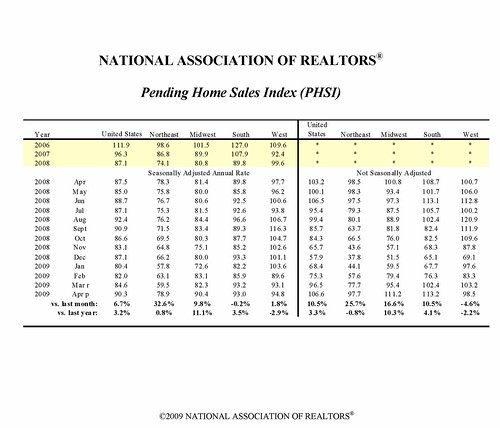
Let’s take NAR’s recent press release regarding Pending Home sales, up 6.7% from a year ago last year. Sounds encouraging – and let’s face it, we all could use encouraging news. But what does the increase really mean?
Let’s take a look at the data behind the aggregated index of 6.7% that NAR published:

NAR Pending Home Sales Index
While 6.7% sounded encouraging, I am not necessarily convinced that it means we are anywhere near out of the woods. Why? Because if you look at the seasonally adjusted for the West and South, areas that have the highest concentrations of inventory and loss of value, the numbers don’t seem to be telling the same encouraging news.
Here’s why. Take Las Vegas for example:
Single Family Home Inventory in Las Vegas per Altos Research
There are about 15,661 properties on the market in LAS VEGAS as of June 07, 2009.
How about Phoenix:
Single Family Home Inventory in Pheonix per Altos Research
There are about 7,816 properties on the market in PHOENIX as of June 07, 2009. Definitely making progress, but still a fairly long way to go.
What about Miami?
Single Family Home Inventory in Miami per Altos Research
There are about 8,450 properties on the market in MIAMI as of June 07, 2009. Again, inventory has significantly dropped, but the statistics do not suggest that the reduction in inventory is due to actual sales.
Let’s take a quick look at Boston:
Single Family Home Inventory in Boston per Altos Research
There are about 187 properties on the market in BOSTON as of June 07, 2009. Only 187 homes in a city of roughly 700,000? Still average market time is roughly 145 days. Even with essentially little inventory, market time is unusually long.
Where was NAR’s tag line “Real Estate is local, consult with a Realtor” in the recent Pending Home Sales Index press release?
Sorry guys – I think we still have a long way to go.
Bookmark this to: del.icio.us • Digg it • StumbleUpon • Subscribe to RSS feed
Related posts:9 comments
Can a REALTOR Truly be a Consumer Advocate?
My query is sincere. But first, I want to make a distinction between a REALTOR and a licensed real estate agent. NAR tells consumers to seek the counsel of REALTOR – in fact, make sure they are working with a REALTOR, leading consumers to believe that a licensed real estate agent and REALTOR are synonymous. They are not.
A REALTOR is a licensed real estate agent who is also a member of the National Association of REALTORs, who’s mission is:
The core purpose of the NATIONAL ASSOCIATION OF REALTORS® is to help its members become more profitable and successful.
Clearly absent from the mission is any reference to the consumer.
The vision of the National Association of REALTORS is equally insightful:
The NATIONAL ASSOCIATION OF REALTORS® strives to be the collective force influencing and shaping the real estate industry. It seeks to be the leading advocate of the right to own, use, and transfer real property; the acknowledged leader in developing standards for efficient, effective, and ethical real estate business practices; and valued by highly skilled real estate professionals and viewed by them as crucial to their success.
Working on behalf of America’s property owners, the NATIONAL ASSOCIATION OF REALTORS® provides a facility for professional development, research and exchange of information among its members and to the public and government for the purpose of preserving the free enterprise system, and the right to own, use, and transfer real property.
I find NARs Vision statement to be interesting. While the concept of advocacy is referenced – It seeks to be the leading advocate of the right to own, use, and transfer real property – NARs advocacy serves first and foremost its members. Again, distinctly absent from the vision statement is a direct reference to the consumer – ultimately the guy or gal who parts with their money to own, use, and transfer real property.
As licensed real estate agents, our behavior is bound and regulated by our state laws, written in the interest of protecting the public from unscrupulous professionals. Licensing is the state’s way to insure that a minimum standard of knowledge and behavior is achieved prior to allowing a licensed real estate agent from practicing his or her profession. Licensing falls outside of the juridiction of NAR, however NAR is actively involved in influencing the standards of real estate practice.
Under license law, we as licensed agents have a fiduciary responsibility to our clients – we are required to do what is in the best fiduciary interest of our client, not our own.
There’s been a great discussion lately here around the issue of transparency and compensation. This issue brought about my question regarding the compatibility of REALTOR and consumer advocacy. In my opinion, transparency is at the very core of consumer advocacy.
Here’s the rub for me. NAR’s final paragraph of its vision statement states:
… research and exchange of information among its members and to the public and government for the purpose of preserving the free enterprise system, and the right to own, use, and transfer real property.
Ah Yes - preserving the free enterprise system.
Help me undertand – in the interest of defending the free enterprise system – why so much emphasis is placed on defending the current business of how agents get paid? No one to date has provided to me a convincing arguement as to why compensation as a percentage of a sale price is justifiable compensation to a buyer or selling agent?
You’re an expert negotiator? So what. Have you tracked the value you have saved clients over the past 50 transactions? Can you determine the value? Does your client need an expert negotiator in every transaction? If the selling agent did their job correctly, the property your buyer may want to purchase may actually be priced right to begin with – wow, what a concept.
You earn every penny? I’d rather earn every dollar. In fact – I’d like to earn alot of dollars, but perhaps more importantly, I want my clients to understand the real value of my services, not have it buried in a lump percentage of a transaction.
Guess what – your clients should understand how much you earn – and even net – for a transaction. Why? Maybe – as a first step – because you’ll first understand whether or not it is even profitable to serve a certain client or not. I don’t want to make $10 an hour when I can work with other clients and make $150 or even $1,000.
Wake up people – this is a business. In fact, you’re a professional. In order to run a business, you need to make something and sell something – ideally for profit. If not, GM is a fine example of how not to run a business. You make knowledge and experience over time. Unless you learn through osmosis, when you are a newly minted agent, I highly doubt you are worth the same amount as the agent that’s been doing this job in the trenches for several years.
Why as experienced agents do we allow our compensation to be equivalent to those who simply don’t have the same level of experience? Maybe they can better articulate their value. If they can’t – is this in the fiduciary interest of our clients?
Oh – I forgot – we’re upholding free enterprise.
Why are you carrying inventory you can’t sell? Ask GM how that’s working out for them. If you’re clients think you are working for free it’s time to tell them otherwise. If you typically make $150/hour working with buyers – tell them. If you make more, I’d tell that too.
So my last question is this:
Will that be a tall, grande or venti?
Bookmark this to: del.icio.us • Digg it • StumbleUpon • Subscribe to RSS feed
Related posts:3 comments
What a Completely Virtual Real Estate Solution Looks Like
Per my earlier post regarding the evolution of technology driven real estate solutions, I believe the next generation of buyers and sellers will be more empowered to search, purchase and sell real estate themselves, without the services of a real estate professional.
At the highest level, the success of an entirely virtual solution rests in its ability to clearly and confidently shepherd a potential buyer or seller through the process of buying and or selling. Very few sites provide a path to success. The irony for me was what I found while reviewing do-it-yourself real estate sites/services. In my opinion, www.helpusell.com provides decent content regarding the “how’s and what’s” of buying and selling. I am not holding Help-U-Sell as a beacon of light, but merely a site which provides far more content regarding the “how” of buying than the “what” to buy.
The focus of technology solutions has been too highly skewed towards the data and not the content nor the process.
Clients are not looking for listings – they are looking for homes. Do not underestimate the connotation or meaning of home. Data is not the answer – it is part of the solution. The solution is achieved by execution. Execution requires clearly defined, repeating steps – a process.
There is a lot of chatter regarding how to keep potential prospects “stuck” on your site. Many believe that IDX property search is critical. Important? Maybe – but if you are relying on search capability as your differentiator, you’re wrong. I argue spending a majority of your time and effort building content around the process – mapping out the steps – one by one – specifically what needs to be done to get from beginning to close will get them stuck – FIRMLY – on your site. Everything else is secondary to the process.
So what does a completely virtual solution look like?
First and foremost, it assumes that there is no real estate professional involved with managing the process – or providing “services”. If you’re recoiling from that last statement, I merely ask, have you mapped out the process step-by-step and defined what you do at each step? Moreover, do you sit down and walk through the process with your clients – even review it daily? Do your clients know what your services are? So many agents argue that consumers require full-service brokerage. What is full-service? Does every one of your clients require full-service? Some do – some do not. Perhaps this sole issue alone is why I believe a total virtual solution is not only possible, but probable.
The current paradigm of buying and selling real estate assumes that a real estate professional is a given – you can’t have “full-service” without one. Without a real estate professional, a consumer is left to fend for themselves.
New paradigm perhaps? Consumers can have full service without a professional.
What’s the first step for buyers?
Amazingly enough, it isn’t search. Step one is forming and confirming buying criteria. Buying criteria is delving into how a buyer(s) lives – likes, dislikes – lifestyle attributes:
“I like to run in the morning, ideally along a path in a park. I love coffee. I like to eat organic and want to be relatively close to a farmer’s market. My daughter goes to Montessori and I want a good program within 10 minutes by car etc.”
Some buyers are not as specific, but they still need to consider how they want to live. Budget constraints need to be reviewed and established. Critical to the budgeting process is a tutorial on financing – what a mortgage is – how rates and different financing options affect monthly payments. Maybe there is a social media component which allows consumers to go out and ask the “expert” for input, whether they be mortgage professionals or other consumers. Buyers should have access to a pre-approval process.
This buyer profile needs to be built and used as the basis for how properties are searched, aligned and essentially weighted to provide a meaningful results to potential buyers. Again, most search engines provide visually interesting results, but they are simply presented by property attributes. Today buyers and/or real estate professionals need to sort through the results to see which ones make most sense.
Onboard Informatics has created the first Lifestyle Search Engine, aligning how people live with property search results. Rentwiki is building a similar renter profile to better link how people live with potential properties. In my opinion, this is how search must evolve. The sorting and matching process is traditionally an agent’s role. With a more technology savvy buying population entering the market, more sophisticated “lifestyle” search engines could leave traditional agents completely out of the property search game.
Will everyone buy into this search process? No, but I suggest many will. The more accurate the results – the better aligned the results are to actual criteria, the more confident buyers will become. Trust and confidence are weighty intangibles, however, Millenials readily use technology solutions and trust and admire brands and sources that identify with their unique needs and wants. Honestly, I am not sure that is limited solely to Millenial.
Ok – of the hundred or so properties that are available, twelve or so properties are close matches to a buyer’s lifestyle preferences. Tools like Trulia or Redfin provide Open House schedules for available properties – this process would be no different. The buyer decides to work his/her weekend schedule around the times the properties are open, viewing each one. Upon completion of each viewing, the buyer completes an on-line worksheet assessing how each property matches their criteria. Maybe the search criteria needs adjusting – maybe broaden the criteria etc. Perhaps the buyer runs a few scenarios and narrows down the choices to 3 specific choices.
The next step would be analysis – maybe a valuation tool like Zillow which provides an estimated value as well as access to the actual sales comparision data. Perhaps the analysis will include a tutorial on how to objectively evaluate the numbers – an explanation from a source with no bias towards the outcome. Instead, maybe providing a probability of success for buying at a certain price, due to current market time etc. Again, maybe accessing a social media function which seeks advice from others specific to the issue of evaluating and assessing value.
Once a property is selected:
CHA-CHING
This is where the buyer parts with his money. The buyer answers a series of questions, not unlike Turbo Tax or Legal Zoom which begins the process of dynamically building the sales contract. How much does this cost? Somewhere between zero and 6% of the value of the property to be purchased. I suspect it is a lot closer to zero than 6%.
Maybe the dynamic documentation leverages ZipForms endorsed by NAR for real estate legal documents throughout the US. Data specific to the property is pulled from IDX data sources. Each key area of the contract is reviewed via tutorials, explaining the relevance of the language and providing access to legal advice.
The basis of navigating through the process is to provide a well defined set of tutorials which provide the backbone of the process knowledge, recommendations, tips – gotchas. This is where the rubber meets the road and where the real value is.
It is the shared knowledge, managed through a repeatable process that adds confidence and builds trust in the solution. In addition, the aspect of social media can be more specifically leveraged at key points in the process.
This is just a brief view of what buyers may do – I believe it can be just as comprehensive for sellers.
Will it replace real estate professionals? Maybe not, but do I believe it will change the landscape for buying and selling real estate.
Bookmark this to: del.icio.us • Digg it • StumbleUpon • Subscribe to RSS feed
Related posts:18 comments
Technology’s Challenge: Understanding How Cats Part with Skins
Several recent posts have had me thinking about just how technology isn’t addressing the needs of cats. Needless to say, there are many different types of cats – cats that roam alleys picking through the remnants of fish bones versus the ones that eat Fancy Feast and sit on the laps of chauffeur driven owners who may, on occasion, stop at a traffic light seeking Grey Poupon. It could happen.
I suspect the cat population is quite diverse – many having different likes and dislikes, perhaps differing motivations as well. Given that some cats roam alleys versus sit in the lap of luxury, perhaps the roamers may be more self reliant- the “fat” cat perhaps in need of greater doting, relying on others to take care of their needs. Needless to say, there’s a larger, even more diverse range of cats beyond the alley cat and the fat cat.
I reckon there’s a parallel between cats and consumers.
When it comes to measuring the success of a broker and/or agent, furry walls are often designated as a sign of success. Jeff recently commented that his hirsute success is based on results. I have absolutely no doubt that his superior service would make him the Rockefeller of fur trading. He knows his cats – but more importantly, his cats know him. Perhaps not all his cats are “fat”, but they have a taste for Grey Poupon.
On the flip side, Greg’s recent post highlighted the self reliant cat’s approach to selling a home. From Greg’s picture, it may be a good thing that cats have nine lives, because this cat is dead.
How are current technology solutions really addressing the differing needs of cats … er… consumers?
I found Glenn Kelman’s recent survey results enlightening.
Well last March we surveyed 1,058 people who were using our site about what they wanted in a real estate agent. Some of the answers were gratifying for us to see — transparency was tops on the list — but one that stood out was the answer as to why people who had already chosen a traditional agent had decided against using Redfin: 47% cited a pre-existing personal relationship and 33% talked about “just clicking with someone.”
I am not entirely sure that the conclusions drawn from Redfin’s recent survey are entirely correct. Their results are no doubt useful, however, my beef is that the cats that were surveyed were given a basic assumption, the role of a real estate agent is a given. It’s fair that the assumption was a premise because Redfin’s model uses an agent. While the results better clarified why consumers didn’t use Redfin’s services, the basic premise that relationships are key does not translate to all cats.
What if the role of a real estate agent is not a requirement, such as in the case of Greg’s recent post? Many argue that the use of an agent should be the requirement, however, there are some very steadfast, self reliant cats out there. Moreover, there is a new breed of cats – they’re maturing from kittens to young cats – Millenials.
While Millenials are equally diverse as older generations, they do have a common thread – they have been raised in the era of new technology. Technology is a nature extension of how they live and interact with the world. Millenials readily seek and obtain information and knowledge via the internet. Google is this generation’s encyclopedia. They celebrate their diversity and admire and trust the brands that recognize and embrace their uniqueness.
Their buying behavior is different and trust sources of information that don’t fit the mold.
They don’t necessarily buy the truism that agents are a requirement. That is not to say that an agent would not be embraced by a Millenial, but it does mean that a trusted technology solution could be embraced as readily as a relationship.
As an example, I had the opportunity to do a post-mortem with a 20-something woman regarding her recent first home purchase. Like her peers – and many others of other generational groups – she immediately used the internet to do her search. She used search sites to locate available properties, sifting through the large number of properties that she thought met her criteria.
She found the latest search sites frustrating because a “pin in the map” didn’t have a great deal of meaning to her as it was presented – sure she saw the location, but location was only one aspect of her criteria. While it looked “cool”, it didn’t necessarily save her time nor present the search results in a way that met her unique requirements.
Not a surprising comment because current search tools are heavily property attribute focused, not lifestyle focused. This alone drove her to seek a trusted source for information – in this case, an agent.
She and her husband weren’t interested in listings – they were interested in finding a home.
“What if a technology solution provided a result that better addressed your specific housing and lifestyle requirement?” I asked.
So long as the results truly met her unique needs and presented them in a way that identified her as someone other than just a typical 3 bedroom, 2.5 bath buyer, she would continue to use a technology based solution. Clearly she doesn’t speak for her entire generation, but she did provide some terrific insights.
I believe technology can provide a total solution, from matching both property attributes and lifestyle attributes presenting a more narrowed, entirely more focused result. Adding analysis to the results may also allow the new breed of cats to continue further down the technology path. Providing a process to ensure that the bases are covered may also allow them to continue with a virtual solution.
Technology solutions won’t be the sole solution for everyone. They won’t meet the needs of every cat, however, I believe the next new wave of buyers and sellers will be more likely to venture into the FSBO camp than previous boomers.
In creating new, broader technology solutions, far more emphasis needs to be focused on exploiting the unique needs of the cats.
Technology may very well define how the new cats part with their skins.
Bookmark this to: del.icio.us • Digg it • StumbleUpon • Subscribe to RSS feed
Related posts:6 comments
Sometimes It’s Good to Go Home
I just returned from a brief respite – short of 2 weeks – in Dallas. I went home.
I needed to get away from the day-to-day grind that my life had become, seemingly caught up in the negative energy that seems to have taken over. My dad just had knee replacement surgery and I thought it would be a great opportunity to help out and reconnect with my folks, my brother and his family. I also wanted to spend some time refocusing my efforts on my business plan to create a web-based community for do-it-yourself buyers and sellers of real estate as well. I had a full plate.
While I did get a plan down on paper regarding my new business idea, I realized I accomplished so much more – quite honestly, it was a significantly more valuable exercise.
I became grounded again.
Ever feel like you’ve lost your mojo? Needless to say, many of us are facing really troubling circumstances, but it so important to keep perspective on our lives. Sometimes when we take a brief moment in time to step away from our crazy lives, we get to experience timeless treasures.
I consider myself blessed to have wonderful, loving parents. My folks are getting older – edging into their late 70’s. Still in great health and active, but beginning to show the signs of lives entering into dusk. I wanted to be around to help out – let my mom have some time to do her own thing. Just be there.
But something both unsettling and comforting at the same time happened. I saw for perhaps the first time my dad completely vulnerable. This is a man that never cracked. A West Point Grad – a man who served his country. Raised 7 seven kids. Proud, disciplined, smart, kind, but a tough son-of-a-bitch. He’s mellowed over the years for sure – but my brothers and sisters and I often laugh that he’s gone from a Type A++ personality to maybe an A-. The surgery seemed to have broken him – just a bit. I wasn’t prepared to see him like that. I felt like I could pick up the reigns, honored to be at his side – just to be there. I’m not sure why, but it made an enormous impact on me. I felt lucky.
Through out the time I was there, even in the mundane exchange between my mom and dad, I witnessed “that spark” – the magic that explains the almost 56 years of why they’re together. Years of understanding – without a word spoken.
Sometimes we need to be reminded as to just how lucky we are. Sometimes it’s good to go home.
Bookmark this to: del.icio.us • Digg it • StumbleUpon • Subscribe to RSS feed
Related posts:5 comments
You’re Unique – Just Like Everyone Else
What makes you unique? I’m not referring to your eleventh toe or your ability to recite the Arabic alphabet backwards. That’s not unique – that’s plain odd.
Why do clients want to work with you? What makes you better than the rest of the pack? I ask this question based upon the comments I received in my last past.
Simply because you may rank first or second in a Google search does not make you unique – it makes you visible. Now that you’re visible, what is the value you bring to the table?
I did a search on an address of a property I’ve listed, sadden to see that my SEO wizardry had failed me – Trulia and a whole host of other sites beat me to the punch – but honestly, I don’t care. My client’s property is well represented in cyberspace. It’s visible. But visibility is not value in and of itself.
Now – say you use the fact that you rank first, maybe second on the list of the Google search you ran, specifically on the property’s address – or maybe even on the property’s characteristics – terrific!
But wait – as a consumer, I see your site and perhaps Trulia, Redfin or another local broker’s site with the same property – and a slew of other sites with the same information. It’s visible but it is not specifically clear to me as a consumer why I would choose your site versus another. Perhaps I choose your link because it’s first on the list. Not a bad choice, but it was relatively arbitrary – it ranked first – not necessarily best.
If you’re marketing yourself as the best professional to sell a client’s home because you own the ranking of their property in a search result, you’re kidding your client – but mostly, you’re kidding yourself.
Greg Swann nailed the value proposition as to why high visibility on the web is a key differentiator: he’s visible – but he also sells his clients’ listings in less time than comparable properties in his market. Like almost 50% less.
Your high visibility facilitates your ability to sell more faster – if you don’t have the facts to back it up, it doesn’t make you unique. Many consumers don’t understand that visibility doesn’t equate to added value.
Providing a true value proposition that demonstrates to your potential seller that the investment you made in creating higher visibility, thus translating into better marketing statistics relative to your competitors makes you truly unique.
Bookmark this to: del.icio.us • Digg it • StumbleUpon • Subscribe to RSS feed
Related posts:11 comments
Just Because You’re More Visible Doesn’t Mean You’re More Valuable
What really is the role of technology in real estate today? So much of the discussion regarding the evolution and use of technology today seems to be centered on SEO – what ever you do, make sure Google finds you.
You have a blog or website. It has super SEO powers. It attracts many prospects. So do hundreds – maybe thousands of other agents.
Sounds great. You’ve found me. Now what?
When consumers find me, what makes them want me? Regardless of whether or not potential clients find me via the phone book, website or as a result of a conversation a past client had at a cocktail party, the real question isn’t necessarily how they found me, the question is – once found, what do I offer to my clients that meets their needs like no other broker can?
What is your value proposition? Your value proposition transcends your marketing message – it provides tangible, measurable ways in which you meet the needs of your clients, prospects and consumers.
“What is the role of technology?“ You can’t answer that question until you know what your client’s needs are and how you meet them.
The role of technology is merely a tool to provide a medium which delivers the desired results to your clients, prospects and consumers.
The emphasis on technology has been entirely too focused on how consumers find you and not enough on why they want you. Just because you are more visible to potential clients does not make you inherently more valuable. If you have a blog or website, is it aligned with meeting the desired results of your clients, prospects and consumers?
Having an IDX link or other MLS search tool isn’t unique. In fact, search in general isn’t entirely unique.
If you’re found, what makes them stay?
What if a purely technology solution met the needs of consumers? It’s possible. If you can’t make it clear how you meet your prospects needs, someone or something will.
Bookmark this to: del.icio.us • Digg it • StumbleUpon • Subscribe to RSS feed
Related posts:14 comments
The Butcher, The Banker, The Candlestickmaker
Maybe it’s just me, but I can’t help but to think that it’s deja vu all over again. Is it really 1980 again? Congress appears to have stolen a page from the Conservative’s play book – but with a twist.
It seems trickle-down economics applies as much to government spending as do tax cuts to the rich, yet with the latest infusion of hundreds of billions of dollars poured into the most powerful corporations – America’s largest banks and insurance companies, we have yet to see much of a trickle – less a drop.
TARP did in fact keep the economy dry.
Perhaps the irony of it all – to me at least - is that the so-called “Socialists” also see virtue in starting at the top – fork over billions to the most powerful to get the engine running again – the proof is not quite in the pudding pie, Georgie.
From my perspective, the deluge is starting at the bottom. My email has been flooded with comments from my condo association regarding the complications my neighbors are facing in the sale of their condo. Economic circumstances are hitting very close to home – my neighbors, one of whom is a fellow Realtor – directly below me in my building – is in dire need of selling their home. Our association has a first right of refusal clause which deems FHA financing impossible. My neighbor has been soliciting the board and fellow owners that an amendment in our bylaws is required to make the sale of their home possible to more buyers.
I was amazed at some of the comments from fellow neighbors concerned about the “quality” of potential buyers who only qualify for 3.5% down – I could only chuckle thinking that some existing owners were able to buy with 0% down 3 years ago. Where’s there equity now?
One neighbor argued that we want to prevent a short sale – moreover a foreclosure – from impacting the values of existing homeowners. I’m pretty sure he didn’t read The Chicago Tribune on Sunday – there was an article about the substantial increase of foreclosures in Chicago. The article referenced a new 39 units condo conversion project which sits half-empty – just a few blocks walking distance from our building.
I think the term might be epidemic.
What I find interesting is the growing sentiment that American’s resent President Obama’s current program to assist struggling homeowners more directly – why should I have to pay for my neighbor’s poor judgment? I didn’t do anything wrong?
We’ve been swindled into thinking that bailing out the banks will be our salvation. I am far more willing to help out my neighbor simply because I see a direct connection to my own well being.
Guess what? We’re all in the same tub – and the water is draining – quickly.
Why can’t the money bubble up versus trickle down?
All of this reminds me too of how much life imitates art. I found the history of the nursery rhyme to be so appropriate to the crisis we’re facing today:
It was due to the lack of written material, and more importantly the lack of education for the working class, that the rhymes which we now refer to as nursery rhymes and Mother Goose tales were passed on by word of mouth. It has been suggested that the rhymes, based on the literary styles of composition, were “originally written for the gentry and copied by the ‘folk’ who worked for them, or observed them at their amusements” (Delamar, 2). One can conclude that this is where the term “folk tales” originated, later to become Mother Goose tales and rhymes.
Mary, Mary is quite contrary – her condo just lost 40% of it’s value. It’s no wonder why Little Boy is so blue. Eeny Meeny Miny Moe – which job will go?
Hush-a-bye, baby,
in the tree top.
When the wind blows,
the cradle will rock.
When the bough breaks,
the cradle will fall,
And down will come baby,
cradle and all.
Actually – in my case, my neighbor is getting slaughtered, I’m getting burned and the banker is getting coin.
Bookmark this to: del.icio.us • Digg it • StumbleUpon • Subscribe to RSS feed
Related posts:2 comments
Monetizing What Counts – Don’t Rain on Their Parade
My brother called me late last week. He lives in Dallas with his wife and kids – he’s in his early 40’s, smart, tech-savvy and owns his own business. He wants to buy a new home. The home he wants isn’t currently listed with a real estate agent – it’s a pocket listing FSBO so to speak -the owner would like to sell but doesn’t want to actively list and sell it. She’ll sell at the right price – she’s not going to go out of her way to find a buyer.
My brother has bought and sold a few homes, rarely with the assistance of a real estate agent – he’s open to cooperating with an agent when he wants to sell his home, but simply not keen on paying a commission for something he feels he is more than capable of doing himself.
I am not an evangelist. If he wants to do it himself, more power to him.
Funny thing happened, however – his call was a plea for help. He wanted me to review the standard real estate sales contract – he doesn’t know what boxes to check – or at least wants to make sure that he’s checked the right ones. He needed to move relatively quickly so he could get his hook into the “unlisted” home before word got out that she would entertain offers.
“Listen Tom, I really need your help – I’ll even pay you.”
Putting the whole lack of being licensed in Texas aside, a smile came across my face. ALAS, my brother of all people understands the value of expertise and knowledge – and you know what, it ain’t free.
I asked him how he knew whether or not the house he wanted to buy was actually worth what the seller wanted?
Not sure but felt her price seemed reasonable. I told him to go to Zillow and find out what it’s Zestimate was – the good news was it fell within a few thousand of the seller’s target price of $1M.
I walked through the contract with my brother – not only telling him what boxes to check, but to explain the significance of checking one box over the other – what does the language really mean in terms of putting an actual deal together. Alot of the discussion revolved around what happens “if” … There are subtle nuances.
I called on Tuesday to see how the presentation went. According to my brother, all went well. He is expecting a response from the seller ideally by the end of the week.
While I wanted to make sure the presentation went well, I was also really interested in learning more about why he didn’t want to involve a real estate professional.
“They don’t provide value – er… I mean … um no offense Tom. I mean, if someone could tell me exactly how to put a deal together – what forms I needed, how to fill them out, who to contact – what information I needed to tell them – I mean, that’s what I need. After reading the documents, I looked through them and I realized I didn’t know what I didn’t know. I need someone to tell me what I don’t know – I’ll pay for that.”
As my younger brother, I could easily tell him he didn’t know anything – BUT he’s the one buying the $1M home while I struggle to sell junior 1 bedroom condos – an entirely different story, but I digress…
I found my discussion enlightening – not that I didn’t think I provided value, but that my brother - consumers are still in the dark regarding how the process works AND that as technology solutions have evolved, few have focused on the real needs of the consumer.
Two recent posts got me thinking about how technology needs to be better in line with what consumers want and need.
John Rowles recently posted about the de-commoditizing of listings – consumers want listings! That’s what consumers want – listings! Again, consumers don’t know what they don’t know. They want access to listings – and even tools to help they identify valuation – but they don’t entirely understand the process of buying or selling. From purely a consumer’s perspective, why do I – as a real estate professional – want to invest resources improving the visability of a commodity – a listing – when my real value is in consumating a transaction? The real value isn’t in the property identification – the real value is getting the property under contract and closed.
Are we monetizing what counts?
Greg’s recent post regarding Active Rain’s recent subscription challenged the merits of charging a fee to new members who post content viewable to consumers, rather than just other AR members. I read the myriad of comments – why pay for a subscription service when the costs of hosting your own site – with your own content – is less expensive. I agree – this is a far better solution for some – but not for all.
Again, I pose the question, are we monetizing what counts?
I believe AR’s subscription strategy zeros in on monetizing the right kind of content – shared knowledge and expertise. My issue isn’t the subscription fee – my issue is that the content still remains free to consumers. I don’t believe it makes sense to rely on advertising revenue when the real value lies in the expertise and knowledge that is created – hence why I believe the subscription service at least moves in that direction.
Is it perfect – no.
As a new generation of buyers and sellers enter the market – The Millenials, the role of technology will become a requirement. Millenials have been raised with technology – they have been raised in a generation where information is readily available via the internet or through the use of technology. What they don’t know, they seek knowlegde via the net. They are willing to pay for expertise where and when needed.
I don’t think a business model that transforms the real estate business will really take hold unless the role of the agent is truly at risk.
If a technology solution can address the real content that consumers want and need – the process knowledge of consumating a transaction, real transformation will take place.
Bookmark this to: del.icio.us • Digg it • StumbleUpon • Subscribe to RSS feed
Related posts:20 comments
Should We Be A Good Society?
Every morning – even in near zero degree weather – I walk my two dogs around my neighborhood – the jaunt is roughly 4 miles with a brief but necessary Starbucks break. While I’d like to admit the motivation is to remain healthy, the reality is the required expresso jolt is what gets me up in the morning.
A little over halfway through my walk, I pass by the sign I have posted – proudly identifying the Neighbors for Responsible Zoning’s (the Zoners) disdain for profiteering Realtors, developers et al. Evidenced now by the presence of two mediocre-ly constructed mini-mansions, the realtors and developers undoubtedly profited.
My neighborhood may be one of the most ethically and socioeconomically diverse neighborhoods in the city of Chicago. Short of bucolic, it is an established neighborhood with mature trees that canopy the cross streets lined with woodframe victorians, brick Prairie-inspired architectural gems and classic Chicago courtyard buildings. Many of the residents have lived in the area their entire lives, having watched the tide of transients transform the neighborhood. In the frenzy of the condo boom, affordable housing became in short supply. There is definitely a strong sense of community. People care about preserving the past as well as the semblance of community.
While the Zoners may not have had success in staving off the wave of new development, they have acted in the interest of preserving what they value.
This sign has really had an impact on me lately. In light of the many recent discussions regarding the impact of the current stimulus package – the implications on the housing industry – so much of the focus has been on the financial impact.
Ideology has drawn the line – we can’t interfere with the market for fear of socialism – government intervention simply prolongs the inevitable.
Admittedly, I have subscribed to that line of thinking, however, recently I struggle with the lack of balance to the enormous social costs – many yet unseen – to this financial mess. It is difficult to have sympathy for many people that have acted irresponsibly – buying homes they know they couldn’t afford, however, the impact on the community is also a factor.
In the interest of preserving our communities, why isn’t the private sector held more accountable? Why do bankruptcy judges have to cram down mortgage rates to make houses more affordable? Why can’t banks be forced to write down asset values and be forced to make their assets perform? When neighborhoods sit vacant, what happens to the community?
The lack of tax revenue has put many cities and states on the verge of bankruptcy. City services including police, fire and social services have been cut or eliminated. It is a simple reality. In Cook County, the Sheriff has made the politically unpopular decision to not enforce eviction notices for homeowners and renters faced with foreclosure.
As Americans, what is our set of moral imperatives? I am not suggesting that government be the solution to all of the problems we are faced with today, however, we do have enormous resources which can drastically impact the lives of our citizens.
What does a balanced solution look like? Should we be a Good Society?
Bookmark this to: del.icio.us • Digg it • StumbleUpon • Subscribe to RSS feed
Related posts:20 comments