Divorcing the real estate commissions is simply a matter of HUD-1 bookkeeping effected by the mortgage lender
In a charmingly romantic post this morning, Jonathan Dalton gets bogged down in the all-too-common idea that divorcing the Realtors’ commissions would impose some new financial burden upon buyers, resulting in their loss of representation.
This is false. Although we operate by the fiction that the seller pays the real estate commissions out of the proceeds of the sale, in fact, if the buyer’s lender is not willing to fund the transaction, no sale will occur and no one will get paid. It’s useful in the abstract to envision the transaction as being either all-cash or 100% financed. In both cases, all the money is brought to the closing table by the buyer or the buyer’s lender.
To effect the divorced commission in the overwhelming majority of transactions, all that is necessary is for lenders to change their underwriting guidelines, making corresponding changes in the way they illustrate the flow of funds on the HUD-1 settlement statement.
Right now, many lenders will allow up to 7% in sales commissions, to be charged against the seller’s side of the HUD-1, with up to 3% in closing costs, also charged against the seller’s side of the HUD-1.
If lenders changed their guidelines, such that no more than 3.5% could be charged against the seller for the compensation of the listing agent, with no more than 3.5% charged against the buyer for the compensation of the buyer’s agent, the commissions would be divorced.
So far, this is nothing more than a change in underwriting guidelines and HUD-1 accounting. Absolutely nothing has changed away from the paper-shuffling lender universe. The costs to the buyer and the proceeds to the seller are exactly the same.
Not to rock too many boats at once, but it would also be possible for lenders to make their internal procedures and the HUD-1 bookkeeping more honest, putting a little extra money in the pockets of both buyer and seller.
In the chart shown below, the first column illustrates the current procedure. The middle column shows how commissions can be divorced while retaining the psychotic style of accounting lenders currently deploy. The third column demonstrates how commissions can be divorced using accounting that is consonant with what is really going on.
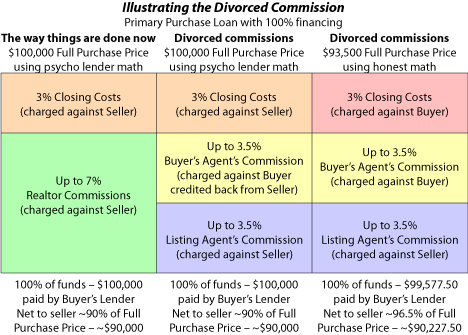
Two points to take away:
First, divorcing the commissions will impose no new financial burdens on buyers. To the contrary, taking control of their agent’s compensation should empower them to pay less and/or get more overall value from their representation.
Second, in reality, divorcing the commissions can be effected simply and instantly, by the voluntary and unilateral action of mortgage loan underwriters. If they choose to insist on either column two or column three, as shown above, column one will be gone overnight.
The divorced real estate commission file: This is an organic compendium of weblog posts and internet-based articles arguing for and against the idea of divorcing the residential real estate commission — eliminating the co-brokerage compensation from the listing agreement, with buyers contracting for and arranging compensation for their own representation. One way this might be effected: Lenders could permit buyers to expense representation on the HUD-1 form as sellers do now. The entries collected here represent the full gamut of opinions on what may be the most important issue facing Realtors today. To submit additional posts or articles for inclusion on this list, fill out the form at this link.
- 11/11/07, Greg Swann: A consumer’s guide to the divorced real estate commission: Why buyers and sellers each paying for their own representation is the most significant reform that can be made today in residential real estate
- Part I: How we got into this mess in the first place
- Part II: How buyers can finally take a seat at the grown-up’s table
- Part III: The who-pays-whom of real estate is not as simple as you might have thought…
- Part IV: Divorcing the real estate commissions will result in benefits not just for buyers but also for their agents and for the real estate market as a whole
- Part V: Why arguments for the current method of compensating real estate agents and against divorcing the real estate commissions must fail
- 10/03/07, Greg Swann: Ask the Broker: How can the seller paying the buyer’s broker’s commission be fair to the seller?
- 09/24/07, Dan Melson: Why the Real Estate Buyers Agent’s Commission is Paid by the Seller
- 07/22/07, Russell Shaw: Top Buyer Agents Unite To Put Themselves Out of Business - Russell Shaw Tries to Save Them
- 07/17/07, Galen Ward: Does the pope condone Divorcing Commissions?
- 07/16/07, Kris Berg: Who does the buyer’s agent’s commission belong to? Maybe… the buyer’s agent?
- 07/16/07, Jim Duncan: More on separating the commissions
- 07/16/07, Jonathan Dalton: Divorcing Real Estate Commissions III: Return of the Rhetoric
- 07/16/07, Todd Tarson: Divorcing commissions
- 07/15/07, Greg Swann: Divorcing the real estate commissions is simply a matter of HUD-1 bookkeeping effected by the mortgage lender
- 07/15/07, Russell Shaw: Greg Swann Joins Redfin - Kelman Rejoicing!
- 07/15/07, Jonathan Dalton: Divorcing Real Estate Commissions, Redux
- 07/15/07, Jonathan Dalton: The First Time Always is Awkward
- 07/14/07, Jeff Kempe: The Imperative of Divorced Commissions, Part 2: The Inherent Value of Free
- 06/22/07, Jeff Kempe: The Imperative of Divorced Commissions, Part 1: Fundamentals of Narcissism.
- 05/28/07, Russell Shaw: Separating the Buyer Agent Commission From the Listing Commission is a REALLY stupid idea
- 05/27/07, Jeff Kempe: Tennessee, Oregon, and the State of Real Estate
- 05/21/07, Jim Duncan: A call for an end cooperative compensation
- 05/21/07, Greg Swann: If lenders divorce the commissions, they’ll be divorced
- 05/18/07, Greg Swann: By withholding the secrets of the mystical MLS system are we betraying the home-buyer’s interests?
- 04/09/07, Greg Swann: Who pays the buyer’s agent? Once we’ve divorced the commissions, we can stop worrying about it
- 04/02/07, Greg Swann: Redfin.com’s Real Estate Consumer’s Bill of Rights: A wolf in sheepskin clothing…
- 03/05/07, Greg Swann: True reform in the real estate industry will not result from undermining buyer representation
- 10/20/06, Greg Swann: The Divorced Commission and the MLS: Building a much better home search tool…
- 10/19/06, Greg Swann: Defining the Divorced Commission: A short-hand term for understanding alternative real estate compensation models…
- 10/17/06, Greg Swann: Smashing the idols: Understanding market value in full context…
- 10/16/06, Greg Swann: What replaces the MLS? Advertising is a given. Compensation/ cooperation can be addressed separately. But the quality and quantity of the data is irreplaceable…
- 10/15/06, Greg Swann: Why the traditional real estate commission model is broken and needs to be replaced…
- 10/07/06, Jim Duncan: The solution to many of real estate’s problems
- 10/07/06, Greg Swann: The seller really pays for the buyer’s agent? Definitely not when the buyer pays out of pocket. But what if the buyer really did pay for the buyer’s agent from the buyer’s side of the HUD-1?
- 09/29/06, Greg Swann: Butterflies might be free, but home-buyers pay for real estate advice — whether they know it or not…
- 09/06/06, Greg Swann: Securing the home-buyer’s place at the table: How two simple reforms can finally result in a full, uncompromised form of buyer representation…
- 08/15/06, Brian Larson: The End of MLS As We Know It
Technorati Tags: compensation for buyer representation, real estate, real estate marketing
Bookmark this to: del.icio.us • Digg it • StumbleUpon • Subscribe to RSS feed
Related posts:16 Comments so far


Gregg:
In rolling out a consulting model in my small Taos, NM brokerage, it’s been interesting trying to structure pricing packages for the buyer side. The seller side is relatively simple.
Buyers, however, are resistant to changes when the consulting model requires some pay-as-you-go method. If we could do as you suggest, it would make it a little easier to float the consulting model boat. As long as they never see an entry on the HUD-1 that shows a cost to them, they’re happy with the status quo.
And this is in spite of the large credit they can receive when the hourly consulting model is employed and the remainder of the offered co-op commission is credited to them at closing.
I would be happy if I could work only on an hourly basis, nothing free, even showings, and get an average of more than $100/hour for my time from the first showing through closing. This is paid in weekly billings, with no refunds if the deal blows up over inspections, etc. But try getting the attention of a buyer with the current “it’s not costing me anything” commission model.
Keep talking up divorcing the commissions. It probably will never happen, but it is the “real world.”
Greg:
I do know how to spell your name, just fat fingers on Sunday morning.
Jim
[...] The Russell Shaw Sales Success FAQ Files There’s always something to howl about « Divorcing the real estate commissions is simply a matter of HUD-1 bookkeeping effected by the mortgage lender [...]
[...] This afternoon I was accused by the Bloodhound both of being a romantic (a claim my wife easily, if not happily, could debunk) and also of furthering the notion that divorcing real restate commissions - in other words, forcing a buyer to pay for his or her own representation - would place an undue burden on said buyer. [...]
Divorcing commissions is an excellent idea, and it more accurately reflects reality. The growing popularity of real estate commission rebates is helping more and more buyers understand that they are the source of the money to pay for commissions and fund commission rebates. Because the money rebates provide to a cash-strapped buyer can be the difference between a deal and no deal, rebates are helping sellers and their brokers as well.
As a previous poster noted, it will take time, but major changes in the way real estate is bought and sold and the way home buyers and sellers think about the process are already in progress. Eventually this good idea will likely be embraced by HUD, lenders, and (dare I hope?) even old fashioned traditional real estate brokers.
[...] 1. This week’s Carnival Winner, Jeff Kempe kicked things off. 2. Jonathan Dalton opined about commissions. 3. Dalton and Kempe sparked Greg Swann’s graphic autopsy of the commission. 4. This, in turn snowballed into Russell Shaw’s quick response as he boards a plane. 5. Kris Berg convincingly sums up the bottom line. 6. Jonathan Dalton responds to being responded to. 7. Jim Duncan urges his readers to react. 8. Todd Tarson reiterates that he’s not traditional. 9. I write a round up list… who’s going to be #10? [...]
[...] There is an ongoing debate over divorcing commissions in the real estate blog world that hasn’t yet jumped into the mainstream media. Divorced commissions doesn’t refer to the consumer divorcing the agent of their pay and it will certainly need a better name to get any traction (pay for representation?). In a word, it means you as a consumer pay your agent for representing you as a buyer or as a seller. [...]
[...] 8 points - Greg Swann - “Divorcing the Real Estate Commissions…” [...]
[...] Half-assed service Divorcing the real estate commissions … Expected rate of decline of home prices in the next year It’s a bloodbath and time to swim with the sharks [...]
[...] I argue stridently that buyers do in fact pay for their own representation - even thought they don’t know it, and, therefore, don’t properly supervise their agents. But the obvious solution to the contradiction created by discount buyer’s agents is to divorce the real estate commissions, with the seller paying only for the listing agent, and the buyer paying only for the buyer’s agent. It will be a knee-slapper for traditional Realtors when a Redfin agent writes a contract on an IggysHouse listing, but that’s what pays the bills at law firms. [...]
[...] Of course, you can’t ride my roller coaster without a discussion of divorcing the real estate sales commissions: You will note that in all the talk about reforming traditional real estate emanating from the new discount real estate start-ups, there is no discussion whatever of divorcing the commissions. This is because it is a true reform, not the sly exploitation of an inane contradiction. When buyers finally knowingly pay for their own representation, they will demand full value for their money. [...]
[...] If we manage to divorce the commissions, we’ll be rid of the whole bunch of you just like that. In the mean time, the best thing you can do for me is to get the hell out of my way. I don’t think you’re competent to make my technological decisions for me. But even if you were, any choice you make will be instantly and necessarily the wrong choice because it will supplant the creativity of free competition with a monopoly vendor. [...]
[...] So far, to my knowledge, there has been one actual rigorous argument against divorcing the commissions. We do what we do for practical reasons, and I have offered practical solutions to these problems, but, so far, no one has been able to defend seller-paid commissions as a matter of equitable rectitude to both principals. If I’m wrong about this, cite the link to the argument. [...]
[...] This is from an essay I wrote on this topic earlier this year: To effect the divorced commission in the overwhelming majority of transactions, all that is necessary is for lenders to change their underwriting guidelines, making corresponding changes in the way they illustrate the flow of funds on the HUD-1 settlement statement. [...]
[...] for the signals or just hearing the noise? Without a doubt, the RE.net is one place where intense and well-articulated debate occurs, but is that really a “broad” debate? I have a strong feeling that many who [...]
[...] learn more about divorcing the commissions start here and [...]