
…is up at Rain City Guide. The big winner? Our own Brian Brady at Active Rain, with Selling Like a Catholic School Girl.
Technorati Tags: blogging, real estate, real estate marketing
There’s always something to howl about.
Suburban Phoenix Real Estate Broker
…is up at Rain City Guide. The big winner? Our own Brian Brady at Active Rain, with Selling Like a Catholic School Girl.
Technorati Tags: blogging, real estate, real estate marketing
Five hundred year old technology (books) is just too slow for the Net. The act of printing, storing and shipping millions of books takes too long for a secret to ever be in a book again.
More.
Books are souvenirs. No one is going to read Potter online, even if it’s free. Holding and owning the book, remembering when and how you got it… that’s what you’re paying for. Books are great at holding memories. They’re lousy at keeping secrets.
Someone recommended a book to me yesterday, and it was fun for me to watch my own revulsion at the idea. I grew up in the thrall of books, literally a worshipper.
More interesting than Harry Potter is the phenomenon of The Cult of the Amateur, whereby Ludditism becomes a Shaker cult, doomed not by the book’s (and the movement’s) effete idiocy but by its inability to engender new acolytes. Even so, the book should prove especially popular on library shelves and remainder racks, where the most passionate book worshippers are to be found.
In the planning stages for Real Estate Weblogging 101, I made an effort to find ways of connecting electronic publishing to paper publishing. But then I had an epiphany: The work of the mind is documented on the nets. Publishers desperately cling to the idea of holding ideas for ransom by chaining them to atoms, but the Djinn is already out of the bottle — to call to mind another cult desperately clinging to the past. Prometheus has broken his chains — to recall our own future-loving creed — and the gift of mind surges forth in pandemic pandemonium.
On the nets, a new idea is published instantaneously across the globe. It is accessible to billions, if they seek it, at a negligible carrying cost. It can be linked to every discoverable supporting and countervailing resource and vetted by the intense scrutiny of thousands of hypercritical experts. Net-based “books” are revisable and extensible at will, with no delay and no lingering inventories of obsolete stock.
Shed a tear at graveside, if you will, but facts are facts: Books are a dead letter.
Technorati Tags: Read more
This is Drew Meyers from Zillow commenting on a post last week:
Please note the real estate guide (which is a wiki) is VERY different than a blog. Since wikis are collaborative, no one person “owns” any of the content.
That turns out to be not quite true.
Zillow Blog featured two of my wiki contributions yesterday. Both had been clobbered, if that’s the past tense of collaboration. No mention of me in the idyllic land of wiki, even though both ideas are very good — and no one at Zillow came up with them. Even so, guess who was promoted in the wacky world of no-one-owns-a-wiki.
Oh, yes, Zillow.com happily promotes itself on the sweat of my labor. What genius! Who ever thought of such things? That Zillow, boy howdy!, you gotta get up purty damn early…
Nice. They stand on the shoulders of giants. They just bury them in dirt so it looks like a hilltop. To top it all off, guess who’s going to profit from the inbound links?
Here are the unmolested — er, un-wiki-perfected — original articles, if that matters:
I think this is a good example of how Zillow’s hoped for social networking scheme is self-defeating. It’s understandable that they would want to keep their pseudo-encyclopedia free of spamvertising. This they could achieve simply by accepting or rejecting submissions. But my only incentive for coming up with and sharing good real estate ideas is to promote my own name, brand and image. Why would I do that if I know that my hard work is going to be expropriated?
This is just dumb on Zillow’s part. I’ll have a lot more ideas. But I won’t be sharing them with Zillow.com and it’s sticky-fingered wiki. I think Wikipedia is an amazing accomplishment, but I don’t care what Jimbo Wales thinks a wiki should be like over there. I don’t write for Read more
Dustin had a post last night that made me rethink the ideas I posted the other day on using a cookie to modify a WordPress.org weblog’s default behavior for first-time visitors.
Clear as mud?
Starting with version 2.0, WordPress introduced the idea of an optional intro.php file that would be a sticky first post. In other words, the file, truly a pseudo-post, could be shown first to every reader who landed on the top-level page of the weblog. That way, you can do all your welcoming house-keeping with new users.
Too cool. What’s the problem? Most people showing up at your weblog are not new users, so you’re going to hammer that intro.php nail into their heads again and again.
And Dustin raised another problem: Many people arriving at your weblog for the first time will be coming in from search engines, from your RSS feed or from deep links on other sites. Those folks are never going to see intro.php, because they won’t enter the weblog from the top level.
The code I wrote the other day solved both of these problems, but with a one-size-fits-all solution. What if you want to issue a special introduction only to top-level first-time visitors? What if you want to address only those people coming in via deep links into your weblog? What if you want to say something different to each type of visitor?
I amended the code today to take account of these two different entry scenarios. Using this version you can have an intro.php file for people who enter your weblog for the first time through the front page. The cookie associated with that expires in 60 days, so that only people who have been away for a long while will see it more than once.
You can also have another file called singlePostIntro.php (or whatever) for people who come in via a hard click from a search engine, an RSS feed or another web site. That cookie lasts for two weeks. The point is to address infrequent visitors who come in via deep links differently, in the hopes of persuading them to become subscribers.
You can see this Read more
From VentureBeat:
For this, Redfin has been banned [false] from operating in Oregon [false], New Jersey [false] and now Tennessee [false]. Additionally, the site has been fined by the National Association of Realtors [false], which owns the Multiple Listing Service [false], a national database [false] of home listings.
That’s two sentences, seven errors of fact.
Redfin can operate all it wants in Oregon, New Jersey and Tennessee. Those states ban commission rebates, which is vicious and wrong, but that doesn’t forbid Redfin from working there. In general, you will not find Redfin in any market where homes are affordable, because its cost-structure can only work — if it can work at all — on high-priced homes.
The second sentence is so rife with errors, I’m not going to bother trying to fix it. If you want to know what really happened, it’s here: Defending Redfin: Sweet Digs weblog buried by inane MLS rules.
Nevertheless, I am so glad that there are fearless guardians of truth willing to take money for this level of ineptitude. It would be an awful curse if we had to depend for news on people who care about facts and are actually paying attention.
Jeesh!
So as not to be unrelentingly negative: Newspapers got some bad news this morning, but for-pay journalism is not dead. But if journalists hope to portray themselves as “trusted professionals,” they need to catch a clue. The audience in the aggregate may net out dumb enough to buy crap like this, but the audience in particular contains individuals who know a lot more than you do about whatever you happen to be writing about. In the past those people were silenced by circumstance. Now each one of them can stand at the narrow end of an international megaphone. Not coincidentally, the best of the for-pay journalists are becoming webloggers, like John Cook, who broke this story and who managed to get it right in the first place.
Technorati Tags: disintermediation, real estate, real estate marketing, Redfin.com
Redfin has raised an additional $12 million in venture funding, money that the Seattle discount real estate broker will use to enhance its Web site and expand into new markets.
First up for Redfin are the Washington D.C and Baltimore areas, which are being unveiled today. Next on the agenda are Sacramento and Chicago, which the company hopes to open later this year. Redfin, which refunds two thirds of its commission to home buyers and offers a flat listing fee of $3,000 to sellers, already operates in Seattle, San Francisco, Boston, San Diego, Orange County and Los Angeles. Since its launch 17 months ago, more than 500 homes — valued at more than $350 million — have been bought and sold through Redfin.
To put things into perspective, Russell Shaw’s team of around ten people sold approximately 600 houses in the same span of time. With a head-count of 75 people — so far — and a capital investment of $40,000 cash-American per closed transaction, Redfin.com is somewhat less efficient.
But: Pay no attention to the man behind the curtain! Redfin will be profitable any day now. Scout’s honor!
Technorati Tags: disintermediation, real estate, real estate marketing, Redfin.com
Project Blogger is over — I think. Truly the fun never starts, but the drama never stops. I mostly ignored everything except the work Teri Lussier and I did here, at TheBrickRanch.com and at RealEstateWeblogging101.com. The contest pretty much ignored me, too, an unexpected delight.
We didn’t win — as nearly as I can tell. We developed a full-blown viral marketing strategy for locally-focused real estate weblogs, then codified the frolicking thing in a blogbook — itself something new under the sun. Teri understood what we were aiming for, but she understood it in her bones before we got down to business. To my knowledge, none of the other contestants paid the slightest bit of attention to what we were doing, even though we did it all in public.
All that’s as may be. I personally have been less than enthralled by the writing on the contestants’ blogs, but I confess to not having much tolerance for local blogs. To write about things of small importance, you really have to be able to write. I picked Teri to suffer through this with me because she writes so engagingly.

Pat Kitano was the judge for the last week of the competition, and he got to bathe in all that Project Blogger drama. One of the things he did that I thought was very smart was running Technorati rankings on each of the contestant’s weblogs.
This just by itself elicited complaints, which I thought were kind of funny. We said for months that the important thing is viral networking, with SEO factors taking a back seat. So the folks who listened not a word when we were demonstrating how to make a family of your farm were quick to pump their fists and shout, “Linking doesn’t matter.”
That’s not quite true. I wrote this in email to Teri tonight:
Technorati Authority is not vital to your purposes, since the users you want will find you by other means — local blogrolls, comments you make on local blogs, face-to-face contact, your local advertising, etc. But significant linkage from other websites will help your Google PageRank, which will help potential clients Read more
Via Freakonomics, the L.A. Land weblog at the Los Angeles Times has a shaggy-dog story about a buyer who came up with a brand new way to shoot herself in the foot: Pay all the commissions herself, regardless of the terms of the listing agreement and the HUD-1 procedures currently in place:
I thought it would be Super Smart to restructure the traditional home purchase offer. Traditionally, when you buy a house you just give the purchase money to the seller and the seller pays the 5% commission out of that. But when you think about it, you are agreeing to pay 5% more for the house, and that translates to a bigger down payment, a bigger mortgage and bigger property taxes every year. So I figured it would be brilliant to subtract the 5% off the purchase price and pay the agents’ commissions separately myself. Seems like no big deal, right? Wrong.
She actually worked it out to honest math, which is more than lenders and title companies can do. But of course the sellers couldn’t go along with this, even if they had wanted to, without being released from the listing agreement.
Per the purchase contract, the buyer would pay 5% of the full purchase price outside of escrow (a RESPA violation?), and the seller would pay an additional 5% at the closing table, per the terms of the listing contract. The agents might well have hated this idea — it is stoopid, after all — but not for financial reasons. Double-dips all around! Who could object?
Even so, just because the buyer made a thoughtless mistake — no doubt against the better advice of her agent — this doesn’t mean she’s wrong. Except in a short sale, the buyer pays for everything that gets paid for at the closing table. It would be a boon to consumers to make our processes reflect this fact.
Technorati Tags: compensation for buyer representation, disintermediation, real estate, real estate marketing
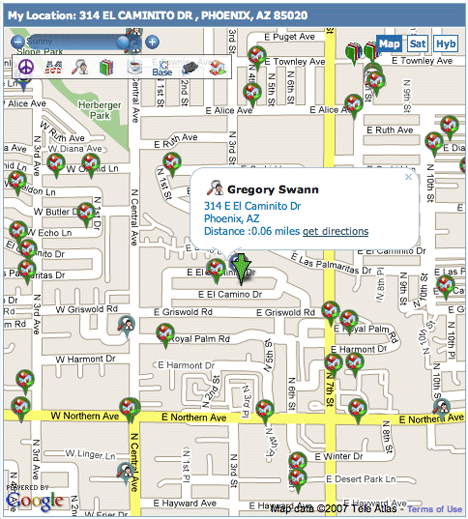
When first I read about Terabitz this morning, I was prepared to make fun of it. It looks and “plays” like an on-line video game. Instead of a simple check-box-based user-interface on top of a map, you drag out icons for the types of searches you want to run, then build a mashed-up map like the one shown above from the results. My guess is that the intent is artificially to limit the number of things you search for at one time, but the overall effect is at least as fun as an on-line video game.
From VentureBeat:
Terabitz is launching a comprehensive site for home buyers wanting to organizing and map information about their prospective homes.
Think of it as a cross between a personal homepage (like iGoogle or Netvibes, for example) and a real estate information site (like Trulia or Zillow).
You can drag and drop housing information from menu bars into a central dashboard with a set of data displays. With one click, you can map this data using the site’s Google Maps mashup.
Besides for-sale listings, there’s information like average local mortgage rates, average rental fees and other real estate information.
You can also find out all sorts of good things about a place that are harder to quantify, like nearby restaurants, libraries, schools, coffee shops. Even the FBI’s crime — and specifically sex offender — database gets included.
This non real estate data is what sets Terabitz, of Palo Alto, Calif. apart from sites like Zillow and Trulia, which also offer home profile pages that are limited mainly to real estate data.
You can customize your own page of data widgets about your prospective home. You can also make an image of your data collection and share it with other users or email to friends.
More from John Cook’s Venture Blog:
Yet another startup company is entering the online real estate category. Palo Alto, Calif.-based Terabitz — backed with $10 million in funding from Tudor Capital and originally conceived by 17-year-old Kamran Munshi — is attempting to create a site that will help home buyers or apartment hunters manage the process from beginning to end. Its Read more
I had the idea of building this last night, cataloging the BloodhoundBlog posts on the subject. Lani had a better idea, so I appropriated it. Attached below is a fairly comprehensive list of posts, both for and against, on the idea of divorced commissions.
I think this is the most important idea we’ve addressed, here and on the RE.net at large, so I wanted to build something that could grow with the debate.
Grow how? Two ways.
First, you can add your own or other people’s posts or articles to the catalog by filling out the form at this link. I want for this to be as comprehensive as possible, so do please let me know what I’ve missed.
Second, you can append this list to any future (or past) posts on the subject by using this PHP code:
<?PHP
include ("https://www.bloodhoundrealty.com/BloodhoundBlog/DCFile.php");
?>
In WordPress, you’ll need to use the runPHP plug-in.
How does it work? Watch and see:
< ?PHP include ("https://www.bloodhoundrealty.com/BloodhoundBlog/DCFile.php"); ?>
Technorati Tags: blogging, disintermediation, real estate, real estate marketing
(I’m waiting for a phone call, which is how Realtors address that awful burden of time that befalls them between birth and death.)
Joel Burslem mentioned the What Would Seth Godin Do plug-in today, and Jim Duncan has also written about it recently.
I like the idea, I just don’t like the execution. Too much one-size-fits-all for my tastes, where CSS and a WordPress theme can make everything unique and perfect.
I have code that will make the “intro.php” behavior introduced in WordPress 2.0 cookie-dependent. In other words, if the cookie is not set, visitors will see intro.php (or any other “sticky” pseudo-post you prepare under any arbitrary filename). If it is, they won’t.
I have it set with the cookie expiring in 60 days, so if someone has been away for a while, I can remind him of what’s what. People who forbid cookies will get the introductory post every time, but this is the default behavior for intro.php anyway. And if I change the name of the stored variable, I can cause everyone to see my presumably-substantially-revised introduction the next time they visit the site.
(There is a lot more you could do with something like this: Show it the first three visits, for example, or show a special message to very-frequent visitors.)
I don’t use this in BloodhoundBlog, although I could easily enough; it doesn’t require WP 2+. It’s really nothing but bread and butter PHP, as is WordPress itself.
If you want the code, it’s yours, but you have to hold your own hand. You don’t need to know PHP, but you do need to know how to edit and FTP your WordPress theme files. Email me if you want the files.
Technorati Tags: blogging, real estate, real estate marketing
On the other hand, do you want to see something cool? No Page Rank. No links to speak of. No history. Just a domain name and relevant headings and content.
Technorati Tags: blogging, real estate, real estate marketing
…is up at Sadie’s Take on Delaware Ohio.

Host Toby Boyce does a truly amazingly phenomenal job as judge — and I’m not just saying that because our own Jeff Kempe won with The Imperative of Divorced Commissions, Part 2: The Inherent Value of Free.
Toby used the idea of a golf tournament as his theme, with the chart above illustrating the competition.
And the competition was fierce, with many first-quality contenders. Wheel you golf cart over to Toby’s place to see what I mean.
Technorati Tags: blogging, real estate, real estate marketing
In a charmingly romantic post this morning, Jonathan Dalton gets bogged down in the all-too-common idea that divorcing the Realtors’ commissions would impose some new financial burden upon buyers, resulting in their loss of representation.
This is false. Although we operate by the fiction that the seller pays the real estate commissions out of the proceeds of the sale, in fact, if the buyer’s lender is not willing to fund the transaction, no sale will occur and no one will get paid. It’s useful in the abstract to envision the transaction as being either all-cash or 100% financed. In both cases, all the money is brought to the closing table by the buyer or the buyer’s lender.
To effect the divorced commission in the overwhelming majority of transactions, all that is necessary is for lenders to change their underwriting guidelines, making corresponding changes in the way they illustrate the flow of funds on the HUD-1 settlement statement.
Right now, many lenders will allow up to 7% in sales commissions, to be charged against the seller’s side of the HUD-1, with up to 3% in closing costs, also charged against the seller’s side of the HUD-1.
If lenders changed their guidelines, such that no more than 3.5% could be charged against the seller for the compensation of the listing agent, with no more than 3.5% charged against the buyer for the compensation of the buyer’s agent, the commissions would be divorced.
So far, this is nothing more than a change in underwriting guidelines and HUD-1 accounting. Absolutely nothing has changed away from the paper-shuffling lender universe. The costs to the buyer and the proceeds to the seller are exactly the same.
Not to rock too many boats at once, but it would also be possible for lenders to make their internal procedures and the HUD-1 bookkeeping more honest, putting a little extra money in the pockets of both buyer and seller.
In the chart shown below, the first column illustrates the current procedure. The middle column shows how commissions can be divorced while retaining the psychotic style of accounting lenders currently deploy. The third column demonstrates how commissions can Read more
This is me in yesterday’s Arizona Republic (permanent link):
Not all neighborhoods feeling a downturn
There are neighborhoods in the Phoenix area where the housing downturn is barely discernible.
How can that be? News reports are full of doom and gloom stories. Defaults, foreclosures and interest rates are up, with mortgages resetting seemingly at whim. If the news is always bad, how can it be good at the same time?
In fact, in some parts of the Valley prices have not fallen, with some neighborhoods actually experiencing continued appreciation. Inventories are up all over, but, so far, we haven’t seen much in the way of desperation selling.
We track a slice of Valley real estate as an indicator of where the market might be headed. We look at newer mid-sized homes in freeway-accessible suburbs. These were the homes that led the market on the way up, and they’ve suffered more than others on the way down.
So how bad is it out there? The homes we track are down 13.41% from the peak in December of 2005. That’s not insignificant. If you bought (or refinanced) a home like this any time after May of 2005, you’ve probably lost money. On the other hand, if you bought your home in January of 2004, you’re still up by around 58%. If you put 20% down, that’s a 290% cash-on-cash return. Better yet, as bad as things have been, there is only about seven months of inventory on the market, suggesting that prices may not fall much farther.
On the other hand, MLS Area 323 in the West Valley runs from Northern to the I-10, from 43rd Avenue west to 115th Avenue, a large and very diverse housing stock. Available inventory is huge, more than a twelve months’ supply. But, interestingly, prices in that region have only dropped by about 2.75% since December of 2005.
Don’t run down the street in celebration. Interest rates are flighty, and sub-prime or even low-down-payment conforming mortgages may be a thing of the past. But, even so, acknowledging that things may get worse before they get better, they haven’t been that bad so far.