
Reflecting on Jeff Brown’s post on economics, which in turn referenced an argument by Malcolm Galdwell, I made a short movie explicating the meme “information wants to be free.”
Cliff’s Notes: When a market good is so redundantly abundant as to be, essentially, ubiquitous and unavoidable, its market price will tend to plummet to zero. It doesn’t matter what the sellers of those goods might want to earn. All that matters, in this context, is what buyers are willing to pay. If the discounted probability of procuring an acceptable alternative is very high, then the price will tend to be very low.
Ordinary information is ubiquitous and unavoidable, and, therefore, the market price it can command is effectively zero. What the sellers or anyone else thinks about that is irrelevant. I have no reason to pay even a penny to you if I can get “just as good” next door for free.
That in turn references the very first post I wrote for BloodhoundBlog:
If almost-as-good is free or nearly free, what is the market value of slightly-better?
The answer? Almost always zero.
In the clip I talk about the difference in the paywalls of the Wall Street Journal and the New York Times. Ironically enough, there comes news this morning that the Times plans to finish off its slow suicide with yet another tilt at a paywall. Much good may it do them.
Here’s the video:
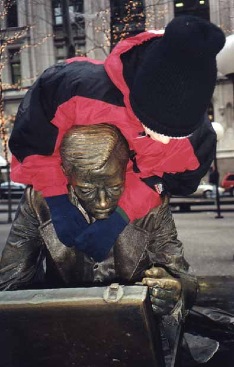 Cathy and I watched The Path to 9/11 on television tonight. I had forgotten that we were in Metro New York for the Turn of the Millennium. My father lives in Connecticut, and we went there that year for New Year’s Day. The photo you see is my son crawling all over a bronze statue of a stock broker in Liberty Park, directly across from what was then the Merrill Lynch Building — on December 30, 1999. I lived in Manhattan for ten years, from 1976 to 1986. For quite a few of those years, I worked just across from Liberty Park, in the Equitable Building at 120 Broadway. At the other end of that little brick park was the southeast entrance to the World Trade Center complex. I worked insane hours in those days, and, very often, when I got out of work, I would go sit at this tiny circular plaza plopped down between the Twin Towers. Not quite pre-dawn, still full dark, but completely deserted — and to be completely alone in New York City is an accomplishment. I would throw my head back and look up at the towers, the fourth movement of the Ninth Symphony running note-perfect through my head.