There’s always something to howl about.

Author: Greg Swann (page 32 of 209)

Suburban Phoenix Real Estate Broker

Divorcing couples need togetherness on sale the sale of their house.

If I can tell that the sellers are divorcing, they are costing themselves money.

We plant the seed of love and it takes root and grows toward the sun, a straight, proud, sturdy tree.

That’s the hope, anyway.

Sometimes, alas, the sapling of love withers and dies. Pulling it up by the roots can occasion no end of problems, but the real-estate problem may be the one of greatest financial consequence.

Consider this: I walk into a home, escorting buyers. In the living room there are two pieces of furniture: a big-screen television and a lawn chair.

The bedrooms are empty, except for the master bedroom, where there is a bare mattress. In the kitchen, there are dirty dishes in the sink and half-empty takeout containers and beer in the fridge.

It’s a divorce, of course. Mom and the kids are gone. Dad got custody of the TV.

It would be funny if it weren’t so nakedly tragic.

I get paid to hear the stories that empty houses whisper. This house tells me not just about the divorce, but that the divorce isn’t a relatively smooth one. It hints that the house is in pre-foreclosure or is for sale by a judge’s orders.

It confides in the certitude of silence that my buyers can steal it for tens of thousands of dollars less than market value.

Together, the sellers own a valuable asset. But neither wants to see the other prosper from their past together. So, out of spite, they are deliberately sabotaging the sale of their home.

“I might lose out,” he growls at the big-screen TV, “but at least she won’t win!”

“He can go to hell with that TV!” she seethes from her new apartment.

This is a mistake.

Frankly, both of them should move out, leaving the home vacant. If one is to stay, then they should agree to leave the furniture behind – and clothes in the closets. I should not be able to tell that the sellers are divorcing.

It’s sad the marriage didn’t work out. But properly staging the home for sale can at least help to pay for a happier divorce.

Overnight News: Take that, doubters! All #iBuyers ever needed to succeed was a pandemic, rioting and a buyer feeding-frenzy! Totally sustainable!

“Ya think it’s easy?”

Redfin: Everything about the iBuyers is funny, especially their Special Olympics approach to self-congratulation. Whose listings sell last and worst? But who is delighted to have had a national feeding frenzy to clear their overpriced inventories? iBuyer Activity Ground to a Halt in the Second Quarter, With Market Share Plummeting to 0.1%.

Forbes: Bubbles happen how? Mortgage Interest Rates Reach Another Record Low, Making Buyers Willing To Borrow More.

Redfin: We noted this yesterday: Who can spot the riots in recent closings? Who can anticipate the looming disaster of all the other listings, unreported here, that did not close? Home Prices Up 13%, Biggest Increase Since 2013.

CNBC: Commercial real estate community comes back from Summer vaycay to find its assets incinerated. Real estate CEO: NYC mayor must make streets safer, cleaner so people will want to return.

HousingWire: NAR: 31% of Realtors say they feel unsafe at open houses.

Reason: Who knew? There Is No Defense for Looting.

PJ Media: Weather Underground Terrorist Bill Ayers Suggests the Civil War Has Already Begun.

And because the reincarnation of every sixties wraith is not quite 2020 enough:

BizPacReview: Killer mosquito clouds rise from swamp, descend on Louisiana livestock and drain their blood.

“Now look at this chart and tell me where the riots are…”

I love this image from Redfin:

What is the name of the condition where people lie with their words but tell the truth with their deeds?

Are there riots in America this Summer – despite the overwhelming public denials?

Are those riots affecting real estate choices?

Meanwhile: Who thinks that price trajectory is healthy?

Yeesh! Good time to be a seller – and then a hermit!

Ask the Broker: “Why do people hate Realtors?”

The question is Cathleen’s, and it really plagues her:

“Why do people hate Realtors?”

Why do people hate Realtors? Because they think they’re supposed to…

It’s funny, truly, because almost nobody hates his own Realtor. Some people have real horror stories to tell, but most people don’t. To the contrary, most people have very happy, funny, charming stories to tell about the Realtor who helped them sell or find their home – or who perhaps undertook many transactions over the years.

Straight-commission sales people in general take a hit, not alone because we might seem to be more interested in the commission than in the work it takes to earn it.

And, of course, there have been no end of unflattering portrayals of real estate agents in art – especially TV and movies.

Here’s my best answer, though:

Why do people hate Realtors?

Because they think they’re supposed to…

Overnight News: “Let’s roll.”

“Profitability? What’s that?”

HousingWire: The upside of the urban exodus: Zillow: Nearly 2 million renters can become homeowners, thanks to telecommuting.

Forbes: WeWork Bets On Outdoor Spaces For The COVID Era.

Forbes: Six Ways Agents And Brokers Can Evolve To Build Better Brokerages.

CNBC: Mortgage lenders just saw record profit, and expect to do better in the next quarter.

Forbes: Surprising Effects Of The Wildfires In California’s Real Estate Industry.

Rob Hahn: The Relationship Narrative and Its Flaws.

TheRealDeal: iBuyer Opendoor eyes $5B IPO via blank-check firm.

City Journal: Chaos is underfathered boys: Breaking Things.

New York Post: ‘Let’s roll’: The heroic final moments of United Flight 93 on 9/11.

My 9/11 prayer…

[This is me – Greg – fourteen years ago, when this blog was still a mewling baby. It astounds me to think that the children who were pre-conceptual on 9/11 – aged 0 to 5 – are now the jihadis attempting to destroy Western Civilization from within. We need to do a lot better…]
 

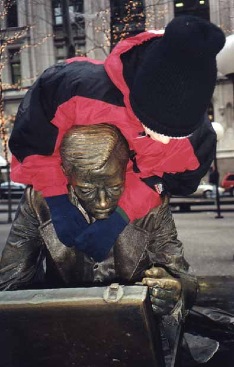
Cathy and I watched The Path to 9/11 on television tonight. I had forgotten that we were in Metro New York for the Turn of the Millennium. My father lives in Connecticut, and we went there that year for New Year’s Day. The photo you see is my son crawling all over a bronze statue of a stock broker in Liberty Park, directly across from what was then the Merrill Lynch Building — on December 30, 1999.

I lived in Manhattan for ten years, from 1976 to 1986. For quite a few of those years, I worked just across from Liberty Park, in the Equitable Building at 120 Broadway. At the other end of that little brick park was the southeast entrance to the World Trade Center complex.

I worked insane hours in those days, and, very often, when I got out of work, I would go sit at this tiny circular plaza plopped down between the Twin Towers. Not quite pre-dawn, still full dark, but completely deserted — and to be completely alone in New York City is an accomplishment. I would throw my head back and look up at the towers, the fourth movement of the Ninth Symphony running note-perfect through my head.

Everything I am describing was either destroyed or heavily damaged on September 11, 2001. Along with the lives of thousand of innocents. Along with the comfort and serenity of their families. Along with the peace of the entire world.

I don’t believe in any heaven except for this earth, this life — the heaven we make every day by pursuing the highest and best within us. The World Trade Center had its faults. I can detail every one. But it was a piece of the sublime, a proud testament to how high, how good our highest and Read more

When the punters come out to play, are they tugging a real estate bubble behind them?

Q: Why is it so hard to buy at the top?
A: That’s how you know it’s the top.

Who’s listing actual fee-simple dirt? Could life get any better? Representing hypothetical cubes of air-space amidst spookily-vacant concrete canyons? Not so much.

I just heard that J.P. Morgan is calling its people back to the office, so maybe vertical cities are not dead yet. My bet runs the other way, and, doubling-down, that employers incur liability by requiring attendance in dangerous locales.

Cinemas and shopping malls were dying, anyway. So, too, cities? A way of thinking of this urban exodus is simply as a matter of economic obsolescence: What is generally the oldest and most decrepit segment of the housing stock is being abandoned.

That pushes up prices in the suburbs, don’t it? “Gimme land, lotsa land, under smoggy skies above – and don’t dance so close to me!”

I thought we were pushing the top of this market turn before Coronavirus hit. That foreign import was killing big cities even before the rioters started burning them down. Accordingly, there won’t be a top in Phoenix for a while, where March of 2020 may be the high-water mark for decades for many great American cities.

But the thing about market tops is, they advertise themselves: Rapid price jumps, low inventory, bidding wars, waived contingencies, escalator clauses, solemn pre-dawn ungulate sacrifices, etc.

Again, not there, but very much here – and everywhere suburban parcels abound.

Here’s another characteristic of market tops, one we were all very well paid to overlook in the housing bubble of this century’s toddler years:

The real estate market tops when even the most marginally-prepared borrowers compete for and get mortgages.

What’s a bubble? It’s when the bike messengers and coffee shop waitresses come down to Wall Street with their mattress money. Wait, that’s a dated image. How about this? A bubble is when lifelong renters become very temporary homeowners. No, that was the last time. Try this: A bubble is when forty-year-old adolescents emerge from mom’s basement just long enough to sign socially-distanced closing docs in a title company’s parking lot.

My point would be that, Read more

Overnight News: If your houses aren’t evaporating, your taxpayers are.

“What’s new, nu?”

Hoover Institution: California Businesses Leave The State By The Thousands.

Housing Wire: U.S. mortgage rates fall to all-time lows this week.

CNBC: The CDC banned evictions, but some renters are still vulnerable.

Forbes: What It Might Mean If We All Work From Home?

City Journal: What the Trump Eviction Ban Gets Wrong.

City Journal: New York City at the precipice: A Tale of Two Cities, Indeed.

CNBC: Manhattan rental market plunges, leaving 15,000 empty apartments in August.

And for hard-working grunts on the ground who have found a praxis that pays…

UPI: Virginia man buys 20 lottery tickets, wins 20 times.

Are big cities hostile to middle class values? Not to worry! Big Data will make it all worthwhile.

Imagine how cities will change after half their populations have fled.

Forbes today, and I shouldn’t pick on them. Some of their writers are interesting. Not here, though, I’m afraid.

Start wrong, stay wrong: What value has the big city provided, until now:

it has provided urban citizens with access to technology

In fact: Access to cheaper transportation of people, information and goods – most of which is now obviated by the internet – which would be the point demanding consideration.

But not here.

There are still many parts of the developed world where having a video call is difficult and starting an ecommerce business is impossible due to poor internet speeds.

And this has nothing to do with anyone reading Forbes. Got two bars on your phone? You’ve got what it takes to work from home.

Oh, but it’s not old-tech that matters. New-tech will require cities because… Why? The claims are all about economies of scale, but that’s pretty 19th-century thinking. In fact, new technology – like all innovation – goes where the money is. If the full-price early-adopters move to the exurbs, so will the people who hope to sell to them.

Am I wrong?

Take, for instance, self-driving vehicles. Autonomous vehicles require a massive infrastructure of live data feeds from cameras, GPRS, smart devices, infrared, Bluetooth and sensors in order to ensure that a car or drone can operate safely. These data feeds are not going to exist on country lanes and byways in rural areas.

Of course, all of that is daft. You can get four bars or better from any cell carrier, anywhere rich people go. Meanwhile, escaping the glaring, blaring distractions of urbanity is a key benefit of the exodus we are seeing.

What’s the downside to remaining in the big burgs?

Those who do live in cities will see a substantial degradation of their privacy rights as surveillance becomes a way of life.

I’m pretty sure getting mugged by gangs of Grasshoppers is going to turn out to be a bigger deal. Don’t worry, though. Virtual reality will give you something else to think about, as your wounds heal.

Why are people racing Read more

Unchained Melody: The DISC of “Darling Be Home Soon.”

The original is pure Di, as are the lyrics: Busy musician home briefly imposes ardent deadlines. It’s truly great that way, an abrupt and demanding lust, and the sheer urgency rends fabric. Artie Schroeck did the original arrangements – and he’s there in all the covers.

Joe Cocker takes and remakes the song – just like always – turning it into the Si viscera of wide-open yearning.

Susan Tedeschi delivers the Joe Cocker vocal performance, but it is Derek Trucks who shows us how Cs the love in that lyric can be.

“We are easy prey” – Propositions Three and Seven by Richard Mitchell

Propositions Three and Seven from The Graves of Academe by Richard Mitchell

 
In the country of the blind, the one-eyed man is, as we all know, king. And across the way, in the country of the witless, the half-wit is king. And why not? It’s only natural, and considering the circumstances, not really a bad system. We do the best we can.

But it is a system with some unhappy consequences. The one-eyed man knows that he could never be king in the land of the two-eyed, and the half-wit knows that he would be small potatoes indeed in a land where most people had all or most of their wits about them. These rulers, therefore, will be inordinately selective about their social programs, which will be designed not only to protect against the rise of the witful and the sighted, but, just as important, to ensure a never-failing supply of the witless and utterly blind. Even to the half-wit and the one-eyed man, it is clear that other half-wits and one-eyed men are potential competitors and supplanters, and they invert the ancient tale in which an anxious tyrant kept watch against a one-sandaled stranger by keeping watch against wanderers with both eyes and operating minds. Uneasy lies the head.

Unfortunately, most people are born with two eyes and even the propensity to think. If nothing is done about this, chaos, obviously, threatens the land. Even worse, unemployment threatens the one-eyed man and the half-wit. However, since they do in fact rule, those potentates have not much to fear, for they can command the construction and perpetuation of a state-supported and legally enforced system for the early detection and obliteration of antisocial traits, and thus arrange that witfulness and 20-20 vision will trouble the land as little as possible. The system is called “education.“

Such is our case. Nor should that surprise anyone. Like living creatures, institutions intend primarily to live and do whatever else they do only to that end. Unlike some living creatures, however, who do in fact occasionally decide that there is something even more to be prized than their own survival, Read more

What’s the secret real estate pricing trick that makes homes sell faster, for more money? Honesty.

“Guile creates rancor and delay, ignoring the financial consequences, where an honest broker is a lifeboat in a sea of lies.”

Our story so far:

There are a zillion other things we do for sellers, but we are getting at the essence of what makes a listing move faster and for more money than its competition.

So: Every choice we make maximizes the seller’s interests, but for that reason every choice maximizes transparency and, for lack of better term, velocity of decision-making.

Translation: I make it as easy as possible for the buyer to commit to my listing.

How, specifically?

No guile.

Disclose everything, of course, but not in any way that’s tricky or cagey or coy. Every buyer’s fear in every transaction is getting taken. Obviously, I want to do everything I can to take that fear away, but even before that I want to make sure that I have done nothing to amplify that fear.

And what might you suppose is the fastest, easiest way to make a buyer wary of me and my new listing?

How about the listing price?

Oh, yes! The price is the most important, most powerful statement on your listing, and if it’s a lie, the whole listing is suspect and the house is one-down – at a minimum – before it even shows.

So what does a lying listing price look like?

Just like this: $299,900.

Is the house worth $300,000? Or $295,000? How to tell? Liar’s Poker: Offer $295,000 and see where they come back.

That back-and-forth takes time, even if you insist it does not cost the seller money. Worse, we start with mistrust and slap-box our way to bad will. That will make the repair negotiations fun.

I think that’s dumb. I despise guile, anyway, but its further fruits are even more rancid that the soul-sacrifice required by deception in the first place. You make an ugly first move and then Read more

Splendor on – and in spite of – Labor Day.

Labor Day is a holiday established by people who hate human productivity, who hate the human mind. It is a day set aside on the calendar to celebrate and sanctify indolence – and violence. Photo by: Karen Horton

This is me looking back on looking back on a Labor Day a long time ago. The first extract was written on Labor Day, 2005, as the City of New Orleans was demonstrating for all of us that dependence on government is a fatal error. The second extract was written a year or two before that. And the Labor Day I am talking about there was years before that. Even so, every bit of this is perfectly apposite to the world we live in now – more is the pity.

This is me from elsewhen. I think about this every year at Labor Day. I spent much of the weekend working on business planning issues, macro, micro and meta. I remember from the days when I had a job how much I relished long weekends, because I could build so much on vast tracts of uninterrupted time. I did a bunch of money work last week, but my weekend was virtually my own – to fill with the work that too often takes a back seat to money work. Off and on we had Fox News on in the office, and the whining, pissing and moaning was an effective counterpoint to my entire way of life. My world is where the Splendor is, no alternatives, no substitutions, no adulterations, no crybaby excuses:

The time of your life is your sole capital. If you trade that time in such a way that you get in exchange less than you really want, less than you might actually have achieved, you have deliberately cheated yourself. You have acted to your own destruction by failing to use your time to construct of your life what you want most and need most and deserve most. You have let your obsession or anger – over what amounts to a trivial evil in a world where people are shredded Read more

My take on fintech? Who doesn’t love a better pen? But: No rainmakers, no rain.

Click to embiggen.

I got a recruitment pitch from OfferPad the other day: Be an in-house listing agent for our fallback upsell team. This is not an honor, an oddity or an error; I’m in a database, that’s all. And: Fun for me to see, but not a temptation.

They’re fools to make agents 1040 employees, rather than 1099 independent contractors. For a second reason, 1040 employees are going to be the death of all corporate entities. But the first reason is in the headline: No rainmakers, no rain.

You can see they understand this simple fact: The pay plan is commission plus a draw, the scheme all corporate sales teams use to attract and retain dedicated plodders.

But straight commission sales separates closers from losers just like that, with zero management intervention. That’s why real estate brokers like it so much.

And I think that illuminates the folly of taking fintech seriously. Who doesn’t love a better pen – but who believes a better pen will make you a better persuader? Technology solves paperwork problems very well, and I would be more impressed with technology vendors if they put more attention there. (Hint: Title and escrow: Rich, ripe, ready.) Technology addresses people problems poorly – a fact it is perpetually incapable of discovering.

Brian Brady pointed out to me that lenders live on Realtor marketing. That’s not wrong, it’s reasonable. Title, escrow, inspectors, tradesmen and home-warrantors all depend on Realtor referrals, which they can farm out only because they have already surfaced the buyer, seller or investor. You can’t buy your date a cocktail until you have a date.

So it’s the other end of the food chain that concerns me – not fintech but leadgen. Realty.bots whose sole business is to get in front of your client before you can – so they can sell access to you – are not your friends.

For what it’s worth: Of the big-name iBuyers, Zillow’s solution to abandoned shopping carts seems best. Instead of using salaried and lawsuit-curious employees to upsell more lawsuit opportunities, pitch the now-useless “leads” to starving Realtors. For 35%! Who has the Read more