There’s always something to howl about.

Author: Greg Swann (page 36 of 209)

Suburban Phoenix Real Estate Broker

Joel Kotkin on the triumph of suburbia.

New Geography:

The “silver lining” in our five-years-and-running Great Recession, we’re told, is that Americans have finally taken heed of their betters and are finally rejecting the empty allure of suburban space and returning to the urban core.

“We’ve reached the limits of suburban development,” HUD Secretary Shaun Donovan declared in 2010. “People are beginning to vote with their feet and come back to the central cities.” Ed Glaeser’s Triumph of the City and Alan Ehrenhalt’s The Great Inversion—widely praised and accepted by the highest echelons of academia, press, business, and government—have advanced much the same claim, and just last week a report on jobs during the downturn garnered headlines like “City Centers in U.S. Gain Share of Jobs as Suburbs Lose.”

There’s just one problem with this narrative: none of it is true. A funny thing happened on the way to the long-trumpeted triumph of the city: the suburbs not only survived but have begun to regain their allure as Americans have continued aspiring to single-family homes.

More:

While they’ve weaved a compelling narrative, the numbers make it clear that the retro-urbanists only chance of prevailing is a disaster, say if the dynamics associated with the Great Recession—a rise in renting, declining home ownership and plunging birthrates—become our new, ongoing normal. Left to their own devices, Americans will continue to make the “wrong” choices about how to live.

And in the end, it boils down to where people choose to live. Despite the dystopian portrays of suburbs, suburbanites seem to win the argument over place and geography, with far higher percentages rating their communities as “excellent” compared to urban core dwellers.

Today’s suburban families, it should be stressed, are hardly replicas of 1950s normality; as Stephanie Coontz has noted, that period was itself an anomaly. But however they are constituted—as blended families, ones headed up by single parents or gay couples—they still tend to congregate in these kinds of dispersed cities, or in the suburban hinterlands of traditional cities. Ultimately life style, affordability and preference seem to trump social views when people decide where they would like to live.

We already see these preferences establishing themselves, again, among Read more

Zero Hedge: “Presenting: The Housing Bubble 2.0”

Tyler Durden:

It was just seven short years ago that the prices at the epicenter of the housing bubble, Los Angeles, CA rose by 50% every six months as the nation experienced its first parabolic move higher in home prices courtesy of Alan Greenspan’s disastrous policies: a time when everyone knew intuitively the housing market was in an epic bubble, yet which nobody wanted to pop because there was just too much fun to be had chasing the bouncing ball, not to mention money. Well, courtesy of the real-time real estate pricing trackers at Altos Research, we now know that the very worst of the housing bubble is not only back, but it is at levels not seen since the days when a house in the Inland Empire was only a faint glimmer of the prototype for BitCoin.

Urf.

A lot of the people I talk to in Phoenix are trying to time their exit. It wasn’t this way in 2005-2006; I had people still eager to buy ten months after the market had turned.

The Samsung Galaxy S4 is the world’s first peripatetic computer: You walk, you work and you thrive.

You walk, you work – and you get the job done.

I was walking around the house Saturday — busily working away, headset in my ear, making phone calls and dealing with emails — when it hit me:

The Samsung Galaxy S4 is the world’s first peripatetic computer.

It’s easy and natural to work — to do real work — while walking. Salesmaniacs know that you work better on the phone when you’re walking and talking, but that’s just one aspect of the the sheer utility of doing the desk work where the work is, instead of trying to disgarble the mangled reports of intermediaries.

Comprehensive reviews of the S4 abound, pick your poison. I’m Apple to the core since 1985, so this was a big move for me. I have zero doubt that all smartphones are rip-offs of Apple, that without the iPhone, cell phones would still look and disappoint like the the Nokias and Motorolas of yore. But Samsung is number two and it is trying harder than Apple is now — a lot harder.

The unique features of the phone are gee-whiz and boy-howdy both, doubt you nothing, but that’s all just geekery (and the whole Android universe is rife with the kind of self-satisfied jargonistic needlessly-arcane asshattery that made normal people shun Unix (Eunichs?) geeks even before they made DOS for the dumb ones). What makes the S4 work is the way it’s made for work.

Like this:

* Size: Nice in my hand, maybe just a touch big for the wimminz, but very pocketable, unlike the largely-comparable Galaxy Note 2. (Between the lines: Leaving the phone out of the iPad and iPad Mini was an unforced error on Apple’s part.)

* Weight: That plastic shell feels cheesy, but it makes the phone super-light. I can hold it stationary in one hand indefinitely, easily, without rest or stress. I sold my iPad 2 because the weight of the thing made it, de facto, a crippled laptop, not a usefully-mobile computing solution.

* Software: This is still the weakest link for true peripateticism, computing while ambulating, working while you walk, but we’re getting there. The whole “app” diversion has been a disaster, with millions of people possessed Read more

The end-times are upon us: DocuSign spam…

From my mail this morning:

DocuSignSpam

That’s a spoofed email — no links back to the mothership, and a big, fat executable at the bottom. I’m betting it’s WinPoison, so it probably won’t hurt my iMac, but I won’t be researching that question.

But: Be alert. Whether it’s spam, malware or a phishing line, nothing goes wrong until you make the mistake of clicking on the wrong file or link.

Kotkin: “Why the next great American cities aren’t what you think.”

Joel Kotkin at The Daily Beast:

Once considered backwaters, these Sunbelt cities are quietly achieving a critical mass of well-educated residents. They are also becoming major magnets for immigrants. Over the past decade, the largest percentage growth in foreign-born population has occurred in sunbelt cities, led by Nashville, which has doubled its number of immigrants, as have Charlotte and Raleigh. During the first decade of the 21st century, Houston attracted the second-most new, foreign-born residents, some 400,000, of any American city—behind only much larger New York and slightly ahead of Dallas-Ft. Worth, but more than three times as many as Los Angeles. According to one recent Rice University study, Census data now shows that Houston has now surpassed New York as the country’s most racially and ethnically diverse metropolis.

Why are these people flocking to the aspirational cities, that lack the hip amenities, tourist draws, and cultural landmarks of the biggest American cities? People are still far more likely to buy a million dollar pied à terre in Manhattan than to do so in Oklahoma City. Like early-20th-century Polish peasants who came to work in Chicago’s factories or Russian immigrants, like my grandparents, who came to New York to labor in the rag trade, the appeal of today’s smaller cities is largely economic. The foreign born, along with generally younger educated workers, are canaries in the coal mine—singing loudest and most frequently in places that offer both employment and opportunities for upward mobility and a better life.

Over the decade, for example, Austin’s job base grew 28 percent, Raleigh’s by 21 percent, Houston by 20 percent, while Nashville, Atlanta, San Antonio, and Dallas-Ft. Worth saw job growth in the 14 percent range or better. In contrast, among all the legacy cities, only Seattle and Washington D.C.—the great economic parasite—have created jobs faster than the national average of roughly 5 percent. Most did far worse, with New York and Boston 20 percent below the norm; big urban regions including Philadelphia, Los Angeles, and, despite the current tech bubble, San Francisco have created essentially zero new jobs over the decade.

[….]

The reality is that most urban growth in Read more

What’s big, dumb, sclerotic and panics on command? A California Association of Realtors member, apparently.

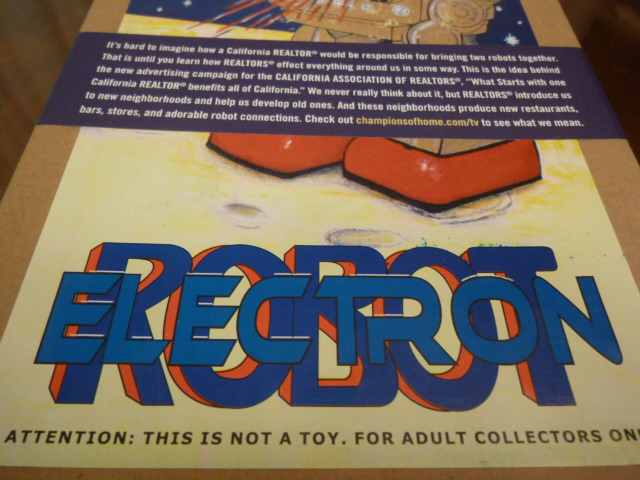
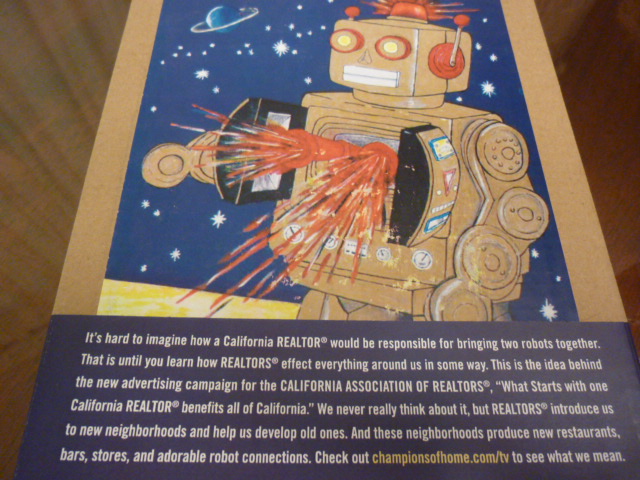
So this big dumb robot shows up on the front porch this morning:

Believe it or not, it’s from the California Association of Realtors. The robot exists to support this video:

Get it? There’s a meet-cute featuring pre-tween pretend robots, and this clunky piece of junk communicates… what…?

My reaction? “Urf. Now I’m going to have to waste time mocking this nonsense…”

Okayfine. You will note that the robot seems to be suggesting that California Real Estate is something of a slot machine.

But at least your CAR member agent has his squarish mechanical head screwed on right.

And in a batteries-not-included world, your mechano-Realtor comes complete with two enormous D-cells, which must have added considerably to the postage.

The box didn’t provide a lot of insight into why one should choose a CAR-certified RealtorBot, but it was fun imagery:

Ultimately, though, it’s the test of the marketplace that matters. And a CAR-approved RealtorBot can panic mindlessly like no other.

Hey, CAR members: No tar, no feathers in California? This is your money I’m having such a good time with…

Apparently, insanity is buying the same house over and over again, even though you never qualify.

You just can’t make this shit up: Obama administration pushes banks to make home loans to people with weaker credit. Why not? It worked out so well the last time.

The Obama administration is engaged in a broad push to make more home loans available to people with weaker credit, an effort that officials say will help power the economic recovery but that skeptics say could open the door to the risky lending that caused the housing crash in the first place.

President Obama’s economic advisers and outside experts say the nation’s much-celebrated housing rebound is leaving too many people behind, including young people looking to buy their first homes and individuals with credit records weakened by the recession.

In response, administration officials say they are working to get banks to lend to a wider range of borrowers by taking advantage of taxpayer-backed programs — including those offered by the Federal Housing Administration — that insure home loans against default.

Housing officials are urging the Justice Department to provide assurances to banks, which have become increasingly cautious, that they will not face legal or financial recriminations if they make loans to riskier borrowers who meet government standards but later default.

Officials are also encouraging lenders to use more subjective judgment in determining whether to offer a loan and are seeking to make it easier for people who owe more than their properties are worth to refinance at today’s low interest rates, among other steps.

Obama pledged in his State of the Union address to do more to make sure more Americans can enjoy the benefits of the housing recovery, but critics say encouraging banks to lend as broadly as the administration hopes will sow the seeds of another housing disaster and endanger taxpayer dollars.

“If that were to come to pass, that would open the floodgates to highly excessive risk and would send us right back on the same path we were just trying to recover from,” said Ed Pinto, a resident fellow at the American Enterprise Institute and former top executive at mortgage giant Fannie Mae.

We are all ‘greater fools’ now: How can you sell your house to a big family when big families don’t exist any longer?

Markets go up. Markets go down. But the whole house of cards is built on the idea that population will grow. What happens when it doesn’t?

matt-king-most-depressing-slide

From Business Insider:

It’s what I like to call “the most depressing slide I’ve ever created.” In almost every country you look at, the peak in real estate prices has coincided – give or take literally a couple of years – with the peak in the inverse dependency ratio (the proportion of population of working age relative to old and young).

In the past, we all levered up, bought a big house, enjoyed capital gains tax-free, lived in the thing, and then, when the kids grew up and left home, we sold it to someone in our children’s generation. Unfortunately, that doesn’t work so well when there start to be more pensioners than workers.

The entire welfare state is built on the idea that young people can be milked of their wealth because they’re too busy being young to notice.

Alas, the welfare state also awards adults either for not reproducing or for reproducing in only the most wealth-destructive ways. The consequence (entirely foreseeable) is that the number of dependents-by-choice goes up while the number of de facto slaves declines — by people either opting out of producing wealth or opting in to the welfare state’s “free” benefits or, as here, by not being born in the first place.

This will not end happily…

Has your town pissed away a fortune on the so-called ‘creative class’? Bad news from Richard Florida: “On close inspection, talent clustering provides little in the way of trickle-down benefits.”

Joel Kotkin:

Among the most pervasive, and arguably pernicious, notions of the past decade has been that the “creative class” of the skilled, educated and hip would remake and revive American cities. The idea, packaged and peddled by consultant Richard Florida, had been that unlike spending public money to court Wall Street fat cats, corporate executives or other traditional elites, paying to appeal to the creative would truly trickle down, generating a widespread urban revival.

Urbanists, journalists, and academics—not to mention big-city developers— were easily persuaded that shelling out to court “the hip and cool” would benefit everyone else, too. And Florida himself has prospered through books, articles, lectures, and university positions that have helped promote his ideas and brand and grow his Creative Class Group’s impressive client list, which in addition to big corporations and developers has included cities as diverse as Detroit and El Paso, Cleveland and Seattle.

Well, oops.

Florida himself, in his role as an editor at The Atlantic, admitted last month what his critics, including myself, have said for a decade: that the benefits of appealing to the creative class accrue largely to its members—and do little to make anyone else any better off. The rewards of the “creative class” strategy, he notes, “flow disproportionately to more highly-skilled knowledge, professional and creative workers,” since the wage increases that blue-collar and lower-skilled workers see “disappear when their higher housing costs are taken into account.” His reasonable and fairly brave, if belated, takeaway: “On close inspection, talent clustering provides little in the way of trickle-down benefits.”

Rotarian Socialism doesn’t work? Not even when you geyser those subsidies at really hip, pomo Rotarians? Who knew…?

My client went shopping for houses on Trulia.com, and only 75% of those she found were bogus listings…

My note to her: “Trulia and Zillow both present inactive listings as though they were active to fool the public into thinking that they have more inventory than the agents they exploit for advertising money, even though their listings come straight from the MLS systems. Mere real estate brokers would be fined out of business for pulling these stunts.”

Despair you nothing, though, hard-working dogs. Every time Trulia or Zillow are caught pulling these bait-and-switch stunts, one more active real estate shopper is turned off of their sites forever. Nice going, suits…

Are Zillow and Trulia thrashing savagely in a blood-red ocean? Here’s a clue: Both of them are jumping the shark.

Do you feel like dinner?Is the business model of all the Realty.bots daft?

It is Citron’s primary thesis that Zillow is a Web 1.0 business presenting itself as a Web 2.0 investment. The entire premise of Web 2.0 is that smart managing and publication of information interactively to users can scale tremendously, while costs remain fixed. But unlike Netflix, LinkedIn, and even Facebook, Zillow isn’t voyaging forth into an ever-expanding horizon of unlimited sized markets opening up on the internet. It generates virtually all of its revenue from U.S. real estate agents. And it does so the old- fashioned way—by cold-calling them on the telephone. It’s been operating since 2006 more or less as it does today, and was consistently unprofitable, until the last two quarters.

[….] It is a “heavyweight” sales company masquerading as a “web 2.0” leveraged technology play. The only way it has to grow revenues right now is with the increasing intensity of the sales effort. It’s not light and leverageable like LinkedIn, or OpenTable (Sales and mktg 21.4% of revenues) Zillow is more similar to Groupon than a Web 2.0 company such as LinkedIn or Open Table.

[….]

Expressed another way, it is apparent to Citron that Zillow is buying revenues with an intense telesales effort. Put in its simplest terms, they spent an additional $3.8 million on sales expense last quarter, and only generated $4.8 million in new revenues!

By comparison, Open Table spends 21% of revenues on sales, and even LinkedIn spends 33%. This comparison shows how much Zillow is dependent on old school phone room sales—not Web 2.0 online leverage.

While management might spin a fun story about their company growing revenues at a rapid pace, the proof is in the numbers. The cost of sales demonstrates that customers do not buy Zillow ads; they are sold Zillow ads, which should be disturbing because they address a target niche market unlike OPEN or LNKD—and cost of sales should be lower.

[….]

Citron notes that MOVE.com, formerly Homestore.com, referenced above, could not make money during the real estate boom of the mid 2000’s. At the time, they were the only online destination for brokers to buy Read more

Virtually belly-to-belly: Don Reedy’s salesmaniacal YouTube video voicemails.

Reacting to this post from yesterday on a better way to handle video testimonials, Don Reedy brought us this idea in the comments:

Greg, this is really easy, and does take planning, but not much time.

I’ve started trying to communicate with prospects, people I just meet coming and going, and folks in escrow by using my laptop, recording a 30-45 second message, posting as an “unlisted” video to YouTube, and then linking a picture of myself with a “play button” on my torso to that link.

I embed the picture with link in emails. They fly through, are almost always clicked on, and provide that belly to belly contact emails don’t always do. And yes, often that simply results in future actual phone calls, but the goal of creating value to and for the client is surely helped along by this methodology.

Here is the photo of Don he sent to me in an email:

And here is the video I see when I click on that image:

As constructive criticism, I think I want the photo to be bigger with a bigger YouTube-like Play button, plus also a reiterated call to action in text form: “I’ve made a ‘video voicemail’ just for you. Click ‘Play’ to see it.” For the video, I want Don’s head and shoulder bigger — closer to the webcam — and higher in the frame.

Those are quibbles, though. I love the idea, and the “Yeah!” special effect is fun. It might work to tack on a business card at the end, along with a link-back, in the video and in the description section, to any client-specific web pages.

This is cool, though: Using rough-and-ready tools to put a very personal touch on voicemail-like contacts. Using smartphone video with one-touch YouTube posting, Don’s technique would be useful for all kinds of client follow up.

As an example, here’s the ‘script’ for a movie you’ll have to screen in your imagination:

Hey, Jim and Shirley. Greg Swann here with a quick video voicemail about the houses I looked at for y’all today. I’ll have a web page for you later today with photos of the homes Read more

Big duh technology tip: Film that testimonial, YouTube it, then share the link with your client.

A while back, I wrote a post on BloodhoundBlog about using pocket-sized video cameras to record and propagate video testimonials. That kind of job is now better done by smartphone video cameras, but you can still buy a Flip camera if you have money burning a hole in your pocket. (But, if that really is your problem, I would be ecstatic if you would buy me a Looxcie headset-size video camera instead.)

Any way you capture the video, here is the procedure I talked about then:

1. Capture the video. Because you’re doing an interview, you can guide the testimonial to elicit the information you want to convey to other clients.

2. Post the video on your YouTube page.

3. Embed the YouTube video on your testimonials page. (I have code that will place a randomly-selected miniaturized-video, as pictured above, in your weblog’s sidebar, so that your clients see a different testimonial every time they come to visit.)

Here is the big duh I left out of that original post:

4. Share the link to the YouTube video with the subject of the testimonial.

When you made the film, you told your clients that you wanted for them to share the news of their good experience with their friends, colleagues and family members. How much easier can you make it for them to follow through than to give them access to their own video-recorded testimonial?

If you make a playlist of all your video testimonials, prospects referred by past clients may end up looking at more than one of your videos. Needless to say, each of those videos should link back to your main blogsite. But the big bonus of working this way is to make it very easy for your satisfied clients to share their satisfaction with their warm network.

How do I know this is a bug duh idea? Because it only took me four-and-a-half years to think of it!

Black Friday? Grey Thursday? Before the flood, a pensive Wednesday night at Walmart.

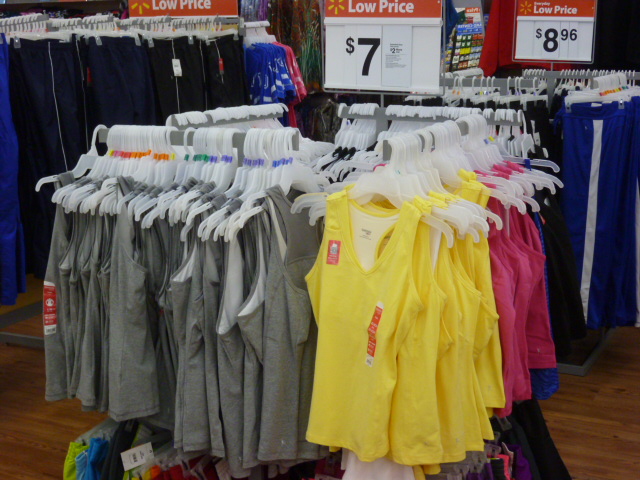
I love Walmart. I am very happy to call myself a member of the middle class, and I take huge delight in cruising the aisles at Walmart, scoping out all the incredible deals.

I don’t buy a lot of stuff, though. Away from TechToyz, I lead a pretty Spartan existence. But I love to see all that incredible wealth stacked floor to ceiling, knowing that it is the much-maligned engine of freeish-market capitalism that makes all that stuff available to me.

I’m not a Black Friday kind of shopper. We’re not all that Christmas-y, and I do not like to be crowded, not ever. But the phenomenon of Black Friday, especially at Walmart, is fascinating to me.

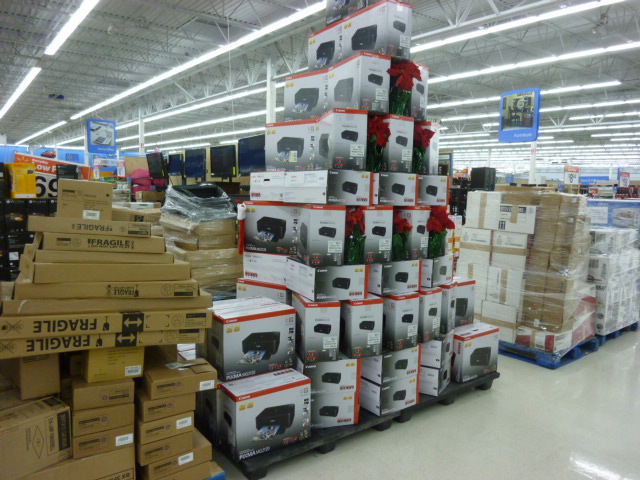
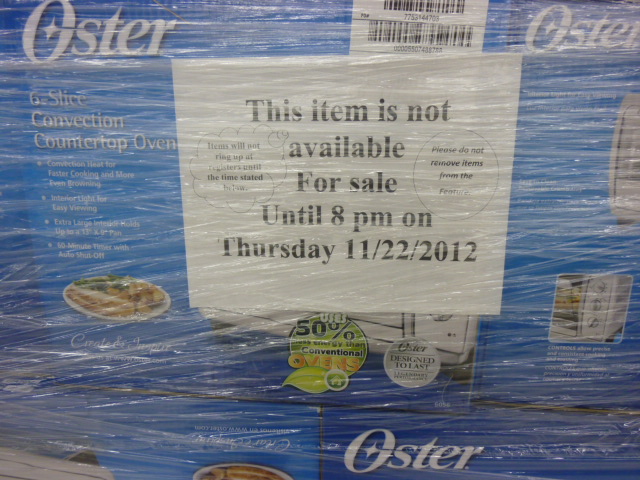
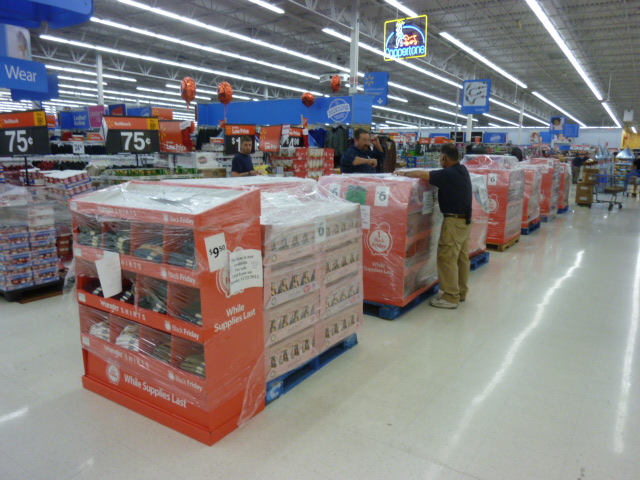
We had to stop in at a Super Walmart late Wednesday night, and I took the opportunity to snap a few dozen photos of that store’s preparations for Grey Thursday and Black Friday. Every wide aisle in the store was lined with pallets full of shrink-wrapped merchandise, millions of dollars worth of stuff waiting to be sold between now and Monday.

There were more staffers than customers in the store, and they were all busy getting ready. Black Friday takes its name from the sad fact that the day after Thanksgiving is the day most retailers reach the stage of profitability for the calendar year. In other words, storekeepers large and small work almost eleven months of the year before they make any profit at all.

Walmart might do better than that. Apple’s retail presence does a lot better. But retail is a hard way to make an easy living, and my bet is that it will get harder as the parasitic weight of government crushes more and more of the economy.

Meanwhile, smug people like to sneer at Walmart for selling Americans goods they want to buy at prices they want to pay. I’m happy that some people are so rich that they can afford to spurn and scorn Walmart. But I’m happier still that Walmart is around to provide incredible values every day for people who work hard for their money and want to make it go Read more