There’s always something to howl about.

Author: Greg Swann (page 41 of 209)

Suburban Phoenix Real Estate Broker

Making immaculate love: My new book about marital bliss, coming soon.

Way off topic for this joint, but I have a new book coming on achieving a perfect bliss in your marriage. It’s a subject I’ve addressed here, as well as at SplendorQuest.com.

The title is Come Hither, Darling: Making Immaculate Love. If your marriage isn’t everything you thought it would be, you might give the link a look.

My promise: We’ll start out with a blinding epiphany.

DocuSign graduates: The ultimate signature bot is about to become a full-blown point-of-purchase.

What’s the real difference between a broker and a salesperson? Whatever his or her license status, the broker is one who knows the deal ain’t done until you’ve got the money. Starting in April, DocuSign is going to make a broker’s life a lot easier:

DocuSign’s upcoming April release ushers in a new era for the global standard for eSignature with the introduction of Payment Processing. Once available, you will be able to close the deal and collect the cash with DocuSign in one step to further accelerate transaction times, increase speed to revenue, reduce costs and enhance your customers’ experience.

It’s PayPal, and the charges are plausibly reversible, so it’s not perfect money. But this is document-as-storefront, a whole new way for paper-pusher to sell.

Note to the vendorslut mafia: I gain nothing by chastising you for your unbounded mediocrity, which is why I’ve stopped paying attention entirely to your artifacts of ineptitude. But take careful note: DocuSign knows how to deliver the goods. They are in a constant added-value mode, with the result that no less-motivated competitor can even come close to them. It’s not just the features, it’s how they are implemented — software-as-a-service in both directions, with a REST API coming in the new release.

Ask the Broker: Has going FSBO lost its fizz?

This came in over the transom. I’m not answering the whole question. To say the truth, I feel as if I’m being shopped with every conceivable infraction in the HUD handbook. So, you, too, please do also exercise restraint on the subject of commissions. For all of me, the FSBO question is more interesting, anyway.

From my interlocutor:

We are selling our home in a very upscale part of Atlanta. We want to do it “by owner” using one of several services advertised on line. Who pays the buyer’s agent and what percentage? We’ve been told its negotiable but too little and no one will show it. The home will sell in the $400,000 range if that makes a difference.

I start here: I want to know more about “one of several services advertised on line.”

I don’t know the real estate market in Atlanta, but this strikes me as being a very poor time to sell without the MLS. If the “services advertised” are limited service MLS listings — which is as far as anyone should go, in my opinion, down the “by owner” road — then those listing agents can address the commission questions.

The seller will definitely be paying the buyer’s agent, of course: If you’re not paying for the product, you are the product — an idea that never seems to occur to home buyers.

But I think it would be a huge marketing disadvantage to forego the MLS. In the age of the internet, an MLS listing is more valuable than ever before. (I think this has come up lately in the Dipshit Broker News, but I stopped following that crap years ago.)

But even more than that, I think the right full-service listing agent can more than repay his marginal cost. The house is unlikely to attract a lot of attention if it is not listed in the MLS system, but, even then, if it is not marketed to its fullest advantage, it will sell more slowly and for less money than it could have.

My take is that most listing agents aren’t worth a damn, but the right agent will bring home Read more

Lunchtime links: Will the robo-signing settlement fail? Will Western Civ collapse to ruins? Who cares? Sheldon Cooper lives!

From good friend of the dawgs, Jim Klein, comes this grim reminder of the times we live in: SurvivalRealty.com.

Todd Zywicki finds the robo-signing settlement unsettling.

But despair you nothing: There is a real-life Sheldon Cooper going to high school in Nevada.

Limited lunchtime? Give it all to the third article. It’s the best read, and the most inspiring. The world runs by itself, but your spirit does not. Feed it wisely.

Schmoozing on-line with the Junior League may or may not get you a listing, but TwitBooking is corporate networking on steroids.

Spam from ARMLS:

On February 13, 2012, at a Special Called Meeting of the ARMLS Board of Directors, Bob Bemis tendered his resignation notice as ARMLS CEO, to accept the newly created position of Vice President of Partner Relations for Zillow, Inc. in Seattle.

Good on him. I’m thinking the retirement plan might be better, although I wonder how Bemis will fare in a non-DMV environment. I might start to worry about an echo-chamber, too, if it were me at the helm, but I don’t have much to do with social media — or with that kind of networking — to begin with.

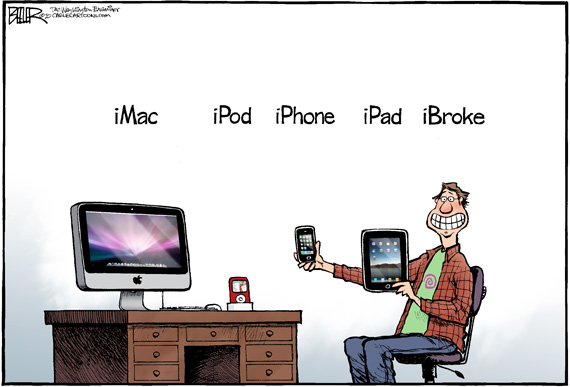
Two years ago, when the iPad was introduced, I said: “Google and MicroSoft can’t even copy genius.”

Vide licet:

With the iPad and its closed software universe, has Steve Jobs committed an unforced error — unnecessarily created an obvious opening for Google and MicroSoft to compete?

Today, Google says: “If you throw enough crap at the wall, sooner or later something’s gotta stick.”

Today, Microsoft says: “Pigs will eat anything.”

The revolution is not the technology.

This is the revolution: The consumer is now in charge.

Learn to love it — or get liquidated. PT Barnum’s day in the marketplace is done.

Wow… And you thought the gonophs at ReMax were mercenary…

Spam today from RealtyExecutives, which really used to matter in Phoenix:

I love the monthly fee with the huge, larcenous split. RealtyExecs actually invented the 100% commission plan. It was that idea that Dave Liniger spirited away to Denver, where he founded ReMax. He discovered right away that a 100% brokerage is a giant cash sink — for the broker — but, luckily, his minions in Canada figured out how to combine the 100% claim with a hidden 5% split. Liniger flies in a private jet today because his 100% commission brokerages are all actually split shops.

Still, $95 a month plus a 15% split is a little steep. HomeSmart will do you a monthly deal for twenty-five bucks plus E&O. But before its ignominious bankruptcy, RealtyExecutives was charging on the order of $750 a month — nine grand a year! — whether you closed anything or not. In the interim, a whole lot of Big Names have moved from RealtyExecs to HomeSmart.

I love the rest of the ad, though: 78% of RealtyExecutives’ agents made less than six figures in 2011. And if the average agent closed 12 deals, that suggests that a whole bunch of those agents sold five houses or fewer last year.

And to think: You could be an “executive” too!

Debunking Artificial Intelligence — while programming your computer to be almost as smart as your dog.

Everything you’ve been taught about Artificial Intelligence for your whole life is false. AI researchers are not frauds, I don’t think, but they’re exuberant when they talk to reporters, and the reporters are ignorant, thoughtless and brash. In real life, AI is Siri, which can reliably lead you to the nearest closed-down super-market. In your imagination, AI is C-3PO, who can lecture you on Chinese lithography while clobbering you at backgammon.

This is the truth — and telling the truth about AI is as rash as telling the truth about Anthropogenic Global Warming or abortion, an incitation to a frothy wrath: There is no Artificial Intelligence anywhere — nor will there be any time soon, if ever. This is a case where new theory really is required. The theories currently being deployed in AI research will produce ever-more-competent Siris — which achievements will be hailed as “proof” of Artificial Intelligence — but they will never produce any actual intelligence.

Why? Ontology and teleology, of course.

AI fails because it is not actually attempting to model intelligence but simply to mimic the effects of intelligence. In this respect, AI is a cargo cult, and its argument of “proof” is the same as that of any cargo cult: Post hoc, ergo propter hocafter this, therefore because of this. If the destination turned out to be a super-market, even if it’s a bankrupt super-market, then Siri is “intelligent.”

Just that much is an error of identification. When you play chess against your iPhone, this is not “man versus machine,” it’s you versus a team of programmers — and they’re cheating, which is how they win. If you could pop out to do 50,000 pre-programmed calculations per move, you’d kick their program’s ass.

It is that error of identification that produces all the absurd AI claims in the popular media: Someone is doing something differently! It must be a miracle! So far, there is nothing in AI that cannot be adequately explained as human ratiocination. The fact that software is written in advance does not mean that the process is driven by anything other than human intelligence. The Read more

Building the perfect beast: A round-up of my recent technology posts.

Caveat lector! The words you are about to read are unvetted, unhomogenized and unlicensed. One of my longer-term projects is to write essays on reasons why you should dismiss the things I have to say. I’ve only done two so far: You should dismiss me because I don’t care if you do and because I can see right through you. There are zillions more reasons, whether I get to them or not, but the one that matters most, in this context, is this one:

I am completely without credentials.

That’s a statement I could quibble with, but I don’t want to. There is no limit to the caviling to be found on that road, and I don’t care, anyway. I am writing about tools that could and should exist, and if you want to dismiss what I have to say because I don’t fit your profile of a nerd — so much the worse for you. The world is awash in a billion blends of stupid, and credentialism is hardly the worst of the bunch. Looking outside yourself for your intellectual self-defense is the parent of that error, though, and that one is deadly.

Whatever. I think these ideas are fun. I’m looking at a much bigger picture, philosophically, but the technology I’m talking about here is a way of effecting those larger ideas in everyday life. You might plead for better organization — and, truly, there is a book scattered around in this stuff — but I believe reading these essays will repay your effort.

< ?PHP include ("https://www.bloodhoundrealty.com/BloodhoundBlog/TechBackStory.php"); ?>

 
There’s more. Here are the essays I wrote about the iPad, at the time of its introduction. Entries #2 and #8 are the best of the bunch, in my opinion.

< ?PHP include ("https://www.bloodhoundrealty.com/BloodhoundBlog/iPadObservations.php"); ?>

That’s a lot of reading, I know, but what else are you going to do with your time — watch football?

Q: Your smartphone has just been stolen. What should happen next? A: Your phone should get the cops on the horn and lead them to the thief.

Here’s the truth of your life: Your so-called smartphone is pretty damned dumb. For one thing, it’s always interrupting your work with phone calls, wiping out whatever screen you happen to be working on. It does this because Steve Jobs, genius though he was, never quite wrapped his head around the idea of the cell-phone function as just another arrow in the quiver of your smartphone’s capabilities. What you actually want, when your phone rings while you are working at something else, is notice that you can drop everything to take the call — or not — without the phone making that decision for you.

I can do more: There is no reason for caller ID to be as stupid as it is. I want Heidi, of course, a full-blown database look-up when a new caller shows up on my phone. But lacking that, a truly smart smartphone would at least Google the number and display whatever information that search suggests about the caller.

But once we’ve gone that far, we get to an important question: Why is your smartphone shipping phone calls to you as phone calls? Data is data, and there is no longer any hardware or software reason to transmit phone calls by Ma Bell’s antiquated protocols. There may be cost or efficiency reasons, but it remains that a file-server-based “switchboard” could be a whole lot smarter than present-day cell-phone vendors seem to be. A lot of the Constance the Connector ideas would be best implemented on a truly smart phone system — one that pre-manages your calls before anything in your pocket sets off a racket.

But here is an entirely new way of thinking about smartphones, one that lets me solve a problem Jim Klein threw my way way back in the last century: Your phone can manage your online security better than any other means devised so far. With the right hardware and software, your phone, together with Sarah and Constance, can manage all of your financial transactions with perfect security and impenetrable encryption. Your phone can identify you — by way of your Constance profile — to Read more

How to solve the video multiplexing problem you didn’t know you had.

I love this news story, an exposition of the Supreme Court exposing its irrelevance:

In an entertaining hour-long episode, Supreme Court justices on Tuesday considered the government’s power to regulate expletives and nudity on the airwaves.

Why is this amusing to me? Because along with many other twentieth-century electromagnetic phenomena, broadcast television is dead.

Every word in that claim is important. “Television” — meaning audio/visual content primarily intended to entertain — is still with us, although it is likely to merge with other forms of on-line content.

But “broadcast television” — TV transmitted over the airwaves, one sender, many recipients — is a dead-letter today, and it will be progressively less important — and progressively less profitable — with every passing year.

The reason is simple: The future of entertainment is iPad-style video:

The iPad is the ultimate perfect television. On-demand. Stop and start at will. Goes with you when mom says you have to go to soccer practice. The iPad is the perfect entertainment-consumption device: Personal, portable, programmable — and infinitely extensible.

You may watch this video content on a device as small as your phone or your wrist-watch or on one as big as your living room wall, but this is the future of video in your life.

Broadcast — one-size-fits-all, limited-choices, isolated in a frozen time-schedule, can’t stop it, can’t rewind it, no easy way to research or cross-reference it, stuck on one very stupid device, hag-ridden with commercials — all of that is dead. It was a kludgey business model when it was the best we could do. By now, it’s a dinosaur — so we should expect it to endure a loud but inescapable death.

Note, too, that your cable company’s very-stupid on-demand service is also headed for the morgue, as are slightly better on-demand services like Netflix. The future of entertainment video is your friendly neighborhood search engine — augmented by the kinds of software services I have been describing lately.

The reality of your life is that you are going to watch what you want, when you want, on whatever device you choose — and you are going to have many more devices to Read more


iPad observation #2: Find a bigger dead-pool: The iPad eats everything.

Kicking this back to the top. This is me, writing just after the introduction of the iPad — two very short years ago. At the time I wrote these essays, every so-called “expert” on the nets was insisting that the iPad was an unforced error. I was right, they were wrong. But I’ve been right about a lot more than I’ve seen in the marketplace so far. Note this, for example: “I hate the remote controls for electronic devices, and one thing we should insist on, going forward, is that every wired device in our lives should be IP-addressable and fully-controllable by internet connection.” It’s interesting to revisit these ideas now, to see where we’ve gotten — and to see how far we still have to come. –GSS


Real life at my house: We actually like to watch television, if watching TV means watching DVDs (lately almost entirely Netflix DVDs) or watching selected cable shows. This usually happens very late in the evening, usually when we’re pretty much exhausted.

But: TV at home used to be TV with laptops. Now it’s TV with iPhone. In six months, it will be TV with iPads — or just iPads on the sofa.

Take careful note:

Broadcast television is dead, as is broadcast radio. Let’s free up the bandwidth now. The iPad is the ultimate perfect television. On-demand. Stop and start at will. Goes with you when mom says you have to go to soccer practice. The iPad is the perfect entertainment-consumption device: Personal, portable, programmable — and infinitely extensible.

As was inferable from my first observation in this series of posts, the annual Christmastime frenzy of cheap-shit electronic children’s “educational” toys is dead. Anything that anyone in your home does while laying stomach-down on the carpet will be done on the iPad.

As I pointed out the other day, Microsoft, Amazon and many, many other hi-tech vendors are dead. (I have a quality/integrity argument to make about this, as well, but I haven’t gotten to it yet.)

Despite the iBook store, books are dead. I love literature and I love the drama, but you don’t have to spend seventy-five bucks Read more