There’s always something to howl about.

Author: Greg Swann (page 47 of 209)

Suburban Phoenix Real Estate Broker

Reasons to be cheerful: Defying the specter of ugly fates.

I’m kicking this back to the top from June, 2010. I had occasion to re-read my thoughts on sex earlier today, and then I went back and looked at this essay. I like it better today than I did last summer, and I hope you will, too. –GSS
 

Reasons to be cheerful, part zero: The ground we stand upon is firm and the lever of the human mind grows ever stronger.

I need to take this someplace else. I am madly off-topic here more often than not, this for the past couple of years. I think I may be in the third act of this spectacle of ideas I have made of my life, and I can’t even say, yet, if it’s a farce in three acts or a tragedy in five. I would prefer an epiphany, to say the truth, a symphony, a grand opera composed of nothing but the simplest and most obvious of abstractions, an idiot’s guide to what every last idiot among us has always known forever, has never once doubted, and has always, always betrayed — until now.

But that’s why I’m cheerful, I think, despite everything. There is still so much time left to us, amidst the crush of on-rushing events. I am thrice lucky, I know it: I can see and I can understand what I am seeing. I can think and I can transcribe my thoughts. And I live in a time when the thoughts of everyone in human history who ever thought productively are instantly available to each one of us — on demand, no charge, quantities unlimited, with every taste in depth and rigor satisfied and then some.

This is an amazing thing. It’s never happened before, and it remains to be seen how deeply humanity is willing to set its roots in the boundless praries of the mind. But the simple fact that this is possible — and that people all over the world are taking advantage of it — is a profoundly important reason to be cheerful, no matter what despair might be unearthed in the day’s events.

Clearly, Barrack Obama is incompetent. That’s Read more

A practical governing strategy for the Republican party. It won’t happen, but at least it’s potentially doable, unlike everything else.

[Back to the top from November 3, 2010. –GSS]
 

Here’s what the Republicans won last night, most probably: The opportunity to be left holding the bag if the whole creaking kleptocracy crashes.

Here’s what they mostly can’t do, at least not right away: Cut spending or taxes. A huge and growing portion of the budgets at all levels of government are entitlement payments — a subsistence dole under various labels. We have taken a once-free people and turned it half-predator, half-prey — often with both halves living under one scalp, amazingly enough.

So what can Republicans actually do, right now, to deliver on their promises?

They can eliminate every form of business regulation, at all levels of government.

Civil court has always been more than adequate to deal with actual injury. Not coincidentally, statutory regulation is always anti-economic nonsense: Banning competitors (as with the real estate licensing laws), government make-work, monkey-see-monkey-do, superstition, ossified tradition, power lust, etc. If no one is getting hurt, what is being regulated out of existence is this: Human intelligence.

That’s significant for two reasons: We need for business people to get to work and to take a bunch of us along with them. If we decriminalize human intelligence, at least partially, it’s reasonable to expect to see more of it — to everyone’s benefit. But even without the innovations we currently forbid in many businesses and industries, business people need to be able to plan for the future. If they are constantly subject to a vast, unknowable array of ever-changing regulations, they will not take risks. This is news to no one.

So: I’m not talking about some kind of “temporary moratorium” on regulation. This is an old, old leftist dodge: If the cows start to look scrawny, let them fatten up a little before you take up the slaughter again. Alas, because Republicans often have no firmly-held philosophical principles, they fall for these stunts again and again — as with the Bush tax “cuts.”

No, what is needed is the complete eradication of regulation: Repeal the enabling legislation, pay off and dismiss the staff, liquidate the chattel- and real-property. (All of this will Read more

It’s not enough for the tea party movement to throw the bums out. To contain the federal government, we have to cut its powers.

[Back to the top from January 21, 2010. –GSS]
 

What a delight it is that the citizens of Massachusetts have risen up against the federal leviathan. All across the country, the tea party movement is furiously aboil, angry Americans anxiously awaiting the opportunity to pull some levers in a voting booth.

But if the current populist uprising is nothing more than yet another throw-the-bums-out movement, it will come to nothing. We threw the bums out good and hard in 1994, and yet the federal leviathan has done nothing but grow since then. By now the national government is so huge that it threatens to crush the nation and its people and productive plant beneath its enormous weight.

It is not enough to throw the bums out. To contain the federal government, we have to cut its powers. Nothing else will stop its long-term growth.

The United States was originally conceived of as a confederation of sovereign states. The states joined together for those common purposes that seemed to make sense to them, with each state retaining is sovereignty in all other matters.

That was the theory — the federal government was to be the hand-servant of the states. In practice, the federal government has usurped the power of the states from the very beginning, with the abuses becoming more bold and more comprehensive with each passing decade.

This turns out to have been a mistake — as we are discovering. Where each state is independent of all the others, each one can try different policies. The states can become the laboratories of democracy that the founding fathers envisioned.

But to achieve this, we will have to rein in the federal leviathan. The states and the people need to reassert their ownership of and control over the national government.

How? By constitutional amendment. Probably by constitutional convention, since it seems unlikely that sitting members of Congress will vote to circumscribe their awesome and terrifying powers.

But here, in a very short summary, is what needs to be done, if the head of steam built up by the tea party movement is not to be wasted. The text within the quotation marks Read more

A strategy for the Republican party that can actually win elections

[Back to the top from November 6, 2009. –GSS]
 

The national Republican party is riven by an insuperable internal contradiction.

Out of one side of their mouths, Republicans wish to portray themselves as tax cutters, red-tape slashers, champions of liberty fearlessly hacking away at the slimy tentacles of the leviathan state. Ignore for the moment that they’re spineless jellyfish when it comes time to cut, slash or hack; this is how they wish to present themselves.

Out of the other side of their mouths, Republicans offer American voters an alternate set of slimy tentacles for the same old leviathan. The state they promise to shrink will simultaneously promote a nebulous family values agenda and forbid abortion. Republicans will simultaneously dismantle the Department of Education and supplant ecosocialist indoctrination with theocratic indoctrination. The leviathan state will lose the power to ban cancer drugs but gain the power to ban rap records.

Things fall apart. The center cannot hold…

Whatever the Republican party seeks to be in the states, in the counties, in the towns, what it cannot be at the national level is the party of both smaller and larger government. It can’t because as a strategy it makes no sense, and it can’t because there is no common ground between the liberty-seeking Republicans and the theocracy-seeking Republicans. Those two wings of the party can only fly apart in the long run.

But: There is a way around this: The Tenth Amendment to the United States Constitution:

The powers not delegated to the United States by the Constitution, nor prohibited by it to the States, are reserved to the States respectively, or to the people.

If the national Republican party were to concentrate solely on shrinking the Federal leviathan to a strict adherence to the Constitution, devolving all of the usurped tentacular powers to the states to do with — or do away with — as they choose, the party could achieve these goals:

  • It would actually deliver on a promise, prompting universal amazement.
  • It would present to both of its contradictory wings the opportunity to achieve at the state and local levels what they cannot hope to achieve nationally.
  • It would result Read more

A demonstration of the value of VirtualOmniscience.com: “I don’t remember offhand what I was doing last Tuesday, but this does not automatically lead me to assume I was gang-raped.”

Ann Coulter gets a bad rap, I think. She is a demagogue, a dirty-pool artist, a Menckenesque presence in the public prints. But she is not a rhetor, a champion of pure debate. Rather, she is a satirist, and she is damn good at it. The shrieking she incites seems like so much group-glowering to me, whipped up, I expect, by people who know that a chorus of grievances, no matter how loud or plaintive, is not an argument.

Tonight she brings us a problem near-omnipresent video can easily solve: False accusations of rape:

Having showcased Jones’ original, false accusation in a 1,500-word article splashed across its front page, as soon as her story unraveled, the Times stared at its shoes and said nothing. In another six months, liberals will once again be citing Jones’ case as evidence of the “troubling trend” of sexual assaults among military contractors.

If only Jones had accused Bill Clinton or any member of the Kennedy family of rape, the mainstream media might have treated her allegations with a little more skepticism. But she accused employees of a company with a tertiary, long-ago, six-degrees-of-separation relationship with Dick Cheney. This was no time for journalistic integrity.

Still, wasn’t it the tiniest bit suspicious that Jones claimed KBR management responded to her rape claim by locking her in a shipping container?

Why would a company that already had a PR problem stick its neck out to protect accused rapists? Isn’t it more likely that a corporation would sell out even innocent employees accused of rape? Wouldn’t it have occurred to them that she’d eventually get back to the U.S.?

None of this could happen if there were video cameras everywhere and on everyone, and if the captured video were stored forever. No need for visual interpretation or database mining. Just a permanent record of everything that happens, for anyone to view in real time or review later. This is the omniscience we have always wanted from our gods, the irrefutable information necessary to correct injustices. But by making it an omni-omniscience — everyone has the capacity to observe anything they want to see — Read more

iPad observation #8: The death of mediocrity and, along with it, the death of contempt for the consumer

I’m kicking this back to the top from February of 2010, when the iPad had just been announced. In another of the posts in this series, I wrote: “The implication of a computer that can train its end-users how to use it is that teaching as a profession is dead. All teaching, at all levels. Just imagine what the iPad could do for you if you really wanted to learn a foreign language…” Technology is giving us the power to disintermediate vast numbers of state employees. No telling if we will actually do it, but it is by now eminently doable. This essay addresses that kind of disruption in the Rotarian Socialist marketplace. –GSS

 
I don’t know if I’m ready for this yet, but I need to get it out there where I can take a look at it. Discursive prose is thinking, first, not communication, and this is a big idea. It’s possible I’ll have to return to it again and again to make it completely pellucid, but I promise to do my best today.

So: One of the events the introduction of the iPad foretells is the death of mediocrity in the marketplace, and, along with it, the death of the kind of endemic contempt for the consumer that results in mediocre products and services.

Why would this be so? We’ll get to that, but indulge me long enough to discuss what is — the world as we live in it now — before we take up what is to come.

Why doesn’t the caps-lock key work properly on any Windows keyboard? When you have the caps-lock key down and you then type the “a” key while holding the shift key down, why do you get an “a” instead of an “A”? Surely when you typed shift-“a”, what you wanted as an “A”, not an “a”. Why has this always been broken on all Windows machines, and on all DOS machines before that?

The answer to those questions is quite simple. It’s because Microsoft has never once cared enough to get this right. It’s been wrong for decades in Windows, right for decades on Read more

Get rich fighting crime! Save the girl — and make big money doing it — by correcting one simple error in your thinking.

The pitch…

That’s a sweet offer in the headline, don’t you think? It’s like Batman meets Ironman, but it’s all real — achievable now, no super-human powers required.

Not enough? You want more?

How’s this?

I can show you how to all-but-eliminate every sort of street crime.

I can show you how to protect any real estate or personal property you own from theft, mayhem, mishap or from simple maintenance oversights.

I can show you how to resolve almost every kind of civil dispute — without courts, without attorneys — and usually without rancor.

I can show you how to perfect your sales praxis to an amazing state of efficiency.

Hell, I can even increase your chance of successfully hooking-up at the singles bar.

I can cut your commute time, maximize your work-day productivity and save you from getting Aunt Whatshername’s name wrong when you see her.

Watch me: I can show you how to create a brand new trillion-dollar industry that will spin off dozens of start-ups as it is aborning and hundreds more later on.

I can show you how to mine an incredible new source of vast, uncountable wealth, a source no one has ever thought of before. I can put you there, at the dawn of a new age of human productivity — a pioneer, a prospector, and ultimately a tycoon in a brand new way of making money.

As you gaze upon that incredible motherlode of riches — knowing that there are unfathomable trillions more buried within it — I have one simple question to ask you:

To gain access to those riches — no fear of crime, no more petty lawsuits, better closing skills on and off the job, plus hundreds of new businesses, each one throwing off astounding new opportunities — would you be willing to correct one simple error in your thinking?

Are you willing to consider the proposition? Stay tuned…

 
The moth, the cat and the ontological nature of error…

Oh, good grief! Was there a fifty-cent word in that subhead?

There was, alas.

The good news is that, if you can hang in there, and if you have the guts to change a fundamental error in your thinking, I Read more

In the land of the free it might be too hot to go up (in flames) on the roof, but it’s always cool when you have an air conditioner cosy.

Since becoming a property manager in March, I’ve added some new hats to my collection: I am, like it or don’t, a bill collector and a tax collector. As of today, I am on the road to becoming an evictor, as well. I’m phlegmatic about all of this. I may not love those roles, but I freely contracted to take them on, and I have done them creditably, I think. Even so, I’m in the mood for a palate cleanser.

So: Here are some real estate photos I took this week:

Can’t figure out where to store those pesky spare gas cans? The whole roof is just sitting up there empty. We might-could build a dog run up there, too!

New in Phoenix this week: The official Aunt Fannie and Uncle Freddie® brand air conditioner cosy. It’s the perfect closing gift, but why wait until Close of Escrow to buy it?

However: Style is style and fashion is fashion, so here’s a somewhat different look:

Form follows function. If we can’t put looters in jail, we have to put ourselves and our things in jail instead. But that doesn’t mean we can’t put gas cans on our roofs, dadgummit! This is still a free country, after all…

Well.

That doesn’t feel much better…

Here’s The White Stripes to change the subject entirely:

What’s the song about? It’s a break-up song, but we read it as a discussion of the most enthralling real estate of all.

And now I feel better.

Do you want to know how cool ARMLS could be? Sell it as a business and see what someone who is working for money can do with it.

Here’s a true fact of life: Not-for-profit “businesses” suck. Don’t believe me? We’ll discuss it after you get back from the Department of Motor Vehicles.

To be fair, I’m willing to regard the Arizona Regional Multiple Listings Service (ARMLS) as something of an exception, at least as administered by Bob Bemis. Under the last guy, it was run like the Mayberry Jail. This was not entirely a bad thing for me at the time, but it was nothing at all like a business. And the Bemis ARMLS is no business, even now, even if it is significantly more efficient — which is not entirely a good thing for me now, alas.

But: ARMLS is a sleepy not-for-profit fiefdom that has been thrust by fate into the data-processing business. As an MLS, it’s not awful. But as a data-processing business — it sucks!

Why? For the same reason every other not-for-profit “business” sucks: Profits and losses are the guideposts to customer satisfaction in business. Without them, a not-for-profit “business” cannot ever hope to achieve customer satisfaction — which is not to imply that most of them are even trying.

Here’s the news, by way of Inman: ARMLS, now owned by four Phoenix-area Realtor associations, is to be sold for $4.75 million to the Arizona Association of Realtors instead.

First, metropolitan Phoenix Realtors will be robbed of an extremely valuable asset, and then all the other Realtors in the state will subsidize us hotshots in Phoenix, but that’s all just good old-fashioned Rotarian Socialism, to be expected from any crime syndicate with “Association of Realtors” as a part of its name.

And, as you might guess, the grand plan is to create a statewide Arizona MLS, so every neck can be conveniently strangled with one noose. ARMLS über alles.

But that’s all just the garden variety stupidity we expect from any not-for-profit “business”. We know from organizational theory that every sort of “service” organization comes to be a force of evil deployed against its own supposed “masters”. Do you disagree? Clearly you’re not spending enough time trying to renew your driver’s license.

I like Bob Bemis, along with the people I Read more

From sunny Phoenix, a love letter to the summer heat…

I wrote this four years ago at DistinctivePhoenix.com. Given all the pissing and moaning going on nationwide about — get this — summer weather, I thought I’d give you a taste of what real heat feels like. –GSS

We’re in negotiations to list a house in the Coronado Historic District of Downtown Phoenix. The temperature hit 110 this week, and the seller has determined he would rather live elsewhere.

If you live anywhere but in the Desert Southwest, 100 degrees probably sounds unbearably hot to you. Eight-five degrees is hot. Ninety is a scorcher. Ninety-five is intolerable. One hundred degrees is the stuff of “you don’t know how lucky you kids have got it” family legends.

I have news for you. In Phoenix, we might see a 100 degree day as early as March. Once those temperatures arrive in earnest, we will go for 100 days with 100-degree-plus temperatures. How much plus? The hottest day on record was 122, but 115 and above is not uncommon.

How can we stand it?

Well, for one thing, you get used to it. If you live here for three years, your blood will thin out. Summer will seem much easier to bear than you remember. But Winter will be a bear, particularly if you go back home for the holidays.

But for another, the people who stay here by choice just like the heat. It’s not all that pleasant getting into the car when the interior is 160 and the steering wheel is even hotter than that. But to step outdoors in the late afternoon, when the heat is at its absolute worst, to feel those irrepressible waves of warmth flowing in on the Western breeze, to see forever by the light of an unrelenting sun…

If you hate it, you hate it, and, like our client, you can’t live here for long.

But if you love it…

I rode my bike today. I went out at 10:30 in the morning, so it was only about 93 degrees outside. Shorts, tee-shirt, sneakers and my iPod, all on a mountain bike. We live along the Arizona Canal in North Central Phoenix. The canals are Read more

Regarding the Zillow.com IPO: “Since when is a seven year old company with really no large scale growth prospects that has lost money every single year on revenue less than $45 million/year worth half a billion dollars? Am I missing something?”

The question comes from a comment to a post at Seattle-based start-up blog, GeekWire. The news? Zillow.com is bumping the per-share price on its forthcoming IPO to as high as $18, up from the $12-$14 range it started with when the public offering was announced.

I like that question, because it parallels one of my own: What, precisely, can Zillow hope to do — other than provide big paydays for its VCs and founders — with $71 million in new funding? Which parts of the site will require that much build-out?

My take: The web-tech IPO craze that’s going on right now is just the next phase in the rape-the-rubes strategy Wall Street has pursued since internet start-ups came on the scene in the late ’90s. There is plenty of money to be made churning the stock of “businesses” that, in the end, all amount to MySpace.com — all hype, no actual value.

What’s the name for that phenomenon…? Oh, yes — a bubble.

The good news: Cynthia Pang Nowak, formerly Redfin.com’s queen-bee PR geek, is now signed on with Zillow. While she may be both the smartest and most breathtakingly beautiful woman on the Puget Sound, it remains to be seen if she can answer the BloodhoundBlog question: What would David Gibbons do?

Meanwhile, GeekWire.com deserves your daily attention. Run by Todd Bishop and John Cook, formerly the start-up reporter for the Seattle Post-Intelligencer and a long-time friend of BloodhoundBlog, it’s kind of like TechCruch in the rain — but without the bluster and hyperbole. The daily email digest is quick way to keep up with the wired side of our world.

But: Am I all wet? Does Zillow.com look like a buy to you at $18? Can it go to $36? To $180? To $0.01? I like the people who work there, and the founders have been very good to us from the beginning. But I’ve never seen the value of Zillow.com, except as an advertising play, and I still don’t. As with the comment quoted above, am I missing something?

Just how carefully chosen was The Chosen One?

Angelo Codevilla, who brought us last year’s stunning essay, America’s ruling Class, is back again with an attempt at filling in the many, many blank pages in Barrack Hussein Obama’s back-story:

In our time, asking how a young man of scarce achievement got into position to win the Democratic Party’s nomination for president courts the contemporary synonyms for “impious”: “birther,” “conspiracy theorist,” and, of course, “racist.” Granted, to inquire into what formed a president is not as important as to understand what he does. Nevertheless, because fully to know where anyone is going requires grasping whence he comes, let us open ourselves to wonder how, minus miracles, a 10-year-old boy without obvious talent who had lived in Indonesia since age six ends up with an eight-year scholarship to Hawaii’s most exclusive school; a scholarship to Occidental College; a transfer into Columbia University; acceptance into Harvard Law School, and editorship of its law review; and how he goes from job to prestigious job without apparently mastering any of the previous ones. No wonder some of Barack Obama’s supporters treat him as if he were anointed by an extraterrestrial power.

No less an object of awe and curiosity is the seamlessness of Obama’s mentality. Without marbling or inconsistency, it is serviceable as a definition of contemporary American leftism, and leads one to wonder what earthly environment could have produced such a pure specimen.

Intellectually, Obama has always been a consumer, having left no record of formulating new ideas or of penetrating old ones. Politically, he is a follower and figurehead: having grown up in the ever branching stream of socialist voluntary organizations, he surfed its leftward eddies, never forming or leading a faction. He was handed a safe seat in the Illinois state senate, a nearly safe one in the U.S. Senate, and was surprised when Harry Reid informed him that influential Democrats wanted to run him for president. The Democratic campaign of 2008 pushed against an open door. As president, he rides his party’s center of gravity.

In short, Barack Obama himself is not that remarkable. He can give a rousing political speech, of course, but Read more

Wired: “Kinect Hackers Are Changing the Future of Robotics.”

A fascinating story about open source programmers deploying Microsoft’s Kinect hardware in amazing off-label applications.

From Wired magazine:

For 25 years, the field of robotics has been bedeviled by a fundamental problem: If a robot is to move through the world, it needs to be able to create a map of its environment and understand its place within it. Roboticists have developed tools to accomplish this task, known as simultaneous localization and mapping, or SLAM. But the sensors required to build that map have traditionally been either expensive and bulky or cheap and inaccurate. Laser arrays cost a few thousand dollars and weigh several pounds, and the images they capture are only two-dimensional. Stereo cameras are less expensive, lighter, and can construct 3-D maps, but they require a massive amount of computing power. Until a reasonably priced, easier method could be designed, autonomous robots were trapped in the lab.

On November 4, a solution was discovered—in a videogame. That’s the day Microsoft released the Kinect for Xbox 360, a $150 add-on that allows players to direct the action in a game simply by moving their bodies. Most of the world focused on the controller-free interface, but roboticists saw something else entirely: an affordable, lightweight camera that could capture 3-D images in real time.

Within weeks of the device’s release, YouTube was filled with videos of Kinect-enabled robots. A group from UC Berkeley strapped a Kinect to a quadrotor—a small helicopter with four propellers—enabling it to fly autonomously around a room. A couple of students at the University of Bundeswehr Munich attached a Kinect to a robotic car and sent it through an obstacle course. And a team from the University of Warwick in the UK built a robot that had the potential to navigate around post-earthquake rubble and search for trapped victims. “When something is that cheap, it opens up all sorts of possibilities,” says Ken Conley of Willow Garage, which sells a $500 open source robotics kit that incorporates the Kinect. (The previous non-Kinect version cost $280,000.) “Now it’s in the hands of just about anybody.”

Robot freaks weren’t the only people to explore the Read more

Wall Street Journal: “A home is a lousy investment.”

Ahem: “Today’s young people would be foolish to imitate their parents and view ownership as the cornerstone of personal finance.”

From the Wall Street Journal:

At the risk of heaping more misery on the struggling residential property market, an analysis of home-price and ownership data for the last 30 years in California—the Golden State with notoriously golden property prices—indicates that the average single family house has never been a particularly stellar investment.

In a society increasingly concerned with providing for retirement security and housing affordability, this finding has large implications. It means that we have put excessive emphasis on owner-occupied housing for social objectives, mistakenly relied on homebuilding for economic stimulus, and fostered misconceptions about homeownership and financial independence. We’ve diverted capital from more productive investments and misallocated scarce public resources.

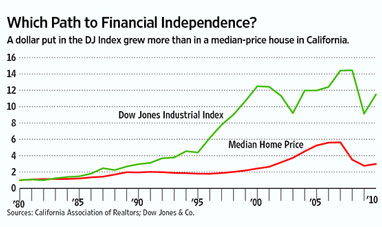
Between 1980 and 2010, the value of a median-price, single-family house in California rose by an average of 3.6% per year—to $296,820 from $99,550, according to data from the California Association of Realtors, Freddie Mac and the U.S. Census. Even if that house was sold at the most recent market peak in 2007, the average annual price growth was just 6.61%.

So a dollar used to purchase a median-price, single-family California home in 1980 would have grown to $5.63 in 2007, and to $2.98 in 2010. The same dollar invested in the Dow Jones Industrial Index would have been worth $14.41 in 2007, and $11.49 in 2010.

No need to pass these facts along to the National Association of Realtors. They already know.