There’s always something to howl about.

Author: Greg Swann (page 60 of 209)

Suburban Phoenix Real Estate Broker

Per-capita wealth and poverty in a given political economy is strongly correlated both with economic freedom and oppression and with the perception of integrity or corruption among government officials.

Countries that pursue policies of economic freedom have rich populations. Countries that obstruct free enterprise have poor populations. The relative wealth or poverty of a given population is strongly correlated with and can be readily predicted from the level of economic oppression in that political economy. This is easily understood from Austrian and Classical economic theory, but it’s stunning to see how relentlessly the theory is borne out in the real-life experiences of the countries of the earth:
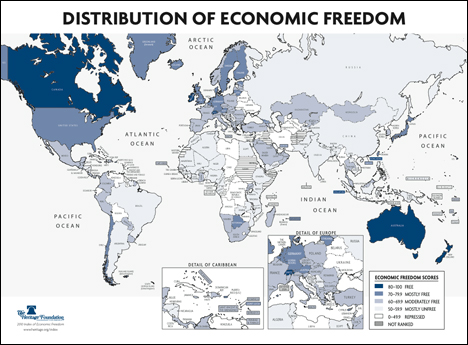
This map is from The Heritage Foundation’s Index of Economic Freedom.

Interestingly, relative wealth and poverty are also very fairly correlated with perceptions of the local population of the integrity or corruption of government officials.
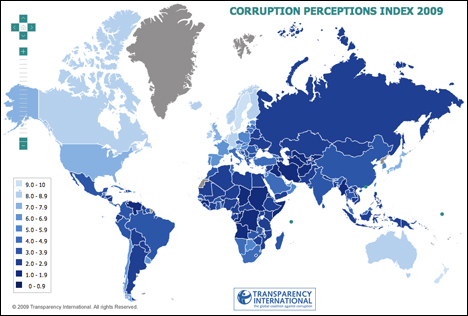
This map is from Transparency International’s Corruption Perceptions Index.

What’s especially striking is to look at the two maps together: Government corruption is correlated with economic oppression. This is not really surprising, but it seems to tell us everything we need to know about wealth and poverty: The closer a given country is to being a slave-state, the closer to starvation the people of that country will be.

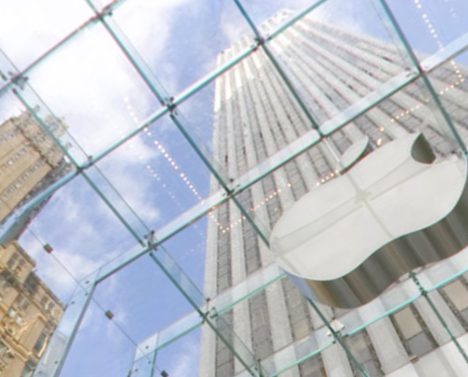
Apple HTML5 demo: “Standards aren’t add-ons to the Web. They are the Web.”

Last week, Don Reedy talked to us about the cool stuff Apple is doing with HTML5 on the iPad. Unchained alum Scott Gaertner followed up with me to talk about the possibility of doing the kind of content we do as single-property coffee-table books, only expressing that content on the iPad like the issue of Sports Illustrated Don had cited.

Take a look at this Apple HTM5 demonstration site. In seven very quick demos, Apple illustrates all the cool things that can be done on the web using only HTML5, CSS3 and Javascript. The photo above was clipped from a live virtual-reality demonstration.

I’ve been talking to Cathleen a lot about the computer science paradigms behind this technology shift. It’s a big deal, actually, but Apple has been careful to sugar-coat it. Perhaps I’ll make a short video detailing what is going on.

The HTML5 demo requires the latest version of Safari, either desktop or mobile. Windazoids can play, too, by installing Safari. The rumor is that Safari 5 will be released this week, so there could be some more cool technology still to come.

How Socialism makes beggars of free people: “The predictable result of these efforts at preventing the exploitation of man by man was the collapse of production, pauperizing an already poor country.”

Theodore Dalrymple reflects on how the imposition of a Marxist redistributionist policy impoverishes what had been a self-sustaining economy:

I next spent a few years (1983 to 1986) in Tanzania, a country that presented another experiment in treating poverty as a matter of maldistribution. Julius Nyerere, the first—and, until then, the only—president, had been in charge for more than 20 years. His honorific, Mwalimu—Teacher—symbolized his relation to his country and his people. He had become a Fabian socialist at the University of Edinburgh, and a more red-blooded one (according to his former ally and foreign minister, Oscar Kambona, who fell out with him over the imposition of a one-party socialist state) after receiving a delirious, orchestrated reception in Mao’s China.

One can say a number of things in Nyerere’s favor, at least by the standards of postindependence African leaders. He was not a tribalist who awarded all the plum jobs to his own kind. He was not a particularly sanguinary dictator, though he did not hesitate to imprison his opponents. Nor was he spectacularly corrupt in the manner of, say, Bongo of Gabon or Moi of Kenya. He was outwardly charming and modest and must have been one of the only people to have had good personal relations with both Queen Elizabeth II and Kim Il-sung.

Nyerere wished the poor well; he was full of sympathy and good intentions. He thought that, being so uneducated, ignorant, and lacking in resources, the poor could not spare the time and energy—and were, in any case, unqualified—to make decisions for themselves. They were also lazy: Nyerere at one point complained about the millions of his fellow countrymen who spent half their time drinking, gossiping, and dancing (which suggested to me that their lives were not altogether intolerable).

But Nyerere knew what to do for them. In 1967, he issued his famous Arusha Declaration, named for the town where he made it, committing Tanzania to socialism and vowing to end the exploitation of man by man that made some people rich and others poor. On this view of things, the greater accumulation of wealth, either by some individuals or Read more

The first word in “free enterprise” is “free” — how economic fallacies are deployed to frustrate human liberty.

In a comment to my post on the NAR’s most recent attempts to rape the taxpayers, Michael Cook set forth a number of subtle economic fallacies. I am not picking on Michael. He is simply repeating Marxist propaganda that is ubiquitous, more’s the pity. But I thought it were well to take these claims apart, to illustrate how these kinds of fallacious arguments are used to frustrate human liberty. I’m taking this to a separate post because the comments thread on the original post is already wildly off topic.

So: Start here, quoting from Michael’s comment:

The very capitalist machine everyone here loves was bolstered by the use of slaves.

This is simply false, not alone simply by definition. The first word in “free enterprise” is “free.” Transactions in a free economy are always mutually-voluntary. If someone is being coerced, what is occurring is a crime, not an honest trade. Every modern economy we can speak of is in some way a form of socialism — a criminal conspiracy harnessing the power of the state to advantage certain people at the expense of the others. Slavery is of a piece with this pattern, although it predates modern economies by many millennia. Moreover, it was the free enterprise that was suffered to exist under modern Rotarian Socialist governments that finally rid the civilized world of chattel slavery. To be fair, this miracle was effected not by a moral awakening but simply because slavery is a lot less efficient than is investing wisely in fixed and human capital. In any case, slavery and free enterprise are mutually-exclusive phenomena.

History is wrought with takings back to the Egyptians, Roman and Greeks.

The same fallacious argument repeated, only this time with respect to land and portable wealth. Theft happens, but theft is not wealth creation. Consumable portable wealth quite literally turns into shit in no time. Mineral wealth and baubles can retain their exchange value, but these are static values. It is not possible to cultivate stolen gold or rubies. And stolen land or livestock is only productive of future wealth by means of intelligent husbandry.

Neither of these crimes — Read more

Unchained melody: Seven nights in Eire by Reckless Kelly

The video is not just visually bereft, it’s also riven with misspellings. But the song is great fun, most appropriate for a Friday evening.

Here is a Pandora radio station built from the Reckless Kelly style of alt.country — rock ‘n’ roll instrumentation with rich saw-tooth voices lamenting intricately-detailed tragedies. This is what country music can and should be, when it’s not trying to sell beer and tampons. This is good art — pure, simple, brutal.

Bubba cools out in the cold

A Ramblin’ Gamblin’ Willie story

News is not my thing, but sometimes it falls into your lap.

That’s what Bubba did — literally.

He was half in the bag and he stumbled and tripped and landed his sloppy self right on me.

For a while he just laid half across my lap, grinning stupidly at the sky, his arms flailing, directing traffic for the stars. He looked at me and his smile weakened. He said, “Ain’t this the shits?” Then he belched. The smell was… unforgettable.

He sat up and slouched on the bench on his own weight, throwing his arm across my shoulder like an old friend. His bouffant gray hair was a mess, finger-raked into deep furrows. The skin of his face was a greenish white and it hung on him like an old sheet. Like the last time I saw him, he was wearing a pink chenille bathrobe embroidered with the initials ‘HRC’. His pockets were stuffed with paper tissues and Big Mac wrappers.

I had been watching him for a while. It was a cold night and I was bundled up on a bench in Lafayette Park, across from the White House. There were news crews camped out over there, of course, and Bubba had been wandering from crew to crew, trying to get someone to pay attention to him. He had gone through the Mood Cycle of the Mentally Adrift: Bravado, self-effacement, supplication, disturbingly plaintive supplication, anger, rage, distressingly uncontrolled rage, resignation and finally a good-humored kind of drunken aplomb. It was in this frame of mind — fatalism amused by its own futility — that he landed in my lap.

“Gotta laugh, don’tcha’?” He hiccoughed.

I shrugged.

“Sure you do! You can run, but you can’t hide! My ol’ granddaddy usta say that. O’ sinner man, where you gonna run to? They made me sing that ol’ hymn ever’ Sunday, and I usta just smile behind my hymnal. I thought I knew better. Right up to the bitter end, I thought I knew better.”

I said nothing. I really, really wanted Bubba to take his arm off of my shoulder.

So of course he pulled me Read more

Mary Canary on her way to feed the pigeons

A Ramblin’ Gamblin’ Willie story

“I married myself a quiet man. He told me so himself, many times. When he was drunk, he’d shout it to the world.”

Mary Canary said that. She says stuff like that just to make sure no one’s listening. And no one on the bus was, no one except me.

And Mary Canary is not her real name. It’s Maria Carnase, and I had to work on her quite a while to get that out of her. She’s not quite homeless, not quite penniless, not quite elderly and only mildly odorous. She’s bone thin and desiccated, and her flowered tent dress fit her like a tent. Her hair is not quite white and she wears it under a net. She had on cheap sneakers and compression hose bunched up at the ankles; seemingly, there was no flesh on her legs for the hose to compress. She has a bus pass and a mission. The bus pass is paid for by the taxpayers, but the mission is all her own.

“I like the sound of a pedal steel guitar. It makes me think of a cat curling up for an ear-scratching.”

A college girl with a black ponytail stared hard at her paperback book. An office geek whistled softly through his teeth and looked every which way except at Mary Canary.

“When it gets too quiet, I can barely hear. I can’t hear myself sigh for the roar of the silence.”

A very tall, very thin black man got up and walked to the front of the bus. He stood hanging from a pole as if he were about to get off, but he didn’t.

“If I look behind my eyes, I can see the naked face of god.”

A portly little man who had gained a pound or two since he’d bought his suit adjusted and adjusted and adjusted his necktie.

And Mary Canary said, “I think you’re noticing me.” She said that to me, of course.

“Yes, I am.”

“You’re not supposed to do that.”

“Why not?”

“Nobody does.”

I shook my head and smiled a gentle smile. “Everybody does. And you know it.”

She shook her head, too, but it Read more

Dear National Association of Realtors: How about you fetid, rotting pusswads do something patriotic and get off the taxpayer’s tit…?

To say the truth, I’m kindasorta liking the Tea Party movement — as far as it goes. I don’t think we’re at a turning of the tides — although I can at least hope that we might be before too long. Any sort of discussion of individual rights is a good thing, but it doesn’t do, I don’t think, to expect too much philosophically from these folks just yet.

Consider: The self-anointed “progressives” were committed, knowing Marxists who developed an incremental strategy for razing individualism in the United States and raising collectivism in its place.

By contrast, the Tea Partyites seem to me to be largely unconscious Marxists promoting a grab-bag of unconnected tactics generally aimed at temporarily delaying the “progress” of the “progressives.”

In other words, the true Marxists know what they want and the (sad-to-say) clueless Marxists portend, at least thus far, to be nothing more than a flat tire on the road to mass extermination — the unvarying end-consequence of Marxism.

That could change, but only if the Tea Party folks engage their battle philosophically and not just tactically.

How will we be able to tell when they’ve done this? One quick bellwether would be for them to get their hands out of the public till, to the extent that they can. I do understand that many people have so mismanaged their finances — at the behest of the “progressives” — that they can only remain alive by sucking on the taxpayer’s tit. That’s sad, and I would follow a different course in the same circumstances.

But many of the Tea Partyites accepting government checks could easily do without them. We’ll know they’re serious — are you listening Drs. Ron and Rand Paul? — when they publicly refuse to accept even one penny that has been stolen from innocent taxpayers.

That’s a debate for another day, though. Here’s a little something closer to hand. Today I was spammed by the professional sucktits at the National Association of Realtors entreating me to help them rape the taxpayers — again. Apparently, all human progress will be stopped cold if we do not continue to reward Class-A morons Read more

“If wind and solar power were practical, entrepreneurs would invest in it. There would be no need for government to take money from taxpayers and give it to people pushing green products.”

John Stossel on the phractured physics of “green” energy:

Maybe the electric car is the next big thing?

“Electric cars are the next big thing, and they always will be.”

There have been impressive headlines about electric cars from my brilliant colleagues in the media. The Washington Post said, “Prices on electric cars will continue to drop until they’re within reach of the average family.”

That was in 1915.

In 1959, The New York Times said, “Electric is the car of the tomorrow.”

In 1979, The Washington Post said, “GM has an electric car breakthrough in batteries, now makes them commercially practical.”

I’m still waiting.

“The problem is very simple,” Bryce said. “It’s not political will. It’s simple physics. Gasoline has 80 times the energy density of the best lithium ion batteries. There’s no conspiracy here of big oil or big auto. It’s a conspiracy of physics.”

Yes, Stossel is pop-science. You can only go so far with him. But this may be the only article you will see that explains why so many of the highly-touted environmentaloid “solutions” are pipe-dreams, based in wishful thinking and a math education that foundered on the shoals of Algebra. Read the whole thing.

Like bugs trapped in amber, take a close look at Rotarian Socialist cockroaches and the pusillanimous pissants who make them possible.

This is from today’s Arizona Republic:

Businesses that send employees door to door through Phoenix neighborhoods have jumped into the discussion over whether the city should require peddlers to be licensed before ringing doorbells.

Phoenix is the only major city in the Valley that does not require some sort of business license for door-to-door solicitors. In the past year, council members have been getting complaints about bad behavior by people who sell door to door.

On Tuesday, about 25 residents and business representatives gathered at the Phoenix Public Library’s main branch for the first of seven public hearings the city will hold on the issue.

Of course we need a new law. Why should fully-grown adults be expected to confront and respond to “bad behavior” without Big Brother to scare away the bad guys and Big Mother to kiss their boo-boos?

But wait. There’s more.

About half of those attending represented areas that are fed up with solicitors. The rest represented businesses that had a range of opinions on regulation.

This is a fact: Business “regulations” are written by and for the businesses putatively being “regulated.” They put the Rotarian in Rotarian Socialism. Hide and watch:

“We are in favor of regulation and monitoring of door-to-door solicitors,” said Magnolia Lee, who described herself as business consultant who represents a small group called Sales, Solicitation and Distribution United.

“There needs to be some sort of standard for professional and courteous conduct,” she said.

What’s the standard? Me-and-mine, not thee-and-thine. The “regulations” will advantage Lee’s clients by disadvantaging their competitors. This is the objective sought by all “regulation.”

But we’re not done yet:

Marc Scher, government relations director for the Phoenix Association of Realtors, said his group favors licensing people who ring doorbells to sell products but wants any new law to exempt real estate sales people seeking listings.

“Realtors have been going and knocking on doors and introducing themselves to their neighbors,” he said. “There has to be a differentiation between selling a product and a relationship.”

This would the the anti-dog-eat-dog rule, straight out of Atlas Shrugged. Steal the other guy’s dinner, but keep your mitts off mine! Makes you proud to be a Realtor, Read more

What caused the housing crisis? Perverse government incentives.

Form an academic paper by George Mason University Economics Professor Russell Roberts:

Beginning in the mid-1990s, home prices in many American cities began a decade-long climb that proved to be an irresistible opportunity for investors. Along the way, a lot of people made a great deal of money. But by the end of the first decade of the twenty- first century, too many of these investments turned out to be much riskier than many people had thought. Homeowners lost their houses, financial institutions imploded, and the entire financial system was in turmoil.

How did this happen? Whose fault was it? Some blame capitalism for being inherently unstable. Some blame Wall Street for its greed, hubris, and stupidity. But greed, hubris, and stupidity are always with us. What changed in recent years that created such a destructive set of decisions that culminated in the collapse of the housing market and the financial system?

In this paper, I argue that public-policy decisions have perverted the incentives that naturally create stability in financial markets and the market for housing. Over the last three decades, government policy has coddled creditors, reducing the risk they face from financing bad investments. Not surprisingly, this encouraged risky investments financed by borrowed money. The increasing use of debt mixed with housing policy, monetary policy, and tax policy crippled the housing market and the financial sector. Wall Street is not blameless in this debacle. It lobbied for the policy decisions that created the mess.

In the United States we like to believe we are a capitalist society based on individual responsibility. But we are what we do. Not what we say we are. Not what we wish to be. But what we do. And what we do in the United States is make it easy to gamble with other people’s money—particularly borrowed money—by making sure that almost everybody who makes bad loans gets his money back anyway. The financial crisis of 2008 was a natural result of these perverse incentives. We must return to the natural incentives of profit and loss if we want to prevent future crises.

The greatest risk of resurrgent statism is that we will forsake the unalienable right to the pursuit of happiness…

Arthur C. Brooks of the American Enterprise Institute in The Washington Post:

The new statism in America, made possible by years of drift and accelerated by the panic over the economic crisis, threatens to make us permanently poorer. But that is not the greatest danger. The real risk is that in the new culture war, we will forsake the third unalienable right set out in our Declaration of Independence: the pursuit of happiness.

Free enterprise brings happiness; redistribution does not. The reason is that only free enterprise brings earned success.

Earned success involves the ability to create value honestly — not by inheriting a fortune, not by picking up a welfare check. It doesn’t mean making money in and of itself. Earned success is the creation of value in our lives or in the lives of others. Earned success is the stuff of entrepreneurs who seek value through innovation, hard work and passion. Earned success is what parents feel when their children do wonderful things, what social innovators feel when they change lives, what artists feel when they create something of beauty.

Money is not the same as earned success but is rather a symbol, important not for what it can buy but for what it says about how people are contributing and what kind of difference they are making. Money corresponds to happiness only through earned success.

Not surprisingly, unearned money — while it may help alleviate suffering — carries with it no personal satisfaction. Studies of lottery winners, for instance, show that after a brief period of increased happiness, their moods darken as they no longer derive the same enjoyment from the simple pleasures in life, and as the glow of buying things wears off.

The same results emerge with other kinds of unearned income — welfare payments, for example. According to the University of Michigan’s 2001 Panel Study of Income Dynamics, going on the welfare rolls increases by 16 percent the likelihood of a person saying that she or he has felt inconsolably sad over the past month. Of course, the misery of welfare recipients probably goes well beyond the check itself. Nonetheless, studies Read more