There’s always something to howl about.

Category: Blogging (page 45 of 84)

Seven Days of the Dog: The regal, indomitable arrogance of a healthy, normal Bloodhound

This came in as a comment last night.

There is nothing wrong with wanting to be competitive and wanting to win, but, reading your posts the last few weeks, you ego is a little bit too big at times. Yes, you are a heck of a writer and you have one heck of a blog and you have assembled a heck of a team of contributors, but your ego is getting a bit cocky.

This is ad hominem, so it violates our comments policy, but I’m not averse to discussing the issue it raises in a general way.

Just not yet.

First, let’s address some general beefs I have with the world of real estate weblogging. You can regard this as an impromptu staff meeting of the RE.net, or, if you’d rather, as a Pompeii-like graffito.

Here’s one: I’m seeing more and more truncated feeds, and I am unthrilled about it. My entire purpose in using a feed reader is to aggregate everything I might want to see in one place. If I’m interested in what you have to say, I might click through to your site, but I don’t appreciate being forced to do so. I understand that you may be trying to boost your hard clicks, possibly to placate your advertisers, or you might be trying to frustrate sploggers. I don’t care. If you don’t capture my attention completely in the forty or fifty words you deign to show me, there is zero chance that I will click through to see if I might be missing something good. I can’t be that different from your target reader. You got ’em to subscribe. Now deliver the goods. Hoarding — for whatever reason — is the economics of the past.

(Near the subject, I had mentioned a long time ago (in a comment or somewhere) that I almost never do trackbacks. If for no other reason than that it offers automatic trackbacks and pingbacks, WordPress should be your CMS of choice for any weblogs you build (or migrate to) in the future.)

Here’s another beef: This came in as a comment to Real Estate Weblogging 101:

I think you Read more

Seven Days of the Dog: Carnival of the Bloodhounds

My father manufactures mens’ outerwear — overcoats, raincoats, jackets. He was with Windbreaker and London Fog for many years, but for the last couple of decades he’s been a private-label vendor: He supplies the goods, the designer or department store supplies its label. One year Consumer Reports reviewed mens’ raincoats and my dad took first, fourth and fifth place with the same raincoat. Different labels, different price points, same coat. The winner was sold by J.C. Penny for $99. Second place went to a $900 Aquascutum.

The Bloodhounds made a run at winning that decisively at this week’s Carnival of Real Estate, but judge Mike Simonsen was smart enough to see through us. I entered three times, and Kris Berg and Brian Brady entered from their home weblogs. A small demonstration of the volume at which we can howl, when we want to. These are the entries I know about (there may have been others from other BHB contributors):

Alas, we didn’t win, although all three of us were mentioned in Mike’s post.

Truly, you can’t win ’em all, but we have won the Carnival of Real Estate more than any other weblog:

Meanwhile, Michael Cook has won Read more

Seven Days of the Dog: BloodhoundBlog makes the short list

That’s the short list, not the short bus.

We are among the nominees for the Inman Innovator Awards — Most Innovative Blog category. These are the other nominees in our category:

Looks like somebody likes bubble blogs…

My own immediate reaction to our nomination is colored by three mental filters: First, I have a fundamental contempt for any sort of beauty contest. Second, I cannot stand the thought of not winning — decisively, by an incontestable margin — any competition I happen to find myself in. But third, I have no confidence that I will win any competition where the results are based on anything other than my own performance. If it’s an objective race, I will win by force of savage will. But I know from bitter experience not to put too much faith in subjective judges.

(I swear there are times that it’s like Fyodor Frolicking Dostoevsky inside my mind…)

Anyway, it doesn’t matter if we win. It doesn’t even matter to me if we get thrown out of the competition for insufficient obsequiousness. All that matters is that we kicked ass this first year of BloodhoundBlog — decisively, incontestably. Whatever the hell “innovation” might be in a real estate weblog, if it’s not us, it’s not worth worrying about…

Technorati Tags: , , , ,

The Carnival of Real Estate . . .

…is up at Altos Research Real Estate Insights. Plenty of great reading, including three posts from BloodhoundBlog contributors.

And… The Carnival of Real Estate Investing is up at The Flipping Pad. Michael Cook one with The Real Risk in Real Estate Flipping, one of the five posts he wrote last week that could have taken first prize.

Technorati Tags: , ,

Building an audience: Using blogging, social networks, email newsletters and viral marketing instead of SEO

“Brian Brady is that mortgage guy in the suspenders on the internet.”

bbGood or bad, that’s my brand on the internet. That goofy picture was taken at the Kodak Theatre in Hollywood on a free Kodak machine. I emailed myself the picture and have been using it for the past two years in all of my online marketing efforts. And while I’m not necessarily the best user of photoshop, I’m a pretty damned good viral marketer.

I met Rudy of Sellsius earlier this year and he said “You’re all over the internet.” I dropped my daughter off at school last month and one of her schoolmate’s parents said “I saw you on Zillow.” My neighbors have told me that they read my articles on MySpace. I organized a coup to take over the Trulia Voices section.

I guest author on BloodhoundBlog, NELA Live, Long Beach Real Estate Home, Sacramento’s Real Estate Voice and maintain an active profile and weblog on the Active Rain Real Estate Network. Lately, I’ve started experimenting on Gather.com.

To the untrained observer, I appear to be on an ego trip. To bloggers, I’m eschewing SEO for a viral marketing approach. I’m not going to wait for a customer to find me on the long tail search. I’m going to insert my goofy little suspenders picture in every imaginable place they might search for real estate related advice.

Does it work?

Well, I’ve received over 1,000 inquiries in the past 12 months from my efforts. Many are from borrowers, so my answer is, “Damn, Skippy, it works!” I’m slowly building up a database of people who have connected with me on the internet. My long-term goal is to have over 10,000 people in my permission-based email marketing database, receiving a newsletter each month. I’m at 1,012 today and I think I’ll be there in about 3-5 years.

Here are five tips to help you build an audience for your budding real estate weblog:

  1. Start an email newsletter. I use Constant Contact because I can send a newsletter which has a teaser for my blog articles. It costs about $40/month. You must be very careful to Read more

Greg Swann at the Southwest Real Estate Blogging Conference: Making locally-focused real estate weblogging work

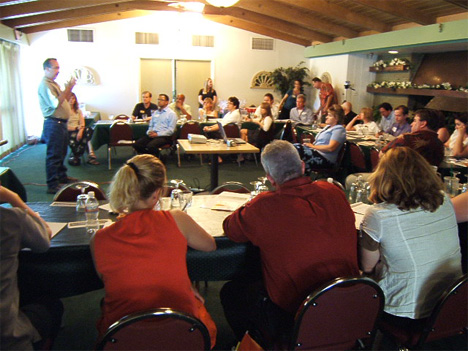
This is the second half of the Southwest Real Estate Blogging Conference, including my presentation and the question and answer session. The sun had started to go down, so the light in the room was a little better. Cathleen built the slides you’ll see in the video. I had handed out a bookmark to the people who came, and your very own virtual copy of that is shown above.

Buying Foreclosure Properties? Don’t Be the Early Worm…

The old adage “the early bird gets the worm” points to the advantage of being first to market. But, has anyone ever thought about the early worm, clearly he was not so lucky. Many of the people who are jumping into the foreclosure market now may be the early worms.

Typically, I am the first one to support jumping into a market that has sustained a significant decline in fundamentals and an increase in the foreclosure rate. The problem with today’s market is the lack of an exit strategy for this type of investment. Take Michigan for example, I luckily got out of this market in 2005 during a downturn. While I made a healthy profit, the investors who bought properties during that time are now the same investors in foreclosure.

The difference between the 2005 market and today is simply access to capital. Many foreclosure markets have two types of buyers. The most common buyers in these markets are low-income families looking to move into their first or second home. In the past these buyers were able to secure subprime or other credit neutral financing. With these vehicles gone or very hard to find, these buyers have been taken out of the market.

The other buyers in these markets are investors. Typically, savvier than families, investors like to get in for a bargain. Unfortunately commercial interest rates have been steadily rising and the prospect of moving these properties has been declining. The commercial interest rate directly affects the value potential of the property. Consider an increase in the commercial multifamily interest rate from 6% to 7.5%. On a $100,000 loan, that is about $100 a month payment increase. With rents holding steady in many markets, the investor will probably have to eat this increase.

Two to five years ago investors could simply rent a property out while waiting for a sale. That option has almost been taken away with the increase in interest rates. Additionally, having a renter in the property opened the buyer pool up further to cash flow investors. Now, the only investors left to turn to are the speculators, looking to Read more

Seven Days of the Dog: BloodhoundBlog is the real estate weblog to turn to for hard-charging hard news reporting

BloodhoundBlog is celebrating its first birthday this coming Friday, so I wanted to take a little time to highlight some of the best work we’ve done over the last twelve months.

There is a limit to how much primary reporting a real estate weblog can do. The webloggers are each stuck in one spot, for one thing, plus we all have day jobs.

But if we choose to, we can do exemplary work at evaluating new product releases. We’re end-users of the products we report on, so we already know what we like, what we don’t like, and what we wish were different. In our own particular case, BloodhoundBlog contributors like Brian Brady tend to go over new products in exhaustive detail, wringing out every conceivable facet and implication. We’re eager to know what the vendor thinks we’ll find in a new tool, but we’re even more avid to unearth the capabilities their software engineers had not foreseen.

So: Watch us work. Here are some of the breaking news posts we have generated over the last year:

The Real Risk in Real Estate Flipping

New investors rarely stop to address the subject of risk tolerance. People who have never done a single real estate deal see others making a lot of money in real estate and want to jump right in. They never stop to understand the true risks of real estate.

Most investors and books will tell you that real estate is a pretty safe asset class to invest in. This is certainly the case if you are buying core buildings or if you are employing a reasonable buy and hold strategy. Sadly, many investors hear safe investment and assume that opportunistic investing is just as safe.

If an investor is solely a real estate flipper, he/she is taking more risk than investing in the stock market. That might be a surprise to some, but consider the returns. On average the stock market returns 9-13%, while flippers should expect 15-20% returns on their capital investment.

This higher return is certainly accompanied by more risk. First, consider the fact that in the stock market your downside risk is typically capped at 20-30%. Very rarely does the stock market lose more than 10% in a given year. Additionally, a single blue chip stock is not likely to even have that kind of a loss. In contrast, a flipper has a very real chance of losing all of the money invested in a deal. The odds of this are even higher for a novice flipper.

Another aspect of real estate investing is the sweat equity or opportunity cost of the investors time. I can go into my E*Trade account in about two minute, buy a Dow Jones ETF (exchange traded fund), and essentially guarantee myself a 9-13% return on that money for 20 years. However, if I decide to flip property I either have to hire a property manager or I have to act as general contractor, organizing the work to be done. Either way, investors will still spend a tremendous amount of time working on site or dong something with the investment.

Taking Read more

Southwest Real Estate Blogging Conference: Notes from the epicenter


Jay Thompson, The Phoenix Real Estate Guy, making his presentation on real estate weblogging at today’s Southwest Real Estate Blogging Conference. Jay was fantastic, with one practical demonstration after another of the power of weblogging. Jonathan Dalton added some great insights from the sidelines, and the incomparable Dave Smith made the trek up from Tucson. I’ll have more tomorrow, along with video of Jay’s presentation and mine. In the meantime, Staging Arizona Real Estate has a report on the event.

More: Jay Thompson, Jonathan Dalton, Shailesh Ghimire.

Technorati Tags: , ,

Can an $8 Billion Private Equity Fund Affect a $1 Million Commercial Investor? It Certainly Can…

Addressing several people’s concerns about the state of private equity and the possible assertion that private equity could be the next fallout candidate, I thought I would look into this situation a bit more. For those of you who think that this discussion will be outside of the scope of commercial real estate investing, read on and I am sure you will be pleasantly surprised.

At the 8th Annual US Real Estate Opportunity & Private Fund Investing Forum several very important items of note were mentioned. The most significant item is the increase in fundraising efforts, which has moved up from $35 billion in 2005 to $60 billion in 2006. On the heels of that announcement, Morgan Stately Real Estate has just announced it has raised an $8 Billion fund designed to invest in Real Estate in established and emerging markets.

Before I discuss how these numbers will affect the common investor, I want to take a step back and clearly outline what a Private Equity Real Estate Fund or Opportunity Fund does. First, these funds begin by raising investment capital. The larger funds typically bring in money from pension funds, hyper wealthy individuals and governments all over the world. Then, they take these funds and make leveraged investments. An $8 Billion fund will probably invest in about $30 Billion worth of real estate. Investors typically expect returns of 12-20% based on the investment strategy and they expect to exit the fund within the span of 7-10 years.

These funds make a variety of investments. First, they typically invest in all major commercial property types (hotel, industrial, office, retail, and apartments) and minor ones as well (storage units, trailer parks, malls, etc.). Additionally, they may purchase Real Estate Investment Trusts, Mortgage Companies, Real Estate Services firms, etc. With $30 Billion to invest, any and all real estate investments are fair game.

Over the past 20 years the private equity industry has grown tremendously. While the major players (Blackstone, KKR, etc.) get all the headlines, many smaller private equity firms operate in lower tier investment categories. If KKR looks for Billion dollar deals, these firms will Read more

Real Estate Weblogging 101: A how-to book-in-weblog-form for would-be real estate webloggers

In commemoration of the Southwest Real Estate Blogging Conference, BloodhoundBlog today launches Real Estate Weblogging 101, a book-in-weblog-form about weblogging for real estate professionals.

The book is built as a WordPress weblog because it seemed foolish to me to write about a deep-linking medium without deep linking. Even so, I believe this is the first time WordPress has been used to publish a book. It seems plausible to me that dead trees are a dead letter, so this won’t be the last book “printed” in an on-line content management system.

In large measure, content for Real Estate Weblogging 101 comes from BloodhoundBlog posts written over the course of the last year by Greg Swann, Teri Lussier, Kris Berg, Brian Brady and Allen Butler. Because the book is written using the “Pages” feature of WordPress, it is built with revisability and extensibility in mind. We anticipate adding appropriate articles to the book as they become available.

From an introductory article to the book:

This is a book about real estate weblogging, but it seems absurd to write about weblogging in the form of a book. The Dan Rathers of the world will finally admit that the old media are obsolete on the day after the last paper-boy dies of old age. The internet is a linked world, and to write about an internet phenomenon without linking is absurd. And the internet is an infinitely revisable world, so to give up the power of instant, infinite revisions seems foolish. Unless you print it out at home, you can’t take this book with you to the beach. But what you can do is pursue all of the supporting links until your understanding of real estate weblogging approaches perfection — where perfection is understood to be a blindingly moving target.

The wonderful thing about a book in the form of a weblog is that you can help make it better, too. Just as Charles Johnson at Little Green Footballs helped Dan Rather discover this strange new world — no matter how much he might rather didn’t — you can set me right when you find me in error — and Read more