There’s always something to howl about.

Category: Blogging (page 57 of 84)

Fortune on Zillow.com: They can gape, but they can’t Google . . .

It’s possible that I’ve written more about Zillow.com than any other real estate weblogger. More on why Automated Valuation Methods necessarily stink. More on why the National Community Reinvestment Coalition’s shake-down of Zillow.com stinks even worse. More on Zillow.com’s new features.

If I haven’t written more than anyone else, I’ve certainly written plenty. Want proof?
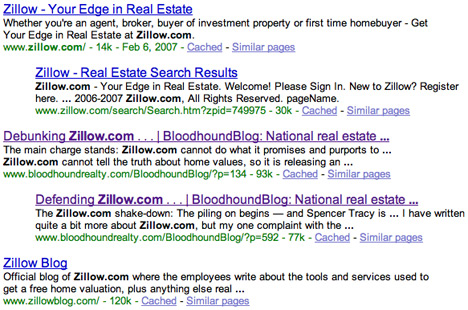
If you Google on Zillow.com, you have to drill all the way down to the third and fourth entries to find my posts. Most days, I beat their own frolickin’ weblog.

But let’s be conservative and simply say that, as a weblogging Realtor based in Phoenix, AZ, I’ve written quite a bit about Zillow.com. So when Fortune magazine writes a cover story about Zillow.com, who don’t they talk to?

They quoted a real estate weblogger — one I’ve never seen before — whose site has been dormant since last October.

And they talked to a Phoenix-based Realtor, Brett Barry, A Realty Executives agent working out of Scottsdale. (Brett emailed me about this article when he was interviewed a while ago.)

But apparently Fortune Senior Editor Jeffrey M. O’Brien didn’t run a simple Google search.

What he did do — almost but not quite — is talk a sweet pregnant lady into turning on her buyer’s agent and disintermediating the bee-hotch. I told David Gibbons last week that the Make Me Move feature puts Zillow.com in the business of brokerage, even thought they’re not taking commissions for it. I wrote about this in December, but, even so, he was taken aback. But in the article, O’Brien is actively marketing his home as a Make Me Move FSBO transaction.

It’s a fun article, but there’s really nothing new in it. It’s impressive, I suppose, that Zillow.com can make the cover of Fortune without even a hint of profitability on its horizons. And it’s certainly a matter of interest to me that I could wrestle my way to third and fourth position on the search for Zillow.com — a search for which BloodhoundBlog gets over a hundred unique hits a day — but not attract the attention of Fortune magazine. Who says real estate is going hi-tech…?

Technorati Read more

Value Investing 101

Value may be easier to find than you think. A few days ago I read this article about Florida Mobile home buyers and thought, man; I need to get into mobile homes. To be fair, I am probably not going to get into mobile homes (certainly not because of this article), but it is clear there is value everywhere. This off the wall scenario happens all the time, heck; it’s what makes real estate an exciting business to be in. So if value is easier to find than you think, where do you start looking?
First, start in your own backyard. I have shared my views on out of state investing in a previous post, so it should not come as a surprise when I say that value can be found close to home. I say this because the small investor knows this environment best. Investing at home is a lot more feel, than numbers because an investor has developed a great sense of the market. As investors move further and further away, information gathering and financial modeling become the chief tool. Of course, this is not to say that you should not use these tools in local investing, however; it is to say you have other tools that may be more valuable (intuition and market knowledge).
Second, find the crowd and look to the peripherals. If you see an area that has grown rapidly, go another half a mile or mile out. If this area is still lying fallow, it might be a good place to invest. This takes a small bit of market timing because you don’t want to be on the very back end of a trend. However, this kind of investing can net significant gains for those of you who buy and hold. There will always be buyers who want to live in the mix, but can only afford to live close to it.
Third, buy the worst of the best. If you can afford the worst house in the best neighborhood, you can usually find great value there. In good markets, great neighborhoods tend to get hot fast. Read more

Yes, Consumers Do Need To Understand You

Cathy Jager wrote this in a comment, and I responded briefly, but I really think the response needs some expansion.

“I tend to disagree consumers should be expected to understand agents. Would anyone suggest that it’s important for patients and clients to “understand” doctors and lawyers?”

Cathy is correct. They don’t need to understand real estate agents in the same way real estate agents need to understand them. But they do need to fully understand why they need to use a real estate agent and it’s clear to many that they don’t.

Why don’t I have to “understand” doctors? Because I already do.

If I’m going to go to a doctor, I first have to understand what a doctor does and why going to a doctor is going to help me. It’s easy to say “I don’t have to understand doctors” in this example, because on the whole, we trust doctors. We’re taught to trust them very early on in life, by our parents. Our parents hold our hands and lead us to the family doctor and explain what the doctor does and why we need to be there. So, we understand not only what they can do for us, but that we can trust them to do it for us, and this development of trust starts very young. So, when we get sick, we go to a doctor. We don’t really have to think about it. We only have to think about which one we choose.

The same can’t be said for real estate agents.

Our parents don’t drag us to a real estate office when we’re a child to meet the family real estate agent. They don’t lead us by the hand and walk us through an understanding of what they do, and why we need them. Value has to be explained and trust must be earned. The consumer isn’t just thinking about which real estate agent to choose, they’re wondering if they should choose one at all.

Consumers are obviously confused. For whatever reason, consumers don’t trust real estate agents. Cathy covered this topic very well herself. In the Harris Interactive Poll Read more

Two thousand mugshots: A failure of leadership . . .

In retrospect, I should have said something. My own initial aversion to the 2000 bloggers incipient fiasco was purely personal, the Inner-Introvert whose skin crawls at the thought of too much social contact.

I was also operating from a rule of thumb I think of as Dustin’s Law: “If it sounds too much like high school, don’t do it.” I derived this by reading comments from Dustin Luther at Rain City Guide.

So why didn’t I say anything?

I didn’t want to rain on other webloggers’ parades. I didn’t actually realize that this game was wrecking Technorati’s utility until Thursday of last week, and, even then, I didn’t anticipate consequence at Google. I’m not aware of any of the usual SEO mavens sounding alarms, either.

But I did know from the very start that the 2000 bloggers project was trading in unearned links, morally suspect even if — at the time — seemingly inconsequential.

And by now we know that the game was not without consequences. On and off all day I’ve read people trying to excuse and rationalize what may turn out to be a huge disaster. Inasmuch as many, many RE.net webloggers were involved in this — bloggers who have great commercial hopes for their organic findability — this is not “only blogging.” It really does not matter what you are I or anyone thinks about this mess. What matters is what Google does about it.

Here’s my takeaway: If I have something to say, I’m going to say it. I don’t care if people call me a stick in the mud or whatever. This smelled wrong to me from the very beginning, and if I had said so at the time, a whole lot of people I like and respect might be sleeping better tonight. “Deliver us from evil,” is in some other guy’s job description, but I think you should be able to count on me to say so when I think something stinks, no matter whose toes I might be stepping on.

The truth is, I thought I was being nice, a good sport. But I’ve never been anybody’s “nice guy”, and I’ve Read more

To Partner or Not to Partner, That is the Question

Partnerships can be disastrous, but they can also open the doors to investing for many individuals, who could not otherwise invest. Personally, I think many investors are too eager or not eager enough to partner with like minded individuals. On one hand, everyone has a friend who always has that “great idea” (you know the liquor store across from the church or the ice cream store in Antarctica). These people should clearly be avoided. But what about people who actually have good ideas or have found good investment properties?

A good partnership begins with common goals. Each partner should have a clear expectation of the investment type, expected return, and reinvestment rate. If the goal is to get a better understanding of the real estate investment process, the partnership should focus on smaller, easier to manage properties. If maximizing return is the goal, everyone should be clear about their risk tolerance. Partnering on a land development deal might not be appropriate for someone with a lower risk preference. More importantly, everyone should understand the risk of every investment. This is easier said than done. Many real estate deals seem simple, but can get very complicated very fast. Keeping everyone well informed of the details is a must.

After common goals have been established, a clear investment strategy should be laid out in writing. It is important this is in writing because it should be referred back to as each investment is considered by the group. It is very dangerous for the group to stray away from their investment philosophy. When things go well this is typically not an issue, but when things go poorly this can be an issue of contention (outside and inside the courtroom). Additionally, by putting the investment strategy in writing, the group is forced to flesh it out. This process will often eliminate extraneous ideas or bring out ideas that people may not have been comfortable with. Either way, it puts everyone on the same page.

Next, bring in the legal and the accounting team. For smaller, less complicated partnerships this step is as simple as paying a Read more

Busted! Two thousand mug shots at Technorati.com . . .

Pinched. More beef. Technorati it going to take is all back.

To dissuade chain posts from submerging your voice in their dilutative effects, we’ve updated our indexing systems on an experimental basis to filter out links of this nature. We all love photo collages of faces; we’ve had them, albeit on a smaller scale, on the Technorati site since last summer. However, “join us and use these links” memes such as 2000 Bloggers is really a disservice to rank measurement systems and thus this decision to change our indexing policies in that regard.

What happens if Google decides it was scammed, too?

Technorati Tags: , ,

“Well, you can’t talk…”

Last month we started a new “tradition” in our house. Now that the four boys are old enough to sit still, every night we read a chapter from a “chapter book.” When we’re finished with the book, we rent the movie and watch it. We started with Because Of Winn Dixie. It was a great experience.

Last night I read chapter five of Charlotte’s Web. I enjoy doing it. It’s a great time with the boys and it takes my mind off work and blogs. At least it did, until I got to this part of the story.

“It’s a miserable inheritance,” said Wilbur, gloomily”. He was sad, because his new friend was so bloodthirsty.

“Yes, it is,” agreed Charlotte. “But I can’t help it. I don’t know how the first spider in the early days of the world happened to think up this fancy way of spinning a web, but she did, and it was clever of her too. And since then, all of us spiders have had to work the same trick. It’s not a bad pitch on the whole.”

“It’s cruel,” replied Wilbur, who did not intend to be argued out of his position.

“Well, you can’t talk,” said Charlotte. “You have your meals brought to you in a pail. Nobody feeds me. I have to get my own living. I live by my wits. I have to be sharp and clever, lest I go hungry. I have to think things out, catch what I can, take what comes.” (White, 1952, pp. 39-40)

It shouldn’t be a stretch to see where my head went, but I’ll explain anyway.

The past few days have been Read more

The Sporting Life – Random Musings

Perhaps I’m just a bad sport. Since that fateful weekend when the Chargers bit the big one, I have checked out of the postseason excitement. For me, unless I have a favorite team in contention, Super Sunday strikes me as a New Years Eve redux – Ready, set, everyone manufacture fun.

Yesterday afternoon, Steve (my partner in crime, business and otherwise) was one funny commercial short of dividing the marital assets. With both daughters off to Superbowl parties of their own, I too had abandoned him. I spent much of the first half judging Carnival entries, mapping improvements to our website, staring into space while I mentally strategized my impending world domination, and figuring out just how I am going to pay our first quarter taxes. These were the things that weighed most heavily on me as Prince hit the stage, while Steve was most concerned with the party atmosphere (or lack thereof).

Granted, my husband would watch any Pop Warner match-up with Superbowl-like enthusiasm assuming it was televised and there was the possibility of guacamole. That is largely a guy thing. I, on the other hand, need to feel I have a stake in the outcome. Steve is a highly social animal; outside of work, I am not. As a team, this provides balance. An an individual, balance is something I only dream about.

Greg alluded to it – It’s the geek gene. I wasn’t born with it (none of us were), but I was born with the inclination. Combine the geek gene with a career in real estate, and you have the perfect storm for social alienation. Being the one in the relationship that is geek-inclined, the business of the business, the IT duties, the technology tasks fall squarely in my lap. But, mostly, I love my work, and being that my work is a seven-days-a-week proposition, the lines between work and hobby blur.

For those agents that reach Russell Shaw status, divorcing oneself from the job may come more easily. Yet, I suspect even Russell has found himself drifting off toward business plan thoughts during a half-time show or two. I submit Read more

Super Bowl? But there’s a Carnival of Real Estate going on . . . !

On second thought, maybe we are the nerdliest joint on the RE.net. I actually watched much of the Super Bowl yesterday, but it was only because it was coming between me and the judging for the Carnival of Real Estate. BloodhoundBlog is host to the 28th edition of the Carnival, and, geek that I am, that was far more interesting to me than watching the Colts stampede the Bears.

And, yes, we are geeks with pride. Snotty sardonic surly teenaged web-programmer god Cameron built us a little bot that would permit multiple judges to view and score each article “blind,” with no knowledge of either the author or weblog. And wise winsome willowy spreadsheet goddess Cathleen Collins built an Excel bot that combined all the results into a one-page report.

These were our judges, six out of the eleven of us: Kris Berg, Brian Brady, Cathleen Collins, Michael Cook, Greg Swann and Jeff Turner. Of the judges, only I saw the articles in their original form. Everyone else saw the versions that I had anonymized.

So: Who won?

Rank Has Its Privileges, and I’m asserting one here. The winner by a significant margin was David Gibbons from Zillow Blog with Attracting a Conversation: Blog Comment Tips. But — I hope without diluting David’s glory — I would like to craft mini-laurels for all of the authors of Zillow Blog’s series on real estate weblogging. Here are the other articles in the series:

And, yes, we’re weblogging about weblogging. But that’s beside the point. The Carnival of Real Estate should celebrate uncontested excellence in real estate weblogging, and David’s post — and the entire Zillow Blog series — are particularly good examples of how to handle this work wisely and well.

But now the pre-game show is over. Here are the top ten winners of the Carnival of Real Estate:

  1. David Gibbons outruns the Colts with Attracting a Conversation: Blog Comment Tips – Zillow Blog posted at Zillow Blog.
  2. REBlogGirl comes in second with Long tail, short tail and coat tail searches posted at Read more

Beginners Landlord Tips

If you have been reading my posts, it may seem like I am all over the board. One day I am talking about mortgages, the next I am talking about agents, and today I am talking about landlords. The coherent theme behind all of these things is smart real estate investing. Commercial investors must have a strong skill set across areas because they represent the cog that brings different real estate functions together. Today, I want to talk about one of the most value jobs a residential (commercial and non-commercial) investor will have to do. This job is that of being a landlord.

People have typically had one of two experiences with landlords. First, they may have rented an apartment growing up, in college, after college, etc. Second, they may have seen one of the many comical landlords on television (Mr. Roper from Three’s Company for example). Regardless of where your experience comes from, being a landlord is never as easy (or as comical) as it appears. This is especially important for the first-time investor, who has no idea what to expect from tenants.

First and most importantly, new landlords must understand that people will not treat their property like it is their own. This is true with just about anything that is rented. Everyone remembers how much more recklessly they drove their rental cars or how poorly they treat their hotel rooms. It’s just a simple fact of life; ownership creates a sense of pride, while rentership (not really a word, but you get the point) creates a sense of carelessness.

Once that very important lesson has been absorbed, investors should go into the process well informed. This means finding every book, article, blog, and person you can to help you gain a better understanding of what it really means to be a landlord. Don’t just listen to the people that say it’s easy. Look for the horror stories. Watch one of the many day time Judge Shows. Ask yourself if you could handle the worst of the worst. Once you feel fully informed, you are ready to begin the process of becoming Read more

BloodhoundBlog week in review: Nothing exceeds like INTx . . .

Surely BloodhoundBlog is not the nerdliest joint on the RE.net, but we’ve still got a lot of arrows in our quiver — er, pocket protector.

For a start, I pinned the tail on Redfin, arguing that nerdy INTx geeks are in fact their target market. (Sing along: “I’m fluent in JavaScript as well as Klingon.”) Kris Berg snagged an interview with Redfin CEO Glenn Kelman, himself a palpably INTx specimen. We have to sit on her podcast until Thursday, but Kelman’s confirmation that the brokerage target markets techno-geeks is not an embargoed tidbit.

Kris had a great Redfin post of her own as did husband Steve Berg at The San Diego Home Blog.

And: I did geek-seeking missile duty by awarding the first Cheez Whiz Prize to a dead-pool destined circle jerk called my-currency.com. What did the starving mathematicians say when they stumbled onto a can of beans? “First we will postulate a can-opener…”

But just to establish my own hopeless geek bona fides, this week I became the first hopeless geek to write a song about real estate weblogging. “Cathy’s Clown” indeed!

But, Dave, I’m just a wave. I ain’t the water. So here’s what else has been going on in the BloodhoundBlog pond:

Investor Michael Cook took us along on his trip to Greensboro, NC, advising us that Time Really is Money and asking What makes a good investment? He follows up by naming some Watchouts for New Market Investing and then invites us to consider Bank Relationships vs. Mortgage Brokers.

In Googling for Pizza Kris Berg takes us on a very straightforward roundabout route through the SEO benefits of real estate weblogging.

Also on the theme of weblogging, Jeff Brown argues against the practice of allowing anonymous comments in It’s Time To Take The Lead — Let’s Turn The Lights On Now. Anonymous commenters are still permitted at BloodhoundBlog, but we’ve had to put everyone on a very short leash to avoid flaming, obscenity, etc. It’s common for people to argue that policing comments is “censorship.” This is incorrect. Censorship is something that is done by governments. The issue here is the right of private property Read more

Pump up the Carnivolume: RE.net blog carnivals proliferate

There was big news in last week’s Carnival of Real Estate, but we were delicate enough not to take notice.

A kinder, gentler BloodhoundBlog? Don’t hold your breath.

There is other RE.net blog carnival news, though:

We know about the Carnival of Real Estate Investing, of course, which was started by Real Estate Investing for Real. (BloodhoundBlog will be hosting this blog carnival on February 19th.)

Now comes news of the Consumer Focused Real Estate Blog Carnival, founded by Sadie’s Take on Delaware, Ohio. The idea is to reward locally-focused weblog posts.

From the other direction, David Gibbons of Zillow.com phoned this afternoon to talk about an idea he has proposed for the Carnival of Real Estate. The idea is to make a five- or ten-minute podcast with each week’s CoRE host, discussing the judging process, the decisive qualities of that week’s winning choice, and, also, offering the host a moment to discuss his or her local real estate market.

I like this idea, although I can never talk about anything for ten minutes. Our phone call to talk about a ten-minute podcast ran for 32 minutes. But I do like the thought that there will be some oversight over the hosts, if only to prevent — or at least draw ignominy to — the kind of news we delicately ignored this week.

I am also concerned about this proliferation of RE.net blog carnivals. I understand the impetus to create niche carnivals, but each new addition tends to dilute the impact of the others. I like the Carnival of Real Estate being “The Oscars,” as it were, of real estate weblogging carnivals. An idea I suggested to David is to split out CoRE awards by category: Best Investing Post, Best Local-Interest Post, Best Feature Post, Best News/Commentary Post, with one overall Best Post picked from among all the entries.

Another idea I have been toying with is to create a weekly Odysseus Medal to be awarded to what I think is the best RE.net weblog post of the week. Why me? Because I had the idea. Because I’m a presumptuous-enough insufferable bastard to trumpet my own opinions with a Read more

A line in the sand: Gaius Popillius Laenas and getting the real estate transaction closed against all opposition . . .

Someday soon I’ll write a full-blown Realty Reality post about this transaction. I’ve written about it several times already, but my client is quite right in telling me, “This should be Chapter 14 in your book!”

What am I talking about? It’s a home that finally closed this week — after much back and forth, feint and parry, sturm und drang, threat and counter-threat — all in a day’s work.

I first wrote about this in an Ask the Broker post about a divorcing seller who was reluctant to move.

I talked about my own buyer briefly in a post about the realities of what we suppose to be tech-infused real estate brokerage.

Two weeks ago, I wrote what I thought was the last chapter in the story for the Arizona Republic (permanent link):

Sellers who aren’t motivated can create headaches

When Realtors speak of unmotivated sellers, what they normally mean are sellers who are unwilling to do what’s necessary to make their home appealing to buyers — price to the market, attend to repairs or keep the home show-ready.

I have a home in escrow right now where the seller doesn’t seem to be motivated to do anything.

I represent the buyer. When first we saw the house, it was graced by a great deal of debris. Not trash, necessarily, but not treasure, either, and none of it put away. When we were back in the home for inspections, nothing had changed.

And, to my knowledge, nothing has changed since then.

I have been driving by the home every other day or so, looking for external evidence of changes. Nothing discernible.

We were there on Friday for the final walk-through and we discovered one important change: The key in the listing agent’s lockbox no longer works. The seller had changed the locks.

What does this mean? The home is about to close and, to all evidence, the seller seems unmotivated to move out. There is every reason to suppose that every bit of debris we saw in the house a month ago is still there.

What happens next? We close the transaction, withholding funds in escrow to pay to have the seller’s personal Read more

A Different Perspective on the Value of Realtors

Has anyone ever wondered why the price of real estate agents has been 5-7% for what seems like an eternity? I know I run a serious risk of stepping on a lot of people’s toes out there since this is a site run by realtors, but I really have been thinking about this a lot lately (particularly this morning after I read Greg’s articles). Additionally, several other articles got my attention (CNN Money, Business News, and The Wall Street Journal). If you stop to really think about this, you will realize that real estate agents have created one of the longest standing monopolies out there. Let me dust off my economics text book and delve a bit deeper into this subject. [Please note this is intended to spark discussion and not personally attack anyone’s profession. As I said before, I love a GOOD real estate agent].

What is a monopoly? Let’s simply define a monopoly as providing a good or service with very little competition. While this may be debated, humor me when I say that real estate agents have been providing their service with very little competition. This is evident in the fact that the price has stayed fixed for so long. One could argue that by using a percentage method, agents are simply hedging themselves against inflation. While that would partially explain this pricing phenomenon, the fact that the percentage has stayed the same despite significant changes in information control speaks of something else. In other arenas, when a significant technological advancement hits the market, prices typically drop accordingly or the level of service increase dramatically. Look at cars for example. As technology has improved cars have become much cheaper (in real dollars) than 70 or even 30 years ago. Additionally, an owner now gets many more standard services.

So do Realtors do more now than say 30 years ago? Of course they do. With the advent of new technologies, they provide marketing over the Internet, in newspapers, and perhaps even their own website. The more important question, however, is does the consumer get a higher value for the services they Read more

Bank Relationships vs. Mortgage Brokers

Every property I have ever purchased has been with the help of a mortgage broker. After my recent trip, I have started to wonder why this is the case. The obvious answer is simply their access to cheaper capital. Brokers can secure rates 50 to 100 basis points (.5%-1%) lower than most local and national banks. Additionally, the terms tend to be more investor friendly, with longer amortization and no recourse. With all of these benefits, why would anyone consider going anywhere else?

The answers lie in two things: Technology and Relationships. The easiest explanation is simple disintermediation through technology. The Internet has opened the mortgage world to investors by allowing them to search many national and local bank rates, as well as, look across the country for the most aggressive mortgage lenders. The time will come (probably very soon, if not already) when some forward thinking investor will provide a site that connects investors and lenders in the same way mortgage brokers do now (think Lending Tree for Commercial Loans).

Additionally, looking at Brian Brady’s recent post, Interview: The XBroker, the industry seems poised for positive transparent change. This change will further allow disintermediation and provide investors unparalleled access lenders. Furthermore, increases in information will drive down pricing. I have consistently been quoted prices in the 1% (of loan value) range for broker services, which can be fairly steep as a percentage of closing cost when purchasing properties in the $500,000 to $1,000,000 range. I would love to see this come down to 50 to 75 basis points (sorry to the brokers out there, but business is business).

The less obvious answer is relationship building. I probably mention that real estate is a relationship business in 90% of my post because I really believe this. This concept is no different when working with banks. The value of the relationship, however, is not apparent right away. Most banks have specific lending criteria and will only be able to offer certain terms based on their risk assessment model. This fact alone keeps mortgage brokers employed. What investors fail to realize, Read more