There’s always something to howl about.

Category: Blogging (page 81 of 84)

Mashterpiece: The return of the prodigal programmer . . .

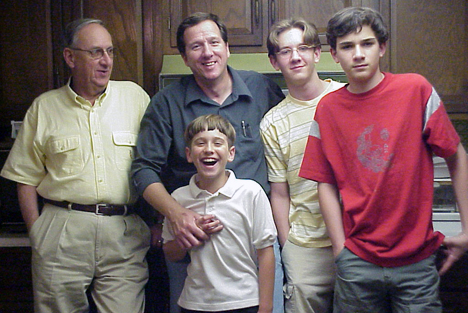
Those are the Swann Boys in April of 2001. My father, James Swann, is to my right, my younger brothers, Matthew and Michael, are to my left, and my son, Cameron, is the little kid in front of me who is being so lovingly coerced. I use a thumbnail of me from that photo in all of our marketing stuff for four good reasons: I’m always going to look like Fred Flintstone no matter which photo I use, we don’t do personality marketing, so it doesn’t matter, Cathy and Odysseus are the cute ones anyway, and that was a very happy day for me.

Cameron is almost 15 by now. That’s him to the right — an astoundingly large specimen, considering that I used to hold him in the crook of my elbow.

He just got back from spending six weeks with his mother in Seattle. When he left, I was just putting BloodhoundBlog together in WordPress, so he came home to a lot of changes. Cameron is our better, smarter programmer. He wrote the current versions of most the software we use to drive our web sites. But while he was away, I discovered dozens of new projects I want him to undertake, starting with this.

I’m curious to see how all this works out. When I was Cameron’s age, I was a teenage photo geek, so I always made good money on the side. But my son is a web programmer growing up in an environment where he has plenty of opportunities to make a whole lot of money (for his age) doing really interesting projects. I can’t do the same quality work he can do, but I can design, manage and test the work he does, and I can direct his efforts toward the best profits for all of us.

It’s kind of a mash-up of disparate skill-sets, and I’m interested to see where he can take it.

Further notice: If you sneak over here, you’ll see the work in progress. As I write, when you zoom in, you’ll end up right over our house. We’re the brown roof, three homes in from Read more

Owning versus renting: In the long-run, owners appreciate their returns . . .

Searchlight Crusade has a compelling comparison of the financial benefits of buying a home, as opposed to renting:

Once you have bought, you step off of that one way escalator of rising rents. Rents increase at a yearly rate about comparable to inflation in most cases, and rents never drop. I have never heard of a rent decrease except in areas that were so far gone they might as well have been war zones. You only borrowed $X when you bought, and unless you take cash out (which is under your control) you should never owe more money next year than the previous one.

So buying stops your situation from getting worse. What about making your situation better? First off, I need to observe that with rising rents, your situation will always get worse until you sell. But buying really does make your situation better. Not immediately; there’s always a hit for buying, and it always costs money to sell. But within a couple of years the average person will be above any reasonable return they can earn any other way, and the reason is leverage.

Fact one: you always need a place to live, and the options are to rent or to buy. Renting typically requires less cash flow, but returns nothing. Once you have bought, all that lovely appreciation belongs to you and nobody else but. Let’s look at an actual scenario for San Diego, one of the highest priced places to buy.

The article runs through a side-by-side, dollar-for-dollar comparison of the costs and benefits of homeownership — even in a high-priced area like San Diego in a slow market.

Technorati Tags: , ,

Tell the world: Zillow.com is bunk . . .

I wrote Debunking Zillow.com on July 25th, two weeks ago today. Without being arcane or technical, I think it completely demolishes the idea that Zillow.com can — or ever can — provide reliable home values. Nathan Hughes at Richmond Business and Commercial News wrote about my post, and, in a comment there, I said:

The Zillow mystique is analogous to the aura that surrounds the nutritional supplements business. No one can possibly confuse a clerk in a GNC store for a physician, but people like the idea of being liberated from the dictates of their doctor while going one up on him at the same time.

We know that Zillow.com rides the Cluetrain, or seems to. When I teased them, they teased back.

Why, then, have they not responded to the much more serious allegation that their base epistemology categorically forbids the very results they promise to deliver? I believe that what Zillow.com does would be actionable professional malfeasance if done by a real estate licensee. If the owners of Zillow.com think I am wrong on one or both points, why haven’t they risen to answer my charges? If they can prove me wrong, why haven’t they done it?

Google me this. Or this. If I am wrong, they need to shout me down right now.

But I’m not wrong, am I? Cum tacent, clamant. Their silence speaks louder than any words: Zillow.com is bunk.

It is the duty of the entire real estate community — and in this company I include the recent dot.com entrants, licensed and unlicensed — to guard consumers from hoaxers, con-men and frauds. I have no doubt that the owners of Zillow.com have the best of intentions. Nevertheless the results they produce are necessarily erroneous — and I have zero doubts that they know it. I think this is a case where everyone who cares about the true value of homes — or simply The Truth in the abstract — should stand up and be counted.

The fact is, if you eat whole bottlesful of the quack nostrums they sell at GNC, nothing will happen to you. The contents are completely inert, with Read more

What’s wrong with real estate weblogs? I might run this way and that, but never hot and cold . . .

Mike Price at Mike’s Corner posted a fascinating interview with Russ Cofano of Rain City Guide on the subject of real estate weblogging and the ‘bloginars’ Russ and Dustin Luther, also of Rain City Guide, have been running. The interview is extensive, and I’m only going to touch on a piece of it, so you should go read the whole thing.

The meat of the matter for me is Russ going through his ideas on do-s and don’t-s for real estate weblogs. Like this:

Here is a list of 10 posts that make for great blog content:

Stories
Data (Charts, Tables, Maps)
Book Reviews
Current Events
Neighborhood Descriptions
Local Events (Fun Stuff!)
Links
Interviews
Advice for Buyers/Sellers
Advice for other Agents

I don’t hate this stuff, but some of it seems to tread dangerously close to the turf Seth Godin calls a Cat Blog. Couple that with “Advice for other Agents” and we trip on the schizophrenia that seems to afflict many real estate weblogs — and BloodhoundBlog is guiltier than most.

Witness: Most real estate weblogs are run by agents or brokerages, and at least one meta-goal is to scare up business. But what is interesting to potential clients is very different from what is interesting to the weblogger. Data, current events, neighborhoods — all that stuff is great, but news about it is not in short supply, and it’s not always easy to come up with an original take on it. On the other hand, the business of the real estate business is endlessly varied and fascinating — even though it might be boring or even completely off-putting to potential clients. We seem to end up talking two games, client-focused material that can too-easily slip into blatant advertising, and inside-baseball commentary for well-schooled insiders.

(I’ve thought about writing a Wiki-fier in PHP that would pre-process a web posting, tagging delimited terms with Wikipedia look-ups, in case I’m assuming that readers know the jargon I’m using when in fact they don’t.)

(The Latin root of the word discursive, as in discursive prose, is discurro, which literally translates to, “I run this way and that.” Discursive prose is the means by which we tame our scattered minds Read more

How to make fast, flexible web pages . . .

Sellsius° has a big bag of how-to’s but I’m from Missouri. I like how-to articles that tell exactly how to do something.

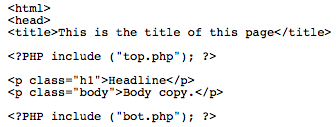
One from me: How to make fast, flexible web pages. This is Realtor 2.0 stuff: Full-service Realtors who plan to compete need to learn how to punch out lots and lots of new web pages with dispatch. For one thing, this is where all those photos I keep talking about are going to go. We do most of our pages with software and I’m not going to tell you how we do that — because I plan to send my kid to college with that software. But here is a road map to kicking out new pages with minimal effort. There’s a bonus to doing things this way, too, which I’ll get to at the end.

Vide licet:

That’s PHP, and if you’re on an Apache web server, you’ve got it. This is really simple code, but that’s the point. The whole purpose of PHP is to generate HTML on the fly, so I can only show this code as a picture and talk about it by paraphrasing.

What does it do?

It generates a complete web page: Title, meta-tags, CSS, internal Javascript, body copy, and graceful exit. If you look at the source of any web page in your browser, you’ll see a lot more than seven lines of code. That would be the case here, too. The two “included” files, “top.php” and “bot.php” are going to explode into a bunch of HTML.

To set this up, you take your standing dummy web-page, the one you’re using to create new web pages. Configure the first three lines the way you see them in the picture. The title tag doesn’t have to come first, but it can, so let’s make it come first. Then copy everything from the first line after the title down to the last line before the actual changeable content of the page. Paste that into a new file named “top.php”.

Then go to the first line after the changeable content of the page and copy from there to the bottom of the Read more

My friend, Richard Riccelli . . .

My friend and esteemed colleague Richard Riccelli called tonight to talk about the custom yard signs — among many hundreds of millions of other things.

I’ve known Richard since the day I found out that my son Cameron was certifiably enwombed — fifteen and a half years ago (wow!). When the boy was born, Richard was the first person to call him “Cam” — and then right away “Cambo.” I can picture both of those events — meeting him and his applying diminutives to my son — just like they were yesterday.

This is not happenstance: Richard Riccelli makes an impression. He walks, talks and — especially — thinks at a blistering pace. He throws off ideas the way the rest of us shed skin cells, dozens a minute. When he is focused, he is so much like a laser that you expect his eyes to burn through paper — through tables, walls, concrete. When he lets his mind float freely, he can glance pinball-like across a universe full of wonders in the span of a moment. At the end of a Richard Riccelli soliloquy, you will be left gasping, but you will have grasped a perfect metaphor, a unique and elegant way of uniting that universe full of wonders in a way you had never thought of before.

Richard Riccelli is our personal marketing god. He has been advising us since we began this business — not formally, but again and again with the perfect idea at the perfect moment. He is the reason that our logo looks the way it does — and why the dog in the logo smiles. He has been along for each of the three versions of our signs — along with many other marketing decisions, large and small. We don’t always do what he says to do, but we think very carefully about everything he says.

Which isn’t easy, given how many stunningly original ideas he can cram into a single sentence! In tonight’s call we agreed that custom real estate signs are essentially direct marketing, inherently testable — and Richard has no use for marketing that is Read more

The Long Tail in real estate photography . . .

Chris Anderson at the Long Tail weblog on how switching from film to digital media changes movie acting and directing:

“I think shooting in digital changes acting as much as film changed stage acting, or as sound changed film,” said Bill.

Why? Because film costs a lot and must be used sparingly, while digital tape is practically free. The difference between the scarcity economics of film and the abundance economics of digital is, as Bill put it, “the difference between pointing a loaded gun at someone and a toy gun. You point a loaded gun at them and they’re going to act different. A film camera is a loaded gun. Digital is not.”

The principle is the same for real estate photography: If you’re not paying for a photographer’s time, nor even for film and processing, you have no reason not to take a lot of photos and simply toss the ones that don’t work out.

Man! That Long Tail is everywhere!

Technorati Tags: , ,