There’s always something to howl about.

Category: Group Therapy (page 51 of 81)

FNMA Lends a Helping Hand (to Our Moral Backside)

Two days ago, FNMA announced their new policy regarding strategic defaults; it’s a mortgage death penalty: seven years before the offender is eligible for another FNMA loan.  Finally, they got one right.  Yes, you read that correctly; if you make your profession in the business of real estate, Wednesday’s announcement is cause for celebration on more than one level.  I’ll explain why in a moment, but first let’s dispense with the two primary arguments in favor of strategic foreclosure we see over and over again from the bubble-heads on the left:

Already we’ve got Shahien Nasiripour on The Huffington Post (I know, that’s an easy target – but it’s usually wise to start slow and thoroughly warm-up one’s disdain muscles) trotting out the tired argument about how the average homeowner should be allowed to default because the corporations that hold mortgages do it themselves.  Mr. Nasiripour would apparently like to see individuals and large corporations share the same default outlook.  I wonder if he would also prefer that homeowners negotiate their own individual, custom loan contracts; pay much higher commercial insurance premiums; price home loans on the specific risk of the homeowner rather than a pooled risk; and so on.  Either he hasn’t thought this all the way through, or he’d actually like to see the cost of home ownership much higher than it is now.

The other misleading argument is neatly presented by Ezra Klein at The Washington Post.  Actually, kudos to Mr. Klein because he not only presents the other misleading argument, but he also manages to mislead us on the very definition of a strategic default.   The essence of the second argument, in his own words: “…a mortgage is a specific contract. It says that if the borrower stops paying, the bank forecloses on his or her house.”  Not quite.  The contract specifies foreclosure as one (and there may be more) remedy available to the bank if the borrower breaks the contract.  The point of the contract itself is a promise by the lender to loan money at a rate and term that will not vary from what’s specified in return for a promise by the borrower to repay the loan as specified.  That’s not such a Read more

Reasons to be cheerful, Part two: If we are wise, and if we are lucky, we won’t “meet the new boss” because there won’t be any bosses.

Watch this:

Yes, everyone knows Saturday Night Live is not funny, but that sketch is interesting, even so.

Why? What is that bit actually saying?

Actors are puppets for writers, never forget that. What are the writers of that unfunny little skit trying to say?

Imagine this: Your parents spent a ton of money to send you to Brown or Yale or Dartmouth, and now you have the thoroughly unsexy job of writing unfunny comedy bits for an unwatched variety show that can’t even sell its own advertising time.

Do you want to believe that some mouth-breather in Dubuque can get an education just as useless as yours at, say, one percent of the cost your parents paid out?

Worse, what if that guy’s education is better than yours? What if he can get a job that amounts to something, in an industry that is growing, not dying? What if people make or lose money — or even live or die — based on his academic performance?

He doesn’t have your class ring, and he doesn’t belong to your network of drunken dissipates — each one of whom is stuck in a going-nowhere job just like yours. But, but, but: He doesn’t feel himself endowed with the centuries of effete sneerpower to which you lay claim but have done nothing to deserve.

The truth you don’t dare admit is that your education distinguishes you in no way at all. You studied nothing serious, and you learned nothing of what you studied. You put in time and you made connections, but you don’t actually know anything, you can’t actually do anything, and if you are ever required to be anything more than an expert at supercilious self-pity, you will be dismissed at once. You are nothing but your vaunted pedigree, and that pedigree is based entirely on the accomplishments of other people — the vast majority of them long since deceased.

This is the naked essence of that fake advertisement, the snarling envy and resentment of an entire social class composed of nothing but empty suits.

Welcome to the disestablishment, y’all…

The question is, what if we’ve really screwed the pooch this time. Read more

First time home-buyers tax credit, the morning after: “The government’s ‘gift’ to new home-buyers? A house immediately worth $8,000 less than they paid for it.”

From the National Review Online:

Things are looking worse on the housing front, with a severe drop-off in existing home sales following the expiration of the home-buyer tax credit. It’s hard to overstate how stupid this policy was. The government marketed it as a measure to boost residential real-estate prices by providing new home-buyers with a tax credit in the neighborhood of $8,000. Did you see the ubiquitous ads featuring the couple that gets an envelope full of cash from Uncle Sam? The idea was to convince potential home-buyers that they were the ones who would benefit from the subsidy, when in fact the opposite was true. The tax credit was a subsidy for sellers, not buyers, allowing them to increase their asking price (or avoid decreasing it) by $8,000.

The government’s “gift” to new home-buyers? A house immediately worth $8,000 less than they paid for it, and falling fast thanks to the sharp drop-off in demand that accompanied the expiration of the tax credit. Gee, thanks, Uncle Sam! I’m not sure the “predatory lenders” Obama likes to talk about ever did anything that sketchy.

This is good, but it’s still wide of the mark. As everyone here knows, the purpose of the tax credit was to churn transactions, so that realtors and their brokers could get paid. You’ll see more evidence of this later this week, as the NAR pushes you to lean on your congresscreep to support Harry Reid’s extension of the expiration deadline for the credit. There are still 180,000 unclosed transactions out there, and that means 180,000 commission checks held hostage by the demons of time. We can’t have that…

Superman

A Ramblin’ Gamblin’ Willie story

The little boy came gamboling up to me when I was just over the ridge. He was big for three, small for four, and cute by any measure. Brown hair, blue eyes and a smile as quiet as firecrackers.

I was cutting across the park on my way to the library, and I’d come a little closer to the playground than I had wanted to. Unaccompanied adults have no business being at the playground. It spooks the parents, and it ought to. For myself, while I like kids well enough, I don’t much like what comes with them these days…

“I’m Shotterman!” said the little boy. He struck a menacing pose. He was wearing little blue shorts and a black Mickey Mouse tee shirt. He had Spiderman sneakers on his tiny feet.

“Hi, Shotterman,” I said. “What are you?”

“Huh?”

“What are your powers, Shotterman?”

“Oh,” he said. “I can shoot.” He cocked his finger. “Pshew! Pshew pshew! Pshew!”

“Shotterman!” I announced. “Strange visitor from another planet with an uncanny aim and accuracy. Shotterman! Able to compete for marksmanship prizes on five continents.”

Shotterman laughed with delight, as I knew he would. This was entertainment he thoroughly understood.

And here’s a little something I understood: He doesn’t have a dad, not at home. Little boys don’t crave male attention when they’re getting enough of it. The nation is crawling with little boys looking for big boys to play little boy games, and I knew without being told that Shotterman was one of them.

“Who are you?” he asked.

I knew what he meant. “Nothingman,” I said.

“Nothingman?”

“Nothingman! A vanishingly small amount of substance, barely here at all. Nothingman! A homeopathic quantity of humanity.”

He looked at me as if he wasn’t quite sure if I was serious in my nonsense.

“Hunter!” called a voice from the benches over by the swings. Shotterman blanched a little.

Hunter!”

“Is that your name? Hunter?”

“No, I’m Shotterman.”

“Hunter Ryan Daniels! You get your butt over here and I mean this instant!”

I winced. I can get enough of that stuff. “C’mon,” I said. “Let’s motivate.”

We walked back over toward the playground equipment and Hunter went “Pshew!” at anything that Read more

Politician admits human behavior is not subject to coercive control: “You can write all the laws that you want. But it sometimes doesn’t make a whole lot of difference. People don’t follow them.”

Arizona Governor Jan Brewer — made famous by Senate Bill 1070, which requires Los Angelenos, expatriate Canadian basketball players and huffy has-been musicians to act like idiots in public — observing that a state-wide ban on texting-while-driving will have zero impact on texting-while-driving.

I figure I violate about 300 traffic laws on a typical day — with no consequences, obviously. I’m not being reckless, just efficient, and the cops don’t waste their time on me — which assumes they’re even paying attention. Meanwhile, the City of Phoenix already has a texting ban, which I violate at will, also without consequences.

If you have cultivated the habit of thought, you might stop to think about how many laws you routinely violate. The logical next step would be to wonder if everyone else is just like you: Scrupulously obeying laws that hinder them in no way and breaking all the others.

After that, you might be so bold as to entertain the notion that laws among civilized people are redundant, while laws among the uncivilized are meaningless. And who knows where that kind of thinking might lead you…

Reasons to be cheerful, Part 1.5: Who cares about the tunnel? All I can see is the light…

I wrote this eighteen months ago, when this economic recession was just getting started. I looked at it again tonight and found nothing in it that I wanted to change. I have more to say on the subject of a long recession, perhaps a depression, but this is a very good place to begin to look for optimistic portents. –GSS

 
Hope and despair at the onset of economic recession: Who cares about the tunnel? All I can see is the light…

I don’t do well in despair.

Clarify that. I don’t mean that, when I find myself in despair, I fare especially badly.

What is mean is, if despair were a classroom discipline for which one could be tested and graded, I would probably flunk out.

I’ve lived through some ugly stuff in my life — who hasn’t? — but mostly I didn’t notice. I’m good at thinking — or so I like to think. And, good at it or not, I really do like to think. But I can only think about one thing at a time. For most of my time, for most of my life, I like to think about work. I like to think about what I’m doing. I like to think about what I’m getting done.

That doesn’t leave much room in my mind for despair. Or depression. Or gloom or sadness or fear or doubt or pain or worry or any of the things that people talk about when they’re not talking about work. I know about those ideas, much as I know about ideas like schadenfreude or universal guilt, things that I’ve heard about or read about but never seen from the inside.

You could say that’s my good luck, I suppose, but I’m sure it’s a choice on my part. Who hasn’t known sadness, after all? It’s not that I’ve never lived with painful emotions, it’s simply that I choose not to live with them any longer than I have to — which almost always turns out to be no time at all. I turn to my work not to escape from pain, nor even to work to alleviate it. Read more

“In a sense, Britain inadvertently, through its actions in Hong Kong, did more to reduce world poverty than all the aid programs that we’ve undertaken in the last century.”

From The Atlantic, an explication of economist Paul Romer’s idea to build modern-day Hong Kong-like enclaves to promote development in poverty-stricken counties:

When Romer explains charter cities, he likes to invoke Hong Kong. For much of the 20th century, Hong Kong’s economy left mainland China’s in the dust, proving that enlightened rules can make a world of difference. By an accident of history, Hong Kong essentially had its own charter—a set of laws and institutions imposed by its British colonial overseers—and the charter served as a magnet for go-getters. At a time when much of East Asia was ruled by nationalist or Communist strongmen, Hong Kong’s colonial authorities put in place low taxes, minimal regulation, and legal protections for property rights and contracts; between 1913 and 1980, the city’s inflation-adjusted output per person jumped more than eightfold, making the average Hong Kong resident 10 times as rich as the average mainland Chinese, and about four-fifths as rich as the average Briton. Then, beginning around 1980, Hong Kong’s example inspired the mainland’s rulers to create copycat enclaves. Starting in Shenzhen City, adjacent to Hong Kong, and then curling west and north around the Pacific shore, China created a series of special economic zones that followed Hong Kong’s model. Pretty soon, one of history’s greatest export booms was under way, and between 1987 and 1998, an estimated 100 million Chinese rose above the $1-a-day income that defines abject poverty. The success of the special economic zones eventually drove China’s rulers to embrace the export-driven, pro-business model for the whole country. “In a sense, Britain inadvertently, through its actions in Hong Kong, did more to reduce world poverty than all the aid programs that we’ve undertaken in the last century,” Romer observes drily.

Of course, versions of China’s special economic zones have existed elsewhere, especially in Asia. But Romer is not just arguing for enclaves; he is arguing for enclaves that are run by foreign governments. To Romer, the fact that Hong Kong was a colonial experiment, imposed upon a humiliated China by means of a treaty signed aboard a British warship, is not just an Read more

Reasons to be cheerful, Part one: Things rarely change as quickly or as dramatically as we expect them to.

Do you want to hear some really bad news? I mean dauntingly bad, horrifyingly bad, news so bad you could spend days or even weeks ruminating on it, worrying about it, desperately praying for it not to be true.

Are you ready? Here goes:

While you might have heard that the national debt in the United States is approaching $14 trillion, the actual unfunded liability of all American governments exceeds $125 trillion.

Stupefying, ain’t it?

And stupefying is precisely the right word, since news like that brings out the stupid in people. Nothing enervates the chicken in Chicken Little like a weather report predicting falling skies. If you find yourself in the business of selling advertising or shrieking treacly books or quack nostrums to Chicken Little, it behooves you to hire yourself some weathermen. Worked for Al Gore, didn’t it?

Am I being cynical? Not so much. Mainly I’m just being old.

I am an old libertarian. Not an old man, I hope, though of course I’m not getting any younger. But I have been a very radically committed libertarian since I was 19 years old, and an anarcho-capitalist since I was 24. I have been swimming in this ocean for 30 years, where many folks all over America are just now daring to wet their toes. I can defend the proposition that I am the first consistent theorist of both rational egoism and market anarchism, but, leaving that claim aside, it remains that I have been a libertarian for a long, long time.

Why does that matter? Because I’ve seen the gravely-predicted collapse of the starry firmament before. More than once. More than twice. More than a dozen times. It does seem plausible to me that the-world-as-we-know-it will someday come to an end. But with every passing day, I become more resolved in the belief that that day will not be tomorrow, regardless of the breathless weather reports.

It’s like this: New libertarians can be excitable. You’ve lived your whole life in an eyes-glazed-over sleep-walking state, and then, all at once, you wake up. The precipitant cause might be Atlas Shrugged or a John Stossel TV special or Read more

Reasons to be cheerful, part 0.5: Sleeping giants can’t sleep forever.

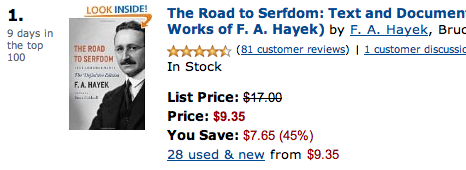
Do you want something to cheer about? Hayek’s The Road to Serfdom is the number one best-seller at Amazon.com right now:

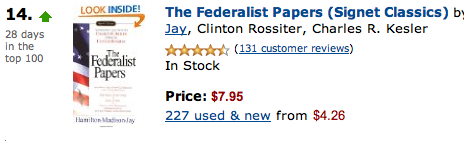
It gets better. The Federalist Papers is at number fourteen.

I think a lot of people are annoyed that the free country they still remember clearly has somehow vanished right from under their noses. It’s very inspiring to see them searching for it so assiduously. My read is that this is very different from 1994…

< ?php include "cheerful.php"; ?>

What a Young Sailor Teaches Us About Life

This morning I woke up to read this article on Abby Sunderland, a young sailor, who is attempting an around the world sail singlehandedly. If you sail, then you know how dangerous this is, and as this article indicates, perhaps that danger has now placed Abby’s life in danger.

I grew up in Youngstown, Ohio, and never though much of sailing. While in college I read about a guy who had worked for the Cleveland Plain Dealer, the largest newspaper in Cleveland, and who had managed to plan and sail the Atlantic Ocean in a boat that was just over 13 feet long…about the size of your car. His name was Robert Manry, and what he did influenced me to become a sailor when I found my way to San Diego some years later. Here’s a very short clip about his adventure.

But this story about Abby, a single day of which is recounted below from her blog, instructs us in the great adventure that awaits us every single day, doing the important, doing the mundane, living, longing, experiencing this opportunity to be the best we can be.

Thursday, May 27, 2010
A Tale from the Sea
Hey everyone,
Sorry it has been so long since I wrote. There were some problems with one of the Inmarsat satellites and so I wasn’t able to get online. That’s all sorted out now though and hopefully won’t happen again.

I have had a pretty busy past few days. Things went well getting out of Cape Town – everything was working well and I was having a lot of fun with my new auto pilot. I’ve been able to carry a lot more sail with the working auto pilot and making some pretty good speeds.

A few days ago (I’m sorry I don’t know exactly how long – the days started to blur together after awhile). I was sailing along nicely doing about 12-15 knots in perfect conditions. The wind started to pick up just as it was getting dark and was a bit too much for the sail I had up, so I went out to Read more

If the National Association of Realtors were to back the repeal of the mortgage interest tax deduction, it could do three very patriotic things: It could reduce the debt load on all Americans, help consumers make wiser use of their money — and get itself off the dole!

I had thought I had said my piece yesterday about the move to repeal the mortgage interest tax deduction as a means of reducing the federal deficit, but today I feel I have not said enough.

Here’s what I would add: The National Association of Realtors should lead the charge to rid the nation of the pestilential subsidy. Very far from being a good thing, it is an undiluted evil.

How so? Two reasons. First, it rewards homeowners by raising taxes on everyone else. This is true of every sort of tax deduction, tax credit or direct subsidy, but the mortgage interest tax deduction is especially pernicious in that it tends to reward the wealthy at the expense of the poor. Frankly, any sort of governmental favoritism is vile, but the NAR is doubly vile in this instance, since poor people are being despoiled not even to benefit the rich, but to benefit Realtors themselves.

Consider this, written in response to a defense of the tax deduction:

Defending mortgage interest deductibility (based on the current tax establishment) is very much in my favor as a consumer.

This is the seen and the unseen, classic Bastiat. You see a tax deduction and regard it as being to your immediate pecuniary advantage. You don’t see all the other taxes that are raised to make up for that deduction.

Worse, you don’t see that the NAR is not seeking your interests but its own: The deduction causes you to value housing above other investments, contrary to market forces, which results in your buying a home when you could and probably should be making more productive use of your surplus income. The goal? Commissions for NAR members, not your interests at all.

Still worse, you don’t see that the recession we are going into was caused, fundamentally, by overvaluing housing as a market good by means of tax deductions, credits, exclusions and deferrals. In five years you could be walking around shoeless, dining out of garbage dumpsters, but at least your mortgage interest will be tax-deductible.

In other words: You are a consumer in your every economic transaction, not just when you are Read more

Per-capita wealth and poverty in a given political economy is strongly correlated both with economic freedom and oppression and with the perception of integrity or corruption among government officials.

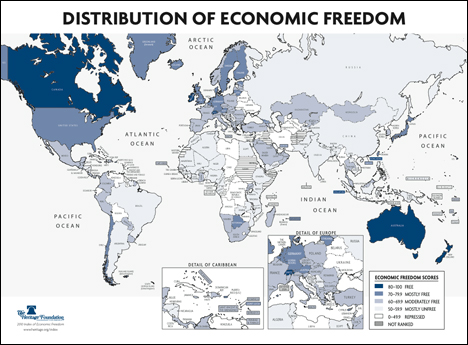
Countries that pursue policies of economic freedom have rich populations. Countries that obstruct free enterprise have poor populations. The relative wealth or poverty of a given population is strongly correlated with and can be readily predicted from the level of economic oppression in that political economy. This is easily understood from Austrian and Classical economic theory, but it’s stunning to see how relentlessly the theory is borne out in the real-life experiences of the countries of the earth:

This map is from The Heritage Foundation’s Index of Economic Freedom.

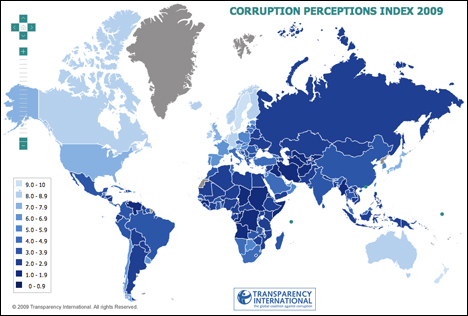
Interestingly, relative wealth and poverty are also very fairly correlated with perceptions of the local population of the integrity or corruption of government officials.

This map is from Transparency International’s Corruption Perceptions Index.

What’s especially striking is to look at the two maps together: Government corruption is correlated with economic oppression. This is not really surprising, but it seems to tell us everything we need to know about wealth and poverty: The closer a given country is to being a slave-state, the closer to starvation the people of that country will be.

How Socialism makes beggars of free people: “The predictable result of these efforts at preventing the exploitation of man by man was the collapse of production, pauperizing an already poor country.”

Theodore Dalrymple reflects on how the imposition of a Marxist redistributionist policy impoverishes what had been a self-sustaining economy:

I next spent a few years (1983 to 1986) in Tanzania, a country that presented another experiment in treating poverty as a matter of maldistribution. Julius Nyerere, the first—and, until then, the only—president, had been in charge for more than 20 years. His honorific, Mwalimu—Teacher—symbolized his relation to his country and his people. He had become a Fabian socialist at the University of Edinburgh, and a more red-blooded one (according to his former ally and foreign minister, Oscar Kambona, who fell out with him over the imposition of a one-party socialist state) after receiving a delirious, orchestrated reception in Mao’s China.

One can say a number of things in Nyerere’s favor, at least by the standards of postindependence African leaders. He was not a tribalist who awarded all the plum jobs to his own kind. He was not a particularly sanguinary dictator, though he did not hesitate to imprison his opponents. Nor was he spectacularly corrupt in the manner of, say, Bongo of Gabon or Moi of Kenya. He was outwardly charming and modest and must have been one of the only people to have had good personal relations with both Queen Elizabeth II and Kim Il-sung.

Nyerere wished the poor well; he was full of sympathy and good intentions. He thought that, being so uneducated, ignorant, and lacking in resources, the poor could not spare the time and energy—and were, in any case, unqualified—to make decisions for themselves. They were also lazy: Nyerere at one point complained about the millions of his fellow countrymen who spent half their time drinking, gossiping, and dancing (which suggested to me that their lives were not altogether intolerable).

But Nyerere knew what to do for them. In 1967, he issued his famous Arusha Declaration, named for the town where he made it, committing Tanzania to socialism and vowing to end the exploitation of man by man that made some people rich and others poor. On this view of things, the greater accumulation of wealth, either by some individuals or Read more