There’s always something to howl about.

Category: Lending (page 44 of 56)

Leveraged Loser Loans Lead To Loss of Liquidity

I’m kicking this one up to the top, in honor of today’s events.  It’s a historical look about the early MBS markets.  Now before you jump me for my incorrect conclusion, I didn’t realize that the hedge funds leveraged their loan holdings 10 to 1 (or more).  That “38 bucks a month” translates to a loss of about 6%.  In hindsight, with full knowledge of the leverage employed, I’d  have thought that your “IRA” would lose half its value.

Enjoy!

BAD LOANS: Buried In The Back Of The BreadBox

Let me tell you a story about how the subprime mortgage market collapsed and millions of baby boomers had to accept less money in retirement. If you liked the Da Vinci Code, you’re gonna love this one. It’s not wrapped up in sex, or murder, or corruption, just good-old fashioned “pass the buck” and “what the little guy doesn’t know won’t hurt him” attitudes.

WARNING: If you are prone to believe conspiracy theories, you are going to curse, kick the cat, and be extremely pissed off after you finish reading this.

Here is the dirty little secret of the mortgage securitization boom of the last 5-10 years: The little guy gets stung with the losses.

First, a little history lesson. It’s kind of boring but stick with me here. Mortgage backed securities (MBS) were originally the old Ginnie Mae pass-through certificates. The VA or FHA packaged up their loans and sold them through Wall Street to little old ladies who wanted to “juice up the yield” on their portfolio. They were safe because they were backed by a government agency. They yielded more than treasuries because they were a conglomeration of various mortgages. The money was loaned at, oh… 14% (remember the early 80’s ?) and the investors received, say…12%. It was a good deal because the little old lady could only get 9% on Certificates of Deposit. The difference was spread among loan servicers, Wall Street, and even the gub-a-mint agency by employing this securitization tactic.

The problem was that loan principal was returned, along with the interest, on the old Ginnie Mae pass-throughs. Little old ladies Read more

Bloodhound Blog Radio: Nehemiah Down Payment Assistance Program

Our guest on Bloodhound Blog Radio, this week, was Ronda Green, area manager with the Nehemiah Down Payment Assistance Program.

Listen to the full episode here.

We opened up the program announcing that we can be found on iTunes as “Radio Mortgage” .  All episodes will be available here, on Bloodhound Blog Radio.  We discussed the Lehman Brothers bankruptcy filing and the Bank of America/ Merrill Lynch merger.  After our brief commentary, we introduced Ronda who discussed the political battle seller-contributed, down payment assistance programs face.  Assuming a successful reintroduction , we had Ronda walk through the process of the program.  Ronda asked folks to support the program by writing their Senators at www.DPAgroundswell.org

Our stated purpose of Mortgage Mondays on Bloodhound Blog Radio is to educate REALTORs about mortgage programs and offer marketing ideas to them.  The Nehemiah Down Payment Assistance Program offers benefits to both listing and selling agents.  We suggest that REALTORS visit www.GetDownPayment.com to find free marketing pieces (and ideas) for both buyers’ agents and listing agents.

The call was attended by about 8-10 agents including William Johnson, Carole Cohen, Marlene Bridges, and Bill Collins.  Oh, the BawldGuy snuck in to announce that he has a listing in San Diego and was looking for unique ways to market it.  Successful agents, attending Mortgage Mondays on Bloodhound Blog, is proof positive that you’re never too smart to learn something.

Visit www.RadioMortgage.net for next Monday’s schedule.

Listen to the full episode here.

So what does this mean to the real estate markets and real estate professionals?

Since I’ve already had almost a dozen e-mails, phone calls and tweets asking me, “So how does the financial meltdown on Wall Street impact me as a Realtor?”   I thought I’d take a few minutes this morning and throw out some observations and thoughts of what it might look like.

Before I do, let me remind you that we are in what could truly be called a historical (in a negative sense) event and therefore any prognostications are exactly that and it’s going to be interesting to see.   But here’s what I see as some potential ramifications for the real estate markets:

1. Mortgage rates – due to the increased “danger” and perceived lack of safety in the stock markets, I think we’re going to see a major “flight to quality” as people pull money out of stock and into bonds.   And, because Fannie and Freddie are now owned by the government, we could see a pretty nice drop in mortgage rates because of it.  I also believe that rates will drop because (see #3) of the anti-inflationary pressures.

2. Non-agency loans – by Agency, I mean anything that is bought by Fannie, Freddie, FHA and VA.  I believe that the death of Lehman and the forced sale of Merrill (as in, sell or die) are going to be, in many ways, the death knell (for the time being) for non-agency loans.   If a bank can’t sell it on the secondary market (and the only secondary market that’s left is Fannie, Freddie, FHA and VA), then they won’t do it or it’s going to be very expensive.   Now, there will be small exceptions to that where you have small community banks who are willing to do some creative portfolio stuff, but that’s going to be the exception rather than the rule.

3. Cash is king in the financial world – we’re going to see a tightening of credit in all forms of lending where it is being done with the bank’s own money.   Commercial loans, equity lines, car loans etc. are going to be harder to get and more expensive.   This will have a negative Read more

Fannie and Freddie fall to foreclosure, but, still, lenders lend

This is my column for this week from the Arizona Republic (permanent link).

 
Fannie and Freddie fall to foreclosure, but, still, lenders lend

I write this column at the beginning of the week, and it appears at the end of the week. My topics are usually timeless, but, if I turn my attention to current events, there’s always the chance that I’ll end up with my foot in my mouth.

Even so, the news that matters most in residential real estate this week is the takeover by the federal government of the Federal National Mortgage Association (FannieMae) and the Federal Home Loan Mortgage Corporation (FreddieMac). These two quasi-private corporations define the lion’s share of the secondary mortgage market in the United States.

What does that mean? If you got a conforming loan for your home, it will have been sold into the secondary mortgage market in short order. FannieMae or FreddieMac would have guaranteed the loan to investors, this so your lender could have had a renewed supply of capital from which to make new loans. Federal Housing Authority and Veterans’ Administration loans would have been guaranteed by those entities, and sub-prime (non-conforming) loans would have been marketed directly to private investors. The secondary mortgage market exists to keep loan originators liquid in a market where very few people keep their savings in banks.

Given the federal takeover, has the sky fallen on the secondary mortgage market? No, although things may be a little sluggish as the newly-installed management teams learn the ropes. But as San Diego real estate broker Jeff Brown says, “Lenders lend.” There are still plenty of dollars chasing mortgages, so there will be mortgages chasing dollars. It’s plausible that interest rates could even go down, now that the secondary mortgage market has a rich Uncle Sam to back its loans.

What is not so plausible is the notion that investors will suddenly abandon housing altogether. Things will shake out. The ideal situation would be for a new free-market clearinghouse for the secondary mortgage market to arise. A business like that could cherry-pick the strongest loans, those least likely to go into foreclosure, leaving Read more

Mortgage Market Week in Review

Well, it’s Friday again, so it’s time for another Mortgage Market Week in Review.   I’m going to talk just a little about Fannie and Freddie and then deal with some of the other issues that are currently affecting the financial markets.

First Fannie and Freddie: As EVERYONE knows by now, Fannie and Freddie were taken over by the Federal Government last Sunday.   What does that mean?   A couple of things that have become clear so far:  1) The fact that US government is now not only implicitly backing Fannie and Freddie’s debt but explicitly (putting your money where their mouth is) has had a good effect on mortgage rates.   We dropped as much as .5% on Monday and since then, things have trickled back up a bit, but we’re still .25% lower than we were last Friday.   2) One of the reasons that they did it was to keep the mortgage markets moving and that appears, at least so far, to be a success.

The things that aren’t so clear yet about the Fannie Freddie bailout are: 1) How much is it going to cost the taxpayers long term?   2) Are the executives really going to get the multi million dollar golden parachutes that it looks like?  3) Starting in 2010, Fannie and Freddie are supposed to downsize by 10% per year.   What sort of mortgage market is going to take their place?   That’s going to be a topic of a lot of discussion in the government going forward.

Now on to what else is effecting the markets.   Let’s just say that it is looking like Fannie and Freddie won’t be the only financial firms that are going to suffer a financial death during the month of September.   Here’s the latest as I know it:

Lehman Brothers is rumored (LOTs of rumors) to be on it’s death bed.   What killed it?   Too many investments in risky mortgages.    They are supposedly looking for buyers who would save them from the untimely death.   Will someone step in and buy them at the last minute?   Maybe…..  Who are the most likely buyers?   The rumors have Read more

Washington Mutual: The Spiral of Death

Many people will be surprised to know that “The Spiral of Death or Death Spiral” is actually a financial term and not just reserved for the latest sci-fi film.  Ok, maybe its not approved by FASB, but most people in the industry have heard the term once or twice.  For those people who may not be familiar, “The Spiral of Death” refers to an event or series of events that triggers and inescapable decline in market value, usually leading to a change in ownership or bankruptcy.  The term is most often used in conjunction with Start Ups that issue convertible debt that can be converted to common stock at a deep discount.  As the stock price falls, the convertible debt can be converted to a great percent of ownership, until some tipping point where the debt holders own the company.

But as the title betrays, Washington Mutual is the focus here and they may be facing their own kind of “Death Spiral.”  With the recent downgrade of WAMU to Junk Bond status (Ba2), their cost of borrowing increases substantially.  This becomes very problematic for a bank because they make money by lending at high rates and borrowing at low rates.  As their cost of borrowing increases, the amount they must charge customers for loans must increase and the amount they pay for the use of customers funds must decrease.  In plain English, their lending rates have to increase and their saving/CD rates have to decrease.

Unfortunately for Washington Mutual, many of their competitors remain in the A+ credit range, putting them at a significant disadvantage.  It does not take an rocket scientist to figure out if your competitors can do exactly what you can do for a much lower cost, you should probably find another line of work.  Many investors find this obvious, making it even harder for WAMU to raise much needed capital.

The only savior for WAMU is the Federal Government’s open lending policy.  But with the government up to their eyeballs in debt (Fannie, Freddie, Bear, Lehman???), one has to wonder how long WAMU can survive?  In this not so humble writer’s opinion, Read more

Zillow.com launches Mortgages Unzipped, a new consumer-focused lenderblog

Hither. The weblog will be an adjunct to Zillow Mortgage Marketplace, with a crew of loan bloggers and frequent ZMM mortgageurs providing the content. Our own Brian Brady and Tom Vanderwell are early contributors, and Zillow’s man on the job, David Gibbons, will be looking to add more writers as time goes on.

Visit the site for more info.

Technorati Tags: , , ,

Nehemiah and AmeriDream May Be Restored By End of the Month

Tomorrow’s Mortgage Industry March on Washington, to save the seller-contributed down payment assistance programs, may be for naught.  It looks like the deal’s been cut already.

Last month, I explained that House Financial Services Commmitee Chair, Barney Frank, was maneuvering to save the seller-contributed down payment assistance program.  Chairman Frank wanted to restore these programs and held risk-based pricing (higher upfront MIP) as his leverage.    HUD Secretary Preston wanted risk-based pricing and held the seller-assisted DPA programs hostage.  Apparently, the HUD Secretary flinched this past weekend and signaled that he would bless the restoration if he got what he wanted.

Rumor has it that Chairman Frank is working with Central California Congressman Dennis Cardoza, and his builder buddies, to green light this prior to the October 1, 2008 deadline.  The deadline was part of Chairman Frank’s original compromise in the last enacted housing law.  Frank made a stink about risk-based pricing, defeated it, and held it as a chit.

The new program appears to be exactly what I thought it might be; tiered credit scoring for pricing and qualification.  What we learned two weeks ago was that the default risk, associated with 100% financing, can be mitigated through strict adherence to published underwriting guidelines.  In layman’s terms, that means if you’re getting a break on the down payment, you better have good credit and a strong ability to repay the loan.  That’s logical; it’s true risk-layering and is the cornerstone of “make sense underwriting”.

What don’t I like about this development? I hate the hypocrisy associated with the seller-assisted DPA programs.  As Sean Purcell, said, it violated the “spirit” if not the letter of the FHA rule.  I also dislike the incessant lobbying our industries have done to promote this hypocrisy. I’d much rather have seen HUD offer 100% financing rather than to perpetuate this flagrant abuse.  I detest the “wink-wink, nudge-nudge” characteristic of these “charities”.  That’s why I never got involved in the industry’s “political movement” to restore these programs.

Alas, it isn’t law, yet.  Chairman Frank should have the support of his side of Congress but the Senators haven’t signaled that they’re playing Read more

A reprieve for seller-paid down-payment assistance programs? Brian Brady has the inside track

Inman News is reporting today on a possible reprieve for seller-paid down-payment assistance programs like AmeriDream and Nehemiah. As you will recall, Brian Brady gave you the heads-up on this initiative on August 27th. Brian will be checking in shortly with details of his schmoozing adventures with Barney Frank’s kitchen cabinet. Cliff’s Notes: Don’t tear up those purchase contracts just yet.

Technorati Tags: ,

Bloodhound Blog Radio: What the Fannie/Freddie Bailout Means to REALTORS

I guess we saw this coming.  Robert Kerr has been talking about the collapse of the GSE’s, in the comments section on Bloodhound Blog, for close to a year now.  Sean Purcell and I recorded a teleconference for California REALTORS about the Treasury bailout of the GSEs.

We talk about what exactly happened and what the near-term (3-4 month) effects and medium-term (12-18 month) effects on underwriting guidelines and rates.  We also guessed at what the long-term (2-10 years) effect on conforming loans will be, in light of the mandate for the GSEs to reduce their portfolios.

The podcast lasts for about 15 minutes with 10 minutes of good questions and commentary by Marlene Bridges, Orange County REALTOR, Roberta Murphy,  San Diego REALTOR, and John Novak, Las Vegas REALTOR.  While I told the participants that their questions wouldn’t be recorded, it appears that they were.  Thanks to everyone who participated in the call.

We’ll be doing more of these teleconferences on a regular basis.

Click here for the Fannie/Freddie Teleconference podcast.

Moral Hazard Revisited…..

One of the important things that Paulson said in the press conference yesterday was that we (the government) don’t want Fannie and Freddie to stay public and that one of the things that the next administration and Congress has to figure out is “How in the world do we take them private again?”

In light of that, I thought I’d repost what I original wrote on July 22, 2008 about a potential bailout.   Not because I think I was right, but because I think we need to start thinking and talking about what happens now.   I certainly don’t want the Federal government “mucking around” in the mortgage world for a long time.

What do you think?

Tom Vanderwell

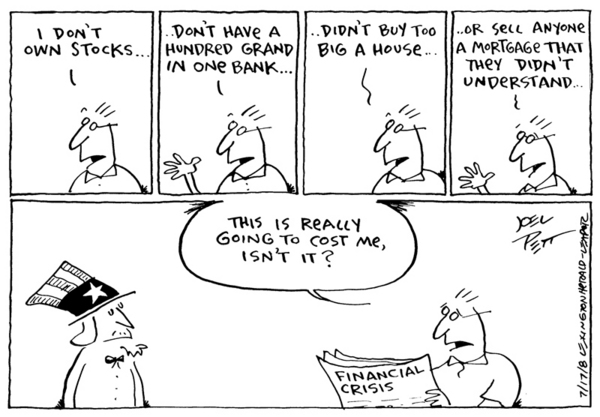
July 22, 2008  Barry Ritholz at The Big Picture had these two comics that brought to the forefront again the issue of moral hazard.   Check out the comics and then we’ll talk “on the other side.”

This is going to get expensive.....

Carry the World on our Shoulders

Okay, now some thoughts about moral hazard:

The definition of moral hazard (as taken from that scholarly journal, Wikipedia):

Moral hazard is the prospect that a party insulated from risk may behave differently from the way it would behave if it were fully exposed to the risk. Moral hazard arises because an individual or institution does not bear the full consequences of its actions, and therefore has a tendency to act less carefully than it otherwise would, leaving another party to bear some responsibility for the consequences of those actions.

Let’s break that down and look at it a little more closely in light of the current market environment:

a party insulated from risk may behave differently…. What that means is that, frankly, the people on Wall Street and the bankers on Main St. (including yours truly) might very well have done things differently over the last few years if we had been more fully exposed to the risk.  Will Fannie or Freddie buy it?   That’s all that most mortgage lenders really cared about when structuring a loan.   On Wall Street, the guys (I’m using that term in a gender neutral sense, okay?) who packaged these loans up and sold them as securities didn’t really care Read more

Update on Fannie and Freddie

Well, it happened.  In case you haven’t heard the news, Fannie and Freddie were bailed out by the Federal Government over the weekend.   I’m not going to go over all of the details but just try to hit some “high points.”

So, here goes:

1. The Federal government now owns 80% of Fannie and Freddie.   That means that the shareholders in those two companies lost 80% of their equity in the company compared to what they had last Friday.

2. Why did the Government do this?   It’s pretty simple.   The markets had lost confidence in the long term viability of the two institutions and therefore the debt that they have issued was being questioned and their ability to finance additional housing was being called in question.   This was done to stabilize and calm the financial sector of the markets which were very volatile to say the least.

3. What has changed since Friday?  A  couple of things:  1) The “unofficial” backing of Fannie and Freddie’s debt by the US Government is now official.   2) The question of what will happen to shareholders in the company has pretty much been answered.

4. What hasn’t changed since Friday?  The problems in the loan portfolios at Fannie and Freddie haven’t gone away.   The problems in the housing market haven’t gone away.  However, today the markets so far have been breathing a huge sigh of relief that says, “Yeah, Uncle Sam is here to protect us!”

So what does this mean going forward?

1. I’ve already heard that a lot of economist are saying that there could be a significant drop in mortgage rates.   I’m not so convinced that we’re going to see THAT BIG of a drop for a couple of reasons:   a) The US Government just became on the hook for an additional $5 Trillion in debt and that will have an impact on the cost of treasury debt and so forth.  b) The additional borrowings by the government are going to have an impact on the value of the dollar and that will make US debt more expensive.   c) The only thing that has Read more

How we got to this place…..

I promise I won’t take up so much space on here after the dust settles, but I’m having a hard time getting my mind around the enormity of what’s happening with Fannie and Freddie and what it means, so I figure the best thing I can do is share what I know with others……

I came across this article in the Wall Street Journal which lays out a good “story” of what has transpired.   I’m going to copy excerpts of it, but I’d urge you to read the whole thing…….

By DEBORAH SOLOMON, SUDEEP REDDY and SUSANNE CRAIG
September 8, 2008

WASHINGTON — In the end, Fannie Mae and Freddie Mac had no choice.

Summoned to separate meetings on Sept. 5 with Treasury Secretary Henry Paulson and other top officials, the two mortgage giants were told they could either agree to a government takeover or one would be foisted upon them.

“We have the grounds to do this on an involuntary basis, and we will go that course if needed,” Mr. Paulson told senior executives at the two companies, who had little idea such a move was coming, according to three people familiar with the meetings.

There was no dramatic trigger, nor was there fear of imminent collapse. Instead, the sweeping government intervention stemmed from a growing realization by Treasury and Federal Reserve officials that the two companies couldn’t survive in their present forms, and that any collapse would be devastating to the economy.

The decision was hashed out over weeks of meetings…….

In the end, Mr. Paulson, Federal Reserve Chairman Ben Bernanke and James Lockhart, head of the companies’ regulator, the Federal Housing Finance Agency, concluded that the two companies had lost the confidence of the markets and couldn’t survive as currently structured. …..

Inside Treasury, the hope was that merely receiving authority to backstop the two companies would comfort markets enough that they could raise capital on their own. ……..

Two things would soon force Treasury’s hand. Uncertainty about Treasury’s plans and how any intervention would affect shareholders caused shares of Fannie and Freddie to fall sharply, making it all but impossible for them to raise equity. At the same Read more

Excerpts from the Press Release about the Death of Fannie and Freddie…..

Treasury Press Release

I have clearly stated three critical objectives: providing stability to financial markets, supporting the availability of mortgage finance, and protecting taxpayers – both by minimizing the near term costs to the taxpayer and by setting policymakers on a course to resolve the systemic risk created by the inherent conflict in the GSE structure.

What he’s talking about in terms of the inherent conflict is that Fannie and Freddie are essentially government institutions with shareholders and that creates a conflict of who do they serve – the shareholders or the common good?

I attribute the need for today’s action primarily to the inherent conflict and flawed business model embedded in the GSE structure, and to the ongoing housing correction. GSE managements and their Boards are responsible for neither. New CEOs supported by new non-executive Chairmen have taken over management of the enterprises, and we hope and expect that the vast majority of key professionals will remain in their jobs.

Out with the old, in with the new – and we hope that the main people besides for upper management don’t leave.

First, Treasury and FHFA have established Preferred Stock Purchase Agreements, contractual agreements between the Treasury and the conserved entities. Under these agreements, Treasury will ensure that each company maintains a positive net worth.

That means that if Fannie or Freddie has a bad quarter and loses enough so that they become upside down, we get to turn on the faucet and fill them up with more cash.   Your cash and mine.

It is more efficient than a one-time equity injection, because it will be used only as needed and on terms that Treasury has set.

On an as needed basis – as often as needed and on terms the Treasury has set (only when they go negative).

Market discipline is best served when shareholders bear both the risk and the reward of their investment. While conservatorship does not eliminate the common stock, it does place common shareholders last in terms of claims on the assets of the enterprise.

If you hold common stock in Fannie or Freddie, you are the first one to get hit with the losses.

Similarly, Read more

A Eulogy….

Dearly Beloved:

We gather here to commemorate the dearly departed who’s passing we mourn today. I’d like us to take a few moments to dwell on the lives that were lived, the good that was done, and the ways we can learn from their excesses.

Fannie lived a good long life. She came to this earth during the Depression and spent many many years doing good and helping many many people live the American Dream and buy a house of their own and benefit from long term fixed and affordable mortgages.

Later in life, Fannie’s younger brother came on the scene. Freddie, beset with a case of sibling rivalry, attempted to outdo his older sister. First Freddie attempted to do the same thing that Fannie did and all was well. Competition was good, it kept the siblings honest and many people benefited.

But as Fannie grew older, she began to resent her younger sibling. He was younger, less experienced, but kept up with his older sibling quite well. As the sibling rivalry grew, more risks were taken. In their attempts to outdo each other, greed and corruption took over. Risks were taken and increasingly risky behavior was considered acceptable.

Over the years, the markets responded very well to Fannie and Freddie’s increasingly competitive and risky behaviors. More and more people were able to live the American Dream until the American Dream became too expensive. Suddenly, the risky behaviors that Fannie and Freddie were engaging in weren’t paying off quite as well.

Initially, Fannie and Freddie seemed fine, but later it was determined that the risky behaviors had caused significant internal damage. Many efforts were made to revive them and bring them back to full health. The medical bills have been staggering and the efforts were heroic. But, alas, it was too late.

Rest in peace, dear brother and sister. Know that you’ve done well and helped many over the years. Know that the lessons that we’ve all learned from you will echo throughout the years: Know your limits, be responsible, don’t let greed run rampant.

In Memory of our Dearly Departed, I ask that you join me Read more