There’s always something to howl about.

Category: Lending (page 46 of 56)

A Realtor’s Life: Deeply Spiritual and Cheesier

I admit my mind works a little differently than most – I like to write and talk about things that are current – so, in light of the past week’s recent events, I decided that I wanted to correlate last week’s LA earthquake, the current credit crunch and my recent trips to Costco into a meaningful discussion regarding real estate.  Surprisingly, there is a high correlation.

I have a habit of sharing my addictions as many of you well know – caffiene – and yes, Costco – sad to say, I often find myself “dining-out” with the combo pizza, occasionally the chicken caesar salad, 2 hotdogs (for my dogs) and let’s face it – the 2 drinks are essentially free.  Critical in today’s tough economic times.

You ask – how is this even remotely relevant?  Well – after hearing the news regarding the quake, and the follow-up public service announcements locally on the radio questioning what my emergency plan is in the event of an actual emergency – have I made the necessary arrangements for 72 hours of provisions – bottled water, food, batteries etc?

I immediately thought – I need to go to Costco.

Prior to my almost twice weekly adventure – mind you there are 2 of us plus 2 dogs – I checked to see what I needed – a quick scan of the pantry revealed 36 boxes of Mac & Cheese, 24 rolls for toilet paper, 72 bottles of water, two 128 fluid oz bottles of Neutrogena handwash – fridge check – 4 gallons of milk, 36 eggs, 128 oz of mayo and 48 slices of Timberlake muenster cheese.   Hmm – no batteries.

Off to Costco.

Being a Sagitarius, I am by nature an optimist, however, in light of my chosen profession, I am becoming intimately familiar with actual emergencies – the professional kind.  I’ve negotiated some tough deals, fended off irrate clients – but the emergencies I am speaking of are realtor’s-life threatening.  I Twittered briefly today with fellow “hound” Tom Vanderwell regarding Meredith Whitney’s interview on CNNMoney.com regarding the nature of the credit market.  She has a fairly solid track Read more

Mortgage Market Week in Review

Is it just me, or do Fridays keep coming around faster and faster? Maybe it’s because I’m so young!

Any way, it’s time for our “Mortgage Market Week in Review.” We’re going to focus on a couple of main topics for today:

Jobs – the ADP report came out on Wednesday and had some relatively positive news. That brought a lot of people in the markets thinking that the jobs report that came out this morning would be a lot more positive than the markets had been expecting. Well, we got to this morning and it came out “moderate.” The market had expected 70,000 losses and we only got 51000 losses. We had expected 5.6% unemployment and we got 5.7%. So, not too bad, but not too good either. However, I’ve read some technical analysis that said that due to some accounting regulations (known as the birth death of businesses adjustments) these numbers are probably overstating things to the positive. That means that next month, these numbers will probably get revised downward.

Losses – talk about missing a target here, wow. General Motors announced that they lost $15 billion this quarter. Think about it, that’s a lot of money. Even if you take out the “one time” expenses, that is still a LOT of money (like maybe $6 billion, I think the number was.) I read today that GM has now “eaten up” all of their profits that they have made since 1985. That means that a profit and loss statement for the last 23 years for General Motors would end up with a big fat $0. In addition to them, Deutsche Bank announce a 64% drop in profits and Merrill Lynch announced some staggeringly negative numbers too.

House prices made a lot of news this week. Alan Greenspan was talking about them and several others also made a lot of noise about what’s happening with house prices. Check out the chart here to give you a good flavor of the regionality of housing prices and how not all areas are seeing the same numbers.

The Housing BillRead more

Before They Get It, Make Sure They Get It.

For many buyers’ agents, there are two distinct stages in a real estate transaction.  I know, it may seem like there are many, but in the broadest sense there are only two.  You might call them the Age of Enlightenment and the Dark Ages.

The first stage is when you do most of the work with your client.  From the marketing that first attracts them to the countless showings and all the way to writing an offer and negotiating that last counter before acceptance.  This can be called the Age of Enlightenment.

The second stage, the Dark Ages, often begins just about the time you recommend a lender or two and begin the loan process.  I have heard agents describe this as akin to pushing the contract, the client, the paperwork AND their commission check into a gaping black hole… of silence… then waiting, hoping and praying a deal will come out the other end.

There are a number of reasons for this, most of them beyond the lender’s control, same as yours.  Underwriting guidelines are changing on an almost daily basis.  The actual loan options have decreased just a tad.  Sort of like Basking Robbins 31 Flavors suddenly going down to two flavors… and raising the price while they were at it.  But there is one aspect you have a lot of control over when recommending a lender: the lender themselves.

When it comes to choosing which lenders to keep on your short list, referrals are certainly important and past performance is great, but I also highly recommend you ask a single, all-important question.  Whether interviewing a lender for the first time or seeing your regular lender, stand straight and tall, look them in the eyes and ask this question:  “Mr/Ms Lender, by recommending you to my client I am also commending my commission to you.  In other words, I am handing you $5000, $10,000, $20,000 of my money in hopes of getting it back in a couple of weeks.  Why should I do that?”

If they cannot convey to you that they get it… if they cannot immediately give you a valid, even outstanding Read more

The Buck Stops Where?

Ya know – I’ve decided that I want run for Congress – my dilemma: overcoming the paradigm that one aspires to move up and not – um – down. BUT! Just think of all the fun I’d have riding the train under The Capitol – sitting in convertibles waving at my constituents in parades, playing golf with my lobbiest “buddies” – Ahhhh – what a LIFE!

Honestly, though – I think the best part would be sitting in commitees and writing legislation. Imagine sitting in a big room covered in mahogany wainscoting, sitting in a cordovan leather highback chair behind the massive, hand carved desk with my BIG brass name tag in front of me -I might even have a microphone in front of me. My voice would boom while speaking down to the little peop – er – constituents – um – not MY constituents, but constituents nonetheless.

My esteemed colleague would be standing behind me whispering where the guys were going to meet up for drinks after the hearing while the pathetic homeowner in front of me goes on and ON AND ON about how some slick mortgage broker sold him a bill of goods and now he can’t make his mortgage payment. But I feign to listen because it’s only for a few hours and then I get to ride the under ground train with my buds ‘cuz tonight I’m drinkin’ and schmoozing with da bankers!

Just think about it! I’d get to drink single malt scotch while Jimbo Biggidy Big Banker throws his arm around my shoulder, pulls me aside – walks me out on the patio at The Capital Grille, hands me a cigar and tells me that those wacky Wall Street boys – ha ha – you know the type – custom shirts and suits from Hong Kong – well they really blew it. Look at ALL that hell they’ve caused.

Jimbo likes to talk in the third person.

Tommy – Jimbo’s bank is losing money. How was Jimbo supposed to know that people weren’t going to be Read more

Mortgage Market Week in Review

Well, here we are on Friday again and I’m trying to figure out how to summarize all that’s been happening in the mortgage and financial worlds.   I could write a book about it, but I won’t (at least not today….)
So, here goes:
The week started out with Wachovia (the 4th largest bank in the country) announcing that they were getting out of wholesale lending.   That started a lot of people wondering how bad things were at Wachovia because Indymac announced that on a Monday and by Friday they were shut down.    On Tuesday, Wachovia announced that they lost a LOT of money ($8.9 billion to be exact) in the 2nd quarter.   But guess what, their CEO stood up and said, “I’m confident that we’re going to be fine,” and their stock went up.
Then we move on to our dear friends at Washington Mutual and they only announced a loss of $5.9 billion and announced that they were going to initiate cost cutting measures that will save them $1 billion.  Oh and their CEO stood up and said, “We aren’t going to need to raise any more money.”   And their stock went up.
In the interest of full disclosure, Fifth Third announced our earnings (losses) for the quarter.   Compared to these two, we did quite well, but we didn’t do as good as we’d like.   We came in down $202 million for the quarter.   But our CEO stood up and said, “We’ve made adjustments, we’ve raised additional money and we’ll be fine.”   Guess what our stock did?  Yep, it went up.
Existing Home Sales came in lower than expectations.   If you’ve been reading this for a while, you know my feelings on the year over year comparisons.   We’ve moved into a new market and comparing last year to this year is like comparing me to Tiger Woods.   There is no comparison because we aren’t even on the same playing field.
Weekly unemployment claims came in higher than expected.

National City came out and announced a huge loss for the 2nd quarter – $1.78 billion.   Their CEO stood up and said (Well, Read more

The Top 7 Things Every Home Buyer Should Know…..

Okay, yesterday, I dealt with the theoretical and philosphical in our discussion of moral hazard.   Almost more of a topic for a college class than a blog about the mortgage world, don’t you think?

Well, today we’re going to get more into the every day nitty gritty with the Top 7 things (in random order) that I think everyone who is looking to buy or sell in today’s market needs to know:

1. 6 months ago is ancient history. What your neighbor sold his house for 6 months ago doesn’t matter.   What the seller was asking for the house 6 months ago doesn’t matter.   What matters is what the market will support today.

2. Don’t worry so much about what you paid for your house. Instead, look at the difference between what you can expect to sell your house for and what it’s going to cost you to buy the new one that you want.   I expect you’ll find that those are much more important numbers (unless you end up without any equity in which case you don’t sell).

3. Now is not the time for do-it-yourselfers. When the inventory levels are, depending on property type and area, any where from twice as much as is healthy (single family homes near my hometown) to 750% as much inventory as there should be (condos in Florida from what I’ve heard), you need to find a professional to help you navigate the markets and get your house noticed.   I’m not, frankly, just talking about calling the Realtor who sold the house up the street.  I’m talking about calling a high caliber professional who knows what it takes and can really give your house the attention that it needs.   People like Greg and Teri and Jeff are examples of the types of Realtors who have the knowledge and talent to help you navigate through this market and make wise decisions.

4. Any interest rate that starts with a 6 is a good number. Check out the attached chart.   From 1971 to 1998, we did not see any mortgage rates that started with a 6.   Frankly, we’ve gotten spoiled in Read more

Moral Hazard….

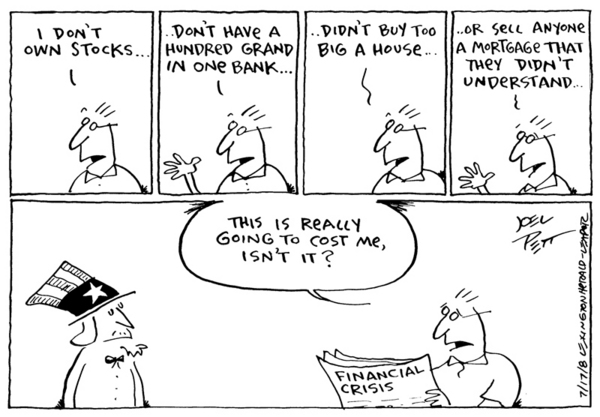
Barry Ritholz at The Big Picture had these two comics that brought to the forefront again the issue of moral hazard. Check out the comics and then we’ll talk “on the other side.”

This is going to get expensive.....

Carry the World on our Shoulders

Okay, now some thoughts about moral hazard:

The definition of moral hazard (as taken from that scholarly journal, Wikipedia):

Moral hazard is the prospect that a party insulated from risk may behave differently from the way it would behave if it were fully exposed to the risk. Moral hazard arises because an individual or institution does not bear the full consequences of its actions, and therefore has a tendency to act less carefully than it otherwise would, leaving another party to bear some responsibility for the consequences of those actions.

Let’s break that down and look at it a little more closely in light of the current market environment:

a party insulated from risk may behave differently…. What that means is that, frankly, the people on Wall Street and the bankers on Main St. (including yours truly) might very well have done things differently over the last few years if we had been more fully exposed to the risk. Will Fannie or Freddie buy it? That’s all that most mortgage lenders really cared about when structuring a loan. On Wall Street, the guys (I’m using that term in a gender neutral sense, okay?) who packaged these loans up and sold them as securities didn’t really care how they performed, all they cared about was the great big fat commissions that they made. The rating agencies didn’t care about whether they really told the truth about these mortgage backed securities, all they cared about was getting the big fat commission checks.

And so what do we have now? We have, between Wachovia and Washington Mutual, $10.1 billion in loan loss provisions in the last 12 hours. That’s for a period of 90 days folks. I was going to figure out the cost per day but my calculator doesn’t crunch numbers that big!

Moral hazard arises because an individual or institution does not bear Read more

Mortgage Market Week in Review

Well, believe it or not, we’ve made it through another week.   And wow, what a week it’s been.   I’m going to try a little bit of a different “scenario” for this week’s Mortgage Market Week in Review.   Rather than trying to tell you everything that’s been happening this week (it would be a REALLY long story) I’m going to try to hit the highlights (or low lights if you will) of what’s been happening.
So, here goes:
1. Starting with last Friday afternoon, we found out that IndyMac Bank (in California) was closed by the FDIC. It’s the largest bank or savings institution that has failed and approximately 10,000 of their clients had more funds in IndyMac bank than was covered by FDIC insurance and will therefore lose a lot of money.   This started the week on a very negative note as the financial markets started getting a serious case of “Who’s next?” worries about the banking world.
2. Chairman Bernanke of the Federal Reserve and Secretary Paulson of the Treasury testified before Congress on Tuesday and Wednesday.   I’m going to give you an extremely abbreviated version (my opinion) of what he said:  1) The economy is not out of the woods, it’s actually not even close to the edge of the forest.   2) Fannie Mae and Freddie Mac are very important to the health of our country’s economy and we are putting these “rescue efforts” in place not because Fannie and Freddie need it now, but strictly because we want the markets to be comfortable that they won’t fail.  3) Right now the risks to the economy from the credit crisis significantly outweigh the risks to the economy due to inflation (meaning rates won’t go up any time soon – at least the rates that they control).
3. The “it’s not so bad” syndrome started taking hold on Wednesday.   What’s that?   I guess I’d describe it this way.   You have a house with a very nice deck and a screened in porch on the back.   A storm comes through and a tree gets knocked down and it falls on your deck Read more

Don’t learn all the wrong lessons about creative mortgages

This is my column for last week from the Arizona Republic (permanent link).

 
Don’t learn all the wrong lessons about creative mortgages

Arguably, the Phoenix real estate market is in a state of incipient recovery. Will there be more bad news? Certainly. There are still thousands of homes stuck in the foreclosure process. But prices are low enough, by now, that our surplus inventory will be absorbed — by investors, new-comers and second-home bargain-hunters.

The bad news is that, at the end of all this, we will have learned all the wrong lessons from the real estate market downturn.

Are Adjustable Rate Mortgages a bad thing? People learned to hate the first generation of ARMs, so lenders built in guaranteed flat starter rates, fixed adjustment periods, maximum adjustment caps. But even with all that, ARMs came through the down market with a sullied reputation. With fixed rates still riding so low, ARMs don’t make a lot of sense right now, but that doesn’t mean they never make sense.

How about stated-income loans? Many of the foreclosed homes in the Valley were bought on stated income. But the problem wasn’t the loans, it was the buyers — who lied about their income — and the lenders — who let them get away with it.

Negative-amortization loans were another source of foreclosures, even though the idea behind the loan product itself is perfectly sound — in an appreciating real estate market.

The problem with all these loan products — and other “exotics” — was not the particular loan program. The problem was the profligacy of a surging real estate market — coupled with the securitization of mortgages.

Everyone acted as if the party would never end, that home prices would continue to rise indefinitely. Still worse, lenders had socialized the risk of their poorly-vetted loans to securities investors. Ultimately, lenders didn’t have to care if their loans were properly secured by good credit, steady income and valuable assets.

You can blame the people involved if you want, but don’t blame creative mortgage programs. Everything’s a trade-off, and it could make sense for you to get a stated neg-am ARM for your next Read more

Brainstorming – an attempt to tap the collective wisdom of the readership….

Okay, I want to try to do a little brainstorming here.   Let me lay out what I’m thinking….

I had a conversation (about an hour and a half long) with a local Realtor who has been in the business for over 20  years.   We were talking about the current state of the housing and financial markets.   She made a comment and raised a question that I’ve got my own thoughts on, but I’d like to hear from the collective wisdom of the group.

The comment that she made was this:   “I think that the majority of our clients and consumers as a whole don’t have a clue as to what’s going on in the economy, what’s going on in the housing market and what’s going on in the banking world.”

The question she had was:  “What can we, as Realtors and lenders, do to educate and inform people in our markets so that they can wisely navigate through the market that we’re in?”

That got me thinking, are we, as the professionals who really understand (more than most) what’s happening in the market, really doing what we should to help people who want or need to either buy, sell or refinance in today’s turbulent markets?

I’d love to hear what the group has to say.  What are  you doing?   How’s it working?   I’m hoping we can raise the bar for all of us and help us all be better advocates for our clients.

What do you think?

Thanks in advance,

Tom Vanderwell

Update on the Fannie and Freddie Issue

Okay, here’s an overview of my take on the Fannie Freddie issue:

Do you think the Stock Markets like the Fannie Freddie Bailout?

Do you think the Stock Markets like the Fannie Freddie Bailout?

Uh, that would be a classic example of an initial elation followed by the let down that comes from looking at the details.   I’m not going to get into the details of exactly what was offered, but to focus more on the big picture instead.

So here’s the big picture (in my opinion):

1. The government has acknowledged officially that Fannie and Freddie are financially in trouble.

2. They have also indicated that they are not going to let Fannie and Freddie fail.

3. The Treasury got out their bandaids and have attempted to put a bandaid on the situation.

4. As part of their bandaid solution, they are essentially obligating the entire government and therefore the tax payers, to pay for Fannie and Freddie’s losses.

The markets initially said, “Yeah!  The government isn’t going to let Fannie and Freddie fail!   Our worries over!”

Then the markets looked at the details and said, “Uh, wait a minute, I’m not sure this is really going to work….”

The government is going to be able to prop up “publicly traded companies” by buying stock in them?   Under what rules?

What really happened at IndyMac bank?   Are there really 10,000 people who are going to lose money in a bank?   What’s that going to do to the rest of the banks?

If we’re going to bail out Fannie and Freddie, what impact is that going to have on the Fed’s financial position?   What’s that going to do the overall borrowing costs for the government?   How much of a hit are us taxpayers going to take for all of this?  These are all of the questions that are circulating out there.

Are there any solid answers?  There’s probably only one solid answer.   Ben Bernanke has done a huge amount of studying of the Great Depression and he firmly believes that the 1927 real estate crash caused the depression.   You can be certain that he’s going to do everything in his power to make sure that doesn’t happen again.

Will there be pain?  Yep, will there be Read more

Mortgage Market Week in Review – Fannie and Freddie

Okay, here it is Friday afternoon and time to write the “Mortgage Market Week in Review.” You know how some newscasts warn you to tell the kids to go in the other room because what comes on next isn’t going to be pretty? Well, there aren’t any pictures but what’s happening in the financial world is not pretty right now. If you’re squeamish, you might want to wait to read this until after you’ve eaten. So here goes:

The battle that’s waging right has now settled quite firmly in the “credit crisis” camp. Here’s what’s been happening on that front:
Indymac Bank (who?) They have a good sized branch presence in Southern California but did a lot of mortgage lending on the wholesale side. They announced that they are effectively ending their writing of residential mortgages and buying residential mortgages from brokers (with the exception of retail staff at their branches in California). How does the song go, “Another one bites the dust?”
Lehman – this time it’s not a mortgage company, it’s another investment bank (remember Bear Stearns?). They’ve spent a lot of time this week trying to dispel rumors that they are in trouble and trying to show that they actually have enough capital (aka cash) to make things work. It sounds a lot like what was being said before Bear Stearns almost went under and almost brought the entire financial system down with them.
and now for the big issue of the week:

Fannie and Freddie: Yep, I put them in bold print and underlined because they are, in my mind, infinitely more important to the housing and mortgage market than what Indymac or Lehman are. So what’s up with Fannie and Freddie? Here’s an overview:
1. They are experiencing substantial losses. Somewhere in the neighborhood of $11 Billion (that’s $11,000,000,000) so far this year.
2. Many analysts are raising questions about whether they have enough capital to keep functioning the way they are.
3. They currently control over $5 Trillion Read more

5 Minutes On “Why Now Is A Good Time To Buy”

Old-fashioned microphoneI gave a quick radio interview this week that may worth a listen.  It’s another take on “Why Now Is A Good Time To Buy” from the mortgage guy’s perspective.

Some of the highlights:

  • Getting a mortgage approval is likely to get tougher
  • FHA is increasing its fees and Fannie and Freddie are likely to follow
  • Why banks are turning down loans with 50 percent downpayments
  • How the election is playing into consumer confidence

Mortgage markets are a pendulum and, right now, we’re swinging to the rough side.  Give a listen, find your talking points, and help your clients understand what’s coming down the pipe.

(Image courtesy: davebytes.com)

IndyMac Bank To Close?

Depositors are fleeing because legislators are pressing.

But depositors may have been spooked by a letter late last week from Sen. Charles E. Schumer (D-N.Y.) to the Federal Deposit Insurance Corp., the Office of Thrift Supervision and the Federal Home Loan Bank of San Francisco, saying he was “concerned that IndyMac’s financial deterioration poses significant risks to both taxpayers and borrowers.”

IndyMac Bank is shrinking.  From their corporate blog:

As a result of the above, we have made the difficult decision, effective July 7, 2008, that we will no longer accept any new loan submissions or rate locks in our retail and wholesale forward mortgage lending channels, except for our servicing retention channel. We plan to honor all of our existing rate-locked loans and will continue to fund these loans in the coming weeks. While the managers and employees in these units have worked incredibly hard, these units are not currently profitable due to the continuing erosion of the housing and mortgage markets. At the same time, these operations take up significant balance sheet capacity and “feed” growth in the servicing asset, an asset we need to shrink given its size relative to our existing capital.

Damn !  Another good bunch of people jobless.

This isn’t the big one.  Expect a BIG bank to go belly up later this year.  I’m completely guessing but my money would be on WaMu or Wachovia.

Mortgage Market Week in Review

Since it’s a long holiday weekend, I’m posting my week in review today rather than the usual Friday.   I hope you all have a chance to enjoy a lot of good family times, some good weather, some good fireworks and LOTS of good food!
How to best summarize this week?   Let’s put it this way, I could go on and on and on about the different economic reports that came out.   Car sales, employment numbers, stock prices, oil prices, bank stock values, earnings (or a lack of), writedowns, the list could go on and on and so would the length of this post!
Instead of doing that, I’m going to point you back to an update I wrote on June 11 that talks about the “battle” that is waging in the markets.   How’s the best way to say it?
A couple of weeks ago, the inflation fears were winning.
Now the credit fears and economic fears are winning the battle, quite decisively.
Have a good weekend!
Tom