There’s always something to howl about.

Category: Lending (page 54 of 56)

How Big Is the Sub-Prime Mortgage Market? Not very big at all

Cited by BusinessWeek Online, a very eye-opening analysis of the sub-prime mess from National Review Online:

I’ve thought a lot about Rain Man over the past few months as I’ve been following the press coverage of the sub-prime mortgage crisis. The story’s been on the front page of the Wall Street Journal nearly every day. Pretty much every show on CNBC — except Kudlow & Co. and one or two others — has been obsessed with the topic. Yet no one seems to be asking the Rain Man question: “How big is the sub-prime mortgage market?”

And the answer, as Ben Stein makes clear, is not very big at all.

Currently there are about 44 million mortgages in the U.S., and less than 14 percent of them are sub-prime. And only about 13 percent of those are late on payments, with the majority of late payers working through their problems with the banks.

So, all in all, when you work through the details and get down to the number that really matters, only about 0.6 percent of U.S. mortgages are currently in foreclosure. That’s up a hair from roughly 0.5 percent last year. That’s it.
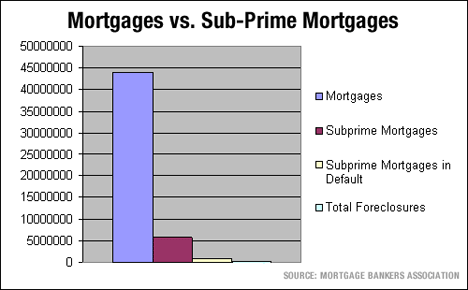
Actually, that’s not it. Things are actually better than the numbers suggest, since sub-prime-mortgage homes are less expensive than prime-mortgage homes. This makes sense. Wealthier people, generally, can afford costlier homes than less-wealthy people. The recent sub-prime surge brought large numbers of moderate-income families into the home-ownership market, and their houses are less expensive than most. Therefore, the dollar impact of the sub-prime default is smaller than if it were a prime default.

With approximately 254,000 mortgages in foreclosure at the moment — up from roughly 219,000 last year — the sub-prime meltdown has given us an increase of 35,000 mortgage foreclosures over the last quarter. Since the average sub-prime mortgage clocks in at almost exactly $200,000, we’re looking at an approximate $7 billion increase in foreclosed value in the first quarter of this year.

Raymond, how big is household net worth in the U.S.? About a hundred dollars?

Actually, it’s a lot bigger than that — about $53 trillion. In other words, the Read more
Mortgage meltdown? The end of the world has been delayed again

This is me from the Arizona Republic (permanent link):

 
Mortgage meltdown? The end of the world has been delayed again

If you watch the TV news, you can’t miss the video clips of financial pundits screeching about the imminent collapse of the mortgage industry. In fact, the world probably cannot end more often than once or twice a day, but it’s worthwhile to remember that television is an entertainment medium. Financial news is inherently boring — unless it’s reported by a shrill demagogue.

So what’s really going on?

Investors are pulling the plug on the most liberal — or most willfully gullible — mortgage underwriting firms. Investment banks that bought or brokered portfolios of shaky loans are also suffering.

Does this mean you can’t get a home loan? Not at all. You just need verifiable income, good credit and a down payment. That wouldn’t even sound odd if we had not lived through 2005, when all you needed was a reliable pulse.

What really happened in the home loan market? There was so much money available, and homes were appreciating so quickly, that some lenders stopped worrying about the financial qualifications of borrowers.

Has there been a surge in foreclosures? Yes. Had there been a substantial number of loans made to high-risk borrowers? Yes. We’re paying the piper now, that’s all.

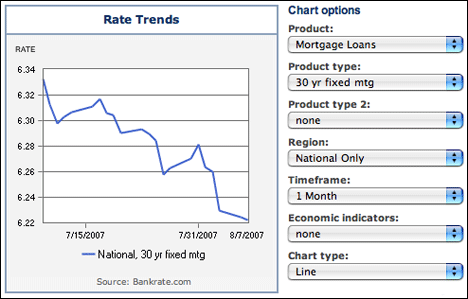
There is still plenty of money in the mortgage market, but guidelines are stricter. Nothing-down loans are harder to obtain, as are stated-income loans. Some lenders are charging higher rates for jumbo loans — amounts over $417,000. But the rates for a 30-year conforming fixed-rate mortgage — the bread-and-butter home loan — are actually down. This fact will have been omitted by the demagogues on TV.

While things shake out, sellers will want to stay on top of their buyers’ loans, and buyers might want to ask their lenders to submit their files to more than one underwriter. Some parts of the Valley are suffering more than others, but buyers are buying, sellers are selling and home values are holding up fairly well through the down-turn. It would seem that the end of the world, contrary to televised reports, Read more

When Lenders Stop Lending, Another Lender Lends.

The title is a funny play on words from advice Jeff Brown and Ron Feinberg gave me last week. When I returned from Inman last week, the market started melting down. I pride myself on my cool head but some days the Awshits sneak up and dominate my mind; Friday was one of those days.

IndyMac- discontinued neg-am

Bear Stearns- repriced neg ams by adding 2.25 points to the fee (thievery)

American Brokers Conduit- I didn’t know they were owned by American Home Mortgage until it was too late.

World Savings- a workable solution but their margins are so expensive. Now, they’re cheaper than the rest.

Jeff Brown told me that some smart company would figure out the void in the market in less than one month. Ron Feinberg said six weeks. I called the 2-3 borrowers and explained that the repricing may have made the neg-am loans a poor recommendation; it just didn’t fit into the plan I had created for them.

Look who slipped in the back door with killer pricing and terms. I’ll be damned! It took less than a week!

The Carnival of Real Estate . . .

…is up at RealEstateUndressed. Host Larry Cragun got around our having broken the rules on entries by breaking all the rules. In consequence, this week there will be two consumer-focused real estate carnivals and no Carnival of Real Estate.

Even so, our friend John L. Wake took second place with Landscape staging your home.

Michael Cook came in fifth with Can I Still Get a Mortgage in Today’s Lending Markets? With Cold Hard Cash and Great Credit, Certainly; Otherwise?

I respect the right of each weekly judge to do what he or she wants about the Carnival — the lord knows we do. But much more than that, I respect, admire, revere and exalt actual excellence in real estate weblogging. We’re going to do something different from now on. News later

Technorati Tags: , , ,

Wagging the dog at the Carnival of Real Estate

Our policy is that Cathleen Collins chooses our nominees for real estate carnivals. I trust her to be objective, particularly about my posts. The contributors are polled for nominations on Saturday night, with their suggestions going to Cathy. Sometimes I overrule her, and sometimes she asks me to cover for her.

This week, Cathy got her short list down to four posts, one each by Morgan Brown, Kris Berg, Brian Brady and me, but she didn’t want to choose from there. She threw it over to me — heavy hangs the head.

I checked and saw that nine of our fifteen contributors had written in the past week. So I entered everything of moment from each of us. That’s a violation of the Carnival of Real Estate rules, but this is my attitude: If we’re going to lose anyway, let’s lose our own way.

These were the posts that I entered, starting with Cathy’s short list:

Morgan Brown:

Kris Berg:

Brian Brady:

Greg Swann:

Michael Cook:

The Mortgage Tax Act of 2007

Michael Cook did an excellent job explaining the two noteworthy debacles of last week. American Home Mortgage went belly up and Bear Stearns may be downgraded to a negative rating. Thursday afternoon, Angelo Mozilo of Countrywide Financial, did his best Nero impression by muttering two words to analysts; “Don’t Worry“.

Mr. Mozilo may be parroting Bobby Mc Ferrin but the rest of the lenders aren’t. Non-conforming lenders readjusted to what they now call “risk-adjustment” pricing. Basically, at Wall Street’s direction, the large lenders added about a 1% fee to the stated income and no income documentation loan programs. Loans that conform to FNMA or FHLMC guidelines, with verified income and assets, remain at their original pricing. There still are 100% financing programs available to those with good credit and the ability to make the payments.

Have borrowers who choose not to disclose income documentation become personae non gratae overnight? Not really. We have always known that light documentation borrowers, who can not demonstrate an ability to repay the loans, have been a higher risk. There has always been a price adjustment for that risk. Large down payments (20-30%) used to be the norm for those programs. It wasn’t until after our country was attacked, in September of 2001, that Wall Street started reaching for yield. The easy money policy and anemic stock market of that post-attack economy left the investment bankers STARVED for business; they found that business in high risk home borrowers.

This brings us to the Mortgage Tax Act of 2007. The way out of this mess is to originate more product. That sounds counterintuitive, doesn’t it? Well, if lenders can originate more loans, they can spread the risk across more assets. The risky loans (stated and no doc) now have a higher risk adjustment. That risk-classified pricing model is not unlike the insurance industry’s move to segregate tobacco users from non-tobacco users. Smokers are charged a higher insurance premium than non-smokers because their life expectancy is lower. That’s what the lenders Read more

Expect a Market Slowdown: A quick thought piece for the more financially minded…

Buyers and sellers should be aware of a general economic slow down in all markets. Everyone will feel the effect of the leverage finance and subprime markets. Since I have been writing about the subprime markets for quite some time, I will focus briefly on the effects of the decline in the leverage finance market.

Leverage finance typically covers loans banks and other financial institutions lend to corporations or large private buyers. Companies like Blackstone use the leverage finance market to buyout companies and REITs. Over the past few years there has been a significant up-tick in Mergers & Acquisitions, leading to strong economic growth. As finance markets close (or shrink significantly) businesses will be less able to get large loans at favorable rates. As buyouts and mergers shrink, expect a dip in the equity markets. Looking at the Dow over the past week bears this out.

Very few people beyond the financial community pay attention to the leverage finance markets. These markets significantly impact the large commercial real estate market. When financing tightens at the top, the price effects trickle down. This could mean a significant negative impact on the commercial real estate market is coming.

All of this will create a drag on the economy, which will serve to slow down most, if not all, real estate markets. Unfortunately this could force even more defaults, putting many real estate markets in quite a tailspin. Buyers with excellent credit that can afford to wait six months to a year to buy will have their pick in most minor markets and increased negotiating leverage in major markets.

Can I Still Get a Mortgage in Today’s Lending Markets? With Cold Hard Cash and Great Credit, Certainly; Otherwise…

On Friday, August 3rd American Home Mortgage officially closed its doors. That same week Standard & Poor’s cut its outlook on Bear Stearns from stable to negative amid fears of firm wide exposure to subprime lending and the leverage finance market. If all that were not bad enough, the leveraged financed market has essentially shut down. The questions on everyone’s mind are: What is next, how will this affect the housing market, and will loans be available in the near future?

To start on a positive note, yes, there will be plenty of loans available in the near future. Unfortunately these loans will only be available to borrowers with good to excellent credit, who have a reasonable down payment (5-10%). Mortgage lenders and banks have gone beyond scared to downright petrified because they can only see the tip of the iceberg. For the readers out there who are not familiar with icebergs, typically everything above the surface (what one could see) represents 10% of the total mass of the iceberg.

Continuing with that analogy, most analysts expect this situation to get significantly worse before it gets better. While Bear Stearns and American Home Mortgage have been the latest news whipping boy, the market has quietly downgraded many (if not all) banks and mortgage lenders. Furthermore, banks know exactly what they are holding, whether they admit it or not. To soften the final blow, expect them to raise rates, charge higher fees, and tighten their approval process. Even though many financial institutions are being very hush-hush about how much of the bag they are holding, they are diligently working to limit any future exposure.

For a borrower that means anything outside of plain vanilla conforming loans will be very hard to come by. But we here at Bloodhound would be remiss if we only gave readers the gloom and doom story. Despite all of this, here are some suggestions that might help ease some of the burden for those currently looking for financing.

Get a GREAT Mortgage Broker

While this could be my Bloodhound tag line, this is the time where it will pay dividends. Many lenders Read more

Ask the Broker- Did I Invest in a Sub-Prime Mortgage?

Scott asks:

How can you tell if you have a sub-prime mortgage bond in a portfolio?

Scott, I’m taking a stab at this. I haven’t sold securities in 14 years. Mortgage-backed securities, in the early 90s, were mostly Ginnie Mae pass-through certificates or Agency-issued pass-throughs and collateralized mortgage obligations (CMOs). There were a few CMOs, issued by non-agency issuers, that may have contained a non-prime loan or two to “juice the yield”. Collateralized Debt Obligations, generally devoid of whole loan mortgages, may have been infiltrated these past few years.

How about this, Scott? I can’t say IF you have a sub prime loan in your portfolio. I can say that sub prime loans won’t be collateralizing GNMA, FNMA, or FHLMC issues. If you own an instrument comprised of primarily these issues, you should be in the clear.

Michael, your more current knowledge and experience might be more precise.

Inman Connect Grand Poobahthon: Stinton: ‘Freedom stinks worse than banks in real estate’; Singer: ‘The only trouble with the MLS is the MLS — and the agents’; Barton: ‘I have visions of gesticulating green-grocers, so that must be good for real estate’

I can’t think of any argument against oral presentations better than the stuff that comes out of the mouths of the people making them.

From InmanBlog, NAR CEO Dale Stinton says:

“If there ever was a case study for banks staying out of real estate it’s the subprime market.” He also said that the subprime situation is an example of the “inevitability of an open society,” “of going too far, too fast,” and “of liquidity in the marketplaces.”

See, it was the lenders who caused these problems, not the sacrosanct tax giveaways to homeowners and real estate investors. And god spare us all from an “an open society” (that is to say, not a police state) and “liquidity in the marketplaces” (money, that is). I’m thinking Stinton had to borrow extra feet from Glenn Kelman to put in his mouth.

Joel Singer, “president of real estate business services for the California Association of Realtors,” was not to be outdone:

“The brokerage industry to a large degree has ceded too much power to the agents. Once you have entrenched power … more importantly, once you have entrenched economic power — the economics are that the MLSs actually have more funding than the organized real estate itself — it becomes very difficult to overcome that.”

I think that says that the obstacle to MLS reform is posed by the MLS systems themselves, which leads me to expect a radical legislative intervention. If you’re a real estate licensee but not an brokerage owner or designated broker, hide your wallet.

But: The prize would seem to go to Zillow.com founder Rich Barton, who summoned forth this vision:

“I see an old-style marketplace formed, a city market like Pike Place Market. I actually dug up an old photo — Pike Place Market at the turn of the last century. People were gesticulating. People were buying things. People were gossiping. Negotiations were happening. Big billboards were advertising things above the marketplace. That’s the picture I have in my head.”

I think this is meant to be poetry — except poetry rhymes, scans and makes sense.

I’m sure Stinton is not an actual Commissar, despite his derision of Read more

What should you do when the real estate news turns out not to be as bad as you had feared?

A. Smile in good grace:

Today, in its Existing Home Sales report for June 2007, the National Association of REALTORS noted that mortgage rates are lower by 0.02% than in June 2006.

I guess I knew that, but wasn’t paying attention to it.  I had wrongly assumed rates were higher because this recent run-up was so long and extreme.

B. Fear harder:

A lot of media, including BusinessWeek, reported that large numbers of mortgages would reset at higher rates, potentially forcing huge numbers of borrowers into default. A popular number widely reported was that $1.5 trillion worth of loans was due to reset in 2006 and 2007, according to the researchers at Economy.com. That’s about a quarter of all mortgages outstanding. Mozilo says that in reality more than two-thirds of the borrowers with adjustable mortgages refinanced their loans before their payments spiked. For example, the company notes that only 26% of prime mortgages that were due to reset to higher rates in 2007 are still active. Among subprime loans, 36% are still active. That suggests that most people have, in the words of analyst Samuel Crawford, “refinanced…out of the way of danger.”

Of course it’s easy to blame the media and analysts like Economy.com for suggesting there may be problems with adjustable mortgages. The reality is that even if many folks with toxic loans did refinance, there are still millions of other borrowers getting squeezed right now.

Technorati Tags: ,

A Realtor’s Guide to Creating A Market Through Lease Options

Realtors can increase business by solving problems. This twenty minute presentation is a recording of the lease option webinar I hosted on Meet Brian Brady, my webinar site.

We teach Realtors how to use lease option financing as an alternatve financing method. Of course, we didn’t invent this simple idea. We stole it from here and perfected it here, back in the late 1990s.

Ask the Audience: How do you defend your own paycheck?

This came in as an Ask the Broker question:

Thanks for having this site.

We found the house we like and we made the offers and counter offers, finally getting to a place where we got stuck. The seller does not want to came down on her price and we cannot pay more. We are $20,000 apart.

What I would like is for all parties involved — the buyer, the seller and the two agents — to come to the table to make up the difference.

Have you heard of a situation like this?

Alas, I have.

I can be pretty free about using commission dollars to solve problems with transactions, but there are constraints. I will rebate every cent of an untoward commission or bonus, and I don’t hesitate to pay out of my own pocket to make problems go away.

But: My money is mine to do with as I choose.

I can address the problem posed by the question with a very simple analogy:

If your employer decided to buy a company car for his own use, would he be justified in asking you to kick in $1,000 toward the purchase price?

That clarifies that.

But take up the problem as a Realtor or lender: What would be the optimal response to an appeal like this?

Technorati Tags: ,

Real Estate Investing vs. Stock Market Investing- Is there a Clear Winner?

Real estate enthusiasts have been sounding their trumpet during the latest run in the real estate market. Many real estate focused investors truly believe real estate outperforms every other investment by a wide margin and even go as far as to wonder why investors would choose any other investment vehicle. Our own Jeff Brown even took quite a swing at the stock market in his post, My 4% will Beat Your 10 Any Day — Stocks vs. Real Estate. In the other corner stock market aficionados contend that in the long run stock market returns dominate. As an investor in both I am here to definitively say neither dominates.

Starting with the facts: Long run real estate investment returns average about 3%. This is simply a year over year long run appreciation average (cnn.com report data), while the average long run stock market return hovers around 10%. It is important to note that anyone can point to specific year, or even five year, period that one asset class has outperformed the other. This is not relevant because long term investing is the focus of this discussion.

Many stock market champions simply stop their analysis right there. That is wrong, plain and simple. Of course, as the analysis goes deeper, the water gets muddier and muddier. The starting point is leverage. Very few investors pay 100% of the purchase price when they buy an investment property. At most an investor will put the standard 20% down in a direct commercial real estate investment. This means that an investor could buy 5 times value of an investment. For example, if an investor has $100,000 to invest, they could buy $100,000 worth of stocks or $500,000 worth of real estate. Using some simple math, after 1 year the stocks would be worth $110,000, while the real estate investment would be worth $115,000 ($100,000 + $500,000 x .03).

Unfortunately many real estate investors stop their analysis here. This is also incorrect. Not only is it unfair to compare a leveraged real estate investment to an investment in the stock market that is not leveraged, but there are a Read more