There’s always something to howl about.

Category: Marketing (page 109 of 191)

Voting for The People Choice Award: The long and short of short-listing Odysseus Medal nominations

Week by week, I’m seeing more and more great Odysseus Medal nominations. To get to a short-list of twenty posts — which still may be too long — I’m having to cut some very good weblog entries. In consequence, this week I’m showing the rest of the long-list as well as the short-list of People’s Choice candidates.

In both lists, the posts are shown in random order. People will tend to favor the top or bottom of a list, so I’m trying flatten the curve of outbound clicks so everyone gets the exposure.

Vote for the People’s Choice Award here. You can use the voting interface to see each nominated post, so comparison is easy.

Voting runs through to 12 Noon PDT/MST Monday. I’ll announce the winners of this week’s awards soon thereafter.

Here is this week’s short-list of Odysseus Medal nominees:

< ?PHP include ("092307ShortList.php"); ?>

Deadline for next week’s competition is Sunday at 12 Noon PDT/MST. You can nominate your own weblog entry or any post you admire here.

Technorati Tags: , ,

Is Greenspan to Blame for the Housing Crisis? And, if he is, is this entirely a bad thing?

The second half of a US News dyscomium on Alan Greenspan’s Fed:

The global spread of capitalism has increased inflation-dampening competition throughout the world and allowed investors to accept lower yields when investing in bonds. What’s more, globalization has boosted incomes, in Asia and beyond. That has expanded the pool of savings that can flow into U.S. debt, forcing rates lower. The result, according to a 2006 paper by economist Tao Wu at the Dallas Federal Reserve Bank, is a “substantially weakened” Fed.

Then again, Greenspan might want to embrace his role in all this. Just as the Internet bubble left behind Google, eBay, and 90 million miles of fiber optic cable, the credit bubble upgraded America’s aging housing infrastructure and created a host of online services—Realtor.com, Zillow—that have permanently shifted the balance of power from real-estate agents to consumers. As Australian economist and bubble-ologist Jason Potts puts it, “A bubble is good for growth because it creates a low-cost environment for experimentation.” Even if it eventually pops.

It’s understood that unwarranted risk results in a voluntary transfer of wealth from the badly-advised to the better-advised. In real estate, professional investors are slavering at the sidelines waiting to pick up foreclosed homes.

For my own part, I find myself wondering why only a few price categories have risen substantially during what has been the ten years since the U.S. went of the Volckerized pseudo-gold-standard. I had thought the answer was in productivity increases owing to technology, but I hadn’t considered the impact of much cheaper imported goods, especially from China.

What Paul Volcker was doing, and what Greenspan was doing until 1997 or so, was surfing the price of gold as a guide for currency inflation. If the price of gold was relatively stable, then the Fed was inflating the currency at approximately the same rate that productivity was growing. Post hoc — irrational exuberance, dot.com bomb, Enron/Tyco/etc., 9/11, housing boom — the price of gold is up substantially, which argues that the money supply has increased far ahead of productivity. Except that prices for services and manufactured goods (excluding housing) have not risen accordingly. Ignoring Read more

Will Google be a victim of the sub-prime mess? “It is inconceivable that mortgage-related advertising revenue isn’t shrinking”

Barrons:

Ever since Google (ticker: GOOG) whiffed on its second-quarter earnings, fans and critics alike have been entertaining this critical question.

Critics such as Barron’s Roundtable member Fred Hickey are convinced that not even GOOG can avoid the impact of the credit mess that has rocked financial markets and prompted the Fed to slash the fed-funds rate by a half point. In a recent edition of his newsletter, High Tech Investor, Hickey wrote that Google’s advertising revenues are likely to take a hit next quarter and beyond.

On the other hand, a number of brokerage analysts have taken a close look at the issue and have run to Google’s defense. Jeff Lindsay of Bernstein Research recently estimated that Google’s cash flows would dip only 10% in an unlikely “worst case” scenario, and he thinks the shares could climb to 625. The stock closed Friday just above 560.

Then, there’s the horse’s mouth. Late last week, Google executives told reporters in New York that mortgage-related advertisers are indeed cutting their budgets, but they aren’t expected to reduce spending on Google search ads. According to Reuters, Jon Kaplan, director of financial-services advertising at Google, declared: “People are cutting their budgets but [Web] search is not the first thing, it’s the last thing.”

That comment is reminiscent of the ruminations heard before the dot-com implosion. But Google is simply arguing that its search is so effective and efficient that advertisers may cut print, broadcast and even other Internet spending, but not their placements with Google. It’s fair to assume that Yahoo! (YHOO) and AOL are likely to feel even more pain from the mortgage meltdown because they rely more on banner ads than Google, which has revolutionized revenue generation on the Web with its “paid search” technology.

“Every single day that somebody is looking for a mortgage…these campaigns from these financial customers are on 24-7, 365 days a year,” says Tim Armstrong, president of Google’s advertising division in North America. “So our ecosystem actually mimics what the GDP looks like.”

Granted, with a $174.8 billion market cap that dwarfs the GDP of many sovereign nations, Google might think it mirrors the Read more

If you don’t have green, use red: Fidel Castro reads Alan Greenspan, but not at full price . . .

Photo from the Drudge Report:

What is Fidel Castro reading?

Let’s take a closer look…

And like any smart senior-citizen on a fixed income…

…he bought it from a discount retailer…

(Sorry about the image quality. Only on TV do photos improve when they are massively enlarged.)

Technorati Tags: ,

Forward into the past: Now you can upgrade Vista to XP

It’s churlish of me to chortle, so I’ll begin by saying that all Power PC (i.e, not Intel-based) Macintoshes running all versions of OSX through Tiger have the ability to launch OS9 in an emulator, running any OS9 compatible software side-by-side with OSX. I have a ton of software that I wrote for the Mac in the 1990s that I have never ported to OSX, so I run it from time to time in the OS9 “blue box.”

Now: On to the chortling: From CNET News.com:

While Microsoft is still pushing Vista hard, the company is quietly allowing PC makers to offer a “downgrade” option to buyers that get machines with the new operating system but want to switch to Windows XP.

The program applies only to Windows Vista Business and Ultimate versions, and it is up to PC makers to decide how, if at all, they want to make XP available. Fujitsu has been among the most aggressive, starting last month to include an XP disc in the box with its laptops and tablets.

“That’s going to help out small- and medium-size businesses,” Fujitsu marketing manager Brandon Farris told CNET News.com.

Hewlett-Packard also started a program in August for many of its business models. “For business desktops, workstations and select business notebooks and tablet PCs, customers can configure their systems to include the XP Pro restore disc for little or no charge,” HP spokeswoman Tiffany Smith said in an e-mail. She said it was too soon to gauge how high customer interest has been. “Since we’ve only been offering (it) for about a month, we don’t really have anything to share on demand.”

A Microsoft representative confirmed there were changes made over the summer to make it easier for customers to downgrade to XP. Under Microsoft’s licensing terms for Vista, buyers of Vista Business and Vista Ultimate Edition have always had the right to downgrade to XP, but in practice this could be challenging. In June, Microsoft changed its practices to allow computer makers that sell pre-activated Vista machines to order Windows XP discs that could be included inside the box with PCs, or shipped to Read more

Fed trades a sharp pain, quick recovery for extended convalescence

This is my column this week from the Arizona Republic (permanent link):

 
Fed trades a sharp pain, quick recovery for extended convalescence

As I write this the Federal Reserve Bank just cut its federal funds rate and also its discount rate, both by half-a-percent. The Fed doesn’t control mortgage interest rates, but, for good or ill, it does have a powerful influence on every aspect of the American economy. These rate cuts send a very strong signal that the central bank intends to stave off any impending liquidity crisis.

So what just happened? We are almost certainly about to enter a time of financial distress — if not a recession then something very close to it. The nation’s central bankers have opted for a longer period of lower-level pain over a brief but very intense agony. It’s as if your broken leg were healing badly, and, rather than re-breaking the bone, your doctor elected to correct the defect with braces, weights and painful exercises.

Which would you choose if you had a choice — a quick, intense pain or a long, drawn-out recovery? It doesn’t matter. You don’t have a choice.

Starting with the dot.com collapse and accelerating with 9/11, the Fed has pumped the American economy full of money. To the extent that that money was wisely invested in increased productivity, it was well used. To the extent it was wasted, it will have to be redeemed — like a bad check hanging over your credit rating.

This is the financial distress we have to look forward to. Given a choice, you might swallow hard and live through that short spasm of agony. Instead, the Fed’s action this week may turn a short-term crisis into a long-term syndrome. Rather than re-breaking the bone, living through the healing and getting back to work, we could be spending the next few years on financial crutches.

On the plus side of the ledger, mortgage rates should go down in the immediate future. It remains to be seen if this will bring buyers out, but this may turn out to be an opportune time to refinance mortgages or home-equity lines Read more

Herd dinosaurs? Not me, but what should we do instead?

Responding at some length to a comment from Charles Woodall:

> Changing the real estate business in the grassroots effort you suggest would be a slow process as well.

I know you’re not joking with me, but are you aware of how quickly the real estate industry is changing right now? None of this is happening through the NAR cartel.

> it would literally take thousands or ten of thousands of people to make it happen.

Shazam! Here we are. BloodhoundBlog is just a part of the changes taking place, but we talk to tens of thousands of unique souls every month.

> We already have a powerful trade organization in place, so getting a few hundred people involved would be easier, in my humble opinion.

You’ve already talked about how it was virtually impossible for you to make an obviously necessary change. The NAR exists to milk agents, consumers and the taxpayers, in that order. It will not even try to do anything else until it is much too late to make any difference.

> While your thoughts are noble, and I agree on several points, until leadership in REALTOR associations on the local and state level want to move into the 21st century, it just isn’t going to happen.

It’s not going to happen.

> Folks such as yourself getting involved will be required.

First, people like me will never get involved with the NAR. I personally am deeply philosophically opposed to what I consider to be the criminal objectives of the NAR, but even someone less philosophically fastidious is going to achieve far better results by improving his own mind, rather than wasting vast amounts of time trying to herd mental dinosaurs toward a future they despise and think they can avoid.

There are actually three issues that you are raising.

The first is that I — or someone like me — would be profited by participating in any sort of committee work, even if it didn’t involve lobbying the state to point its guns at innocent people. Assuming a committee can learn anything at all, it cannot learn any faster than its slowest member, and committees seem to me Read more

Municipalities aren’t very good internet service providers; spotty garbage collection could have been a clue

From USA Today:

Plans to blanket cities across the nation with low-cost or free wireless Internet access are being delayed or abandoned because they are proving to be too costly and complicated.

Houston, San Francisco, Chicago and other cities are putting proposed Wi-Fi networks on hold.

“Wi-Fi woes everywhere you turn,” says Russell Hancock of Silicon Valley Network, a troubled Wi-Fi project for 40 towns in California’s high-tech corridor.

Wi-Fi allows laptop users to work anywhere, making some jobs portable. It also is essential to mobile devices, including iPhones, enabling such emerging technology to perform complex online tasks fast.

Chicago couldn’t reach agreement with service providers after offering free use of street lamps for radio transmitters in exchange for a network built, owned and operated by providers at no cost to the city.

“All these big city projects were doomed to failure because they were too complicated,” says Glenn Fleishman of Wi-Fi Networking News.

Cities are bad at doing simple jobs like picking up the garbage. Why would anyone think they could manage ISPs?

I love this observation: “St. Louis is trying to figure out how to power Wi-Fi transmitters on 1,700 street lights when they’re not illuminated without spending millions of dollars.” I know! Solar power! Wishful thinking plus wishful thinking equals fait accompli.

Take heart, though. Wishful thinking is how we can know for sure that monopoly technology rammed down our throats by thumb-sucking dilberts will be even better than what we might have chosen for ourselves…

Technorati Tags: ,

Zillow.com snares another $30 million in venture capital

VentureBeat:

Zillow, the controversial website that gives value estimates of people’s homes and other real estate info, has raised a significant $30 million of funding, despite the mortgage industry credit crunch.

The Seattle company has now raised a hefty $87 million in total funding during its short lifetime, making it one of the most richly backed of the new era of “Web 2.0″ Internet companies.

The round was led by Legg Mason Capital Management. Previous backers Benchmark Capital, Technology Crossover Ventures and PAR Capital all participated.

Opened in early 2005 by the founders of Expedia, Zillow started out as a portal for information about homes around the country. Over time, it has added on sales components for owners and real estate agents, and also provides a place for buyers to discuss or ask questions about a property.

Only last month, we reported that competitor site Redfin had landed $12 million in funding, led by Draper Fisher Jurvetson. Trulia, the other main player in the Web 2.0 real estate space, pulled in $10 million in May. Terabitz, started by a teenager, raised $10 million in July (our coverage).

Asked whether this most recent funding round has anything to do with the real estate slowdown, chief financial officer Spencer Rascoff told me that there was no relation. Rather, it had to do with the company’s focus on employing plenty of skilled developers and improving the site.

The country’s real estate troubles may indirectly benefit the Zillow, though; real estate agents desperate to sell homes are far more likely to post their offerings online, sacrificing some control in exchange for having more people see their properties.

Nota bene: Revised to reflect changes in VentureBeat’s story.

Technorati Tags: , , ,

Heaven is made real when the weather breaks in Phoenix

The weather broke “officially” last Tuesday. I could see it in the quality of the light, but we had lingering humidity from a Gulf hurricane. The last of that fell as rainfall on Monday afternoon, and by dusk it was obvious that the Arizona Monsoon was over.

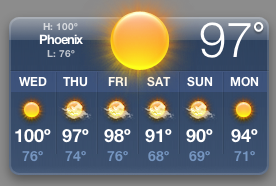
It’s 97 degrees and nine percent humidity right now, and you have no way of appreciating how wonderful that is unless you live here. With the occasional break for light rainfail, we’re looking at ten solid months of truly heavenly weather.

The Monsoon is brutal, but it only lasts for two months. The trade-off is this: Crisp, clean, dry air, with light of a clarity and perfection you can’t achieve in a studio. In Phoenix, you can train your eyes to see the quality of the atmosphere by the color of the sunlight. On a perfect day — and they are legion — the shadows are sharp enough to cut your eyes.

The rest of the world dreams of heaven. In Phoenix, we live it…

Technorati Tags: , , , , ,

No committee will ever make the Cluetrain run on time

Proposition 1: Groups, clubs, committees and professional associations would make better decisions if their smarter, more passionate members were to get involved.

Proposition 2: Central banking would work if only Alan Greenspan had a smarter brother.

Proposition 3: True Communism has never been tried.

I don’t consider these statements equivalent, but they are of the same species, the Wishful Thinking Fallacy.

Inasmuch as we are living through the nightmare of Proposition 2, one might think we could learn a lesson. We won’t, and every eye was on the Fed this afternoon.

Parents who wrote a fat check for a skinny college Freshman in August can expect the return on their investment in the form of Proposition 3 over Thanksgiving dinner.

From Proposition 1, though, there is not even the comic relief of a sardonic resignation. We want so desperately for it to be true that we will not even consider entertaining the obvious truth that all committees suck, and good committees suck the least when they adjourn early.

These three propositions are alike in another way, a way that illustrates why they are uniformly false, any devout wishing to the contrary: All three turn on a power devoid of consequences. They are fundamentally anti-Capitalist. Their errors are not correctable accidents, they are a necessary consequence of the caprice that is the opposite of Capitalism:

But in fact, in politics and economics, the opposite of capitalism is caprice. A government’s decisions are not awful because they are always corrupt — although they often are. They are awful because there is no reward for being right, no penalty for being wrong, and no one anywhere to take responsibility for anything either way.

Capitalism is not instantly rational — it is not always automatically right about what to do, where and in what quantity. But capitalism is ultimately rational. In due course, entrepreneurs will achieve something approaching optimal results. Why? Because they are rewarded for being right, penalized for being wrong, and they are proud to take responsibility for their endeavors.

Matthew Hardy left what I thought was a brilliant comment to my post on technological ineptitude at the Arizona Association of Realtors:

So the Read more

Federal funds rate cut by a half-point

Here:

The Federal Open Market Committee cut its benchmark federal funds rate by a half percentage point to 4.75%. In an effort to ease the credit crunch, the Federal Reserve also reduced its discount rate in lockstep to 5.25%. This is the first cut in the federal funds rate since June 2003. In a statement, the FOMC said the action “was necessary to forestall some of the adverse effects on the broad economy that might otherwise arise from the disruptions in financial markets and to promote moderate growth over time.” The Fed said that some inflation risks remain. It said the credit crunch could hurt the economy.

Technorati Tags: ,

New Times likes the present: Smarmy, tendentious blather wants to be free!

Even a blind pig can find an acorn now and then, and, in that spirit, The New York Times has discovered that cowering behind a paywall is a profitless pursuit of irrelevance. More from TechCrunch:

The history of paid content goes back to the collapse of the Web 1.0 bubble, a time before content monetization was a sure bet through programs such as Google Adsense and others. There was a backlash against free content for a while, and a number of companies launched pay-to-view programs. The New York Times was one of the last to maintain this model.

Surely, with the Wall Street Journal being acquired by News Corp, the WSJ pay-to-view program must now be on death row. Similarly, the Australian Financial Review’s paid AFR.com service has been rumored to be on its last legs for some time, and will shortly close.

Most importantly: this is a win for all of us. The notion of paying to access content is flawed in a connected online world where virtually everything is free, particularly content. Companies such as the NY Times can make money from providing content for free. The fall of the model for all publications is nigh.

Technorati Tags: , ,

The Odysseus Medal: Propagating better ideas in real estate by celebrating better ideas in real estate

This is probably not much of a secret, but I really love ideas. I think the argument that smart people can improve the NAR cartel from the inside is absurd, but the instant form of the claim — that I could advance Realtors’ use of technology by wasting my time at committee meetings — is especially specious. It’s no goal of mine to change any life but my own, but, even so, the best technological benefit I can bring to Realtors, lenders, investors and thoughtful consumers is right here: Explicating our own new ideas and and drawing attention to other peoples’ innovations. Ideas are an attribute of active minds, and minds and meetings are sets with the tiniest of intersections.

Among all the other virtues I might claim for it, The Odysseus Medal competition is a celebration of great ideas in real estate. Here are this week’s winners:

This week’s Odysseus Medal goes to Dan Melson for Should Lenders Be Permitted to Sell Real Estate?:

Let us ask about real estate which has become owned by the lender. Why should lenders lack an ability shared by every other citizen, resident, illegal alien, and even people who have never set foot in the country – the ability to sell their own property? There’s no requirement for anyone else to use an agent. It may be smart to use an agent, but everyone else has the legal right to go it on their own. Why not lenders?

I’ll tell you why. Because not only would lenders being able to get into the business threaten the interests of the major chains that control most real estate, but this requires lenders to pay those same firms money if they want to get the property from their bad loans sold – and they need to get the property sold.

I have to admit, I’m not exactly eager to compete with yet more big corporations with huge advertising budgets. It remains the right thing to do. Right for the industry, and right for the consumers. As I’ve said many times before, rent-seeking is repugnant, and that’s what NAR is doing – seeking Read more