There’s always something to howl about.

Category: Marketing (page 116 of 191)

Real estate weblogging to create the kind of relationships that lead to closed transactions, repeats and referrals

Sorry, Michael, but sometimes plumbers gotta talk about pipes. This is Teresa Boardman writing at The Real Estate Tomato:

In my humble opinion it isn’t about how many people read me. It is about who reads me and why. It is about speaking directly to the clients you prefer working with. A ton of leads can mean a ton of work and little business. Some of my blog readers are exactly the kind of person I want as a client and others are not. Not all leads are equal. The type and quality of the content does have an impact on the type of leads a blogger attracts.

I think this is dead-on. By pursuing real estate weblogging with a long-term strategy, you can grow your business in the way you want it to grow.

Technorati Tags: , ,

Vote for The People’s Choice Award — Nominees on-line now

Okay, the live version of the People’s Choice Award voting interface is on-line. My short-list isn’t all that short, alas — 18 entries total, including seven from BloodhoundBlog. I’ll do a better job of eliminating posts in the future.

The selections are shown in random order in the voting interface, this because being at the top or the bottom of a list like this is a decided advantage.

These are the posts, in no special order, except the BloodhoundBlog entries are shown last:

Go here to view the entries and to vote. I’ll accumulate votes until 12 Noon PDT Monday. I’ll post the winners of The Odysseus Medal, The Black Pearl and The People’s Choice Award Monday afternoon.

Technorati Tags: , , ,

Feel like playing? The People’s Choice voting interface is live

I have a dummy version of the People’s Choice voting interface for the Odysseus Medal competition up and running. I used five of my recent posts for examples, since I’m excluded from the competition. Play with it, if you’re of a mind to. See if it makes sense to you. See if you can get it to break. The live version will go up later today.

Technorati Tags: , ,

Thomas Sowell: Housing woes caused by land-use restrictions and federal micro-management of lenders

Hoover Institute Economist Thomas Sowell:

Amid all the hand-wringing and finger-pointing as housing markets collapse, mortgage foreclosures skyrocket, and financial markets panic, there is very little attention being paid to the fundamental economic and political decisions that led to this mess.

The growth in risky “sub-prime” mortgage loans by people buying homes they could not really afford has been a key factor in the collapse of housing markets, when the risks caught up with both borrowers and lenders.

But why were home buyers suddenly taking out so many risky loans and lenders suddenly arranging so much “creative” financing for these borrowers?

One clue is the concentration of such risky behavior in particular places and times.

Interest-only mortgages, where nothing is being paid on the principal for the first few years, enable many people to get started on buying a home with lower mortgage payments at the outset.

But of course it is only a matter of time before the mortgage payments go up and, unless their income has gone up enough in the meantime for them to be able to afford the new and higher payments, such borrowers can end up losing their homes.

Such risky mortgage loans were rare just a few years ago. As of 2002, fewer than 10 percent of the new mortgages in the United States were of this type. But, by 2006, 31 percent of all new mortgages were of this “creative” or risky type.

In the San Francisco Bay Area, 66 percent of the new mortgages were of this type.

Why this difference in times and places? Because housing prices were skyrocketing in some places and times, so that people of modest incomes had to go out on a limb to buy a house, if they expected to buy a house at all.

But why were housing prices going up so fast, in the first place? A number of studies of communities across the United States and in countries overseas turned up the same conclusion: Government restrictions on building.

While many other factors can be involved — rising incomes, population growth, construction costs — a scrutiny of the times and places where housing prices doubled, tripled, Read more

How Big Is the Sub-Prime Mortgage Market? Not very big at all

Cited by BusinessWeek Online, a very eye-opening analysis of the sub-prime mess from National Review Online:

I’ve thought a lot about Rain Man over the past few months as I’ve been following the press coverage of the sub-prime mortgage crisis. The story’s been on the front page of the Wall Street Journal nearly every day. Pretty much every show on CNBC — except Kudlow & Co. and one or two others — has been obsessed with the topic. Yet no one seems to be asking the Rain Man question: “How big is the sub-prime mortgage market?”

And the answer, as Ben Stein makes clear, is not very big at all.

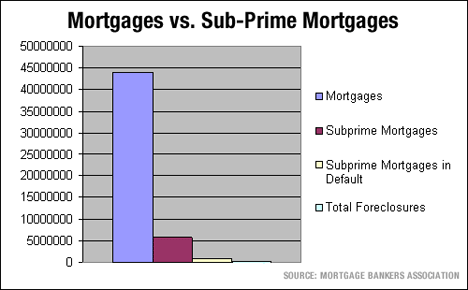
Currently there are about 44 million mortgages in the U.S., and less than 14 percent of them are sub-prime. And only about 13 percent of those are late on payments, with the majority of late payers working through their problems with the banks.

So, all in all, when you work through the details and get down to the number that really matters, only about 0.6 percent of U.S. mortgages are currently in foreclosure. That’s up a hair from roughly 0.5 percent last year. That’s it.

Actually, that’s not it. Things are actually better than the numbers suggest, since sub-prime-mortgage homes are less expensive than prime-mortgage homes. This makes sense. Wealthier people, generally, can afford costlier homes than less-wealthy people. The recent sub-prime surge brought large numbers of moderate-income families into the home-ownership market, and their houses are less expensive than most. Therefore, the dollar impact of the sub-prime default is smaller than if it were a prime default.

With approximately 254,000 mortgages in foreclosure at the moment — up from roughly 219,000 last year — the sub-prime meltdown has given us an increase of 35,000 mortgage foreclosures over the last quarter. Since the average sub-prime mortgage clocks in at almost exactly $200,000, we’re looking at an approximate $7 billion increase in foreclosed value in the first quarter of this year.

Raymond, how big is household net worth in the U.S.? About a hundred dollars?

Actually, it’s a lot bigger than that — about $53 trillion. In other words, the Read more

How do you win The Odysseus Medal? Write your heart out — and follow the rules . . .

I’ve posted the rules for The Odysseus Medal competition, but there aren’t so many that I can’t also show them here:

The Rules (few and fair):

  • The entry must have been posted within the two weeks before the entry deadline
  • The entrant must be the author of the post
  • More than one entry from the same weblog is fine
  • More than one entry from the same person is also fine, provided that you have multiple personality disorder
  • No second-guessing, no do-overs, no cry-babies

The Prizes:

Three awards will be given weekly:

  • The Odysseus Medal, for the overall best post of the week
  • The Black Pearl, for the best practical, technical or marketing idea of the week
  • The People’s Choice Award, selected by popular voting on Sunday evenings

The Deadline: Sunday at 12 Noon MST — which is 12 Noon PDT, 3 pm EDT, etc.

Entry form: It’s here.

No doubt this will change somewhat with time, but probably not by much. I really don’t like rules, making them or, especially, complying with them. Entries that I’ve already received will be grandfathered, of course. Fair is fair.

Anyway, get crackin’. Either Cameron or I will build a voting bot for the People’s Choice Award, and I’ll put together graphic trophies for the winners. I want for this to be an enduring tribute to quality weblogging. But the truth is, I’ve got the easy job. You’re the one whose going to have to do the hard work…

Technorati Tags: , ,

Mortgage meltdown? The end of the world has been delayed again

This is me from the Arizona Republic (permanent link):

 
Mortgage meltdown? The end of the world has been delayed again

If you watch the TV news, you can’t miss the video clips of financial pundits screeching about the imminent collapse of the mortgage industry. In fact, the world probably cannot end more often than once or twice a day, but it’s worthwhile to remember that television is an entertainment medium. Financial news is inherently boring — unless it’s reported by a shrill demagogue.

So what’s really going on?

Investors are pulling the plug on the most liberal — or most willfully gullible — mortgage underwriting firms. Investment banks that bought or brokered portfolios of shaky loans are also suffering.

Does this mean you can’t get a home loan? Not at all. You just need verifiable income, good credit and a down payment. That wouldn’t even sound odd if we had not lived through 2005, when all you needed was a reliable pulse.

What really happened in the home loan market? There was so much money available, and homes were appreciating so quickly, that some lenders stopped worrying about the financial qualifications of borrowers.

Has there been a surge in foreclosures? Yes. Had there been a substantial number of loans made to high-risk borrowers? Yes. We’re paying the piper now, that’s all.

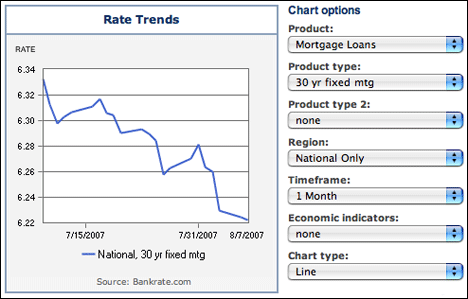
There is still plenty of money in the mortgage market, but guidelines are stricter. Nothing-down loans are harder to obtain, as are stated-income loans. Some lenders are charging higher rates for jumbo loans — amounts over $417,000. But the rates for a 30-year conforming fixed-rate mortgage — the bread-and-butter home loan — are actually down. This fact will have been omitted by the demagogues on TV.

While things shake out, sellers will want to stay on top of their buyers’ loans, and buyers might want to ask their lenders to submit their files to more than one underwriter. Some parts of the Valley are suffering more than others, but buyers are buying, sellers are selling and home values are holding up fairly well through the down-turn. It would seem that the end of the world, contrary to televised reports, Read more

Realtors, Wake Up and Start Helping Consumers

Jeff Brown’s, Real Estate Bloggers — Why Are You Blogging? What Currency Does Your Banker Accept?, has evoke a ton of comments and emotion over the past few days. As an outside observer I find it interesting during these crazy times in the real estate market, people get so worked up over SEO, but don’t seem to carry that same passion over to the market.

While I have no real interest in SEO, I thought I would mention that if (and when) the real estate market tanks, it wont matter how many people are coming to your site if they aren’t able to buy. While the point of Jeff’s article got lost after about the 20th comment, I think that it is really unfortunate. Blogging for business is fine by me, but what about the consumer? There will be a point very soon when consumers will be looking for advice on how to approach and handle a down market. It would seem like everyone’s time would be better spent having these discussions.

I am probably one of the few non-real estate agents writing/reading here, but as a current home shopper, a Realtor could really differentiate themselves by understanding the market and providing helpful advice. In a world where good content is king, I am spending my time reading and understanding where the market is going, so that I can provide readers support as things go from bad to worse.

A major knock on Realtors is the fact that they are always selling, not necessarily with their client’s best interest in mind. The National Association of Realtors makes this perception worse with every rosy real estate forecast they send out to the market in spite of overwhelmingly negative information. Interestingly, two days after I wrote this piece about the NAR forecast, the stock market had the second worse day of the year.

Looking at a variety of the real estate bloggers blogs, who have been commenting here, I have seen very little content on many sites that could really help consumers deal with this changing market. Now Read more

I went duck-hunting with Elmer Fudd and came home with a radically different approach to real estate prospecting

About fifteen months ago, we were preparing to list a home for someone we had known for quite a while. The house was a cosmetic flip in an excellent location. We had been consulting with the seller for months to get the repairs and upgrades done the way we wanted them. The seller had great equity, even if he were to sell it at the fix-up price. But he kept trying to cheap out the remodeling, which we thought was the wrong thing to do in a luxury location.

We even paid to have the home inspected, pre-listing, to get another set of eyes on the problems we had identified. The major items on the punch-list were addressed, but not in a way appropriate to the price-range of the neighborhood.

Okayfine. There are listings you can’t get away from — family, old friends, past clients. So knowing that close-enough was going to have to be good-enough, we priced the house as it would be delivered into a buyer’s market: $425,000.

The seller wanted $475,000, which would have been easy to get if the home had been improved to the quality of the location. But it hadn’t. Whoever bought it was going to live in it as-is, or, more likely, they were going to spend that extra $50,000 to bring the house up to its true potential. Ether way, there were competing listings at both prices points, so no one was going to confuse the one for the other.

At $425,000, we could have sold that house in 30 days or fewer, even against all the competition. Lucky us, the seller let us off the hook. He insisted on $475,000, by phone, and he got so mad that he hung up on me.

Dang! I lost a $475,000 listing, which at 3% of never-ever-sold would only have netted out to a loss of around $2,500 for us, not counting our labor.

It takes us a solid week to get a home on the market — photos, floorplans, signs, web site, open house cards, etc. The house was listed the next day — for $479,000. The extra $4,000 might Read more

“They are conniving and con artists” – Redfin launches Southern California Sweet Digs

And for the record, Redfin, the title was a quote taken from one of your Southern California Forum posters, and it was directed at me, or rather my ilk. I started writing this with every intention of giving you the publicity you asked for, the “don’t promote yourself, let others do it, and it will become viral” marketing which has been your hallmark. I changed my mind.

This morning Redfin issued a press release announcing expansion of the “Online Magazine Formerly Known As”, well, something else.

SEATTLE — August 9, 2007: Online real estate broker Redfin Corporation today launched its online real estate magazine, “Sweet Digs,” for Southern California. Home-buyers in Los Angeles, Orange County and San Diego neighborhoods can read daily, local real estate market information via the Sweet Digs blog or email newsletter.

The new Southern California Sweet Digs will offer as many as 40 candid, saucy and analytical write-ups each week of recent sales, price reductions, open houses and real estate trends in local areas, including Beverly Hills, Irvine, Newport Beach, Ocean Beach and Westwood. Southern California already boasts some of the top real estate blogs, and Sweet Digs complements them with its hyper-local, data-driven format written by real estate fanatics, not agents.

We are talking about real estate fanatics here, as in, people marked by extreme enthusiasm for real estate, not agents, since we all know real estate agents have little interest in real estate. Fanatics, as in people being paid to show extreme enthusiasm for that for which they were paid. One of my first jobs was at Bob’s Big Boy (during the Steel Age). I was fanatical about the Big Boy Combo, but this was in large part due to the fact that the Big Boy cut my paycheck.

Okay, in all fairness, I know what you were trying to say. The newsletter-blog thingy will be written by non-industry professionals. I get that, and I can see an appeal. And, in the name of fairness, I wouldn’t enlist contributors to my Blog who were Redfin disciples.

Sweet Digs launched December 2006 in Seattle and February 2007 in San Francisco to provide Read more

Sun Microsystems draws free pictures of the twenty-first century; to be shown to barbarians to illustrate the path to relevance

What’s the opposite of an antiquated product in a useless form-factor being hoarded behind a paywall? Sun Microsystems has developed the world’s fastest microprocessor — and is making all of the design details available by Open Source:

To add fuel to the fire, the blueprints for our UltraSPARC T2 (I personally like the moniker, “Niagara 2” – named after Niagara Falls, btw, and the great volumes of water that pass over them), the core design files and test suites, will be available to the open source community, via its most popular license: the GPL. Making Niagara 2 the only commodity silicon whose core designs are available to the open source community – whose strength, and market power, only grows by the day.

The economics of walls and safes and locks and chains is based in fear, hostility, suspicion, anger and doubt. Resources are presumed to be scarce, so if I don’t hoard them with an ugly vigilance, I’ll starve.

The economics of abundance is built on the opposite premises: Openness, candor, an effortless joy that flowers into pure splendor: The only true economic resource is human intelligence, a resource infinite in potential. By sharing with you everything I know, I will enrich us both: You will have the wealth I have created so far, and I will have the wealth you will create from that starting point.

These startling innovations are as new as Socrates, at least, so people can be forgiven for not having learned them after twenty-five centuries’ time. But there are two unhappy consequences to the economics of hoarding. The first is the tax on human dignity that comes from wresting treasure away with a thief’s cunning, hiding it and cowering over it, like the baubles in a raven’s nest, with a stingy, guarded greed. But the second is the vast riches that are foregone by this idea of wealth as trinkets to be withheld, rather than as ideas to be shared and cultivated.

We come back to Cain and Abel. Abel’s wealth is the raven’s wealth, gems and metals, portable and enduring but finite in quantity. Cain’s wealth is the fruit of Read more

Greg plays PHP games with ZeeMaps: The story for July in the F.Q. Story Historic District of Phoenix

Kris Berg and Jonathan Dalton have been making good use of ZeeMaps to show sales activity in their local market areas.

I’ve been digging this, but at StarPower, I discovered that I am smart and lazy — good at figuring out how to avoid hard work. So: I built a little bot that, in conjunction with our MLS system, will build ZeeMaps of ideas I want to illustrate visually. Here, for example, is MLS activity in the F.Q. Story Historic District of Phoenix for the month of July: Active, Pending, Expired and Cancelled. I have the bot set up to use different colors for Sold, Active With Contingencies and Temporarily Off Market, as well.

We’ll use this for DistinctivePhoenix.com, to show off the neighborhoods we farm, but we will be able to use it for any purpose we can imagine — listing appointments, price-adjustment meetings, etc. We can make a map out of any search we can run. It’s not a mapping search interface, but it’s something while we wait to get a mapping search interface.

New York Times discovers Earth: “Mr. Sulzberger, tear down that wall!”

Says the New York Post, the New York Times is about to remove the paywall that conceals from public awareness its once-famous (even if smarmy and tendentious) op-ed columnists:

The New York Times is poised to stop charging readers for online access to its Op-Ed columnists and other content, The Post has learned.

After much internal debate, Times executives – including publisher Arthur Sulzberger Jr. – made the decision to end the subscription-only TimesSelect service but have yet to make an official announcement, according to a source briefed on the matter.

The timing of when TimesSelect will shut down hinges on resolving software issues associated with making the switch to a free service, the source said.

Times spokeswoman Catherine Mathis would only say in an e-mailed statement, “We continue to evaluate the best approach for NYTimes.com.”

While other online publications were abandoning subscriptions, the Times took the opposite approach in 2005 and began charging for access to well-known writers, including Maureen Dowd, Frank Rich and Thomas L. Friedman.

I’m told there is something like this in real estate — news of dubious value jealously hoarded behind a paywall — but, since I don’t pay for ordinary information, I can’t say for sure.

Technorati Tags: , ,

Vale, carne vale: Recasting The Odysseus Medal as a carnival of real estate weblogging excellence

I’m pretty fed up with the Carnival of Real Estate. It is what it is, and there have been times over the past year when it has blown tender kisses toward the sublime. But much too often it has chosen to rut around in the mud, and, in any case, it is much too much of everything to be anything at all.

This is not good.

There is a Carnival of Real Estate Investing and a Consumer-Focused Real Estate Carnival, both of which seem to do a decent job of staying on-topic. The Carnival of Real Estate should be devoted to excellence in real estate weblogging, broadly defined. Instead it has become a Carnival of Solipsism, a space where the inherent subjectivity of judging has given way to an overarching, overreaching subjectivism: The universe is whatever that week’s judge says it is. An entry that would have been judged the best by any rational standard can get buried beneath the judge’s whim, the testy assertion of a right to supplant enduring standards of excellence with a momentary fit of pique.

In rebuttal, one word: Bah!

For a first thing, I am done with the Carnival of Real Estate. I have supported it since its birthing. BloodhoundBlog has entered a post for every new edition, winning, despite everything, more than any other weblog. No more. I will no longer submit posts from BloodhoundBlog to the CoRE. If individual contributors wish to enter their posts, that’s their business, but I will no longer make an official entry from BloodhoundBlog, nor will I enter any of my own posts.

Second, I have recast The Odysseus Medal as a new carnival of real estate weblogging. This is the description of the new carnival from its home page:

A weekly carnival for real estate, mortgage, real property investing and housing weblogs — very broadly defined. The Odysseus Medal is awarded to the highest quality writing in real estate weblogging.

The Odysseus Medal competition will be hosted at BloodhoundBlog every week, and it will be judged by me alone. That is arrogance personified, but by doing things this way webloggers will be assured of Read more