There’s always something to howl about.

Category: Marketing (page 120 of 191)

The divorced real estate commission file: An organic compendium of arguments, pro and con, on divorcing commissions

I had the idea of building this last night, cataloging the BloodhoundBlog posts on the subject. Lani had a better idea, so I appropriated it. Attached below is a fairly comprehensive list of posts, both for and against, on the idea of divorced commissions.

I think this is the most important idea we’ve addressed, here and on the RE.net at large, so I wanted to build something that could grow with the debate.

Grow how? Two ways.

First, you can add your own or other people’s posts or articles to the catalog by filling out the form at this link. I want for this to be as comprehensive as possible, so do please let me know what I’ve missed.

Second, you can append this list to any future (or past) posts on the subject by using this PHP code:

<?PHP
include ("https://www.bloodhoundrealty.com/BloodhoundBlog/DCFile.php");
?>

In WordPress, you’ll need to use the runPHP plug-in.

How does it work? Watch and see:

< ?PHP include ("https://www.bloodhoundrealty.com/BloodhoundBlog/DCFile.php"); ?>

Technorati Tags: , , ,

What would Seth Godin do? Probably not one-size-fits-all . . .

(I’m waiting for a phone call, which is how Realtors address that awful burden of time that befalls them between birth and death.)

Joel Burslem mentioned the What Would Seth Godin Do plug-in today, and Jim Duncan has also written about it recently.

I like the idea, I just don’t like the execution. Too much one-size-fits-all for my tastes, where CSS and a WordPress theme can make everything unique and perfect.

I have code that will make the “intro.php” behavior introduced in WordPress 2.0 cookie-dependent. In other words, if the cookie is not set, visitors will see intro.php (or any other “sticky” pseudo-post you prepare under any arbitrary filename). If it is, they won’t.

I have it set with the cookie expiring in 60 days, so if someone has been away for a while, I can remind him of what’s what. People who forbid cookies will get the introductory post every time, but this is the default behavior for intro.php anyway. And if I change the name of the stored variable, I can cause everyone to see my presumably-substantially-revised introduction the next time they visit the site.

(There is a lot more you could do with something like this: Show it the first three visits, for example, or show a special message to very-frequent visitors.)

I don’t use this in BloodhoundBlog, although I could easily enough; it doesn’t require WP 2+. It’s really nothing but bread and butter PHP, as is WordPress itself.

If you want the code, it’s yours, but you have to hold your own hand. You don’t need to know PHP, but you do need to know how to edit and FTP your WordPress theme files. Email me if you want the files.

Technorati Tags: , ,

The Carnival of Real Estate . . .

…is up at Sadie’s Take on Delaware Ohio.

Host Toby Boyce does a truly amazingly phenomenal job as judge — and I’m not just saying that because our own Jeff Kempe won with The Imperative of Divorced Commissions, Part 2: The Inherent Value of Free.

Toby used the idea of a golf tournament as his theme, with the chart above illustrating the competition.

And the competition was fierce, with many first-quality contenders. Wheel you golf cart over to Toby’s place to see what I mean.

Technorati Tags: , ,

Greg Swann Joins Redfin – Kelman Rejoicing!

Greg Swann has joined Glen Kelman in the way they both think and talk about the amount of commission, the splits and how it can be divided and allocated.

There isn’t some “set commission amount” for groups and companies to “divide for the public”. This kind of thinking is one of the primary flaws with the Redfin business model. For example, we charge our sellers less commission if we handle the buyer side and are not paying an outside agent. Almost all listing agreements are signed by sellers who are agreeing to pay the listing agent. To suggest that the purchase price the buyer pays for the house has “the buyer really paying it” would
also be saying that the buyer has a right to tell the seller how they should spend any and all of the money they receive from the sale of the house. Why stop with the sales commission?

The idea and concept of the buyer pays the commission is absurd. It is flawed logic. What if some seller (or buyer?) came into my office and started ordering my staff around, explaining that “they paid them”? I pay my staff with MY money. I may have received that money from a commission paid to me by my seller but it is then MINE. The home seller is in the same position. It is their money that they have agreed to pay to an agent. Under the present system, the buyer has
made no such agreement.

I’ve commented elsewhere on why divorcing the commissions will never happen anyway – but just didn’t want to let this particular bit of poop sit. Damn, I haven’t posted anything in a while and right now have a plane to catch. This got me out of hibernation, so thank you! LOL.

Jeff, I will mentor you for the same fee I charge everyone else. The amount most buyer agents currently charge buyers. This is the same price I always charge. My goal all along has been to make charging Read more

Divorcing the real estate commissions is simply a matter of HUD-1 bookkeeping effected by the mortgage lender

In a charmingly romantic post this morning, Jonathan Dalton gets bogged down in the all-too-common idea that divorcing the Realtors’ commissions would impose some new financial burden upon buyers, resulting in their loss of representation.

This is false. Although we operate by the fiction that the seller pays the real estate commissions out of the proceeds of the sale, in fact, if the buyer’s lender is not willing to fund the transaction, no sale will occur and no one will get paid. It’s useful in the abstract to envision the transaction as being either all-cash or 100% financed. In both cases, all the money is brought to the closing table by the buyer or the buyer’s lender.

To effect the divorced commission in the overwhelming majority of transactions, all that is necessary is for lenders to change their underwriting guidelines, making corresponding changes in the way they illustrate the flow of funds on the HUD-1 settlement statement.

Right now, many lenders will allow up to 7% in sales commissions, to be charged against the seller’s side of the HUD-1, with up to 3% in closing costs, also charged against the seller’s side of the HUD-1.

If lenders changed their guidelines, such that no more than 3.5% could be charged against the seller for the compensation of the listing agent, with no more than 3.5% charged against the buyer for the compensation of the buyer’s agent, the commissions would be divorced.

So far, this is nothing more than a change in underwriting guidelines and HUD-1 accounting. Absolutely nothing has changed away from the paper-shuffling lender universe. The costs to the buyer and the proceeds to the seller are exactly the same.

Not to rock too many boats at once, but it would also be possible for lenders to make their internal procedures and the HUD-1 bookkeeping more honest, putting a little extra money in the pockets of both buyer and seller.

In the chart shown below, the first column illustrates the current procedure. The middle column shows how commissions can be divorced while retaining the psychotic style of accounting lenders currently deploy. The third column demonstrates how commissions can Read more

Not all neighborhoods feeling a downturn

This is me in yesterday’s Arizona Republic (permanent link):

 
Not all neighborhoods feeling a downturn

There are neighborhoods in the Phoenix area where the housing downturn is barely discernible.

How can that be? News reports are full of doom and gloom stories. Defaults, foreclosures and interest rates are up, with mortgages resetting seemingly at whim. If the news is always bad, how can it be good at the same time?

In fact, in some parts of the Valley prices have not fallen, with some neighborhoods actually experiencing continued appreciation. Inventories are up all over, but, so far, we haven’t seen much in the way of desperation selling.

We track a slice of Valley real estate as an indicator of where the market might be headed. We look at newer mid-sized homes in freeway-accessible suburbs. These were the homes that led the market on the way up, and they’ve suffered more than others on the way down.

So how bad is it out there? The homes we track are down 13.41% from the peak in December of 2005. That’s not insignificant. If you bought (or refinanced) a home like this any time after May of 2005, you’ve probably lost money. On the other hand, if you bought your home in January of 2004, you’re still up by around 58%. If you put 20% down, that’s a 290% cash-on-cash return. Better yet, as bad as things have been, there is only about seven months of inventory on the market, suggesting that prices may not fall much farther.

On the other hand, MLS Area 323 in the West Valley runs from Northern to the I-10, from 43rd Avenue west to 115th Avenue, a large and very diverse housing stock. Available inventory is huge, more than a twelve months’ supply. But, interestingly, prices in that region have only dropped by about 2.75% since December of 2005.

Don’t run down the street in celebration. Interest rates are flighty, and sub-prime or even low-down-payment conforming mortgages may be a thing of the past. But, even so, acknowledging that things may get worse before they get better, they haven’t been that bad so far.

Technorati Tags: , Read more

Teri Lussier, blogging star

From email from Teri Lussier:

By the way, I’ve changed brokerages. Another agent and I have teamed up — he found me through TBR. He asked me yesterday if I subscribed to a blogging service for content feeds. “No, I write it myself.” I’m adding content he never considered. He’s a former IT guy, and he teaches the brokerage’s tech class. I know more about blogging than he does, so yesterday he tapped me to teach the blogging portion of the next tech class. REWL101 bookmarks for everyone! And I’m thinking of offering to hire myself out to guest blog — to plug in regular content for any agent who would like. Great fun.

I seem to remember there being some kind of weblogging competition, but I cannot for the life of me imagine how it’s being judged…

Furthermore: The girl is nothing but class

Technorati Tags: , ,

Realtor.org’s inner-geeks peer into the iPhone

The Center for Realtor Technology Web Log (there’s a mouthful) has a Realtor-oriented review of the iPhone:

On the real estate side of things, though, there were a few disappointments. I went to Trulia, Zillow, and Realtor.com. All three had some rendering issues from a missing MAP to elements on web pages covering each other (making filling out a search impossible.) One issue is that one of the sites has their map via Flash, which isn’t yet supported on the iPhone. I visited some of the sites on Safari and Mac and Windows and didn’t have the same rendering issues, but did still have the same missing non-flash map elements. The rendering issue I saw on the iPhone could be a bug in that version that will hopefully be corrected soon. Don’t get me wrong, they were still mostly usable, but it wasn’t as clean an experience as most of the non-real estate sites I’ve visited. It could just be luck on my choices either way.

We’re not ready to make the leap yet, but it seem clear that this device — or a near-term competitor — is inches and hours away from shipping my laptop off to the Museum of Computer History.

Technorati Tags: ,

What might make the idea of community work on Zillow.com? The individual autonomy we have learned to expect on the internet

We live and work right on the Arizona Canal in North Central Phoenix. North Central is a nebulous geographical region. Properly speaking, it runs from Seventh Street to Seventh Avenue, Missouri Street to the Canal. Within those boundaries, you will find some of the most prosperous and powerful people in the city — two categories from which we are more than amply excluded.

People living as far east as 16th Street and as far west as 19th Avenue might claim to live in North Central, and it would be considered churlish to contradict them. But this courtesy would not be extended to anyone living north of the Arizona Canal. North of the Canal is Sunnyslope, one of the worst neighborhoods in Phoenix.

What’s the difference? About $150,000 right now. In other words, the house you could buy just north of the Canal for $250,000 would cost you at least $400,000 if you were to buy it just south of the Canal. Location, location, location.

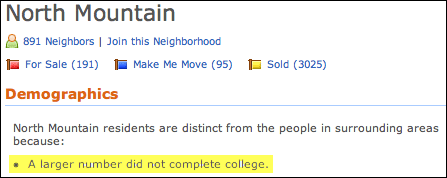
Now suppose you have joyfully paid that price premium to own, use, enjoy and profit from a home in North Central. If you went to your neighborhood page on Zillow.com, what might you not want to see?

I added the highlighting, just to put a finer point on the slur. In fact, this is just the kind of ham-handed stupidity you would expect from a robo-bartender, which, if you think about it, is one of the bogus roles a social network can take on.

Full disclosure: I am a social networking skeptic. The youthful fetish clubs are immensely popular with people who are determined to stay forever young. The commerce-oriented sites are full of self-promoters, every bit as interesting as the Friday morning business card exchange at the Denny’s over by the freeway. It could be there is something else I’m missing, but I’m not predisposed to care.

The truth is, I’m an introvert, as are many smart, technically-oriented people. My skin doesn’t actually crawl when I’m around other people, but my social interactions are always project-focused, and I’ve never been to a party that I didn’t want to leave before I got Read more

Zillow.com to launch Realtor rating system

From John Cook’s Venture Blog:

As an investor and board member at Avvo, I asked [Zillow.com’s Rich Barton] when Zillow might roll out an online rating system for real estate agents. That idea is in the works, with Barton saying that the company also is trying to develop ways for consumers to search for agents based on specific criteria. Stay tuned…

First we’ll milk ’em for free content as the only persistent members of our “community.” Then we’ll sell ’em astoundingly low-yield advertising. Then we’ll get anonymous misanthropes to write poison-pen letters about them. That sounds like a plan…

Am I missing something, or is this evidence of an unbounded cluelessness?

Technorati Tags: , , ,

Zillow.com’s latest release me-too’s Trulia.com’s recent me-too release: Can either make the leap from ghost-town to community?

With its Z6 software release, which goes live tonight, Zillow.com adds a neighborhood level of user conversations, similar to Trulia.com’s Trulia Voices feature released in May of this year.

From Zillow’s press release:

Real estate Web site Zillow.com today added a number of new community features, opening up the site even further to user contributions. Chief among these additions are individual neighborhood pages in more than 130 U.S. cities (more than 6,500 neighborhoods in all). The pages are seeded with rich local demographic and real estate information, but are built for communities and neighbors to make their own. Anyone within a community has the ability to add photos, events, local news, engage in discussions and ask or answer questions about neighborhood real estate.

“Adding the ability for neighbors to meet, share information and learn about their local neighborhood is a natural next step for Zillow. We started with individual Web pages and Home Q&A for more than 70 million homes, and today we’re bringing the conversation out to the neighborhood level,” said Lloyd Frink, Zillow president. “In the offline world, conversations happen all the time around homes, neighborhoods and communities. With these additions, we’re adding the data, tools and a platform for these conversations to thrive online — and help people become smarter about real estate, for free, in the process.”

Neighborhoods are accessed from any of the 70 million Home Details pages within Zillow, or via the “local real estate” link at the bottom of every Zillow page.

There’s more, but we’ll come back to it.

First: Is this a surprise to anyone? The new features were accidentally pre-announced last week in an inadvertently transmitted email. I understood the portent of that email, as I’m sure did everyone else in the RE.net who got it: Responding to Trulia was Zillow’s obvious next move, and they’re fairly steady at doing major upgrades once a quarter. The only real surprise was that the hermetically-sealed start-up actually leaked something.

But could it be that Zillow and Trulia are stuck in a tennis volley of answering each other’s features? Truila Voices was the loud claim from the Read more

Ignore the so-called experts: Blogrolls are good, m’kay?

No one is better suited for a discussion of the value of blogrolls in viral weblogging than South Park’s Mr. Mackey. (“Drugs are bad, m’kay?”)

Some supposed experts have done extensive research by reading other weblogs and they have come up with (and reiterated) this startling conclusion: “Blogrolls are bad, m’kay?”

I would link to the source, but that might turn out to hurt their SEO prospects. I have, out of thoughtful consideration, removed them from BloodhoundBlog’s blogroll. Not, mind you, because, “Blogrolls are bad, m’kay?” but because I don’t want to promote pernicious nonsense.

Why are blogrolls thought to be bad? Because they might look like a link exchange, and they might get brand new weblogs temporarily sandboxed by Google.

What are we talking about? SEO results, yes?

What should be your objective in producing a real estate weblog? Viral marketing, yes?

If we stipulate Mr. Mackey’s case without contest, would blogrolling being bad for SEO imply that blogrolling is bad for viral marketing?

Take it apart. The masque of Mackey is bullshit: Brand new blogrolls don’t have extensive blogrolls, and, even if they did, there is no reason to suppose that Google is penalizing them. More likely the contrary. Google likes links.

But even arguing to the contrary, would a hypothetical Google-that-doesn’t-like-links make any difference in your viral marketing strategy?

First, lightning can strike with an over-the-transom lead from Google, but it’s not very likely.

Second, the objective of your viral marketing strategy should be to nurture a substantial community of people who are predisposed to use you when they have a real estate need. This has almost nothing to do with SEO results.

Ergo, everything you do with your real estate weblog — and with other viral marketing tools — should be focused on nurturing relationships with people who can and will do business with you, not with attracting random hits from all over the world. In other words, if your primary concern is SEO, you’re spinning your wheels.

So what does this imply about blogrolls? In a community-focused real estate weblog, a blogroll of other weblogs and web sites focused on that community is an immensely powerful viral marketing Read more