There’s always something to howl about.

Category: Marketing (page 166 of 191)

Smashing the idols: Understanding market value in full context . . .

Nominate me Ikonoklastes, for I am come to raze this temple of half-baked ideas. I want to come back to the MLS later in the week, and I have a deep need to expose the motivations of brokers, as these are distinguished from the motivations of lesser licensees. But for now I want to take on the idea of market value.

Jeff Brown, whom I admire without limit, asks of me:

I’m still wondering though about the apparent premise underlying your argument that says the buyer pays everything.

That premise is this: That somehow the market value of the home is controlled by something other than supply/demand, and the other factors of which we’re all aware. Would you please clear this up for me?

There are actually two different issues on the surface there, and there is still a third issue buried in the underlying premises.

First things first: In every economic transaction, unless the seller is taking a loss — or unless the seller pays for something outside of the transaction — the buyer pays for everything. This is true of anything that can be bought, and it is why — in every business except real estate — the buyer is given the red-carpet treatment. The seller (of anything) brings the value to be sold, but the buyer brings every dollar of the money, and every dollar that is disbursed to the seller and to any other involved parties is disbursed from the buyer’s pile of dollars.

In real estate, we make believe that the money is first transferred to the seller and then instantaneously distributed to the other parties, but this is a sleight of hand we effect in order to get the sales commissions past the lender. It might once, historically, have described a sequence of events, but even then the activity was a pantomime.

The seller does not cause the sale by claiming to pay for it. The buyer causes the sale, and no uncoerced sale ever happened until the buyer caused it.

Moreover, nothing in the laws of god or man ever prevented a seller from paying sales commissions out-of-pocket, in advance, instead of Read more

Contra Freakonmetrics: The Big Picture in real estate negotiations . . .

Taking on Mark Nadel’s white paper on real estate commissions, Kevin Boer at Three Oceans Real Estate points out that there is more at stake than any one particular negotiation:

Successful agents, however, know that a solid business is built on long-term relationships with satisfied clients. If a past client indeed thought his Realtor had left $10,000 on the table, that would be the end of that relationship. No more future deals, and no more future referrals.

For agents who think long-term, however, the math goes something like this:

20 extra hours of work =

75% greater chance of doing another transaction with that same client in 5 years

+

75% greater chance of getting 1 referral a year for the next 10 years from that client.

No matter how you slice that one, that’s a lot of money the Realtor is leaving on the table by being shortsighted.

This is a reasonable argument, and a one-off transactional analysis is common in economics, where entrepreneurs succeed by taking account of The Big Picture.

To be fair to Nadel, he suggests short-term incentives to offset what he views as short-term disincentives. His suggestion comes pretty close to a net listing, though, a type of listing contract that is frowned on by regulators in Arizona.

Here’s why: I convince Mrs. Newlywidowed that her long-time family home, now an empty nest, is only worth $90,000. I offer to sell it “for free” unless I can get more than $90,000, in which case I will take $.50 on the dollar for every dollar over $90,000. I sell the home for $300,000, taking $105,000 in commission, leaving $195,000 for Mrs. Newlywidowed, where she could have netted $282,000 or more.

That notwithstanding, Kevin has a fun take on this idea.

Technorati Tags: , , ,

Drinks with Todd Tarson . . .

Todd Tarson from MOCO Real Estate News stopped by the house last night for beer and chips before rushing off to a WARDEX dinner, this in advance of an AAR conference.

I’d like to tell you that we cut through every knotty problem facing the real estate industry, but that would be an exaggeration. However, we did sap all resistance from a twelve-pack of Corona…

Technorati Tags: ,

PropSmart and Trulia, you’re cuddly and cool, but you don’t know a thing about searching for homes . . .

Here’s what I mean. This is a search I’m doing right now for a client:

Active listings only
MLS grids l32, k32 and j32 only (3 x 9 miles)
Minimum of 3, maximum of 4 bedrooms
Single-family detached homes only
Minimum of $350,000, maximum of $450,000 list price
Single-level homes only
3- or 4-car garage only
Only homes with formal dining rooms
Only homes with all tile roofs
Only neighborhoods with homeowner’s associations
Only homes where the land is owned in fee simple

There are two desired criteria that I’m omitting because they’re not reliably entered into the MLS system:

North/south exposure only
Only homes with pantries

But even with all those highly exclusive criteria, I’m still getting 25 possible candidates, way too many to work with. Probably we’ll end up isolating by particular subdivisions.

There is nothing in any computer system other than the Arizona Regional Multiple Listings Service that can search at this level of detail. But this is the only appropriate level of detail for a true home search. We campaign constantly for more power.

If you have visions of replacing MLS systems, please enlarge you vision to at least this size…

Technorati Tags: , , , , , , ,

What replaces the MLS? Advertising is a given. Compensation/ cooperation can be addressed separately. But the quality and quantity of the data is irreplaceable…

Tyler Sookochoff ask these questions in a comment to another post, but my reply is long enough that I think it warrants a post of its own.

Marketing of homes aside, do you rely solely on your local MLS to do CMAs and price homes you’re hired to sell? Or could you survive/thrive without the MLS?

Too many questions conflated as one. There are actually three justifications for the MLS: Advertising, the co-broke — and protection of the earned commissions of “procuring” agents. The latter is what is literally meant by “cooperation” — all member agents agree in advance to respect each other’s client relationships, with a dispute-resolution procedure if they don’t.

If the MLS were opened up or replaced, would sellers still want maximum exposure for their properties? Yes, certainly.

Would this entail an offer of broker cooperation/compensation? That depends on whether the buyer’s agent’s compensation continues to come through the seller/listing agent, or whether the RESPA/HUD-1 procedure can be interpreted or revised to permit buyers to finance the buyer’s agent’s compensation as part of the home loan. (This is what is happening now, it’s just being done by sleight of hand through the seller and listing agent.)

Will brokers use whatever price information they have at hand to prepare CMAs? You bet — but not exclusively. Their own on-the-ground knowledge of neighborhoods and the comp listings, plus a first-hand inspection of the subject property are at least as important as any information derived from a database.

So the question is not, will I be stuck working without an MLS (commercial brokers often do, as do land and business brokers)? The question is, what form might a future MLS take?

For what it’s worth, I’m a skeptic on MLS-replacement for now. First, it takes an incredible amount of data to make an MLS listing worthwhile — more work than FSBO sellers might be willing to do, in many cases entailing knowledge they do not have. Second, significant details vary from one locale to another.

Witness: My friend and colleague Richard Riccelli is selling a triplex right now. What’s a triplex? In Boston and New York City, it’s a Read more

“Hi! I’m a jackass. My name is Google Adwords.”

Culled from my email this morning:

AD TEXT:

Relocating to Phoenix AZ?
Hit the ground running. Tour homes
by net with smart, hi-tech Realtors
www.BloodhoundRealty.com

Ad Status: Suspended – Pending Revision
Ad Issue(s): Trademark in Ad Content

SUGGESTIONS:
-> Ad Content: Please remove the following trademark from your ad: “hi”.

Adwords has been very good to us, for years now. There was a time when the ROI on our Google spend was incredible. But it’s a diminishing return. Other Realtors have discovered it, bidding up our keywords and thus bidding down our positions. And regular users have trained themselves to prefer organic over paid results.

So it’s doubly-smart for Adwords to tell me that “hi” is a trademark just when I’m turning the boat, as it were.

“Do no evil” but go right ahead and shoot yourself in the foot. It’s the American way of doing business…

Technorati Tags:

Something to howl about: BloodhoundBlog wins the Carnival of Real Estate . . .

Inman Blog, this week’s host of the Carnival of Real Estate, sets the bar even higher than we did last week, cutting the list of entries down to a solid ten. Astoundingly enough, we took first place.

Why astounding? For one thing, we had come to fear that our urbanity was eclipsed by an overarching arcanity: We thought we might be too hard to read. Plus which, we cut all four of Inman Blog’s entries last week because we thought they were too short. We never for a moment thought they would be so petty as to exact revenge — but it would be hard to blame them if they did.

Todd Tarson is in town tomorrow for an AAR event, so we’ll save the celebratory drink until he stops by to say hello. In the mean time, we’re off to read all the other great entrants, and we commend you thither. (Who is hard to read?)

Technorati Tags: , , , , , , ,

When real estate brokers face a substantial cost for head-count, only the most profitable heads will survive unsevered . . .

Mark Nadel’s white paper on real estate commissions is very thoroughgoing, rich in detail and a rational understanding of human motivation — without slipping over to the hyperbole that afflicts much criticism of the residential real estate industry.

But Nadel is an outsider, so, while his diagnosis of what ails our business is spot on, I don’t get the impression he apprehends the underlying causes of our belligerent sclerosis.

I wrote the text quoted below a couple of weeks ago, and I need to come back to do it better justice. But it remains that the real estate brokerage business is not so much about selling real estate as it is about milking agents.

There are at least three components that have made this industry amazingly stupid, as compared with any other business in the capitalist system. The first two are commissions and licensing, but the third, and by far the most consequential, is the safe-harbor income tax exclusion. Because brokers can “hire” everyone as an independent contractor, they have no reason to cultivate human capital — the only kind that really matters. This was a foolish mistake, and it may well be the death knell for traditional personal-service real estate. One of the things we want to do, in the long run, is effect a totally different kind of business model for real estate representation. This again could result in huge costs savings for buyers and sellers while increasing our own profitability.

Want to get the bums out of this business? Make real estate brokerage so efficient that only smart, honest, ethical people can make a living. Profit is the purpose of capitalism, but a gradual movement toward moral perfection is a necessary secondary consequence.

Getting rid of the broker-level license would help, but don’t hold your breath. Getting rid of the safe-harbor withholding-tax exclusion would achieve a similar effect. When real estate brokers face a substantial cost for head-count, only the profitable agents will survive in this business.

This alone is probably not enough to get brokers to behave like the owners of other professional-service practices, but it’s a step in the right direction…

Technorati Tags: Read more

Why the traditional real estate commission model is broken and needs to be replaced . . .

These are the concluding paragraphs of Mark Nadel’s white paper on real estate commissions. The executive summary has been quoted all over, but I think this text is more compelling.

For what it’s worth, I think Nadel has hit a home run. There are things he doesn’t know about, which we’ll get to in a minute. But he has the whole residential real estate industry dead to rights. This is an important thesis. If you don’t make time to read the whole thing, as least read this summing up:

The traditional, straight percentage-of-sale-price residential real estate brokerage commission does not serve the interests of either home buyers or sellers. Fees are unrelated to the quantity or quality of service provided by brokers and their agents. The rate structure creates little incentive for agents to provide the value-added services of which many are capable, and also produces some serious harms to buyers and sellers. These harms include buyers not being alerted about available homes meeting their search criteria because the listing broker or seller has not offered an attractive fee to the buyer’s broker; and providing sellers’ agents little incentive to invest the effort to raise the net sale price of a home. The traditional commission rate structure has become structurally unsound and should be rebuilt.

The foundation of a new fee structure should have buyers’ brokers setting their own fees or negotiating with buyers; not relying on standard, default commissions set by sellers’ brokers in the MLS. The traditional practice of sellers’ brokers specifying the fees that buyers’ brokers charge to the latter’s own clients, should be recognized by appropriate governmental bodies as at least an attempt to fix market prices. Antitrust law simply does not permit one firm to attempt to set the price that its competitors charge for a competing service.

The situation today is very different from that of twenty years ago. At that time, sellers’ brokers noted their co-op fee offer in their MLS listing because they were making an offer to the agents working with buyers to join the seller’s broker in serving the interests of the seller. There was Read more

Flat fee buyer representation the Scientific Advertising way…

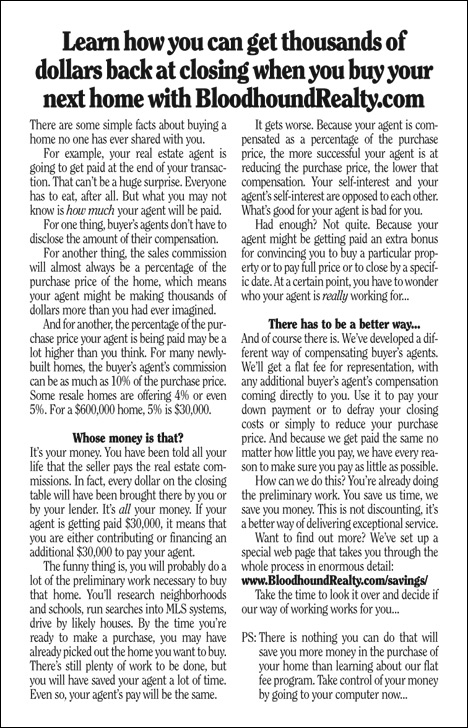
Richard Riccelli made me re-write the ad for flat fee buyer representation last night. He convinced me that trying to sell the whole idea in a space ad would not be as effective as driving traffic to a web page, where we are free to discuss the idea at any length necessary.

This is the draft of the new ad:

If you click on the image, a PDF version will open up, for easier reading.

The modern name for this style of advertising is “advertorial,” but this idea was invented a century ago by Claude Hopkins. This is direct response advertising. The theory is that the buyer wants to be informed and will pursue dense text to gather information.

Properly deployed, an ad like this would be run in different versions — different headlines, different body copy, different offers — to see which version pulls the optimum response — not necessarily biggest response, but highest-profit response. For an ad like this, I can use a different web page for every version to measure response. Moreover, I can build different versions of the web page for a particular ad and test those against each other as well.

Hopkins believed that if you couldn’t (or didn’t) measure your response to find out what was and was not working, you were wasting your advertising dollars. Most advertising is not done this way, precisely because most advertising dollars are wasted.

Richard has already hit me with detailed instructions about what to do with the design of this ad. I have one or more revision cycles on the copy, plus I need to re-write the web page. Even so, we’re just that close to being ready to roll, and I’m showing with a flat fee client later today…

Technorati Tags: , , , , ,

Pinocchio made flesh: Crafting a real business from the splintered ruins of the real estate industry . . .

I had email late last night night from Mark Nadel, author of the AEI-Brookings Joint Center white paper on real estate commissions that has been cited lately by the Freakonomics blog and by weblogs all over the RE.net:

Greg,

I wish I had discovered your BloodhoundRealty blog earlier. If so, I would have referenced you in many of the footnotes of my 75-page law review article (including almost 400 footnotes) criticizing the traditional broker commission rate structure. If and when you have the time, I would love to get any criticisms, corrections, suggestions, etc., that you (or any of your readers) might have to my piece.

It is posted [here] and has been recommended by the Freakonomics blog.

Keep up the good work and I will be including appropriate references to your work in the revised version of my article.

Take care,
Mark S. Nadel

That’s very sweet, and I hope he’s writing notes like this all across the enblogged globe, most particularly to Our Lady Ardell.

For my own part, I think we are about to witness a revolution. BloodhoundRealty.com is at a de facto flat fee for buyer representation right now, and we’ll be rolling the idea out in stages starting tomorrow. In the short run, I think we’re gong to take a lot of business. In the long run, I think the co-broke is going to settle down to a flat fee for everything or nearly everything — and from the high-end first. In other words, my view is that we’re buying a short-term advantage and we’ll have to be ready with even better ideas when the market responds.

This is where we’ve been since we’ve been here: If there is any room left in the real estate marketplace for personal-service representation, it will have to be insanely great personal-service representation. One of the things we’re always looking for, as a business strategy, is the way to attack on two flanks: We bring much better service and benefits at a much lower cost. Whichever argument you want to make against us, you’re already beat.

What’s left — three years out, five years out, ten years out? Read more

Thinking outside the sandbox: Paradise found again, for now . . .

Okay, I’m officially flummoxed. I’ve been sand-boxed, sand-bagged, sand-blasted, quick-sanded and burnished to the Olde World Glow of Burled Walnut: My searches are back, kindasorta. Not as many results as I had before, and not the same sequence. The heavy-hitter on “214 South 122nd Av” is BloodhoundBlog, but my reference to “214 South 122nd Av” on our listings page is nowhere to be found so far.

This might confound our friends at Free The Drones, who ferry us across the desert sands to The Google Sandbox Revisited. My take for now: A link to a custom weblog from BloodhoundBlog is probably more findable than building the website as a subfolder on our main website.

Google findability doesn’t matter to me as much as the “Wow!” factor of a custom website/weblog, but, from a completely useless one-off sample, linking from a weblog to anything else is findable faster than building anything into a static website. Next time out, I’ll register the new site at Technorati and cross-link from the new weblog to BloodhoundBlog to see if we can make things happen even faster.

For now: I concede. All of this was very quick, less than seven days so far. But Free The Drones has done better than I have at predicting events. My hat is off.

Further notice: By one standard, the new weblog isn’t really findable yet: Even though it’s been splogged at least twice now, there have been no spam comments yet…

Further further notice: Now everything we were seeing a few days ago is back — but still nothing from my listings page…

Technorati Tags: , , , , ,

Valley of the Rubes: There’s always a new boondoggle to rob the taxpayers . . .

I love Metropolitan Phoenix. I understand that some people don’t, but for me it is the perfect paradise on Earth. So do please understand that the withering critique I am about to offer is directed only at the gullibility of some of the people who live here and not at the place itself.

Okayfine. Look at this picture:

This is the confluence of two freeways, de facto some of the most valuable real estate that can be created by fiat of state. Just east of the SR-101 Freeway, the City of Tempe is building a huge shopping mall, which is what you expect to find where two freeways come together. Just east of that, they have built the Tempe Town Lake in the dry riverbed of the Salt River, creating even more very valuable real estate on the banks of the fake lake.

However, an unintended side effect of the giant inflated pontoons that contain the Tempe Town Lake is that any water that happens to flow down the riverbed of the Salt is trapped upstream, creating what I have named the Mesa Town Swamp. To my knowledge, no one but me has ever written about the Mesa Town Swamp, but, as it happens, some of the pilings of the SR-202 Freeway are embedded in the swampy riverbed. I will bet a large dollar that the engineers who planned those pilings did not plan for them to be planted into perpetually saturated soil. (This not to mention the West Nile Virus mosquito-breeding environment of standing water. Nor the more immediate threat that enraged bearded Birkenstockers will declare the Mesa Town Swamp a wetland wildlife refuge, to be preserved unmolested to the very edge of doom.)

But wait. There’s more. In the lower middle of that map, there is a golf course, to which we will return. To the right is a huge city park with it own little fake lake, but just above the golf course are some silver buildings, expressing what the City of Mesa thought was the most important thing to be built at the confluence of two freeways: A water treatment plant. Read more

The Big Linkowski: Catching up in the hopes of getting no further behind . . .

I’m hugely far behind, but I want to do my best to catch up over the weekend, because I think I’m about to get very busy. I’m linking as much for my own future benefit as for yours, so, if you’ve already taken note of some of these posts, forgive my redundancy. If you haven’t seen them, though, please do. This is good stuff.

Like this: The Phoenix Real Estate Guy teaches you how to catch a CLUE report. I don’t know how serious this is outside Arizona, and it was much worse here two years ago than it is now, but since it is by now enshrined in our standard contract, we have to know how to deal with it like it or don’t. Also: An excellent discussion of disintermediation and a smart take on this week’s Phoenix real estate news. Cliff’s Notes: The sky remains unfallen.

Two of note from Daniel Rothamel at The Real Estate Zebra: Working with clients before the real game starts to make sure they understand the process and some unsavory games being run north of the border.

Holy Cow! PressReal.com has been reading our mail! No, not really, but the advice they offer to sellers is remarkably like the things we do for our sellers. (Realtors: Would you like to know how to justify your commissions? Doing more for the money goes a long, long way.) But wait. There’s more. Plummeting costs for building materials suggest it may be wiser to build than buy. And How to prime the referral pump. If you haven’t already done so, subscribe to the PressReal feed. These are serious folks with a very professional approach to real estate commentary.

There’s Double-Bubble trouble at 360 Digest and Rain City Guide, with cavitation echoes in San Diego and who knows where else. The ugly truth is, if you resolve to lay down with fleas, you had better be prepared to fight like a dog. The thread at RCG ran to 106 comments, possibly not including some that were deleted. My own best effort at bubble ballistics has only accrued 92 comments, but that may Read more