There’s always something to howl about.

Category: Marketing (page 176 of 191)

Blogoff Post #19: How to write a great blog post . . . ?

From the Problogger ‘How To…’ Group Writing Project, Blogging Blog teaches us how to write a great weblog post:

Once you’ve decided on a topic and a goal, begin writing. Don’t be hard on yourself yet – write whatever pops into your head. You can always change things later, but often you cannot remember lost ideas.

After you’re out of ideas, start editing your post – and be tough on yourself. Quality is far more important that quantity here. You want to be sure that your original message comes across exactly the way you intended it. You also will want to cut out some of the fat – remember, editing is absolutely crucial, and is a step you cannot afford to skip.

Actually, I consider this hideously bad advice, but probably the only way to learn to do better is by following it.

Usually — meaning not now — I have things written in my head before I take keyboard to finger. I don’t hate the idea of free-flow writing with a lot of chop-and-drop editing — except that it can be a huge waste of time. If you train yourself to draft next-to-perfect prose, editing becomes simple. Even better, because you have so little editing work to do, you can concentrate on punching up the prose with more-active constructions and perfectly apposite word choices.

But: How do you learn to do this? Write a lot. It gets easier…

Technorati Tags: , ,

Blogoff Post #18: Most home-improvement stories are substantially improved . . .

This is from my Arizona Republic column:

Home improvement is usually not a good financial investment. Instead, remodeling will normally have lifestyle value as you use and enjoy your improvements while you live in the home, then pass them along to the next buyer at a discount.

How big a discount? You may get dollar for dollar for tasteful upgrades to kitchens and bathrooms. A well-maintained pool can trade at its replacement value. For everything else, you’ll do very well if you get 50 cents on the dollar.

There are ways to improve these results. The worse shape the house is in, the greater the relative value of intelligent remodeling. If you can upgrade the market value of the property at the same time — for example, adding a master suite to a two-bedroom house — so much the better.

On the other hand, it is possible to spend a lot of money and make the house worth less. I was in a home where the sellers had redone the kitchen with black marble tile, black cabinets, a black porcelain sink and, as the crowning glory, black Corian countertops with bright red accent stripes. They couldn’t understand why they kept getting low-ball offers.

It’s always a treat on listing appointments to listen to sellers explain why their home improvements are worth even more than what they cost. This would be the only used stuff in the world that sells at a premium over new…

Technorati Tags: , , , , , ,

Blogoff Post #17: Weblog Review: Rain City Guide . . .

What’s the curse of volunteer organizations? For every stand-up guy or gal who steps up to pick up the slack, there is a cadre of slackers standing down, standing around, circling in inaction until they wear a hole in the ground.

This is a signal defect of Rain City Guide, arguably the best of the real estate weblogs. Blogger-in-Chief Dustin Luther has assembled a fantastic team of writers. But it seems, too often, that the team is happy enough to let Ardell DellaLoggia or Dustin himself carry the ball.

When the others are there, they’re all the way there. But I wish they were there more often. No one can tell volunteers when they have or have not done enough, but, as much as I like RCG, I like it best when all of the contributors on the masthead are making prominent contributions.

That criticism aside, RCG is first-rate in every way: Nicely-presented in WordPress, finely-tuned and very, very active.

Technorati Tags: , , ,

Blogoff Post #16: Ask the Broker: Why are the lots so small . . . ?

This question comes from my mother-in-law, Cathy’s mother:

Why do builders make yards so small?

This is a question that applies to the Phoenix area, but I know it fits in many markets in the southwest.

Phoenix was settled in sections, 640 acre square-mile parcels. A farm might be a section, a half-section, rarely smaller than a quarter-section. When parcels were split to become housing lots, the one acre lot was a very common size. There are still thousands of acre lots in Phoenix, vast and lush.

But most new homes are built 6, 8, 10, 12 or more homes to the acre. Why is that?

Land isn’t cheap, for one thing. But neither is landscaping. If you work in town and commute 45 minutes each way, you may find that your enthusiasm for yard work in the 115-degree heat is not as robust as it could be.

The bottom line is: New home buyers don’t want larger lots enough to pay for them. They might say they do, but when it comes time to write a purchase contract, they tend to buy more house for their money, or a pool, instead.

Technorati Tags: , , , , , ,

Blogoff Post #15: How to steal your way into the hearts of your readership . . .

From the seminal SEOBook article “101 Ways to Build Link Popularity in 2006”, here is a sure-fire way to get no inbound links:

Steal content published by well known names. Strip out any attribution. Aggregate many popular channels and just wait for them to start talking about you.

This one makes me nuts. There are some amazingly great real estate weblogs out there. But there are many, many more than consist of nothing but stolen content. Some rip-off RSS feeds and re-syndicate them without permission, usually as pretend-content to cover their own splogging ads.

But still worse are the hand-crafted plagiarist sites: Actual real estate licensees, stealing weblog content or ripping-off newspaper or magazine articles, presenting them in full, often without even attribution. Presumably, most of these creeps don’t even know how sleazy they’re being, simply because honest webloggers aren’t even talking to them, much less linking to them…

Technorati Tags: , , ,

Blogoff Post #14: FSBO without fizzling out . . . ?

From the Problogger ‘How To…’ Group Writing Project, Pittsburgh Homes Daily teaches sacrilege: How to sell your own home ‘by owner’:

1. Fix up your home before you put it on the market.

2. Read up

3. Set your level of involvement.

4. Set a price.

5. Prepare for the finish.

6. Market it!

Details abound, but there’s nothing about praying, crying or spending every weekend at home.

Here’s an even better how-to: Hire a Realtor and gripe about the costs, never knowing what you missed by skirting the outskirts of FSBO hell…

Technorati Tags: , , , , , , ,

Blogoff Post #13: Little white signs are tin-eared real estate marketing . . .

This is one of my favorites from my Arizona Republic column:

You’re driving through a neighborhood, and there it is. Not the “For Sale” sign, the rider – the little white plastic sign slung beneath. There, for all the world to see, is the ultimate testament to tin-eared real-estate marketing: A house that declares in bright red letters, “I’m gorgeous inside!”

Words are simple machines. They’re the means by which we transmit ideas from one mind to another. Whatever message the sender might have hoped to convey, the only translation a thoughtful mind can make is this: “I look like a dump from the street!” More fully: “Even though I look like a dump from the street, I promise to make up for it by being more than unusually nice on the inside.” The worst part is, the houses usually don’t look like dumps from the street, not that anyone would have to point that out.

What should the sign say? How about this: “I’m even more gorgeous inside!” A house making that claim ought to have a nice curb appeal, but here’s an even better idea: Why not trust buyers to make up their own minds?

Someday I may expand on this, because I think all those goofy signs are funny:

“Very Special!” “Many Extras!” “Won’t Last!” “You’ll Love This Place!” “Honey, Stop the Car!”

My own thoughts on real estate signs are well-documented by now, but I just can’t get enough of making fun of these little riders. Everything sells something: Not just dumb, but palpably cheap…

Technorati Tags: , , , , , ,

Blogoff Post #12: Weblog Review: Sellsius° . . .

If I ever said anything nice about the Sellsius° real estate weblog weblog, I take it all back! My hands are tired, my back is sore and I’m barely 11% done with their insane challenge!

No, I take that taking-that-back back. Someday, I will find a way to love these boys again. They publish one of the brightest and most eclectic of the real estate weblogs, often casting out into waters none of the rest of us are fishing. The writing is sprightly, the graphics are deft and the overall presentation is first class.

WordPress, of course, and they know how to use it. They’re a gee whiz technology company themselves, an incipient listing bot, but they are not so enamored of technology as to miss the sleaze factor among some new entrants in hi-tech real estate.

I don’t like to be uncritical in a review, but I really like the Sellsius° blog just the way it is. Except for the rassafrassin’ Sellsius° 101 Blogoff…

Technorati Tags: , , ,

Blogoff Post #11: Ask the Broker: Why wood . . . ?

This is me asking a question of myself:

Why in hell do we frame houses with wood in the Sonoran Desert?

Because it’s cheap.

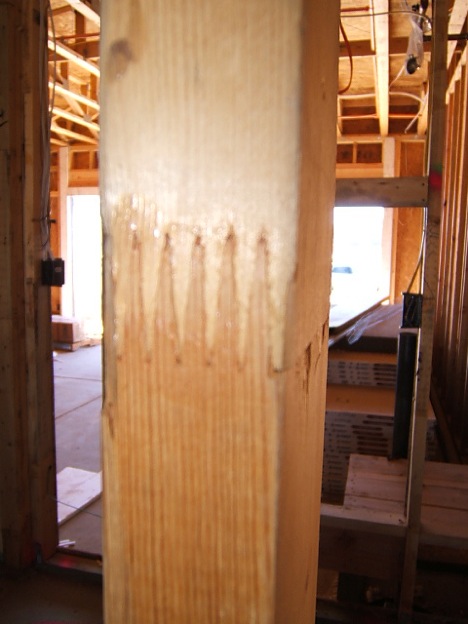
Look at this:

That’s a finger-jointed 2×4. An ordinary 2×4 wasn’t cheap enough, so the builder is using glued-together mill waste to keep his costs down. Nice.

This is one of the driest deserts in the United States. Wood dries out in our air, warping as it dries. If it gets wet, it is susceptible to mold and dry rot — a fungal infection that causes it to crumble. It is an irresistible treat for subterranean and dry-wood termites.

That finger-jointed member is going to shrink away from its glue as it dries, and the glue itself is going to dry up. Some day, that 2×4 is going to be about as sturdy as a stack of empty milk cartons. Nice.

Wood framing is cheap. Steel framing is forever.

Technorati Tags: , , , , , ,

Blogoff Post #10: How your weblog can attract inbound links . . .

From the seminal SEOBook article “101 Ways to Build Link Popularity in 2006”, the section titled “71 Good Ways to Build Links”:

45. Start a blog. Not just for the sake of having one. Post regularly and post great content. Good execution is what gets the links.

46. Link to other blogs from your blog. Outbound links are one of the cheapest forms of marketing available. Many bloggers also track who is linking to them or where their traffic comes from, so linking to them is an easy way to get noticed by some of them.

47. Comment on other blogs. Most of these comments will not provide much direct search engine value, but if your comments are useful, insightful, and relevant they can drive direct traffic. They also help make the other bloggers become aware of you, and they may start reading your blog and/or linking to it.

48. Technorati tag pages rank well in Yahoo! and MSN, and to a lesser extent in Google. Even if your blog is fairly new you can have your posts featured on the Technorati tag pages by tagging your posts with relevant tags.

49. If you create a blog make sure you list it in a few of the best blog directories.

Again and again, I see real estate weblogs with no blogroll and no outbound links to other real estate weblogs, and — in consequence — no inbound traffic. The hoarding mentality is failing in tangible economics, but it never worked at all on the intangible internet. If your goal is to hold your readers hostage by giving them no way out — they will never find the way in

Technorati Tags: , , ,

Blogoff Post #9: How to proofread your own writing . . .

From the Problogger ‘How To…’ Group Writing Project, The Golden Pencil offers some tips on how to proofread your own writing:

The fact that you wrote it means you know what it’s supposed to say and that’s exactly what your mind tends to see – what should be there, not what’s really there.

Of course, ideally, you’ll have someone else proof it – they bring a fresh eye and no pre-conceived notions, and hopefully they can spell. In fact, if the writing is for something that really matters, it can make sense to pay a professional proof reader.

The next best bet is to put it away for a day or a week – that way, your eye is much fresher and you’re much more likely to spot errors.

But life doesn’t often give us that much time. When the writing (or the check) has to go out today, take time to read it out loud to yourself.

Sure, you’ll feel really stupid the first few times you do this, but it works. If you’re in cube or other un-private place, whisper it to yourself. Somehow your ear will hear mistakes your eyes wont see.

I worked once with a great proofreader who read everything upside down to overcome the eye’s tendency to correct errors. At that same job, I had a vicious drunk of a boss who could fall down dead drunk, his finger landing unerringly on the ugly typo everyone else had missed.

Technorati Tags: , , ,

Blogoff Post #8: Make your first open house the only one . . .

This is from my Arizona Republic column. The topic, how to do your open house so well you won’t have to do it twice:

It’s possible to do an open house so well that you won’t be holding one every weekend. Done right, you should be able to make your first open house your last.

Obviously, the best open house is no open house. If your home is in tiptop shape, white-glove clean — and if your price it right — you should be able to sell it as soon as it hits the market and cancel that pesky open house.

But even if you’re stuck holding the house open, you can still make it sell fast.

Here is some specific advice:

First, nothing draws a crowd like a crowd. Promote the house hard among your neighbors. You should extend invitations to everyone in your surrounding area — hundreds of invitations. When passers-by see all the cars around your house, they’ll stop, too.

Second, nothing creates a sense of urgency like a deadline. Schedule your open house for one hour, two at most, and stick to your schedule. Make sure your Realtor is at the ready, contracts and pens in hand, with a lender on call to prequalify buyers.

Directional signs matter a lot. Balloons may help. But the house matters more than anything: squeaky-clean, in great repair, uncluttered, ready to sell now.

If you do your first open house right, your house could be sold before the second one.

Technorati Tags: , , , , , ,

Blogoff Post #7: Weblog Review: In the Trenches . . .

Kevin Boer’s In the Trenches weblog is a serious place — notwithstanding Kevin’s creation of a predictive betting market for the Sellsius° 101 Blogoff. Kevin believes in math, and it shows. His weblog is awash in charts and data, and he doesn’t hesitate to create his own metrics where none are available.

But don’t get the idea that the man can’t write. His data defends his prose — clear, concise and readable.

Kevin uses Blogger.com as his weblogging platform. This is not the end of the world, an event that transpired well after Blogger was invented. For writing or reading, this doesn’t matter much, I suppose. But Blogger shows its age as soon as you try to comment or to search into the database of posts.

The good news is that Kevin is working with TransparentRE to find a better weblogging platform.

Technorati Tags: , , ,

Blogoff Post #6: Ask the Broker: What does “refrigeration” mean . . . ?

The question:

What does “refrigeration” mean for cooling? An evaporator? Central air? Standing in the open fridge?

Bravo! You have exposed one of the oozing wounds in the Arizona Regional Multiple Listings Service. Right there among all the utilities information, it will say “Refrigeration”.

What does it mean?

Refrigeration is distinguished from either an evaporative cooler, a wall air conditioning unit or nothing. An evaporative cooler — also known as a swamp cooler — works by blowing dry desert air through a burlap-like pad saturated with water. A certain amount of the water evaporates, cooling the air, which is then blown through the house as a crude form of air conditioning. An even cruder form of this cooling system was invented by Native Americans in the Southwest.

Refrigeration, of course, is true central air conditioning. A noble gas is put under high pressure, causing it to cool substantially. This cold gas is forced through a radiator, as air is driven past the cold radiator fins. The cooled air is blown thorough the house.

There is actually an interim step between the evaporative cooler and central air conditioning — the chiller system — a heating and cooling system not-unlike the radiator systems used Back East.

Now you know more than you’d ever dreamed about desert cooling systems.

Technorati Tags: , , , , , ,

Blogoff Post #5: It takes sharp-elbowed self-promotion to grab the brass link . . .

From the seminal SEOBook article “101 Ways to Build Link Popularity in 2006”:

1. Sorry, but link building is still going to be the SEO trump card for the foreseeable future.

2. I wouldn’t hold your breath for search engine algorithms to place less importance on link popularity until the Semantic Web arrives, or maybe when HTTP gets replaced by a new protocol. Because links are still the basic connector, the basic relationship, on the Web. And for the forseeable future they’re going to be the easiest way for a computer program to judge the importance and trustworthiness of a Web page.

Whether your concern is your primary web site, your weblog — or both — the essence of search engine findability is the inbound link. Our goal at BloodhoundBlog is to build a community — but we want to build a big community. We don’t go out of our way to attract links — contemporaneous appearances seemingly to the contrary — but neither do we shun them.

I’ll come back to this as we proceed, because I think it’s interesting. In the mean time, what’s the best way to attract an inbound link? Very simple: An outbound link.

Technorati Tags: , , ,