There’s always something to howl about.

Category: Marketing (page 188 of 191)

Owning versus renting: In the long-run, owners appreciate their returns . . .

Searchlight Crusade has a compelling comparison of the financial benefits of buying a home, as opposed to renting:

Once you have bought, you step off of that one way escalator of rising rents. Rents increase at a yearly rate about comparable to inflation in most cases, and rents never drop. I have never heard of a rent decrease except in areas that were so far gone they might as well have been war zones. You only borrowed $X when you bought, and unless you take cash out (which is under your control) you should never owe more money next year than the previous one.

So buying stops your situation from getting worse. What about making your situation better? First off, I need to observe that with rising rents, your situation will always get worse until you sell. But buying really does make your situation better. Not immediately; there’s always a hit for buying, and it always costs money to sell. But within a couple of years the average person will be above any reasonable return they can earn any other way, and the reason is leverage.

Fact one: you always need a place to live, and the options are to rent or to buy. Renting typically requires less cash flow, but returns nothing. Once you have bought, all that lovely appreciation belongs to you and nobody else but. Let’s look at an actual scenario for San Diego, one of the highest priced places to buy.

The article runs through a side-by-side, dollar-for-dollar comparison of the costs and benefits of homeownership — even in a high-priced area like San Diego in a slow market.

Technorati Tags: , ,

Goodyear burns rubber in pursuit of growth . . .

From the Business Journal of Phoenix:

The city of Goodyear Tuesday announced a plan that will extend its southern border down to Mobile and nearly quadruple its population.

The southwest Valley community has expanded its General Plan area by 70 percent to include about 61,000 acres. The 95-square mile area is bordered by Patterson Road to the north, State Route 238 to the south, the Sonoran National Desert Monument to the west, and the Maricopa/Pinal County line along the east edge.

This is the town due east of Buckeye, which is also growing at a furious pace. This is amazingly ambitious.

In the professional prescience department, I have been telling my clients this for years:

“We believe eventually the Loop 303 should be extended all the way south to Interstate 8, providing a second access point for Estrella Mountain Ranch residents and to provide better circulation for everyone in that area,” said Krauss.

And there are more shoes to drop on the route of the 303…

Technorati Tags: , , , , ,

Tell the world: Zillow.com is bunk . . .

I wrote Debunking Zillow.com on July 25th, two weeks ago today. Without being arcane or technical, I think it completely demolishes the idea that Zillow.com can — or ever can — provide reliable home values. Nathan Hughes at Richmond Business and Commercial News wrote about my post, and, in a comment there, I said:

The Zillow mystique is analogous to the aura that surrounds the nutritional supplements business. No one can possibly confuse a clerk in a GNC store for a physician, but people like the idea of being liberated from the dictates of their doctor while going one up on him at the same time.

We know that Zillow.com rides the Cluetrain, or seems to. When I teased them, they teased back.

Why, then, have they not responded to the much more serious allegation that their base epistemology categorically forbids the very results they promise to deliver? I believe that what Zillow.com does would be actionable professional malfeasance if done by a real estate licensee. If the owners of Zillow.com think I am wrong on one or both points, why haven’t they risen to answer my charges? If they can prove me wrong, why haven’t they done it?

Google me this. Or this. If I am wrong, they need to shout me down right now.

But I’m not wrong, am I? Cum tacent, clamant. Their silence speaks louder than any words: Zillow.com is bunk.

It is the duty of the entire real estate community — and in this company I include the recent dot.com entrants, licensed and unlicensed — to guard consumers from hoaxers, con-men and frauds. I have no doubt that the owners of Zillow.com have the best of intentions. Nevertheless the results they produce are necessarily erroneous — and I have zero doubts that they know it. I think this is a case where everyone who cares about the true value of homes — or simply The Truth in the abstract — should stand up and be counted.

The fact is, if you eat whole bottlesful of the quack nostrums they sell at GNC, nothing will happen to you. The contents are completely inert, with Read more

Flinch!: Whipsaw sellers to get the house you want at the price you want . . .

Ardell has a story today about a multiple-bidder contest that occurred I know not where. As described, the situation would have been an Undisclosed Dual Agency in Arizona — even though both of the clients betrayed were buyers. Two agents of the same broker engaged in a bidding war, which means that the broker himself was pitting two of his own clients against each other, to his own benefit and contrary to the interests of both.

The story put me in mind of our own recent seller’s market. It was a lot of fun to be on the listing side. List on Thursday and the offers start coming in before the photos are integrated into the listing. Put everybody off until Monday, just let ’em pile up. Cathy wrote software to compare net sheets on an apples-to-apples basis, so we could winnow a stack of 30 offers down to the two or three most worth looking at and just ignore the rest — with the seller’s permission, of course, and always with a note of thanks faxed to the buyers’ agents.

But being on the buyer’s side was no fun. The house lists at 10:20 on a Sunday morning, heaven knows why. We’re there by 11. The lister says, “We’d love to have your offer, but it’s only fair to let you know that we already have five — and I’m expecting six more. Pound out a contract on the laptop at Denny’s, stealing power for the portable printer. Huge earnest deposit, non-refundable. Huge down payment. As-is. No appraisal contingency. Double-think and double-think and double-think the price, figuring out exactly where everyone else is so we can be a couple thousand dollars higher. Race it back to the lister by hand.

Hustle back to the office, where the fax machine is already spitting out the bad news — the worst news, really. Not a rejection. Not a counter. No, the worst possible fate in a market that crazy: A Multiple Counter Offer.

The buyer says, “A counter is a counter, right? Acceptance is transmittal, right? That’s what you told me. So all we have to Read more

Christmas in August for some, three years of excuses for most . . .

Apple’s World Wide Developer Conference commences today. Steve Jobs’ keynote speech will feature announcements for a rash of products that Mac users will find under their Christmas trees and Windows users will get in buggy, stripped-down, Yugo-like versions three years from now. This is off-topic (and mean, albeit true), but since Apple drives so much innovation in computing technology, it’s news for the real estate community nevertheless. The really interesting thing for me is how radically Mac developers are rethinking user-interfaces. We’re all too busy reading Andersonto realize that we might-could-should be reading Kurzweilinstead. Macintosh development is more than a few steps back from The Singularity — but it’s on the path. Now think of this: If you were offered the chance to transition from mere mortal flesh to something much more enduring — is this a task you would entrust to Microsoft…?


Technorati Tags: ,

A Long-range vision for Long-term benefits . . .

There is a nice feature in today’s Arizona Republic about John F. Long’s plans for the SR-101 corridor:

More than a half century ago, John F. Long began building the first of tens of thousands of ranch-style homes that would become west Phoenix’s Maryvale community.

Later, he would shift his focus to developing retail centers, providing residents with such commercial outlets as grocery stores, banks and pharmacies.

Now 86, the longtime Valley philanthropist and developer is turning to his three grown children to help him realize his latest vision: the Algod?n Center, a 1,000-acre business and medical office park expected to bring thousands of jobs to the West Valley.

I’ve been watching that land for years. It’s striking, because, as you’re driving down a major freeway, there are thousands of acres of undeveloped land on both sides of the road. John F. Long owns or controls a lot of that land. The shoe dropped in the paper today because the Cardinal’s football stadium opened Saturday. Long is ready to make his move, now that the land has substantially increased in value.

Without John F. Long, Phoenix would be a radically different place. And he’s not done yet…

Technorati Tags: , , , , ,

What’s wrong with real estate weblogs? I might run this way and that, but never hot and cold . . .

Mike Price at Mike’s Corner posted a fascinating interview with Russ Cofano of Rain City Guide on the subject of real estate weblogging and the ‘bloginars’ Russ and Dustin Luther, also of Rain City Guide, have been running. The interview is extensive, and I’m only going to touch on a piece of it, so you should go read the whole thing.

The meat of the matter for me is Russ going through his ideas on do-s and don’t-s for real estate weblogs. Like this:

Here is a list of 10 posts that make for great blog content:

Stories
Data (Charts, Tables, Maps)
Book Reviews
Current Events
Neighborhood Descriptions
Local Events (Fun Stuff!)
Links
Interviews
Advice for Buyers/Sellers
Advice for other Agents

I don’t hate this stuff, but some of it seems to tread dangerously close to the turf Seth Godin calls a Cat Blog. Couple that with “Advice for other Agents” and we trip on the schizophrenia that seems to afflict many real estate weblogs — and BloodhoundBlog is guiltier than most.

Witness: Most real estate weblogs are run by agents or brokerages, and at least one meta-goal is to scare up business. But what is interesting to potential clients is very different from what is interesting to the weblogger. Data, current events, neighborhoods — all that stuff is great, but news about it is not in short supply, and it’s not always easy to come up with an original take on it. On the other hand, the business of the real estate business is endlessly varied and fascinating — even though it might be boring or even completely off-putting to potential clients. We seem to end up talking two games, client-focused material that can too-easily slip into blatant advertising, and inside-baseball commentary for well-schooled insiders.

(I’ve thought about writing a Wiki-fier in PHP that would pre-process a web posting, tagging delimited terms with Wikipedia look-ups, in case I’m assuming that readers know the jargon I’m using when in fact they don’t.)

(The Latin root of the word discursive, as in discursive prose, is discurro, which literally translates to, “I run this way and that.” Discursive prose is the means by which we tame our scattered minds Read more

Market-Basket of Homes: Values down 1.83% on slow sales

Market-Basket of Homes: Values down 1.83% on slow sales

The July BloodhoundRealty.com Market-Basket of Homes is available. Prices down, sales volumes down, but — interestingly — inventory is down. Make of it what you will:

This fall in Valley schools, the faces of the teachers may change, but the kids may be the same. The annual selling season, when parents move in time for children to start the school-year in their new neighborhood, for the most part has not materialized. Home prices for July were down 1.83%, compared to June, in the BloodhoundRealty.com Market-Basket of Homes. More significantly, only 151 home sales were recorded, a fairly low number for this time of year. Average sales prices were down $4,715, from 257,999 in June to $253,284 in July. Values are down $16,591, or 6.15%, from the December 2005 high of $269,875. Market-Basket homes spent an average of 74 days on market, five days more than in June.

As has been the case in recent months, most Market-Basket homes are selling at or above list price. A few deeply-discounted properties pulled down the average, and average discounting netted out to 1.61%, down from 1.75% in June.

A total of 151 Market-Basket homes were sold in July, down from 176 in June. However, inventories of available homes have declined. There are now 1,506 homes available for sale in the Market-Basket, where there were 1,525 in June. With sales of only 151 homes, the implied absorption rate is almost 10 months, but, interestingly, there are 179 Market-Basket homes currently listed as “Sale Pending.” A six-month absorption rate is considered normal.

In the Arizona Regional Multiple Listings Service at large, 6,101 homes have sold against an inventory of 46,269, an implied absorption rate of 7.6 months. There are 6,262 properties listed as “Sale Pending.”

The historical numbers make it plain that we did not experience the traditional selling season, but they also make it plain that a simplistic year-over-year analysis — which we can expect from the Arizona Republic a week or more from now — is misleading.

Number of Homes Sold (with Days on Market)

March 2003 6471 Read more

How to make fast, flexible web pages . . .

Sellsius° has a big bag of how-to’s but I’m from Missouri. I like how-to articles that tell exactly how to do something.

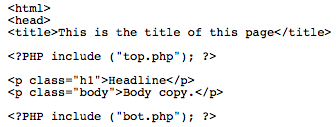
One from me: How to make fast, flexible web pages. This is Realtor 2.0 stuff: Full-service Realtors who plan to compete need to learn how to punch out lots and lots of new web pages with dispatch. For one thing, this is where all those photos I keep talking about are going to go. We do most of our pages with software and I’m not going to tell you how we do that — because I plan to send my kid to college with that software. But here is a road map to kicking out new pages with minimal effort. There’s a bonus to doing things this way, too, which I’ll get to at the end.

Vide licet:

That’s PHP, and if you’re on an Apache web server, you’ve got it. This is really simple code, but that’s the point. The whole purpose of PHP is to generate HTML on the fly, so I can only show this code as a picture and talk about it by paraphrasing.

What does it do?

It generates a complete web page: Title, meta-tags, CSS, internal Javascript, body copy, and graceful exit. If you look at the source of any web page in your browser, you’ll see a lot more than seven lines of code. That would be the case here, too. The two “included” files, “top.php” and “bot.php” are going to explode into a bunch of HTML.

To set this up, you take your standing dummy web-page, the one you’re using to create new web pages. Configure the first three lines the way you see them in the picture. The title tag doesn’t have to come first, but it can, so let’s make it come first. Then copy everything from the first line after the title down to the last line before the actual changeable content of the page. Paste that into a new file named “top.php”.

Then go to the first line after the changeable content of the page and copy from there to the bottom of the Read more

Real estate photography snapshot: Composition is salesmanship . . .

Coming back to this, I wanted to spend a few minutes on photo composition techniques. That’s almost absurd: Who doesn’t know how to take a picture? Almost everybody, it turns out. We’re not talking about Ansel Adams levels of perfection, we’re talking about taking real estate photos that sell the property but don’t require a lot of back-end effort on your part. That means that we want to take a photo we’re ready to show off as-is, not one that requires cropping or re-touching in PhotoShop.

Here’s an obvious rule first: A camera is not a gun, and a house is not its target. If you look at published real estate photos, again and again you’ll see the house centered in the frame with miles and miles of do-nothing sky above it. This is wrong. Fill the frame with whatever it is you’re drawing attention to. If you think you might want to crop the image later, why not crop it now by filling the whole frame?

We like drama, so often we’ll get in really close at a point of view much lower than normal (it’s called crouching or kneeling; even old people can do it). In this case we also blasted hard with an electronic flash — even in bright sunlight outdoors — in order to bring out the details that would otherwise be in shadow.

Another way to lend drama to a scene is to go higher than eye-level and look down. Most digital cameras have a video viewfinder, so it’s easy to frame photos while holding the camera overhead.

If the ceiling is interesting, it should be in the photos. The wide angle lens on your camera will include the floor and ceiling of your interior shots, so you should be watching for things to bring out. Here in Arizona, ceiling fans are worth money, so we make sure we show them off.

Here is the value of a very wide angle lens: We can see this whole bedroom in two photographs. The human eye is much more adept at apprehending visual information than any camera. Our eyes-forward range of vision is Read more

“Don’t be chicken about the real estate market . . . “

An easier Friday for me, nothing to torque the brokers. Maybe I’ll hear from weary sellers instead. Me in today’s Republic. Here is the permanent link.

During our recent run-up in values, the Chicken Littles couldn’t stop clucking about imminent doom. Since then the market has cooled, but the Chicken Little chatter is hotter than ever. The real estate market must collapse. It simply must.

This prediction will lay an egg. But don’t hold your breath waiting for an admission of error. And if you yourself are waiting for the explosive report of the real estate bubble popping, you might just hear a pin drop instead.

Here’s why:

  • Real estate and securities are both leveraged, but the real estate market is not the stock market. Stocks are instantly transferable. You can acquire or liquidate a portfolio in seconds. Moreover, while stocks are subject to margin calls, it would be insane for lenders to call their mortgages en masse.
  • More to the point, homes have intrinsic value. A stock is worth what someone will pay for it, right down to nothing. In any place where it rains, snows or gets really hot, homes will be worth something.
  • Which leads us to demand. Some locales have more houses than occupants. No bubbles will burst in those places, either, but their values will slowly deflate. In a market like metropolitan Phoenix, long-term demand exceeds supply. As long as it does, our long-term trend in values should be nothing but upward.
  • Finally, sellers in a buyer’s market are a lot less time-sensitive than buyers in a seller’s market. In the latter case, the longer that buyers delay acting, the greater their costs. Hence, the frenzy. But if sellers stand fast in a buyer’s market, they might suffer a loss. But they might do better by waiting. Or the marginal cost of waiting may be less than taking a low-ball offer. Or they may elect simply to wait out the market.

The bottom line is, Chicken Little be fried, the real estate market will be fine.

Technorati Tags: , , , , ,