There’s always something to howl about.

Category: Marketing (page 41 of 191)

Are the uninformed chatterboxes in your area insisting that the real estate market has recovered? You may want to defer the celebration. Even so, this could be the golden moment for investors in Phoenix.

I’ve known for six months or more that there was a sweet spot on the horizon for investors and other highly-solvent buyers. That event was delayed by the first-time home-buyer’s tax credit. Today’s news about declines in the number of pending purchase contracts is a symptom of the market returning to an unstimulated level of demand. I watched the dropoff reflected in today’s news as it happened last fall. Lenders cut off new applications for first-timers and, just like that, price pressure eased, available inventories started to rise and it came to be a lot easier to get a house under contract.

We’re all waiting for the other shoe — the shadow inventory — to drop, but the supply of the homes I want most for my investors has almost doubled since mid-October, from around 350 units then to just over 600 today.

Here’s even better news for buyers (not for banks): Prices are going down.

This is the Cliff’s Notes for the last four months, as reflected in the BloodhoundRealty.com Market Basket of Homes:

September: +3.15%
October: +2.14%
November: +2.22%
December: -8.03%

That’s a huge drop for December — giving back almost everything we’ve gained since April, 2009. But, interestingly enough, the ratio of sales price to list price was positive. In other words, there is still competition for listed homes, but list prices are dropping.

I don’t know how it is by you, but this is the perfect storm for investors in Metropolitan Phoenix. The homes are in much better condition than they were this time last year, and the prices are at hovering just above the 2009 low.

Are we at the bottom? Feels like it — but we’re going to be here for a while. Positive cash flow is easy, but cash flow is all there is right now. If you’re not a buy-and-hold investor, Phoenix is not for you. I’m sure that’s true in most rental markets.

But if you’re thinking of buying a rental home anywhere in the South or Southwest, reflect on this: This could be the coldest winter in 25 years. Whether they can afford to or not, people are going to move. When Read more

Using the DISC system to understand the boys of Entourage

I’ve talked about the DISC system of personality profiling in past. I’m talking about it again, now, because I want to use it to discuss how we are going to build our ideal real estate team. For now, I just want to talk about thinking in a DISC-like way, using on-the-fly DISC analysis to evaluate and respond to the people you come into contact with.

Here are the four DISC categories:

Dominance; Influence; Steadiness; Compliance

That’s less than useful. Here’s a better way of understand what DISC is measuring:

D’s are drivers. They’re all about getting things Done. A high-D (c’est moi) can be a prick to work for (yeah), but every successful boss will have a lot of D in his personality.

I’s are all about Image, about the way other people perceive them, their accomplishments and their stuff. Many successful salespeople are strong on I traits.

S’s are strongly associated with family life and social communities generally. If your office has a Secret Santa gift exchange, it’s being run by an S.

C’s are associated with calculation, computation and a comprehensive attention to detail. If the till comes up three cents short, a D will toss in some coins to get on with business, but a C will keep counting and counting until the cause of the discrepancy is uncovered.

Here are two more axes for understanding DISC profiling:

D’s and I’s are about telling, where S’s and C’s are about asking.

And D’s and C’s are about process, where I’s and S’s are about people.

It would be terribly convenient (at least for me) if people fell neatly into one DISC quadrant or another, but of course they don’t. Some people are chameleons, with just about the same amounts of each characteristic. More commonly, people will tend to have one strong trait and another that is fairly strong, with the other two coming in less strong.

So, for example, in my own idealized self-image, I am all D and nothing else. But in the reality of day-to-day life, I am a high D with relatively high I-like tendencies — which you could guess just by reading this post. I want Read more

Interest rates have been trending upward, but what happens when Uncle Sugar quadruples the sugar supply at Fannie and Freddie?

From the Wall Street Journal:

The Obama administration’s decision to cover an unlimited amount of losses at the mortgage-finance giants Fannie Mae and Freddie Mac over the next three years stirred controversy over the holiday.

The Treasury announced Thursday it was removing the caps that limited the amount of available capital to the companies to $200 billion each.

Unlimited access to bailout funds through 2012 was “necessary for preserving the continued strength and stability of the mortgage market,” the Treasury said. Fannie and Freddie purchase or guarantee most U.S. home mortgages and have run up huge losses stemming from the worst wave of defaults since the 1930s.

“The timing of this executive order giving Fannie and Freddie a blank check is no coincidence,” said Rep. Spencer Bachus of Alabama, the ranking Republican on the House Financial Services Committee. He said the Christmas Eve announcement was designed “to prevent the general public from taking note.”

Treasury officials couldn’t be reached for comment Friday.

So far, Treasury has provided $60 billion of capital to Fannie and $51 billion to Freddie. Mahesh Swaminathan, a senior mortgage analyst at Credit Suisse in New York, said he didn’t believe Fannie and Freddie would need more than $200 billion apiece from the Treasury. But he and other analysts have said the market would find a larger commitment from the Treasury reassuring.

What’s your take? Are we looking at another two years of 30-year fixed mortgages under 5%?

Howling for the hard-working dogs: “We interrupt this Christmas Season for the following brief commercial transactions.”

Rich full day today, lots of variety. Working Christmas Eve with me were home inspector Mike Elsberry (two houses), wood inspector Joe Letourneau (two houses) and our handyman, Mark Deermer (one house). We had a plumber working at one of our listings, as well. I could tell by the (lack of) traffic on the streets that a lot of people took the day off, but I am delighted that so many of the people that I work with were working today.

I’m going to work quite a bit tomorrow, Christmas Day. Mail, of course. But I’m also going to service a listing and take a look at half-a-dozen vacant REOs. Nothing terribly time-consuming, more like errands than anything else. But it’s work I want and need to get done, and I don’t want to put it off.

I think this is all part of the revolution incited by these devices — alike unto the idea that privacy is an artifact of inefficiency. I don’t take time off as a binary state event, and it kind of drives me crazy when other people do.

I think it’s insane that too much of the commercial world comes to a complete standstill on special days. But at least we are not insane enough to be consistent. No one preaching the virtue of sacred pretend-poverty wants for the power plant or the hospital emergency room to shut down from now until the Feast of the Epiphany.

Even so, it is simultaneously plausible to me that I might have something to prove: I’m going to celebrate my Christmas, and I am not going to interrupt anyone else’s. But I can do valuable work for my clients tomorrow, and it is important to me to get it done. And, at a minimum, my clients will be ahead of the game and my workload Saturday will be lighter. Everybody wins.

But here’s the thing: I think you’re going to work tomorrow, too, even it’s only to deal with your client email. And I think this is something to be celebrated, not condemned. We work in the pursuit of happiness, as Jefferson had it Read more

My car is not a real estate office. In 2010, my car is going to become a wi-fi-enabled mobile real property exchange and conference room.

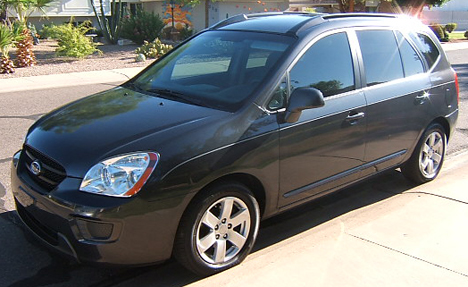
This is the car we bought for me in July. It’s a used Kia Rondo, a semi-unassuming wannabe minivan that I have denominated with this demanding appellation: Prometheus.

My favorite god, as you might have guessed, from all of human history. Prometheus, you will recall, stole the fire of the gods from Zeus and gave it to the people. An alternate reading of the Greek cites Prometheus as having borne the gift of mind to humanity, a rendering of the tale I like even better. If you are a life-sucking real estate broker or any other functionary of the life-sucking National Association of Realtors, the memes that move me will tell you a lot about my long-term plans for you.

But: Sometimes a minivan is just a minivan. I chose the Rondo because a client of mine rented one when he was in town, and I realized it was the perfect real estate car. I had looked at more expensive so-called “crossover” vehicles, but we have practiced and perfected the art of being cheap bastards. At ten grand out the door, the Rondo seemed like the optimax choice.

And this has it proved to be. I’m in it a lot, and it is a very comfortable roaming office for me. I don’t know how other Realtors deal with all the lengthy phone calls that go into selling real estate, but I take down a whole bunch of them from my car. I can make anywhere from one to five calls between stops, and if I were not doing those calls from behind the wheel, I wouldn’t be doing them at all.

But wait. There’s more. I bought the Rondo because I knew I would be doing more and more real office work from the car. The vehicle has three cigar lighters, and I have 300 watt 110 volt power inverters plugged into two of them. That is to say, two three-prong outlets in the front seat and two more in the back. I could be working on my laptop, an assistant on another and a client on a third, all of us plugged in to Read more

Darth Vader With a Toothache – A Better 2010

Ever looked over at the agent down the hall and wondered how they get from home to the office without hands-on help? They usually didn’t get past the front door back in the 1960’s, at least in our offices. I remember vividly that you were tough or you found another place to work. Cream puffs generally didn’t get too far into Dad’s job interview before they knew they weren’t in Kansas anymore. There was no such thing as laser beams back then, unless he was starin’ right through ya.

Dad used to conduct what I’ll call no nonsense weekly meetings back in the mid-20th century. Attending my first one three days after my virgin day at the office was, um, eye opening. It was Tuesday, October 21, 1969. Dad was his usual toned down Zig Ziggler self, with undertones of Darth Vader nursin’ a toothache. It was the first time I’d ever seen how others perceived him as a boss.

They soaked in every word as if he was readin’ off the third tablet Moses lost while coming back down the mountain. Though I could believe it cuz he was hugely successful (1,000 sides/yr), and arguably charismatic, I wasn’t sure about ‘why’ he was viewed this way until much later. One thing for sure, you worked for him or you took up space elsewhere. Even though the firm did so many sides a year, he never had more than 28 full timers, complimented by a dozen or so part timers. To this day I’m convinced the profile of his typical agent was ‘assassin’.

This is all prelude to explaining how a one act pony like Dad (his words, but painfully accurate), went from zero to over a 1,000 sides yearly in just over a year. Ryan Hartman’s excellent post about dominating the market struck a deep chord with me. Not just because it reminded me of the ‘good ol’ days’, but because I think he may have found the key to the mint.

That aside, the plan, whatever it may be, is secondary to the combination of unflappable belief and consistent, Read more

Are email drips equal in ROI to snail mail drips?

When I established Worthington Realty about 1.5 years ago,  I wanted to always be experimenting with what I could do to convert leads to closed sales.  So I set out to have the best email drip campaigns as well as the best snail mail campaigns.  I have had much more success from a snail mail campaign than I have had from an email drip campaign.  I often question myself…what I am doing right and what I am doing wrong!?!

The snail mail has a thick stock cotton style envelope.  Inside is a high definition business card, high definition tri-fold resume & a typed letter about me on one side & how I can help on the other side.  I feel the presentation even though I’m not in person and doing this by snail mail is so powerful that customers call; about 2 out of 100 mailers to be exact.  Generally speaking, I usually list and sell the property.  I ask myself the question, what if I implemented a follow up snail mail campaign after the initial mailing?  I will report back with my results in a future post.  Can I close more snail mail sales as opposed to just one mailer, why not 3 or 4 snail mailers, especially on quality listings?

The email drips seem to have less response than a snail mail campaign.  Surely I have closed leads off of my website and then referred from those sales.  BUT, my conversion rate is far less than 2% like the snail mail.

My take is simply this.  Email drips do work, but are easily forgettable to consumers.  Snail mails are more expensive but since the consumers are physically touching quality materials, they are not easily forgettable as apposed to emails.  Your thoughts?  So much for my quest to go paperless…

Next year we’re going to splurge — maybe — starting with the twenty-first thousand dollars for the month

Here’s my favorite Christmas card this year:

I helped Stephen and Suzanne Kranick buy that house in the weeks before Thanksgiving. I think it’s cool that they love it so much that they made it the star of their holiday card.

I put two houses into escrow today. I’ve done that before, but Cathleen and I are both packing transactions into January at a nice pace. I’m still holding out hopes for one more all-cash deal in December, but the calendar is turning on me day-by-day.

But here’s the thing: The pace we’re on right now puts us at $20,000 gross commission income a month for 2010. I’m sure that sounds like a lot of money to anyone who is not in the real estate business, but it ain’t. But our marketing costs are where they’ve always been — very low — so we’re right on the cusp of proving the claim I’ve been making here for coming on four years: It is possible to do this job without spending fifty cents on the dollar for client acquisition and without feeding a vast cadre of useless eaters.

It’s plausible to me that we could be at $40,000 a month by the third quarter, and from there it’s not a huge jump to seven figures, GCI, per annum.

But: Meanwhile: We are cheap bastards. We never hesitate to spend whatever it takes on mission critical tools, and that will always be the case. But we have been very tight on every discretionary expenditure for a long, long time. And as much as business has sucked over the past four years, it is being tight that has gotten us through the worst of it. A lot of Realtors didn’t make it, as we all know.

So: Cathy just had her birthday, and from me she got a 2 gigabyte memory upgrade for her iMac. So romantic…

But, even so, we can foresee that we are going to have a little money for luxuries in the coming year, and the question plaguing me has been how to manage that kind of spending without going crazy on the upside, as it were.

Here’s Read more

The twelve days of iPhone apps: Turning your phone into a real estate agent’s pocket powerhouse

All right: So: Let’s start in the middle.

First, we have four cell phones among the two of us. We have the two spares in case we need to put a phone in the pocket of a subcontractor. We keep a close eye on the folks who work with us, but we don’t ever want for our people to be without a lifeline.

Even so, the phones we actually use are the iPhones. It seems plausible to me that I may add a Droid and a Pre in 2010, both of them to keep any eye on what else can be done. But the iPhone app universe is exploding like the universe of time, space, mass and energy, and it seems reasonable to me that that the iPhone will be driving cell phone/pocket computer/etc. innovation for the foreseeable future.

Just in recent days, the appworld has added live video streaming and real-time credit card processing, and my thinking is that there are a lot of as yet undisclosed tricks in the iPhone developers’ APIs. In other words, I suspect that Apple has been holding back on the iPhone’s feature set to kill competitive features as they’re aborning, nipping every supposed incipient iPhone-killer in the bud.

I realized last night that I want for my laptop (a MacBook Pro) and my desktop computer (an iMac) to be the same one computer. Does that make sense? I want for those two computers to be cloned and continuously-syncing instances of the same one database of files. And I want for my iPhone to be a moon of that doubled planetary system.

This is singularity thinking: One way that human beings could leap to the next level of our evolution is by moving into computing hardware. The philosophy of all this is brain-breaking: Hardware geeks insist that the human mind must be a finite-state machine, while everyone with an introspective consciousness acts reflexively upon a seemingly undoubted belief in free will.

That’s a problem we’ll have to deal with on the way to the singularity. Meanwhile, a software instance of “you” could be cloned to live on as many hardware devices Read more

Ustream brings us live video streaming from your iPhone — and the world of video podcasting just got a lot more interesting…

Don’t let anyone tell you that I never say anything good about ActiveRain. I saw a passing note yesterday about Ustream.com’s new iPhone app, but I ignored it in the crush of business. But this morning there was a post about the Ustream client in ActiveRain’s daily spamletter, and that led me to download the app.

What does it do?

Live video streaming from any iPhone 3G or 3GS. No kidding. Ustream quality, of course, compounded by the cheesy little lens on the iPhone, all compounded by WiFi or 3G transmission speeds. But still…

Live video streaming from your phone…

Practical applications?

Well, for one thing, Rodney King now has nothing to fear. Abusive cops are a thing of the past, and I would love to see a Ustream/YouTube channel devoted to abusive government functionaries everywhere. Especially in Iran, by the way, and I can’t think of a better antidote to bad behavior everywhere than instantaneous, live, streaming video for all the world to see.

But what about real estate applications?

Don’t throw away that video camera. It’s still Ustream, after all. But when you’re doing a home inspection for an out-of-state buyer, a live video conference with the inspector may be just the ticket. With a second phone, the client and the inspector can talk as you are shooting live video of the repair issues. Is that more sizzle than steak? I say it’s good salesmanship.

Are there other uses you can think of in your day-to-day real estate work? I’m never a big booster of new-for-the-sake-of-being-new. Mission-critical is all that ever matters to me in judging a new tool or idea. But I’m thinking that live or easily-recorded lo-rez video might serve a host of mission-critical functions.

Two (bad) videos as examples, as I learn to play with this new tool:

First, a bad demo recorded to the phone, then uploaded to Ustream.

Second, a live stream saved directly from Ustream.

In both cases, the iPhone shut off on me. To make this software work, you will have to change your auto shut-off setting in the main iPhone preference app. Then you have to remember to switch it back — or Read more

Should I Touch You or Contact You?

Yesterday in a marketing Mastermind Group with a half dozen agents, a bit of confusion arose over two of the primary principles I use when developing their marketing campaigns.  The question was new to me and that means it might be new to some of the readers here at BHB.

Earlier, we had discussed the parameters of an effective drip campaign on those we already know: friends, family, past clients, past prospects, and so on.  I call this group your S.O.I.L (Source of Income List) because we want to grow a very robust referral business from it.  Gary Keller, in his outstanding book Millionaire Real Estate Agent, refers to this group as METs and suggests you touch them or drip on them 33x per year.  I have “adopted” this philosophy wholesale and – as with most of the concepts in that book – find it applicable to agents no matter where they work.

A little later, I mentioned that statistically speaking, 80% of all business happens after the fifth contact.  This is not real estate specific.  It’s more of a universal rule borrowed from the direct marketing world.  (You may notice I do a lot of “borrowing” and “adopting”… most great marketing is based on ideas stolen from another industry or product.  Take a look around outside the world of real estate.  You’ll be amazed how many great ideas you find.)  While discussing this idea, one of the agents asked why we need to touch our sphere 33x when most of the business is going to happen after the fifth contact.  Great question because it illuminates one of the basic misunderstandings in marketing.

When you drip on your sphere – touch them regularly – you are practicing Epiphany Marketing.  This is very similar to branding but, in my opinion, more effective.  It’s designed to generate referrals and is on the very edge of what we can accurately call “marketing”.  On the other hand a true, honest-to-God marketing campaign revolves around a specific concept (hopefully a USP) and is designed to carry people along a well-lit path until they inevitably reach the decision to Read more

A first look at the Panasonic Lumix ZR1 as a real estate camera

Just a real quick look at the Panasonic Lumix ZR1, in use with the dogs this week as a real estate camera. When I get time, I’ll do some side-by-side comparisons. This is just a quick look at some photos and a demo movie.

First some pix:

These are good, nice and wide, nice and bright. No distortion on the straight lines. A little bit of lens flare, but this ain’t Life magazine.

Here’s a huge benefit: Even with the flash on, the ZR1 is fast. Refresh time is maybe two seconds, essentially no delay at all. The auto-focus/auto-exposure systems need a little time to do their calculations, so it’s possible to rush the camera. But a wide lens has a huge depth of focus, so it’s hard to get into real trouble.

The movie is not so pleasing. The wide lens is great, but the AF/AE issue is much more serious on-the-fly. I don’t like house videos, anyway, but, if you plan to do them with the ZR1, you need to make sure you have a lot of light.

Here’s the video as recompressed by YouTube:

Not great. The original is better. You can see it by clicking “Play in Popup” in the links at the bottom of the post.

My one complaint with the camera, so far, is that it’s so tiny. I have big hands, so it’s taking some getting used to. But it’s wicked easy to get a lot of very good photos very quickly. And the 25mm lens is very, very wide for a point-and-shoot camera.

Further thoughts when I’ve had more time to play.