There’s always something to howl about.

Category: Marketing (page 62 of 191)

With a new iPhone application and support for other mobile devices, Trulia.com is pushing the Realty.bot race into the cloud, but its new free weblogging platform may put ActiveRain under a cloud

Who’s winning the Realty.bot race, Trulia or Zillow? There is a constant flurry of new press releases from the two companies, but their boastful claims often sound like a pair of garrulous amputees agreeing with each other that the two-legged world is off its rocker: “Five million visitors! Ha-ha!” “A hundred thousand new listings! So there!”

Does any of this mean anything? There are wonderfully useful metrics for judging net.behavior. Unique visitors, for example. Pageviews per visit. Time on site. Even better: ROI per visit. But these measures are not independently verifiable, and the guides we do have available to us are inherently suspect.

So who is winning the Realty.bot race, Trulia or Zillow? Neither company has gone IPO. Neither company has gone belly-up. Beyond that, your guess is as good as anyone’s.

But: Tonight marks a decisive change in the game: Truila.com is releasing a fairly robust iPhone application as a part of a site-wide upgrade.

What’s new?

  1. Trulia Mobile will offer a limited set of location-based searches from Apple’s iPhone, from an array of Lightpole-enabled smartphones and from Dash Navigation GPS devices. The user-experience will differ by device, but the design premise is based on location-sensitivity: Your iPhone always knows where you are, so it can interact with Trulia’s file servers to show you a list of nearby listings or open houses. You can get a detailed summary for each home on your list, and you can then email the listing to a friend, contact the listing agent directly or map the home so that you can hop over for a quick peek.
  2. Trulia is adding a higher degree of user participation in the form of a new, free weblogging platform. Any registered user of the site will be able to start a blog.
  3. Finally, Trulia is offering greater personalization of the user experience in the form of a self-customizing home page. Your home page will reflect “new property listings, home prices changes, upcoming open houses, median sales price trends, recently sold properties,” all of these based on your past search history, along with “relevant blogs and Q&As from our Trulia Voices Community.”

In truth, personalization might Read more
BloodhoundBlog sports new iPhone theme: All the dog, half the drool

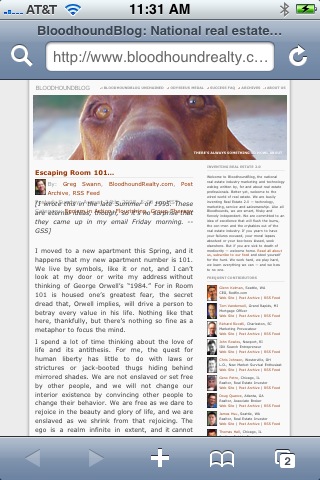
I installed an iPhone-only theme this morning. If you land on BloodhoundBlog from any browser except Safari for the iPhone, you’ll see our normal theme. If you come in from the iPhone, you’ll get a theme optimized for the iPhone’s (or iTouch’s) screen size.

This is the way BHB looked on an iPhone until this morning:

This is how it looks now:

The theme rotates as you would expect it to, so you can get to a wider, shorter, easier-reading page if you want to.

The normal sidebar stuff is entirely omitted, so you’ll have to come in from a desktop browser to see that content.

Remember that you can easily add a BloodhoundBlog button to your iPhone home page.

I have to work out an algorithm, but, last night, in a fit of ecstatic romantic frenzy, Cathy and I worked out how to produce engenu-like pages on-the-spot. If I can figure out how to move iPhone photos to a file server, we could produce previewing web pages from within the house we are previewing.

Sufficient unto the day: If you have an iPhone, the new theme should make BloodhoundBlog easier to read on the run.

Technorati Tags: , , ,

Buy low? Sell high? You can’t sell high for now, but prices are low enough that a buy-and-hold strategy could pay off handsomely

This is my column for this week from the Arizona Republic (permanent link).

 
Buy low? Sell high? You can’t sell high for now, but prices are low enough that a buy-and-hold strategy could pay off handsomely

Last week I met with a potential real estate investor. She’s an investor because she’s got the money, the credit and the will to dip her toe in the water. She’s a potential investor because she hasn’t yet been a landlord.

With new investors, I talk about premium suburban single-family rental homes. This is normally the safest, most economical way to start a real estate investment plan in Phoenix. That’s especially true right now, when the right rental home will be cash-flow positive from the outset.

But I also talk about other income opportunities in real estate, if only because land-lording is not for everyone. I would not advise a first-time investor to take the plunge in a large multi-family community or a strip mall, but there are plenty of other ways to take advantage of our current market conditions.

An example? Flipping. There never was heard a more discouraging word, but flipping has a horrible reputation because a horde of TV-educated tycoons bought at the top of the market and sold their refurbished masterpieces at auction. Now, when entry prices are low and trending lower, a slow flipping strategy promises nice rewards.

Here’s one slow strategy: Find a great flip candidate at a rock-bottom price. Buy it to own as a rental. Hold it in that state — with the monthly cash-flow covering your costs — until prices recover to your satisfaction. Then do the refurb and sell.

Here’s another one: Buy your cheap refurb candidate and move into it. Redo the home slowly, room by room, especially when the materials for doing a particular room are very cheap. Sell it after you’ve owned it for five years or more and take the capital gain tax free.

There is a common investment idea behind these strategies: Buy low. Sell high. You can’t predict when you’ll be able to sell high, but you know for sure you can buy low right now. If Read more

OODA Redux: Marketing is What You Do, & Who You Are.

I talked about OODA for Real Estate before, mostly because it’s more clear to more people that there are no barriers to doing amazing (even splendid) things in or out of Real Estate.  Again, OODA is:  Observe, Orient, Decide Act (lather, rince repeat).   A better definition is here,   A still better definition is here.   But my current campaign work has me thinking more tactically in lieu of strategically. 

What I’m guessing is this:  Most Realtors (and chess players…and people….) would be far better served to study tactics than strategy.  Yes, yes, strategy matters—there are some preconditions that must be met before success in any venue is attainable.  A few would be: the ability to tell the truth, the ability to focus, the desire to help people, etc.  But, beyond the building blocks of a complete man, most people are addicted to strategy and planning.  Because making a plan is a blast.   And because you are getting a glimpse of the possible.   It’s the doing that’s a bitch.

Most people plan their work, and then plan their work, and then plan their work when they should be working.  Planning and thinking becomes procrastination, and then you may be great at Observing & Orienting but when it comes to deciding and acting…it’s easier to go to Reader to check in than it is to grind out a deal.  Easier to join the cadre of nincompoops on Twitter…and say ‘that sux,’ to one another.

Orly?   Easier for a day, that is…until you suddenly find someone calling about your car payment which is 16-days-past-due and you but you have only-$312 to last you until the 23rd where you SHOULD have a closing if the mortgage loan officer (or underwriter) gets off their ass, so why don’t you call the LO right now to get an “update?"  That kind of stress comes from overplanning and underworking. 

LO:  Hi, How’s it going.

Broke Realtor:  Well, You tell me.  (weighty silence)

Buh-leave me.   I know from brutal (and sadly, all too recent) past experience Read more

Rhapsodizing the iPhone: A full day of my chaotic life, hours of phone time, a trip to Pleasantville — and I could not love it more

I’m totally loving my iPhone, so far. Wine Dog is right about power. I think I want two, one each for in- and out-bound calls. But it’s so far beyond any other phone I’ve ever had, I would never even think of stepping back to yesterday’s phone.

I have a piece of software called HandBrake for the Macintosh. It will convert DVDs to other file formats. It’s how I made this clip of Pleasantville last Summer. In early July, I ripped a full copy of Pleasantville in the iPhone’s ideal video format. I just watched it now. Excellent video, and theater-quality sound through the headphones. I’m ready to convert a DVD a night, while I sleep, and park them on a big hard disk for easy syncing.

I had calls drop today when I was in the mountains — nothing new for Phoenicians. Otherwise, the iPhone was fault free, and it works beautifully with the Jawbone headset. I do see power as being an issue, but it was with the Treo 650, too. I often drive for part of the day with my phone plugged into the cigarette lighter (what’s that?). With a hands-free headset, it doesn’t matter. Give me a strong voice dialer, and it will matter even less.

The Jawbone is so much better in sound quality that I’m thinking of pushing a lot more work toward Jott or other transcription software. Cathy is playing with OmniFocus, an iPhone-optimized GTD app. The iPhone is a software universe, rather than simply a set of tools like an ordinary smartphone, so there are almost unlimited horizons for us to discover.

My biggest challenge, I think, is to get Cameron interested in the iPhone SDK. Brian already has a project, and we can come up with dozens more. It’s not that this is the ultimate computing solution — far from it. But in many ways it is the optimax solution, the tool that offers the most, the most-flexible and the most-available computing power relative to its portability and form factor.

An example: I was talking to a reporter today from a business magazine about the availability of Read more

Splendor versus squalor: The part you throw away

[I wrote this in March of 2007. I’m revisiting it now because it fits so well with the essay I wrote last night about honesty. At just about the same time I wrote this post, I penned an essay about an idea I call The Implied Accusation — the elephant in the room. I lucked upon a sweet cover of the Tom Waits tune quoted below, so I’m adding that as well. –GSS]

 
I believe in integrity, but I believe in a very Latinly kind of integrity. It’s normal for me to translate words in and out of Latin, to write and think in those words in the way that they are composed from their Latin atoms. So when I think of the word “integrity,” what I think of is “all one thing.”

And I try to live that way, too, with my whole life, as best I can manage it, being the expression of one idea: Splendor.

I’ll give you a definition, which I will immediately qualify:

Splendor is the interior experience of being so enthralled by the act of creating the values that contribute to and ultimately comprise your idealized perfect self that, while you are experiencing it, you are your idealized perfect self.

What’s the qualification? Splendor is not words, and it is not merely thoughts or deeds. Splendor is the tone and the timbre, the warp and the weft of a life spent pursuing it. Words, deeds, thoughts, actions, hopes, dreams, plans, memories, work, leisure, solitude and companionship — everything you do in the pursuit of positive values and nothing that you do in quests for disvalues.

This is such a simple idea, and I love it better than anything. It is everything I want to be when I am being the best person I can be, and it is everything I want for everyone I see. It’s one of the reasons I love being a Realtor, because this job, at its best, is all about Splendor, helping people get the most and the best that life can offer.

I don’t talk to my clients directly about this, but they get the idea. We Read more

“Shoot the elephant in the room before he breaks all the furniture?” Yes, because even if we don’t always do well by doing good, we must always do the right thing — even when no one else is watching.

I had a house close yesterday, and there was a little incident as I was trading keys with the buyers that I found instructive.

Back story: These folks came to me through my Arizona Republic column. That column produces almost no business for us, and I don’t milk it for business. But the clients it brings out are invariably very interesting, and they often bring with them multiple transactions. This particular family will do two listings and one purchase, and it was the purchase that closed yesterday.

They had started out thinking in terms of $800,000 homes in very tony desert locations. There are health issues, so I suggested that a smaller home closer to town might work better. We ended up buying a very nice home that comped for $425,000.

They were willing to risk losing the home in order to make sure they weren’t overpaying, so we offered $335,000 — $90,000 under two recent comp sales. We got that price, and the seller didn’t flinch at our repair requests. A fun, painless transaction, my kind of deal.

But wait. Didn’t I betray my sacred duty to milk the consumer for every last penny? I talked myself out of a commission on $800,000, then talked myself down again to a commission on $335,000. I don’t even think that way. I got a smokin’ deal for my buyers, and we all had fun every step of the way.

Because we’re doing multiple sides, we gave them a break on all three commissions. They didn’t ask, we just did it. Commission is always the elephant in the room, so, no matter what we plan to do, we always raise the issue first.

Why? Because doing the right thing is always the right thing to do, no matter what.

But also: Because affecting to ignore the elephant in the room only serves to make you look oily, evasive and corrupt — and the other party can use your presumptive corruption as leverage against you.

I believe that we do well by doing good — that consistent virtue reaps commensurate rewards in the long run. But even if we don’t, doing the Read more

HomeGain Releases AgentView, a RE 2.0 Rifle. Will it Fire True Or Shoot Blanks?

I don’t hide my admiration for Louis Cammarosano.  We “met” first on Active Rain, last winter.  Louis noticed a comment I made about how third-party lead generation companies weren’t inherently evil and invited me to be the inaugural “expert blogger” on the HomeGain Blog.  I thought Louis would transform Home Gain from a Web 1.0 leads aggregator to a Web 2.0 platform, with a suite of online marketing tools for agents.

Louis hasn’t disappointed me.

HomeGain releases it’s “Agent View” service tomorrow morning.  From the press release:

AgentView connects HomeGain visitors with its real estate agent members by showcasing useful real estate content alongside prominently featured local real estate professionals. Visitors can view agent listings, agent profiles, agent blogs and local information. Visitors can also get an instant home valuation estimate from HomeGain’s home valuation tool or use Home Sale Maximizer™ to determine which home improvements will best help increase the resale value of their homes.

In short, Home Gain is allowing its agents to add featured listings to their “blog homes” and providing useful valuation tools for the consumer…that keep the consumer on the agent’s page.  What’s this mean to you, the agent who may be on the far right-hand side of the learning curve?  Probably nothing…for now.

What is DOES mean is that HomeGain is unleashing a RE 2.0 platform to its customers. As some 5000 customers connect with consumers , from the powerful HomeGain site, their listings, blog posts, and profiles will get some legs in the SERPs for their particular keyword search terms.  We’ve seen Trulia, Zillow, et al dominate the SERPs and challenge the individual practitioner’s RE2.0 efforts.  Now, the 800 lb gorilla could be an army of HomeGainers throwing content off of a Google PageRank 7 site.

At $40-$50/month, the tool is affordable enough for the novice to “get engaged” in the interactive web evolution.  Why would anyone pay for a blog when WordPress or ActiveRain gives it away for free?  Results.  HomeGain is, in my opinion, a traffic wholesaler.  Through SEO, SEM, and affiliate marketing they drive a heckuva lot of TARGETED traffic to its site.  The Read more

Content development in the new model (aka: Jessica is Right)

This started as a comment on Jessica’s earlier post about content. Welcome aboard, Jessica, and thanks for the grist.

Jessica points out that the average agent is no better than the average owner at generating content. I disagree with that a little: FSBO listings with owner-generated content are often better than agent-generated content (which isn’t saying much).

Owners just know more about their property and its surroundings, have more at stake, and have just one listing to worry about. Not to mention that, if they are even going the Web-based FSBO route, they know their way around a computer and the Web and are more likely to be an educated professional in their own right. All they really need to do is develop the content they know they would like to see themselves.

eCommerce professionals know that content sells. Period. Just compare the quality and depth of content Amazon has around a $10 copy of Home Buying for Dummies to the average listing for a $500k ranch on Realtor.com. The only thing I’ve seen that plays in that ballpark are Greg’s single property Web sites.

The current model (agent responsible for everything, gets paid nothing unless they sell), has Zero capacity for generating consistent, quality content that consumers are accustomed to when they buy anything else on line, and that violates the most basic principle of merchandising: Use the consumer’s learned behaviors to encourage them to do what you want them to do (like contact you).

So how do you change that when the entrenched interests have a dis-incentive to do the right thing? To wit:

  • Agents don’t want to dip into their split to pay professionals.
  • Brokers take advantage of the indie contractor tax loophole to make sure they don’t have to pay agents in the first place, and even the very best admins (the people who really keep the wheels on in every RE office I’ve visited) make, what? $30/hr.? That is not a mindset that is conducive to paying specialists.
  • The NAR and the MLSs have a stake in keeping the agent population over-stuffed with dues-paying half-wits.
  • The franchises consider consumers secondary customers: Their majority of their Read more

Just because a Realtor® can do something, does it mean that they should?

OK, boys and girls it’s Pop Quiz time!

Quick, without beautifying your answer, be honest and name one of the normal pickup lines a Realtor® would tell a FSBO in order to get their business?  This one comes to mind:

“If you let a professional sell your home, you will walk away with more money.”

IF, that’s the case (third class condition, maybe it is and maybe it isn’t depending on the agent, property and market) then why are Realtors® so darn stubborn about following their own advice?

Is it that we have to do everything ourselves? That we can do it better? Faster? Cheaper? What drives this mentality? Since when did passing a multiple-choice examination on specific real estate matters make us omniscient about all things under the sun having to do with marketing and selling homes? I’m not being overly critical. I’m just asking. I believe it’s a very fair and valid question.

For Example:

Photography: Sure, I own a digital camera and have taken hundreds of pictures of my family. That doesn’t even begin to qualify me as a professional photographer. I’ve read a few things about lighting and the rule of thirds, but I’m still not an expert. I’m experienced enough to be dangerous. And that might not be a good thing for my client. You know what they say, “A picture is worth a thousand words.” Well, I’m being paid thousands of dollars to make the photos speak to buyers. Maybe an expert could help more accurately express what needs to be said through them? Just a thought…

Video: Yes, I own a flip camera and Jason has a $5,000.00 Sony pro-consumer video camera that he loves to play around with. He has filmed videos of the kids opening birthday presents, Brutus jumping into the pool, and many other wonderful and exciting things (don’t even go there). But Peter Jackson making Lord of the Rings, he is not! We’ve always hired a professional for any project that wasn’t just for our enjoyment. A video of your client’s home Read more

Kodak’s new Zi6 hand-held video camera is pricey and comes with no memory, but if it’s QuickTime HD native, it might be worth it

That’s Kodak’s brand new Zi6 hand-held video camera. If it looks a lot like a Flip camera, there’s a reason for that. At first glance, it’s a virtual Flip cam clone, right down to the built-in USB connector and the YouTube video-sharing software.

And like the Flip camera, the optics are nothing special. This is not a camcorder, much less a pro-quality video recording device. This is a hand-held solid-state-memory camera meant to be used to capture memoranda, video podcasts or embarrassing moments at parties.

The Kodak version of the concept stands out from the Flip, though. For one thing, it’s pretty costly — $179.95 list. Much worse, while it can handle SDHC memory cards up to 64GB (which could equate to a day-and-a-half of continuous video), it actually ships with nothing but its own on-board memory. After overhead, there is 30MB left for video — not enough for a sustained belch from a practiced teenager.

By contrast the Flip Mino lists for $179.99 but ships with 2GB of memory — 60 minutes’ worth. The Flip Ultra lists for $149,99 and ships with the same 2GB. Both the Kodak and the Flip Mino use a rechargeable battery scheme. The Flip Ultra uses AA batteries, which is by far preferable to me.

Where the Kodak pulls away from the pack is in video quality. The camera can shoot 720p HD video at either 30 or 60 fps. A short lens and lots of camera motion, but better-than-TV-quality video. Go figure. More significantly, Kodak claims that H.264 is one of the native capture formats for the camera. That’s QuickTime, folks, the MOV format. That implies on-board hardware compression, which would make clips from this camera wicked easy to edit in Apple’s Final Cut video editing software.

YouTube is pretty strong on compression, so my thinking is that a YouTube video from the Kodak Zi6 (dumb name; it’s not a German roadster) is not going to look much better than a YouTube video from a Flip camera. But if you’re shooting hand-held video to be edited with high-end software, it’s plausible that the Zi6 could save you a boatload Read more

Give me your money, Part II: Emergent investment opportunities in the recovering real estate market

Last Tuesday I met with a potential real estate investor. She’s an investor because she’s got the money, the credit and the will to dip her toe in the water. She’s a potential investor because she has never yet been a landlord. That’s okay. I’ve worked with many potential investors, some of whom have gone on to own multiple properties, most of those — not all, alas — very successfully.

Mostly when I do these kinds of interviews, I talk about premium suburban single-family rental homes. This is normally the safest and most economical way to start a real estate investment plan in Phoenix. This is especially true right now, when the right rental home will be cash-flow positive from day one. Our rents are low but stable, and our home prices can be very low right now.

But I also talk about other income opportunities in real estate, if only because land-lording is not for everyone. I would not advise a first-time investor to take the plunge in a large multi-family community or a strip mall, but there are plenty of other ways to take advantage of our current market conditions.

An example? Flipping. Never was heard a more discouraging word right now, but flipping has a horrible reputation because ten bazillion TV-tycoons bought at the top of the market and sold their refurbished masterpieces at auction. Now, when entry prices are low and trending lower, a slow flipping strategy promises nice rewards.

Here’s one slow strategy: Find a great flip candidate at a rock-bottom price. Buy it to own as a rental, doing what you have to on the way in to make it marketable as a rental. Hold it in that state — with the monthly cash-flow covering your costs — until prices recover to your satisfaction. When the tenant’s lease expires, do the refurb and sell.

Here’s another one, a strategy that worked very well from 1997 to 2006: Buy your cheap refurb candidate and move into it. Redo the home slowly, room by room, especially when the materials for doing a particular room are very cheap. Sell it after you’ve owned Read more

What went wrong in the real estate market? We told homeowners to treat their homes like securities investments — and they did…

This is my column for this week from the Arizona Republic (permanent link).

As a matter of eating crow, I will attest that I publicly denied that housing prices could ever behave like securities prices, falling far below their fundamental value. The market has proved me wrong. We’re writing contracts on REO properties where the purchase price is well below the replacement cost. I read a listing for a potential rental property in a not-awful neighborhood that is selling for $49,500. We anticipate prices like that in premium rental neighborhoods when the Ameridream/Nehemiah calliope grinds to a halt. A house in Detroit was listed last week for one dollar. This bust behavior is just as irrational as the boon behavior — and it is a choice opportunity for people who are not irrational. Nevertheless, I was wrong. The real estate industry told buyers that homes were an investment just like securities — and damned if they didn’t believe us.

 
What went wrong in the real estate market? We told homeowners to treat their homes like securities investments — and they did…

If you were to turn back the clock on the Phoenix real estate market by four years — that would be just about right.

Judging by prices for bread-and-butter homes, it’s just as if the last four years didn’t happen. The average stucco and tile suburban dream home sold in July of 2008 for almost the same price you would have paid for it in July of 2004.

A lot has happened since then, of course. The 1,400 square foot single family home you could have had back then for $150,000 soared to $250,000 by December of 2005. That seemed like $100,000 in free money, and, regrettably, many people borrowed against that paper equity in their homes. Even if they did not, it has proved difficult to eradicate that entirely imaginary $100,000 from list prices.

The real estate market got hammered good and hard by two very bad ideas. The first is that homeownership is an unlimited good, that everyone should own a home regardless of their circumstances. Governments — and the National Association of Realtors Read more

My blossoming love affair with flexMLS, the new MLS system adopted by the Arizona Regional Multiple Listings Service

This

is the F.Q. Story Historic District in Downtown Phoenix as rendered by the flexMLS MLS system recently adopted by the Arizona Regional Multiple Listings Service. ARMLS is 30,000 Realtors working in the fifth largest city in the U.S. — and the 14th largest market area — so this is a big MLS system by any measure.

This particular map looks a whole lot better on the screen. I had to scale drastically to get it to fit here. Here’s the good news: You can see it for real, live, on a “portal” that I built for this post.

Do this:

Go here.

Your user name is: Jack Swilling

Your password is: demo

Please don’t reset the password, or no one else will be able to get in. For all of me, I would make passwords optional, but that’s only because I hate them with the passionate heat of a thousand suns — no big deal.

I built this search to show off just a little bit of what flexMLS can do. I’m not even a good tour guide on the subject. Cathy has a much richer base of experience than mine. For all the gee whiz technology we talk about around here, I am not an early adopter. The words you are most likely to hear from my mouth, when discussing new technology, are “mission critical,” and I won’t risk a mission critical function on something new until it is completely tested. I’ve been in love with the iPhone for 19 months — and I’m getting mine next week.

But, even so, this software is cool.

In the photo (or in the map view in the portal), you will see that I have defined F.Q. Story as three irregular polygons. Why? Because Realtors can’t spell. In principle, I should be able to use the “Subdivision” field in the MLS listing — but I don’t trust it. If the address is mapped correctly — and flexMLS makes it difficult to map a home improperly — it will show up in a polygon search.

And because I can use multiple non-contiguous irregular polygons to define a search, I can base my search of Read more

Is An Educational Session A Sales Pitch? Of Course It Is.

I’m a salesman and have been since I hawked peanuts on the Ocean City boardwalk.  I’m addicted to “the pitch”.  I love writing them, watching them, and critiquing them.  Many people get upset when a “trainer” comes on to give an educational talk and finishes with an offer to buy books, tapes, coaching, et al.  Not me; I love it.  It gives me an opportunity to study someone else so I can better perfect my “pitch”.

The best pitch is the one that isn’t noticeable  It builds value and ends with a call to action that has the audience swamping you.  Rather than “asking for the order” it is so compelling that the prospective customers beg to buy what you’re selling- I saw one of those yesterday.

Lender (and Unchained graduate) Scott Schang invaded San Diego yesterday and presented to the East County Board of Realtors about a niche loan product.  He gave starving REALTORs  a juicy cheeseburger.  Scott invited me to both attend and critique his presentation yesterday.  He kicked butt but I spotted a few things he might improve.

Scott runs a shop called Porchlight Mortgage. Scott lends statewide and offers buyer brokerage in Orange County.  He has traditionally marketed directly to the consumer so this was his first shot at marketing to the REALTOR channel.  He did an excellent job explaining how his firm is committed to working purchase business rather than refinance loans and that value was recognized by the audience.  One agent questioned about his ability to wear his “lender” hat, with her clients, since he practices real estate brokerage.  What measures would he take to insure that her clients weren’t turned over to one of his “in-house” agents?

That was a fair question and I think Scott addressed it well.  I was thinking of Greg Swann’s “shoot the elephant in the room before he breaks all the furniture” approach to salesmanship.  Simply put, you HIGHLIGHT the negative objection up front…then shoot it down so it doesn’t become an issue. I suggested that Scott open his presentation by serving up that elephant.  I think he should proclaim that he is Read more