There’s always something to howl about.

Category: Real Estate (page 128 of 266)

Less is More

If I asked you “what business are you in” and your answer is “the real estate business,” you (like 98% of REALTORS®) are wrong according to Michael Russer of Russer Communications.  Michael is a genius of sorts; he claimed the title Mr. Internet before we even found out that Al Gore invented it.  Russer was tech before tech was cool. He made quite a name for himself in real estate circles back in the 90’s with his Mr. Internet moniker and a passionate belief that the Internet is not about technology, it is about connecting people. Now he flies all over the world telling real estate and other businesses how to use the Internet to market themselves and connect with clients and customers. 

So why does Michael Russer think 98% of agents don’t know what business they are in?  Actually, he asks his classes a different question.  He asks attendees at his seminars if they have a specific target market that would be recognizable by visiting their personal web site.  98% do not have such a specialty or niche market.  In other words, only 2% of REALTORS® are NOT generalist.

I am not a REALTOR®, but I did stay in a Holiday Inn Express last night, and that empowered me to come up with a few niche market suggestions for those of you who might want to stand out from the 1.3 million other REALTORS®.  One of my strong beliefs is that if you try to be everything to everybody, you will end up being nothing to nobody.  This is as true for an association of REALTORS® as it is for each individual member.  It is also true in every other part of our lives.  Remember High School?  If you did not find your niche (band, AV Club, football team, etc.) you really struggled to fit in – to be relevant. 

Why then, do 98% of REALTORS® fail to develop a niche within the overall real estate industry?  For the same reason many other businesses fail to find a target market – they fear that limiting the pool of potential clients will Read more

Redfin.com beats the field again, this time in both Seattle and San Francisco: Buyers pay less and reap commission rebates, too

Redfin.com has news this midnight, but it’s the sort of thing I would normally ignore: It’s basically the kind of rah-rah-for-us stuff I leave for the vendor cheerleaders and the mainstream media. But: I gave Redfin a lot of grief last year when they made a similar announcement, so today I’ll give them a bit of their own back:

Online real estate broker Redfin Corporation today published an analysis of the last 12 months’ public real estate records in Seattle and the San Francisco Bay Area that shows its buyers and their Redfin agents negotiated a better price than buyers who used other brokerages. Redfin’s average negotiating advantage was $5,048. The company also reported a 95 percent customer satisfaction rate for users of its home-buying service, and an average commission refund of $10,520.

This is the actual news, which you will not find in any news source: Redfin beat the field for the second year in a row. Is it plausible that particular agents beat Redfin? Not just plausible, highly probable. I don’t know of any teams of buyer’s agents like the kind of team Russell Shaw runs for listing agents, but a team like that would be much more useful for comparison purposes than the entire field of Realtors in three MLS systems. But give Redfin its due: The company deploys the kind of task specialization common to every sort of business except residential real estate brokerage. It’s very hard to resist the idea that specialist negotiators, more often than not, could out-dicker ordinary jack-of-all-trades Realtors.

And all of that is caviling, and wasted caviling at that. Stand in awe as Redfin.com CEO Glenn Kelman illustrates the high art of PR triangulation:

“Why do Redfin customers consistently tend to negotiate a better price, in different markets and different market conditions?” said Redfin CEO Glenn Kelman. “Last year, we concluded it was because of our agents, whom we pay bonuses based on customer satisfaction rather than commissions. Others argued that it was because of our deal-savvy customers, who benefit from Redfin’s transparency to take a more active role in the deal. Today, we think it’s Read more

The Real Estate Bailout Act of 2008

When successful financiers achieve a certain level of success, they up the ante and practice social engineering. Robert Rubin, Jon Corzine, and Hank Paulson  advanced to government service after piling up the pesos at Goldman Sachs (in financial circles, we say those two words with hushed reverence). After decades of whipping and driving the markets, the titans answer the call of noblesee oblige and decide to play with EVERYBODY’s money. While I haven’t risen to the austere positions Messrs Corzine, Rubin, and Paulson have, my friend Nick and I

have a little idea about how to save the American real estate market.

Let’s start with the premise that lenders are taking 20-30% hits on short sales. Then, let’s have the US Treasury loan 30% of the balance, of the aggregate debt, to homeowners whom request it, in order to pay down the first mortgage (or second mortgage). If I have $200,000, in aggregate liens against the property, the US Treasury will lend me $60,000, to pay down those aggregate liens, to $140,000. This reduces the lenders exposure.

What type of loan will the Treasury make to homeowners?

The term can be for the lesser of:

1- the remaining term of the first mortgage

2- 65 less the age of the primary borrower.

The interest rate can be the corresponding term treasury rate, plus .5% (for administrative costs). Maybe we can use some of that “yield spread” to coerce a few mortgage brokers to “originate” this government debt (okay, that was completely self-serving). For a 42 year old, with a 27 year term on his first mortgage, the term of this new government loan (in second position) would be 23 years (65-42=23). If a 23 year treasury bond yields 4.1%, than the note rate for the new loan will be 4.6%.

The borrowers never have to make a payment on this debt; it accrues like a negative amortization loan. In the aforementioned example, the balance would grow to about $168,000, after 23 years. With a first mortgage paid down to $140,000, we’re banking on Read more

Commission

There were a number of interesting articles last week regarding the value of a real estate agent.  Essentially asking the agent to justify their commission.  I know it got heated up over on Active Rain and there was some discussion on AgentGenius as well.  Here at BHB we enjoyed two very good posts.  You can read Brian Brady’s post here and Barry Cunningham’s post here.  I disagree with both of them, which is all the more reason to recommend you read them.  That and the fact that they are both very good reads.

Let’s Clarify the Question
First things first: the timing of the whole “justify your commission” question is counter-intuitive.  It is coming up a lot lately, yet one would expect clients to question commissions when home sales are rapid and appreciation high. During those periods it appears simple to sell a home but, probably because of the prices being greater than the seller assumed, we rarely hear this conversation.  Yet times like the current, when homes are not selling and people are most in need of a professional agent, you get the most questions about commissions.  This has a lot to do with the fact that they are making less money than they expected.  So let’s start by clarifying the true nature of the question.  It has little to do with the agents’ value and everything to do with the clients’ profit.

Also, the question of value is directed primarily to the listing agent.  There are some who will question the selling agent about their commission and they will do so regardless of the market.  But for the vast majority of clients the selling agent has very little to do with this conversation.  Why?  Because the selling agent’s commission is already loosely tied to the market and so a function of supply and demand more than intrinsic value.  When homes are moving quickly and inventory is small, the seller and the listing agent discuss what to pay the selling agent and often arrive at 2.5% or even 2% because there is no demand to pay them more (supply of buyers is high).  When the market is slow like it is now, we begin to see the seller and listing Read more

While The National Real Estate Market Is Soft – Google Pay-Per-Click Real Estate Advertising Still Going Strong

Is Your Online Marketing Costing You Too Much?

As one of those with an online presence, I am always interested in how others attract “eyeballs”. Back in the early days of Google, I proudly staked my claim on some choice keywords in their pay-per-click program – which brought me a great deal of traffic at a relatively low cost.

But that was then – and this is now.

The pay-per-click rates for the major cities are now – in some cases – astronomical.

Currently, the rate for Atlanta Real Estate is between $0.80 – $3.17… which is what is was a few years back when I quit advertising there. Three bucks a click is too rich for my blood. Average daily clicks on that search term is between 38 and 48… not that much, really.

For Houston Real Estate, the rates are between $0.86 – $3.76… with between 89 and 113 daily clicks for that term. A little more expensive – but there is more activity.

For New York Real Estate, the rates are between $0.65 and $2.18… with between 32 and 41 daily clicks. I thought that was odd, so when I researched New York City Real Estate, I see that rates are $0.69 – $2.44… and only 7 to 11 clicks daily on that search term. Unbelievable.

Manhattan Real Estate, on the other hand, has rates of $0.67 – $2.32… with daily clicks of between 10 and 13. You would think that in the Manhattan market, there would be more online competition for that Google space… but the truth is in the numbers – the searches just aren’t there.

For Los Angeles Real Estate, we find rates of $0.96 – $4.85… with daily clicks between 105 and 133.

For San Francisco Real Estate, the rates are $0.93 – $.43… with daily clicks between 43 and 55.

For Chicago Real Estate, the rates are $1.03 – $5.97… with daily clicks betwteen 122 and 154.

For Las Vegas Real Estate, the rates are $1.07 – $9.92… with daily clicks between 76 and 97. Getting kinda pricey, eh?

For Phoenix Real Estate, the rates are $0.77 – $3.01… with daily clicks between 29 to Read more

The Odysseus Medal: “Lions in the wild seem about ten times more alive”

The Odysseus Medal this week goes to another truly amazing essay from outside our little RE.net cloister. I knew when I saw this on Saturday that it had won. Teri Lussier convinced me on Sunday that I have a leadership opportunity with the ten dozen people following me on Twitter — so I led them to this article. What is it? You weren’t meant to have a boss by Paul Graham. Ostensibly he’s writing about programmers, but that’s a superficial characteristic. What he’s writing about is the nature of human beings. What he’s writing about it you:
A few days ago I was sitting in a cafe in Palo Alto and a group of programmers came in on some kind of scavenger hunt. It was obviously one of those corporate “team-building” exercises.

They looked familiar. I spend nearly all my time working with programmers in their twenties and early thirties. But something seemed wrong about these. There was something missing.

And yet the company they worked for is considered a good one, and from what I overheard of their conversation, they seemed smart enough. In fact, they seemed to be from one of the more prestigious groups within the company.

So why did it seem there was something odd about them?

I have a uniquely warped perspective, because nearly all the programmers I know are startup founders. We’ve now funded 80 startups with a total of about 200 founders, nearly all of them programmers. I spend a lot of time with them, and not much with other programmers. So my mental image of a young programmer is a startup founder.

The guys on the scavenger hunt looked like the programmers I was used to, but they were employees instead of founders. And it was startling how different they seemed.

So what, you may say. So I happen to know a subset of programmers who are especially ambitious. Of course less ambitious people will seem different. But the difference between the programmers I saw in the cafe and the ones I was used to wasn’t just a difference of degree. Something seemed wrong.

I think it’s not so much that Read more

In the Metropolitan Phoenix real estate market, our long, slow slide in home prices is finally encountering demand

This is my column for this week from the Arizona Republic (permanent link):

 
In the Metropolitan Phoenix real estate market, our long, slow slide in home prices is finally encountering demand

If you’ve been looking for the bottom of the Phoenix real estate market, it might well be upon us.

The world beyond our control — Washington and Wall Street — is so volatile right now that it’s hard for anyone to make plans.

The Federal Reserve Bank is determined to keep markets liquid, so its own interest rates are heading back toward record lows. The investment banks that brokered the mortgage-backed securities that made sub-prime loans possible are in turmoil. Meanwhile, Congress is desperate to do something — which will almost certainly make things worse.

The interesting thing about all that chaos is that it seems to be isolated to the real estate market. The larger economy is growing so fast that the twitterpated monetary policies of the Fed seem not to have had much of an impact.

That’s a good thing, and let’s hope things stay that way.

Meanwhile, in the world we have some control over — the local real estate market in Metropolitan Phoenix — our long, slow slide in prices is finally encountering demand.

Because so many people wanted to buy houses in Phoenix, our builders gleefully over-built the Valley. This caused the glut of inventory we have been trying to absorb over the past nine quarters.

Many of the resale homes that have languished on the market are by now short sales or have been taken back by the bank. Lenders don’t want to own houses, so they’re cutting prices until the homes get sold.

At the same time, our reliable inflow of population, along with investors and second-home buyers, is there to absorb these newly-affordable homes. The snow belt just got belted with its worst winter in memory, which will bring even more newcomers to Phoenix.

It could be we’ll be back to normal inventory levels fairly soon. The bad news? If your home is for sale, the price it will sell for right now is probably quite a bit lower than you think it Read more

JP Morgan Ups Bid For Bear Stearns

Have we reached the bottom of the credit crisis? Not likely but we are definitely going through, what Barry Johnson calls, price discovery.

From The New York Times via Yahoo News:

JPMorgan Chase & Co (JPM.N) is in talks to increase its offer for Bear Stearns CosBear Stearns, (BSC.N) to $10 per share in an effort to pacify angry shareholders of Bear Stearns, the New York Times reported in its online edition.

“The Fed, which must approve any new deal, was balking at the new offer price on Sunday night after several days of frantic, secret negotiations,” the newspaper reported, citing people involved in the negotiations.

I said, earlier this week, that this deal may very well QUANTIFY the bottom:

Here’s the part we’re all forgetting. 30% of the Bear Stearns stock is owned by the employees and Joe Lewis own another 10%. Both these “stakeholders” are a tad more than pissed at the weekend looting that happened when the power went out at Bear. Thursday, the stated book value was some $80. The value of their headquarters’ building is eight bucks a share. Manhattan real estate was supposed to be holding up pretty well in this real estate decline. I “get” lowball offers but 20 cents on the dollar for the building and firm that comes with it?

I reported that this was an asset play for JP Morgan, last night; they certainly assume some risk with Bear’s mortgage-laden portfolio. I thought the offer was scary, not derisory when I saw it. A pit formed, in my stomach, when I thought that valuations were THAT low. If Bear Stearns, a respected securities form could be devalued THAT much by mortgages, what would happen to the economy?

Hunker down, folks! Hunker down for a heavyweight fight between Joe Lewis and Jamie Dimon. The currency trader versus the bean counter. The cowboy versus the storekeeper. If we’re fighting about WHERE the bottom is , today, the bottom might be just around the corner.

In my annual market report, I said:

Today, we can feel the bottom amidst the Read more

The Short List goes to the dogs: Voting for the People’s Choice Award is open

By the time I had time to deal with The Odysseus Medal last week, it was pretty late in the week. The week had been pretty light on nominations, and we were heading into Easter, so I made a command decision to combine these two weeks into one award.

Then today, when I went to look at The Long List, I found a whole lot of Bloodhounds in there. There were a total of 70 unique posts from 17 of our current contributors. Just short of 40% of all of the nominated posts were written by Bloodhounds.

You can say what you want about this weblog. It seems to be some sort of badge of dishonor to make snarky remarks about BloodhoundBlog or its contributors. About this I have one thought only — predictably a marketing issue: If your clients observe you talking trash about us behind our backs, might they not reasonably conclude that you are also spewing bile about them behind their backs? Everything you do establishes your character in the eyes of your clients — now more than ever before. That’s a Black Pearl — and the more you want to reject it, the more valuable it is.

In any case, I don’t give a rat’s ass what anyone says, but I care a great deal about what people can demonstrate. The quality of work our contributors do, here and at their home blogs, is a potent demonstration of its own — a demonstration of the quality of minds who work here, and, I think, of the quality of thought we inspire in each other.

In consequence, this week’s People’s Choice is given over to BloodhoundBlog contributors, to one post from each of them who made this week’s Long List.

We end with with a total of 17 People’s Choice nominees. You can vote for the People’s Choice Award here. You can use the voting interface to see each nominated post, so comparison is easy.

Voting runs through to 12 Noon MST Monday. I’ll announce the winners of this week’s awards soon thereafter.

Here is this week’s short-list of Odysseus Medal nominees:

< ?PHP $AltEntries = array Read more

Every Day a Birthday

Wrapping up the end to another interesting week.  Kind of a slow Friday what with Easter, spring break and so on.  I am not sure what your experience has been, but I find that not many agents want to talk training (or mortgages for that matter) while licking salt off of a margarita glass on a sunny Friday afternoon.  As I mentioned though, I do find most weeks interesting and this one did not disappoint.  I celebrated my birthday yesterday.  I am not much on birthday celebrations per se,  I figure you celebrate on the fives and leave the rest alone.  I doubt if anyone out here even knew about it.  But this year I found myself doing a lot more contemplating and a lot less writing as the odometer turned over.  One area of interest was rebirth.  This year my birthday (the first day of spring) falls particularly close to Easter.  Both the first day of spring and Easter are hardcore proponents of rebirth.

Staying fresh is a difficult concept in real estate.  Essentially, a good agent is someone who endlessly repeats the same tasks around an ever changing core – yet does so as if it were the first time each and every time.  In this way good agents are quite similar to good stage actors.  It may be the 100th time they have given their listing presentation, but the best know that their current audience is hearing it for the first time.  Embracing change and supporting a willingness to recreate yourself is a formidable weapon if you earn your living in the arena competitive – which real estate most certainly is.

Over the past few days we have been privy to posts on super real estate companies, being entertaining, virtual remodeling and, believe it or not, talking signs!  Lots of good ideas, but only really useful to those among us that are willing to rearrange ourselves; root around inside and make changes.  Sometimes a new idea will require letting go of a long held belief.  In the 2.0 world these ideas fly by us at breakneck speed and the blessing is this: when you miss one it is OK because another one is coming.  We do not have to assimilate every innovation that lights us Read more

2008 Swanepoel Trends Report

This is a summary of Trend #1 from the 2008 Swanepoel Trends Report.  I have included a link below to the summary of the other 9 top trends below.  I recommend purchasing the book and getting the full boatload of information Swanepoel provides.  I left out a lot…  To purchase the report for yourself, go to www.retrends.com.

 Trend #1 Two Worlds; One IndustryThe Evolution of Online Communities & Networks 

The first phase of the Internet was surfing or browsing where you just aimlessly wondered until you stumbled onto something of interest.  Then, powerful search engines like Google and Yahoo let us sort through the Internet with ease.  Now, we are at a third stage where we use the Internet for sharing both personal and business information.  We share on blogs and social networks where users interact with the help of technology.

Social networking is not a new concept – the term was coined in 1954.  It first hit the web in 1995 with classmates.com and other sites.  Later, MySpace and Facebook came along and social networks soared.  As of September 2007, 1 in 20 visits to the Internet went to one of the top 20 social networks.  Americans spend about 12% of their Internet time on social networking sites.  Investors are betting that number will grow dramatically as the value of social sites soars.  Microsoft paid $240 million last year for about a 2% stake in Facebook.

The report lists 5 examples of on-line communities that are worth looking at:

  1. www.linkedin.com – a business oriented social networking site
  2. www.ning.com – allows users to build their own custom social networks.
  3. www.squidoo.com – this is a network of experts who are sharing their knowledge
  4. www.digg.com – users add stories and if other users like the content, they “digg” the story or rate it.
  5. www.secondlife.com – this is a virtual world in which you can live and even do business.

Blogs are great places to share and gain knowledge.  The report list several blogs, but I would suggest the following as must reads for REALTORS® in Charlottesville:

  1. www.varbuzz.com – the official Blog of the State Association of REALTORS®
  2. www.inman.com/blog – great news content
  3. www.RealTown.comRead more

Listing real estate the Bloodhound way: Virtual remodeling

I wrote about Obeo’s virtual remodeling feature when first I discovered it (they call it Style Designer). As far as I’m concerned, this one feature is a total category killer among virtual tours. Panoramas? Check. Ken Burns zooming tricks? Check. Cheesy music loops ripped-off from CHiPs and Charlie’s Angels? Check. But to give the buyer the ability to re-envision the home — that’s worth talking about.

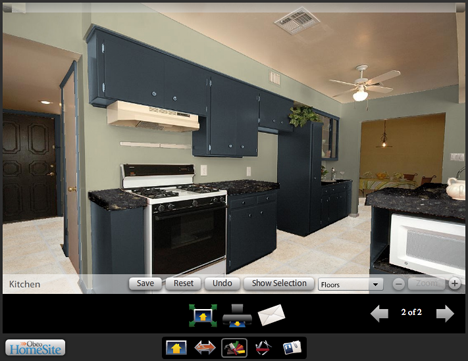
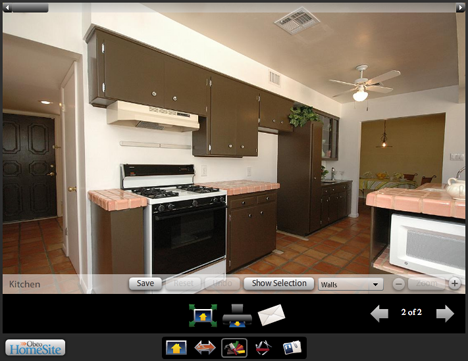
I’ll talk about the full tour when we’re done with it, but here’s a before-and-after example of virtual remodeling:

Before:

Cathy and Mark Deermer, our factotum-like handyman, worked hard to make this kitchen pop. My contribution: The white walls. They had been a custard yellow, and I thought they were making the room too warm and dark. Now this kitchen looks like candy — the elaborate girly kind of candy.

After:

I agree with Cathy and Mark that kitchens should be girly, but, even so, I really like masculine kitchens. This is how I redesigned that kitchen in Obeo’s Style Designer.

How long did it take? Less than two minutes, although I could see people spending hours remodeling our homes. I want for people to spend hours remodeling our homes.

Note the reflections along the left-most face of the cabinets. Compare the surfaces underneath the microwave oven. I feel like we should be paying royalties to Pixar for results like this.

I invest a lot of invective beefing about vendors, but I am delighted to be able to rejoice when a vendor gives us a feature we have wanted for years — in a slick, fool-proof interface at a reasonable price. I promise to be astounded if Obeo does everything this well, but they are doing this perfectly.

This is the kind of technology that sell houses. And to that I can add but one carefully-considered sentiment: Hot damn!

Technorati Tags: , , , ,

Listing real estate the Bloodhound way: Photography

I read somewhere the other day, I forget where, about a web site for a listing that had 47 pictures. The author of the post clearly thought that was a lot of photos.

Cathy organized her first batch of photos for the web site I will be building today. We will be adding other photos later, but this is by far the biggest batch.

How many? Not a huge number for Cathleen — only 221, about 28 megabyte’s worth. The finished web site probably won’t have many more than 300 photos — not counting the virtual tour and the video we have planned.

Is that overkill? We don’t think so. Everybody knows how to turn off the TV, but if you want to know everything about the home, we want to show you everything about the home.

Technorati Tags: , , , ,

Hubcaps on breadcrumbs? How BloodhoundRealty.com builds single-property web sites — and why they sell homes

Vance Shutes left a comment to my post about how we use web sites and web pages about particular houses as “breadcrumbs” to lead potential clients back to BloodhoundRealty.com. My response to him is long enough that I’m turning it into a post of its own.

Vance:

I’m intrigued by this concept. Will you be expanding on it during Unchained?

At BloodhoundBlog Unchained I will show you two different ways to leave a breadcrumb at every home you might ever want to sell. Each of those ways will result in a different kind of market penetration, but each should make you very easy to find and very hard to miss in your target markets.

Put into practice, these two ideas are worth thousands or tens of thousands of dollars in gross commission income just by themselves. I don’t normally keep secrets, but I wanted a big blow-out for Unchained. We have been quietly testing one of the two ideas and the results are coming in quite a bit better than I had predicted.

Are you setting up a separate page for each listing at BloodhoundRealty.com, or are you setting up a separate domain for each address?

For homes we are previewing for clients or photographing for other reasons, we host the pages on on Phoenix real estate web site, on our main file server. I don’t even know how many we have out there. Hundreds, certainly, possibly over a thousand. Someday I want to create a database of links so we can find them without having to hunt too hard.

For listings, we do a single-property web site on a separate domain. These are pretty elaborate, usually running to 60-100 megabytes of content before we’re done: Dozens of photos, an interactive floorplan of the house, a live Google map of the neighborhood, PDFs of the listing and the flyer, along with any historic photos or documents we have of the house, etc. If there is any question we can answer about the house on the web site, we do it.

Then we promote the home’s URL with everything else that we do: The custom yard sign, the business-card-sized open Read more