
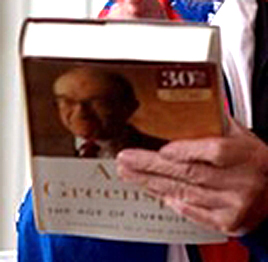
The second half of a US News dyscomium on Alan Greenspan’s Fed:
The global spread of capitalism has increased inflation-dampening competition throughout the world and allowed investors to accept lower yields when investing in bonds. What’s more, globalization has boosted incomes, in Asia and beyond. That has expanded the pool of savings that can flow into U.S. debt, forcing rates lower. The result, according to a 2006 paper by economist Tao Wu at the Dallas Federal Reserve Bank, is a “substantially weakened” Fed.
Then again, Greenspan might want to embrace his role in all this. Just as the Internet bubble left behind Google, eBay, and 90 million miles of fiber optic cable, the credit bubble upgraded America’s aging housing infrastructure and created a host of online services—Realtor.com, Zillow—that have permanently shifted the balance of power from real-estate agents to consumers. As Australian economist and bubble-ologist Jason Potts puts it, “A bubble is good for growth because it creates a low-cost environment for experimentation.” Even if it eventually pops.
It’s understood that unwarranted risk results in a voluntary transfer of wealth from the badly-advised to the better-advised. In real estate, professional investors are slavering at the sidelines waiting to pick up foreclosed homes.
For my own part, I find myself wondering why only a few price categories have risen substantially during what has been the ten years since the U.S. went of the Volckerized pseudo-gold-standard. I had thought the answer was in productivity increases owing to technology, but I hadn’t considered the impact of much cheaper imported goods, especially from China.
What Paul Volcker was doing, and what Greenspan was doing until 1997 or so, was surfing the price of gold as a guide for currency inflation. If the price of gold was relatively stable, then the Fed was inflating the currency at approximately the same rate that productivity was growing. Post hoc — irrational exuberance, dot.com bomb, Enron/Tyco/etc., 9/11, housing boom — the price of gold is up substantially, which argues that the money supply has increased far ahead of productivity. Except that prices for services and manufactured goods (excluding housing) have not risen accordingly. Ignoring Read more




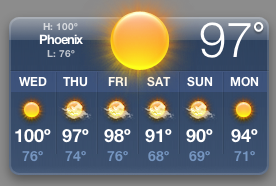 The weather broke “officially” last Tuesday. I could see it in the quality of the light, but we had lingering humidity from a Gulf hurricane. The last of that fell as rainfall on Monday afternoon, and by dusk it was obvious that the Arizona Monsoon was over.
 Inasmuch as we are living through the nightmare of Proposition 2, one might think we could learn a lesson. We won’t, and every eye was on the Fed this afternoon.