There’s always something to howl about.

Category: Real Estate (page 212 of 266)

Podcast Audio

Hello Folks!

It’s been a very interesting few days. First, I must say that you people are just a total class act; you couldn’t ask for a better-hearted group of people. You guys are going places, maybe even to heaven.

Well, as it happens, I have some experience with professional audio engineering, and offered to help by cleaning up some audio files so that they could post them on the site as pod-casts. First, I did one for Kris Berg in SoCal when she interviewed the CEO of Redfin, Inc. You can listen here.

Next, I “scrubbed” some audio for a seminar on web potency for Realtors that was conducted by Dustin Luther from Move.com & Realtor.com. You will find these pod-casts at BloodhoundBlog soon, I’m sure.

I’m very excited to help these guys out, as audio engineering is actually rather relaxing for me. It’s a really fun hobby (although extremely expensive), and gives me a chance to exercise the other side of my brain. One of the things I would like to offer to the world at large, is just a bit of advice on how to go about setting up a very affordable and professional sounding portable audio rig to do some recording. For the purposes of this brief treatise, I will assume an absolute ignorance of all things audio, so if you’re a know-it-all, just indulge me for a moment.

I have come up with a plan that includes 3 or 4 very small and inexpensive pieces of audio gadgetry that together would cost less than $400, and would capture audio for both interviews and seminars (or anything else, for that matter) with aplomb. Now, these items that I am about to list are readily available, and are cheap. (Note to Audio Geeks: I know that there are much better tools for this job, and you’re foaming at the mouth to make a recommendation. Let me just preemptively state that I am aware that this job can also be done admirably for around $12,000. Just go back to your corner.)

The first scenario that I envision is that you’ll want to interview Read more

Home Gift Helps the Hoi Polloi Get Happy

I had a chance to talk to Mark Sennott, President of Home Gift, this week. Home Gift is an affinity marketer much like MBNA. MBNA started as a credit card marketing division of the old Maryland National Bank. Their model was to offer credit cards to alumni association members that were “branded” as the official card. MBNA then rebated a portion of their income to the alumni association. Joe College felt good about racking up the old debt because he was supporting State U.

It was a wildly successful idea. It was so successful that MBNA spun-off from Maryland National Bank in 1991 in a public offering.. They grew to a 12% market share of all credit card customers before being bought by Bank of America in 2005.

Enter Mark Sennott. His company offers a consumer access to a network of real estate agents and mortgage companies who are willing to “rebate” a portion of their fee to the consumer. Portions of that “rebate” are earmarked for a certain charity. Home Gift takes an administrative fee. It’s relocation company meets Redfin wrapped up in the warm and fuzzy blanket of philanthropy. Check out Mark at his web log. He’s passionate, engaging, and claims to be an avid reader of Bloodhound Blog (so he can’t be all that bad).

I found out about Home Gift some two months ago. I was trying to help a little Carmelite Monastery in Massachusetts make American Tower Company honor a contract. ATC found out that the land the monks bought for their monastery was the perfect location for a wind farm and pulled out of the sale. The monks are suing the cell tower behemoth for specific performance. I posted “Don’t Mess with My Monks” on Active Rain and was referred to Mark by the Prior of the Monastery.

Mark’s doing what so many real estate professionals deplore. He’s rebating fees to the consumer and charging a toll for access to the customer. Customers, however, like the idea. They deal Read more

Small But Helpful Tip — Practical Use Of After-Tax Analysis

You’re a married couple in your mid-30’s living in your first home, bought five years ago. You’ve discussed your future, especially as it relates to retirement, and agree that real estate provides a much more predictable potential for capital growth. You have about $20K in your company retirement plans combined. Your cash savings amount to about $8K, held as a cushion and for peace of mind. You realize you have enough home equity to pull enough cash out to begin your real estate investment portfolio. However, you’re not sure about much else. You decide buying a small duplex in your area makes the most sense because they seem to be priced about the same as your home, which is now worth about $300K or so. You contact your buddy Fred who sold you your home way back. He asks what you want to buy and where. Before you know it Fred has half a dozen duplexes ready for your inspection.

mens shoes

This approach should raise a giant red flag, as you’ve now been designated by your buddy Fred, as knowledgeable investors. If that doesn’t scare you, you’re truly fearless. πŸ™‚ You have stumbled upon what I call the Nordstrom’s Shoe Salesman Syndrome, or NSSS. Of course, Nordstrom’s approach is wildly successful as perceived by its very loyal customers — as far as selling shoes is concerned. They don’t sell income properties. I’ve discussed this before.

Your ‘analysis’ of these properties will be superficial at best because you’re looking at money in, money out, and your budget. Nothing wrong with that, as far as it goes. But as a first time investor you should also understand just how important after-tax analysis is. It can go straight to your weekly paycheck if you understand how it works.

If you guys are in the federal tax bracket of 25% and state bracket of 5%, every dollar ‘lost’ through the use of depreciation will act as a producer of positive cash flow. “What?” you ask.

If you purchase one of those duplexes for say, $300K you’ll be able to show depreciation of roughly $12K which will include both the Read more

Sellers: Ready for cherry-picking time?

This is me in today’s Arizona Republic (permanent link).

 
Sellers: Ready for cherry-picking time?

We can’t grow cherry trees in the desert, but it’s cherry-picking time in the Phoenix real estate market.

Why? Because even though the buyers seem to be coming out in normal numbers, there is still a large surplus of inventory for sale.

The implication? Buyers are going to shop for the best overall value — price, preparation, presentation. In other words, they’re going to pick the cherries and leave the rest.

From the buyer’s agent’s side of the transaction, we’re going to look at a lot of houses. If buyers have a very tight set of criteria for their home search, normally they might have four or six or eight choices on their short list of candidates. In this market, the short list of possibly acceptable homes might run to 10 or 20 houses.

One would think that would make it easier to choose, but, in fact, no one house will have everything buyers might want. They can end up with a short-short list of homes that might work, each one of which falls slightly short of abstract perfection.

The consequence can be analysis paralysis, the inability to make a decisive choice among two or three cherry-picked homes.

But what happens to all the others?

From the seller’s point of view, the frustration can be huge: “My home is showing — finally. Why isn’t it selling?”

If the home isn’t a cherry waiting to be picked, or if the price is not very aggressive, the marketing effort might be hopeless. If buyers are dithering over two nearly perfect choices, then the other 18 houses they looked at are already out of the running.

But even that perfect cherry of a home — priced right, staged beautifully and in perfect repair, broadly marketed — can languish on the market. Your home can be the second choice again and again before some buyer falls deeply in love.

In the long run, things will settle down. In the nearer term, if you want your home sold, make sure it is the cherry buyers will want most to pick.

Technorati Tags: , Read more

What if Redfin gave a PR offensive and nobody came?

We pulled out all the stops for Redfin.com’s announcement yesterday because we thought it was important news. Such insiders we are, like Obscure Sports Quarterly subscribers glued to ESPN-8 for the Women’s Curling Semi-Finals. On and off all morning, I combed Google and Technorati for news, linking to what I found. Bottom line: Big yawn.

Redfin employee Matt Goyer provides a similar rundown, catching a few that I missed. Goyer also does the kind of stupid Realty.bot math trick that we have learned to expect from fawning news coverage of stupid Realty.bots: In adding three agents, Redfin.com grew by 340%. No, the number of MLS listings on its stupid Realty.bot grew by 340%. Redfin grew its head-count and its burn rate.

The only truly amazingly stupid math I saw, though, was at The Real Estate Economy, which cannot tell an apple from an orange, but which knows they must be equal if there are a million of them:

When Redfin gets up to six cities, it should carry a total of about a million listings on any given day, roughly the same that rival Trulia currently stocks.

It would take an hour to sort out every idiocy in that one sentence, and that may be the actual problem: The Realty.bot revolution is being fomented by geeks who can’t do the math and is being heralded by dinks who can’t think at all.

Marlow Harris, by pointed contrast, shows us what can be done with a fully-functioning mind and an insider’s insight:

One of the problems I have with Redfin is their continual commoditization of the bad-boy stance, their claim of being the outsider, the renegade ready to fight against The Man, ready to defend their clients against the Real Estate Industrial Complex, when in reality the business is made up of hundreds of thousands of individuals. There’s no cartel. There are thousands of little real estate offices all across the U.S., with 100’s of MLS’s, each with their own rules. Redfin has co-opted the power of dissent by appropriating the language and symbolism of non-conformist youth and tech/geek culture. By inserting themselves into the real estate equation, Read more

Is Your Broker Profitable?- Traditional Brokerage

Have you ever analyzed the business model your broker has? Try to run the numbers sometime and see just how much profit the owners(s) of your real estate brokerage really earn. I learned a lot about running a mortgage brokerage and real estate brokerage from 1999-2002. I’ve owned both and was successful with the former and a walking disaster with the latter.

Here is the deep, dark truth about traditional real estate brokerage as a business; it’s just not that profitable in its purest sense of practice unless (a) the broker produces (which brings up a whole host of issues) or (b) the brokerage is really HUGE. Let’s analyze the typical medium-sized brokerage (25 producers) in a typical American city ($250,000 median value).

There are A, B, and C agents. There will be five “A” agents who close 20 transactions per year or $5,000,000. Assume they average a fee of $7,500 per transaction. Each producer closes $150,000 in gross commission income (GCI). These producers generally command a commission split of 90%. This means that their gross contribution to the brokerage is $750 per transaction or $15,000 per agent annually. This translates to an aggregate GCI for “A” agents of $75,000.

There will be five “B” agents who close 10 transactions per year or $2,500,000. The average GCI per producer is $75,000. Now, they might command as little as a 80% commission split so the aggregate GCI translates to $75,500. We’re up to $150,000.

The rest are “C” agents who close an average of just 3 transactions per year. They will receive a commission split of 50%. So the aggregate GCI to the company is $168,750. Now we have total revenues to the brokerage of $318,750.

Let’s analyze the annual expenses. Receptionist, operations assistant, and sales manager salaries will total $130,000. We gross that number up 115% to include payroll taxes and benefits for a total of $149,500. This is a traditional model so you should figure on $12,000 for advertising. Throw in the rent and facilities charges of $75,000 for a 2000 sq. ft. office, $12,000 for supplies and $12,000 for Read more

Lucky or Consistent(ly Bad)?

And if Redfin’s trip to SoCal wasn’t enough of a distraction today, Zillow issued their Quarterly Home Value reports for 2006. Alas, so much “material” and so little time.

You can see their “Zindex’s” for 75 metro area both on their website and at their blog. I begin by stating the obvious; their median “home values” are based on their own Zestimates, which agents largely agree are (sometimes significantly) flawed. Like a bad wreck, I had to look however.

Surprisingly, Zillow’s quarter-over-quarter and year-over-year numbers for San Diego and its various neighborhoods are not far off compared to recorded sale price changes. I guess when you are talking averages, you can be consistently bad or consistently good, so long as you are consistent.

Edited to add a thank you to Amanda Hoffman at Zillow for sending me the links to the info this morning. They have put together a staggering amount of statistical data which I admittedly haven’t had time to give more than a cursory glance yet.

Helpless In San Diego — Or Any Place Like It — Get Outa Dodge Now

This is somewhat of a ‘simulcast’ with my own blog, as I just published a longer piece on the same subject for the second day in a row. I think it’s important.

This is for those investors living in areas like San Diego.

You know, median home price around half a million, and rents for the ‘average’ 2 bedroom rental $1,000-1,300 a month. I’d say if your median home price is over $400K your area probably qualifies.

In San Diego a boring but safely located duplex sells for $480-700K, and a fourplex goes for $750K-1Mil. In the next 10 years those ranges will have climbed, probably significantly. If over the next decade San Diego appreciates at just 3.5% yearly, the top of the range for duplexes will have reached just under $1Mil! And there’s not been a decade in the last four with an average of only 3.5% appreciation in San Diego. Tell me seriously — who is going to consider that a good investment? Unless they flew in from San Francisco they’re going to think the owner is over medicating.

So I see a paradox.

dodge city

Investors owning rental property in areas like San Diego will see them appreciate, only to find it very difficult locating that last fool who thinks it’s still a solid investment. They’ll get the growth they gambled on, but won’t be able to cash in. Impotent growth. (The name of my new band.):)

The solution?

Get outa Dodge now.

You’ll be happy to know there are a few regions in the country where you can buy property for way less, while also using low down payments. You’ll be back on the growth track, only now you’ll be in control of 2-4 times the property (in terms of value). This will turbo charge your capital growth rate magnificently.

Make use of a tax deferred exchange (1031) to move your equity to one of these lower priced growth areas. Do it now. You’re losing money staying in San Diego or any place like it. And your capital’s future isn’t bright.

Unless of course you think there will be a bull market for million dollar duplexes.

Podcast with Redfin.com CEO Glenn Kelman: “We’re looking for nerds living in nice houses”

Last week I had the pleasure of meeting with Redfin CEO Glenn Kelman and his Senior Communications Director, Cynthia Pang. Let me begin by saying that I waltzed into my local Starbucks anticipating a date with the devil. While I exited no more enamored with their business model, I have to admit that both Glenn and Cynthia were a delight. No horns, no forked tails and no speaking in tongues (well, not exactly).

My impression of Glenn was one of a passionate entrepreneur who genuinely believes in his work. He struck me as honest and sincere, and I thoroughly enjoyed our brief time together. Having said that, I don’t get the impression that he entirely understands the depth of our business or of our duties as agents and fiduciaries. Some of his core premises strike me as fundamentally flawed from the standpoint of end game success or, worse, as ingredients in a recipe for future liability claims and outright failure.

I could be wrong. Divergent opinions and perspectives are what make our world go round. So, I would like to thank Glenn and Cynthia for their time. It may surprise some to know that I honestly wish them much success, as I believe their success will only be found (if it is truly realized at all) in a niche market sense.

So, Redfin, welcome to San Diego!

More: Kris Berg’s husband, Steve, has a very thorough Redfin post at The San Diego Home Blog. Los Angeles Times. Redfin.com’s weblog. (Ahem. Gertrude Stein’s ungrateful whine about Oakland was “There is no there there.”) Kevin Boer at The San Francisco Bay Area Real Estate Blog illustrates the demographics of Redfin’s move. The Future of Real Estate Marketing. More from Kevin Boer.

Technorati Tags: , ,

Glenn Kelman on Redfin.com’s move into Southern California: “I’ve never had to think so hard in an interview in my life”

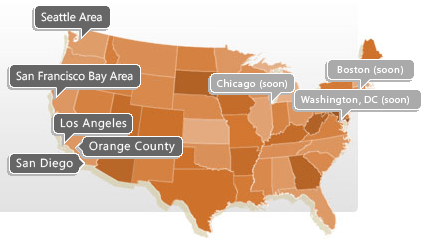
Here’s the newspaper news, and we’ll come back to it in due course: Redfin.com today opens three new offices in Southern California: Los Angeles, Orange County and San Diego. The company has expanded its web site to include listings from nine Southern California MLS systems.

Here’s the real news, which emerges from a forty-five-minute podcast interview made by BloodhoundBlog contributor and San Diego-based Realtor Kris Berg with Redfin.com CEO Glenn Kelman: Redfin.com is not profitable at present and may never achieve a reliable state of profitability. Most notably, Kelman’s willingness to reverse himself on unpopular but cost-saving policies may ultimately doom the company, at least in its present configuration as a discount brokerage.

The immediate problem is simply the payroll. As Kelman says in the interview:

What investors worry about with Redfin is the margin in the model. So today we generate about a 50% margin out of real estate operations. So for every dollar we make, we have to pay fifty cents to one of our agents. And we have to pay our agents more than we initially thought, just because we wanted to to get good people.

Redfin’s agents are salaried employees, not the more typical independent contractor paid on some sort of commission sales plan.

A new Realtor in a traditional brokerage offering training would expect to earn from 50% to 90% of the total available commission offered for the sale of a the home — which might be 3% of the purchase price.

A more experienced Realtor working in a brokerage with no training could expect to keep 95% or more of earned commissions.

Redfin concedes two-thirds of the buyer’s agent’s commission to the buyer, with half of the remainder going to compensate its agents. By this we can see that Redfin agents are being paid substantially less than successful Realtors in other types of brokerages. Even so, Kelman concedes, “We’ve got it around fifty cents, and that’s not enough to pay our developers.”

Since launching as a brokerage, Redfin.com has met with considerable criticism for some of its more unorthodox business practices. At first, the company advised buyers to appeal directly to the listing Read more

What Is Intelligence, Anyway?

I just received this in an email from a friend. I liked it so much I wanted to pass it along here on the blog.

__

What Is Intelligence, Anyway?
Isaac Asimov

What is intelligence, anyway? When I was in the army, I received the kind of aptitude test that all soldiers took and, against a normal of 100, scored 160. No one at the base had ever seen a figure like that, and for two hours they made a big fuss over me. (It didn’t mean anything. The next day I was still a buck private with KP – kitchen police – as my highest duty.)

All my life I’ve been registering scores like that, so that I have the complacent feeling that I’m highly intelligent, and I expect other people to think so too. Actually, though, don’t such scores simply mean that I am very good at answering the type of academic questions that are considered worthy of answers by people who make up the intelligence tests – people with intellectual bents similar to mine?

For instance, I had an auto-repair man once, who, on these intelligence tests, could not possibly have scored more than 80, by my estimate. I always took it for granted that I was far more intelligent than he was. Yet, when anything went wrong with my car I hastened to him with it, watched him anxiously as he explored its vitals, and listened to his pronouncements as though they were divine oracles – and he always fixed my car.

Well, then, suppose my auto-repair man devised questions for an intelligence test. Or suppose a carpenter did, or a farmer, or, indeed, almost anyone but an academician. By every one of those tests, I’d prove myself a moron, and I’d be a moron, too. In a world where I could not use my academic training and my verbal talents but had to do something intricate or hard, working with my hands, I would do poorly. My intelligence, then, is not absolute but is a function of the society I live in and of the fact that a small subsection of that society Read more

Ask The Broker – What Do We Do If We Can’t Find The Listing Agent?

We (my fiance and I) put in an offer on a condo priced way below market, and the seller would like to take us up on the offer. However his agent is absent, disappeared w/o a trace.

The seller is bound by contract to his listing agent. Since our agent and the seller have been unable to get in touch with the sellers agent, the seller is only hesitant because he has to pay the commission to an absentee agent.

Is there anything that we can do to move forward?

Yes. Write an offer, and ask your agent to submit it – to the listing agent’s broker.

The fact that the listing agent can’t be found is really not an issue. It’s a nuisance… and we deal with nuisances all the time… but it’s not an issue.

The listing is actually an agreement between the seller and the listing broker – not the listing agent. The broker will either handle it personally… or s/he will delegate the duty to an agent in the brokerage.

The issue of whether or not the seller must pay a commission is really of little concern to you. You want to buy a house – the sellers want to sell a house – and that’s all that really matters.

Fortune on Zillow.com: They can gape, but they can’t Google . . .

It’s possible that I’ve written more about Zillow.com than any other real estate weblogger. More on why Automated Valuation Methods necessarily stink. More on why the National Community Reinvestment Coalition’s shake-down of Zillow.com stinks even worse. More on Zillow.com’s new features.

If I haven’t written more than anyone else, I’ve certainly written plenty. Want proof?

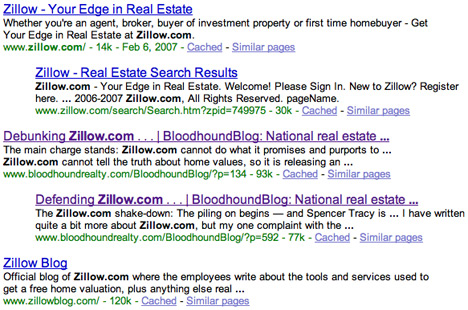
If you Google on Zillow.com, you have to drill all the way down to the third and fourth entries to find my posts. Most days, I beat their own frolickin’ weblog.

But let’s be conservative and simply say that, as a weblogging Realtor based in Phoenix, AZ, I’ve written quite a bit about Zillow.com. So when Fortune magazine writes a cover story about Zillow.com, who don’t they talk to?

They quoted a real estate weblogger — one I’ve never seen before — whose site has been dormant since last October.

And they talked to a Phoenix-based Realtor, Brett Barry, A Realty Executives agent working out of Scottsdale. (Brett emailed me about this article when he was interviewed a while ago.)

But apparently Fortune Senior Editor Jeffrey M. O’Brien didn’t run a simple Google search.

What he did do — almost but not quite — is talk a sweet pregnant lady into turning on her buyer’s agent and disintermediating the bee-hotch. I told David Gibbons last week that the Make Me Move feature puts Zillow.com in the business of brokerage, even thought they’re not taking commissions for it. I wrote about this in December, but, even so, he was taken aback. But in the article, O’Brien is actively marketing his home as a Make Me Move FSBO transaction.

It’s a fun article, but there’s really nothing new in it. It’s impressive, I suppose, that Zillow.com can make the cover of Fortune without even a hint of profitability on its horizons. And it’s certainly a matter of interest to me that I could wrestle my way to third and fourth position on the search for Zillow.com — a search for which BloodhoundBlog gets over a hundred unique hits a day — but not attract the attention of Fortune magazine. Who says real estate is going hi-tech…?

Technorati Read more

So, you wanna be a real estate blogger?

Dustin Luther’s seminar was an excellent primer for the real estate professional who is contemplating web logging as a business tool. Mary McKnight from RSS Pieces, wrote that you should have already established your web log by January, 2007. However, if you’re the type that puts off the book report until the night before it was due, here are the Cliff Notes to Dustin’s Seminar.

The full podcast of the seminar is hosted by Rudy over at Sellsius. I believe he has broken it up into three parts.

The “4C’s” of the RE.net evolution:
1- Change: The “techies” decided that there was inefficiency in the pricing of real estate brokerage and attempted to disinter mediate; they found that more than “raw data” access was needed bu the consumer.
2- Communication: Real estate 1.0 was all about publishing, 2.0 is about communication with the consumer. RSS feeds, weblogs, and sticky websites are the solution.
3- Community: social networking sites and web logs are creating communities where you, as a real estate professional, want to be known as an “expert”.
4- Consumers: This movement is about the consumer and inviting them to a conversation online.

The way to invite the consumer to a conversation and create your online expert reputation is to:
1- Create a weblog
2- Post interesting content
3- Link to other sites
4- Leave lots of comments

He further outlined the steps to creating a web log, the steps to writing a blog post (along with an excellent analogy to composing an e-mail message), how to comment on other’s web logs, and how to create a link.

The second half was dedicated to more advanced ideas for creating communities. It was agreed (as it was in Phoenix at the Webloggers Roundtable) that Active Rain is an excellent place to learn how to create and write a blog post. If you are in the profession, and haven’t joined The Active Rain Real Estate network, do so right now. It’s free and you can click this link to join.

Dustin also showed us how to effectively use a feed reader. He demonstrated Google Feed Read more

Getting the “L” Out – A Stump Speech

Why is it that so many agents seem to see a “Sell” in “Selfless”? Don’t people see through the facade, or does this really have a positive marketing impact? I suppose it depends on your particular shtick, and perhaps the “love me” approach will play to some audiences. Call it naivete or an ignorant, misguided notion, but I somehow believe that the tone and quality of our personal marketing is a reflection of the type of people and professionals we are and the way we view and conduct our business. I could be wrong.

Love me! This is a common mantra among the dozens of agent ads I see in our little monthly community newsletter, circulation approximately 14,000. Dozens of “reprinted” testimonial letters, happy client gushings of adoration, and “We’re #1!” screams. The latter has gotten so ridiculous that we see statements like “#1 agent team for (name of company) in (name of community) in past (number of) years combined”. Now, I know that this means this team was out-produced by individual agents and agents for other companies and most everyone in other communities and during any single year. My question is, are consumers so gullible that they don’t get it?

Personally, I have always taken a high-road approach to my ad content, and this newsletter is no exception. No “sweetheart deals” in the February issue, no “new home in your stocking” in December. Bah-humbug. “Here are our listings, we sell bunches of them, call us if we can help you” has been our consistent message. My clients are not hiring me to run an ad filled with shamrocks and maypoles. They want their property exposed and sold. Of course, through marketing our inventory, we are de facto marketing ourselves, but in-your-face self-promotion has never struck me as the best method of gaining respect and trust for ones competence. As they say in Steve’s home state, “Show Me”. I am ever hopeful that our actions and our success speak for themselves.

I’m selfless! Let me tell you just how much so you will bring me business because of it! Another recurring theme I see Read more