There’s always something to howl about.

Category: Real Estate (page 260 of 266)

How to make fast, flexible web pages . . .

Sellsius° has a big bag of how-to’s but I’m from Missouri. I like how-to articles that tell exactly how to do something.

One from me: How to make fast, flexible web pages. This is Realtor 2.0 stuff: Full-service Realtors who plan to compete need to learn how to punch out lots and lots of new web pages with dispatch. For one thing, this is where all those photos I keep talking about are going to go. We do most of our pages with software and I’m not going to tell you how we do that — because I plan to send my kid to college with that software. But here is a road map to kicking out new pages with minimal effort. There’s a bonus to doing things this way, too, which I’ll get to at the end.

Vide licet:
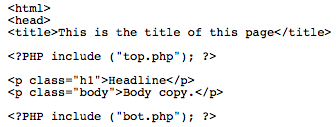
That’s PHP, and if you’re on an Apache web server, you’ve got it. This is really simple code, but that’s the point. The whole purpose of PHP is to generate HTML on the fly, so I can only show this code as a picture and talk about it by paraphrasing.

What does it do?

It generates a complete web page: Title, meta-tags, CSS, internal Javascript, body copy, and graceful exit. If you look at the source of any web page in your browser, you’ll see a lot more than seven lines of code. That would be the case here, too. The two “included” files, “top.php” and “bot.php” are going to explode into a bunch of HTML.

To set this up, you take your standing dummy web-page, the one you’re using to create new web pages. Configure the first three lines the way you see them in the picture. The title tag doesn’t have to come first, but it can, so let’s make it come first. Then copy everything from the first line after the title down to the last line before the actual changeable content of the page. Paste that into a new file named “top.php”.

Then go to the first line after the changeable content of the page and copy from there to the bottom of the Read more


Real estate photography snapshot: Composition is salesmanship . . .

Coming back to this, I wanted to spend a few minutes on photo composition techniques. That’s almost absurd: Who doesn’t know how to take a picture? Almost everybody, it turns out. We’re not talking about Ansel Adams levels of perfection, we’re talking about taking real estate photos that sell the property but don’t require a lot of back-end effort on your part. That means that we want to take a photo we’re ready to show off as-is, not one that requires cropping or re-touching in PhotoShop.

Here’s an obvious rule first: A camera is not a gun, and a house is not its target. If you look at published real estate photos, again and again you’ll see the house centered in the frame with miles and miles of do-nothing sky above it. This is wrong. Fill the frame with whatever it is you’re drawing attention to. If you think you might want to crop the image later, why not crop it now by filling the whole frame?

We like drama, so often we’ll get in really close at a point of view much lower than normal (it’s called crouching or kneeling; even old people can do it). In this case we also blasted hard with an electronic flash — even in bright sunlight outdoors — in order to bring out the details that would otherwise be in shadow.

Another way to lend drama to a scene is to go higher than eye-level and look down. Most digital cameras have a video viewfinder, so it’s easy to frame photos while holding the camera overhead.

If the ceiling is interesting, it should be in the photos. The wide angle lens on your camera will include the floor and ceiling of your interior shots, so you should be watching for things to bring out. Here in Arizona, ceiling fans are worth money, so we make sure we show them off.

Here is the value of a very wide angle lens: We can see this whole bedroom in two photographs. The human eye is much more adept at apprehending visual information than any camera. Our eyes-forward range of vision is Read more

“Don’t be chicken about the real estate market . . . “

An easier Friday for me, nothing to torque the brokers. Maybe I’ll hear from weary sellers instead. Me in today’s Republic. Here is the permanent link.

During our recent run-up in values, the Chicken Littles couldn’t stop clucking about imminent doom. Since then the market has cooled, but the Chicken Little chatter is hotter than ever. The real estate market must collapse. It simply must.

This prediction will lay an egg. But don’t hold your breath waiting for an admission of error. And if you yourself are waiting for the explosive report of the real estate bubble popping, you might just hear a pin drop instead.

Here’s why:

  • Real estate and securities are both leveraged, but the real estate market is not the stock market. Stocks are instantly transferable. You can acquire or liquidate a portfolio in seconds. Moreover, while stocks are subject to margin calls, it would be insane for lenders to call their mortgages en masse.
  • More to the point, homes have intrinsic value. A stock is worth what someone will pay for it, right down to nothing. In any place where it rains, snows or gets really hot, homes will be worth something.
  • Which leads us to demand. Some locales have more houses than occupants. No bubbles will burst in those places, either, but their values will slowly deflate. In a market like metropolitan Phoenix, long-term demand exceeds supply. As long as it does, our long-term trend in values should be nothing but upward.
  • Finally, sellers in a buyer’s market are a lot less time-sensitive than buyers in a seller’s market. In the latter case, the longer that buyers delay acting, the greater their costs. Hence, the frenzy. But if sellers stand fast in a buyer’s market, they might suffer a loss. But they might do better by waiting. Or the marginal cost of waiting may be less than taking a low-ball offer. Or they may elect simply to wait out the market.

The bottom line is, Chicken Little be fried, the real estate market will be fine.

Technorati Tags: , , , , ,

My friend, Richard Riccelli . . .

My friend and esteemed colleague Richard Riccelli called tonight to talk about the custom yard signs — among many hundreds of millions of other things.

I’ve known Richard since the day I found out that my son Cameron was certifiably enwombed — fifteen and a half years ago (wow!). When the boy was born, Richard was the first person to call him “Cam” — and then right away “Cambo.” I can picture both of those events — meeting him and his applying diminutives to my son — just like they were yesterday.

This is not happenstance: Richard Riccelli makes an impression. He walks, talks and — especially — thinks at a blistering pace. He throws off ideas the way the rest of us shed skin cells, dozens a minute. When he is focused, he is so much like a laser that you expect his eyes to burn through paper — through tables, walls, concrete. When he lets his mind float freely, he can glance pinball-like across a universe full of wonders in the span of a moment. At the end of a Richard Riccelli soliloquy, you will be left gasping, but you will have grasped a perfect metaphor, a unique and elegant way of uniting that universe full of wonders in a way you had never thought of before.

Richard Riccelli is our personal marketing god. He has been advising us since we began this business — not formally, but again and again with the perfect idea at the perfect moment. He is the reason that our logo looks the way it does — and why the dog in the logo smiles. He has been along for each of the three versions of our signs — along with many other marketing decisions, large and small. We don’t always do what he says to do, but we think very carefully about everything he says.


Which isn’t easy, given how many stunningly original ideas he can cram into a single sentence! In tonight’s call we agreed that custom real estate signs are essentially direct marketing, inherently testable — and Richard has no use for marketing that is Read more

Is the Blame Game best played solitaire?

In case you missed it yesterday, Jonathan J Miller from Matrix gives us a truly great mental image in his posting, The Housing Blame Game. As a real estate professional, of course all of this has been on my mind. While all of our buyer clients have done very well in the Phoenix market, I’m aware that a big part of their success is that they bought without intending to flee the market if and when it changed — and they used good sense funding the houses they bought. Our sellers, too, have done pretty well in general. Certainly those who agreed to list their houses at the right price in the first place have achieved their goals. So, I admit that I have found myself guilty of playing the blame game a bit myself. With all the oracles out there writing articles that foretell the doom of the real estate market, I keep hearing a mental replay of FDR’s voice warning our nation in the depth of the Great Depression that the “only thing we have to fear is fear itself.” In contrast, here we are living in a wonderfully prosperous nation, having just gone through a period where more people probably than ever were able to realize the dream of owning their own homes. And yet so many doomsayers are wringing their literary hands that things must get worse for those homeowners, based on the simple fact that things have until just recently been so good!

I am not unsympathetic to the fact that some of those new home-buyers or mover-uppers may have gotten in over their heads. Some may be going through life changes that create a need for them to move before they are able to stay in their new homes long enough for the new-home smell to have faded. But, in general, anyone who must sell in this market who has owned his house for at least two years, will be able to sell and make a handsome profit, as long as he didn’t make poor decisions regarding refinancing during the past year, and is not making Read more

Time of the signs times two . . .

Here are a couple of demos of custom signs for listings. These aren’t built to size (24×36″), they’re just scale models (~27%) so that I can see how things work together. Our normal riser will sit atop these, with a rider with the price hanging below. The whole Bloodhound sign idea is to stop traffic, and I think these could be very effective.


Technorati Tags: , , , , ,

On the Nickel with the boys . . .

My BubbleBoys are mostly gone for the moment, no doubt off like a cloud of gnats desperate to enshroud someone else’s head. The truth is, I do have a particular kind of fun at their expense, not the least of which are their pitch-perfect echoes of the charges I make against them. They were so aghast they I called them flying monkeys that they swooped in by the hundreds to express their outrage. Surely none dare call them Brownshirts, when most of what they did was rage, swear and threaten with all their minimal mental might. A certain few of them were brighter than I expected, but not one seems to have caught on that the Heckler’s Veto doesn’t work on the internet. And for all their complaints, none of them seems to have noticed that I also compared them to the Communists.

Even so, I ended up feeling sorry for them. It’s not the specious arguments repeated over and over, not the garbled grammar, not the atrocious spelling. Those are secondary consequences. What grabbed at my heart, despite myself, was the lack of internal resources that would lead a man — and they seem to be almost exclusively men — to join a gang of thugs. Surely this is not true of each one of them, but it is true in the main, in the same way that their belief in the efficacy of browbeating is an attribute of the browbeaten and their conviction in the ubiquity of corruption betrays only too completely the contents of their own souls. This is the stuff of the Brownshirts, of the Bolsheviks, of the Khmer Rouge and the Klan. This is the stuff from which the ugliest episodes in human history are sprung.

And yet it is still a sorrowful spectacle. I’m not absolving them. If you dig deeply enough into any sort of human squalor, at the bottom of everything you’ll find some combination of laziness, deceit and envy — usually about 112% of each. But every one of these boys would be a better man if he had more to do. The curse Read more

Signs of competitive advantage . . .

I’ve written about our signs before. Counting the custom rider and the rental for the post, a configuration like that shown to the right costs about $275. The post rental is per house, of course, as is the cost of the rider. The top and middle signs are re-usable, but the weather is not kind to them. We don’t want our signs to look beat-up, so we rotate them out as soon as they start to look worn.

We’ve been playing with four-color ink-jet sign printers on the riders, and I’ve known all along that someday we would be able to do custom signs for each of our listings. That day may be today. We’re meeting with a sign vendor who has a massive six-color digital ink-jet sign printer. If I can get the kind of UV and scuff-and-scratch protection I’m looking for, we may make our move now.

This is Seth Godin from November of last year:

If you’re in any business where the cost to enter as a competitor is very low, you’ve got this problem. The minute there are big profits being made, competitors will flood in and steal them. This is why there are five times as many real estate brokers in San Francisco as in Steubenville, Ohio. Because the houses cost five times as much, the commissions are five times as great, so brokers show up in enough volume that everyone goes back to making exactly the same amount of money.

The only way to win is to break the rules. To play by your own rules, creating a market in which the cost of entry is very high, or even impossible. If you’re the only one, then you win, by default.

Mr. and Mrs. Homeowner, in addition to everything else we’ve talked about, I will produce huge, stunning, traffic-stopping, custom yard signs for your home in less than 24 hours. Is there any other Realtor you’re talking to who will make you this offer?

Further notice: Doable. Two days turnaround, which is fine. The funny part is, our current sign philosophy (which is version 2.0 for us) is losing the CRS Read more

The Long Tail in real estate photography . . .

Chris Anderson at the Long Tail weblog on how switching from film to digital media changes movie acting and directing:

“I think shooting in digital changes acting as much as film changed stage acting, or as sound changed film,” said Bill.

Why? Because film costs a lot and must be used sparingly, while digital tape is practically free. The difference between the scarcity economics of film and the abundance economics of digital is, as Bill put it, “the difference between pointing a loaded gun at someone and a toy gun. You point a loaded gun at them and they’re going to act different. A film camera is a loaded gun. Digital is not.”

The principle is the same for real estate photography: If you’re not paying for a photographer’s time, nor even for film and processing, you have no reason not to take a lot of photos and simply toss the ones that don’t work out.

Man! That Long Tail is everywhere!

Technorati Tags: , ,

High phinance on the editorial page . . .

I lived in Phoenix when the Arizona Republic was still a great American newspaper, a daily example of how good a mainstream media outlet could be if it worked from fact, not bias. The Copy Desk — the folks who write headlines and captions — was rich with poets and punsters in those days, which meant a lot to me, too.

Long gone. The paper was bought by Gannett and over the last decade has been infested if not infiltrated with ideologues. Even the smallest item is suspect, but major issues are always reported from the slant of one long-range agenda or another. For example, the repeated mentions of allegedly homeless schoolteachers and firefighters is part of a propaganda campaign to pass ‘affordable housing’ legislation. Soviet-style, the paper will run half-a-dozen glowing puff-pieces on a pet topic on one day.

That’s the bad news. The good news is, they’re really bad at it. Anyone schooled in rhetoric can see right through it. Here’s an example from today’s Editorial page:

News flash: The law of gravity wasn’t suspended in the Valley. In last year’s sizzling real estate market, home prices and sales kept going up.

And up. And up.

At least one of four sales was to a speculator. Prices skyrocketed 55 percent in 2005. Sellers raked in profits as bidding wars drove up prices.

And now, an astonishing number of people are startled to find that the law of gravity still applies to the Phoenix area.

Ignore the real estate argument, which is really no more or less stupid than the ones that erupt, Tourettes-like, from those afflicted with enbubbulation. What matters is that finance is not physics. Equating the two is specious. So much the better, the idiot editorialist doesn’t even understand the law of gravity.

So what’s the purpose? To gull the gullible — among whom the author might nevertheless be numbered — into believing that economics describes unavoidable events and relationships in the same way that physics does. Proximate masses must accelerate toward each other, the lesser toward the greater? Yup, and if a market booms it must bust, if Moneybags got richer then Penniless must Read more

Trulia maptivating . . .

Jeff at Trulia.com ate my feed and set up what I needed to make my own map. You can customize many details. Note that while Trulia gives you a color palette to work from, you can plug in your own hexadecimal values for web-safe colors. Very, very slick…

BloodhoundRealty’s Historic Properties


Technorati Tags: , , , , , ,

Real estate photography snapshot: Choosing a camera . . .

I keep meaning to write about real estate photography, and I keep not getting it done. Let’s consider this a first cut, to which I may return more than once.

Mark Reibman of Rain City Guide has written two great posts on digital photography for real estate, and we can only pray that he does more. I lack his talent, but the wonderful thing about photography is that quality can be an emergent property of quantity: Any one photo I take might stink, but if I take 500 shots, one of them might accidentally kiss the forehead of greatness. Film and prints were cheap, but digital photos are next door to being free. We can take lots and lots of photos and cull down to those that present the property in the best possible light.

Camera selection is always a problem. The two most-advertised features of digital cameras, mega-pixels and zoom lenses, are the two you need least.

Except for print reproduction, the best size for a real estate photo is 640 x 480 pixels — which is 0.3 megapixels. Ideally, your everyday camera should be able to produce that size image without post-processing. The photos on your web pages can be bigger than this, but not by much. If you try to load 20 images on a page, with each image weighing in at one megabyte or more, you’ll overtax most web browsers — well after you’ve overtaxed the patience of your audience.

What you want from a lens is not a long zoom but the widest possible angle. Most digital cameras have their widest angle setting at 45 – 55mm, if the lens were on a 35mm film-camera equivalent. A few cameras get down to 38mm. This is inadequate. What you want is 28mm or less — with reservations. The Fuji FinePix E500 shown in the sidebar is an excellent everyday real estate camera. It gets down to 28mm, which is very good for most rooms. The flash recycles fairly quickly. It will do 4 megapixels at the high end, which is good enough for lower-quality print work. But it will also work Read more

Losing the homestead to a sucker’s bet . . .

The Real Estate Bloggers have a nice post on one of my pet peeves in real estate, the lease option/lease purchase scam:

If you are serious about buying a home, spend the time that you would have rented a lease purchase and save hard, clean up your credit report, and focus on the opportunity. By buying into the opportunity for a lease purchase you are limiting your opportunities to one home and putting yourself into a relationship that could end up setting you further behind in your attempts to become a homeowner.

Songwriter James McMurtry (son of novelist Larry McMurtry) nails the issue in Choctaw Bingo:

Uncle Slayton’s got his Texan pride
Back in the thickets with his Asian bride
He’s cut that corner pasture into acre lots
He sells ’em owner financed
Strictly to them that’s got no kind of credit
‘Cause he knows they’re slackers
When they miss that payment
Then he takes it back

If interest rates rise substantially, we may see a return to the days when financially solvent people purchased homes with carry-backs, wraps or land contracts. But, for now, these tricks are just one more sucker’s bet for folks who got themselves into trouble in the first place by being suckers for just about anything.

Technorati Tags: , , , , ,