There’s always something to howl about.

Category: Technology (page 46 of 60)

ActiveRain discovers that the Code of Web 2.0 is the Code of the West: Do unto others before them others do it unto you

The Code of the West ain’t some words on a page
You just naturally know it when you come of age
You eat when you’re hungry, you drink when you’re dry
You look every man in the eye

In the nineteenth century, rogue investors like Jay Gould and Big Jim Fisk would buy up parcels of land parallel to a successful railroad. They would lay some track and invite reporters in, regaling them with tales of the new railroad they planned to build in direct competition with the going concern. The owners of the competing railroad would panic, racing to put together a buy-out package that would get the rogues to sell out — at many multiples of their initial outlay. Did they ever intend to build anything? No one ever put them to the test.

It’s the Code of the West when the boys talk of women
The Code of the West what you know you don’t tell
The Code of the West a man soaps his own saddle
Brands his own cattle and some of his neighbor’s as well

A century later on Wall Street, greenmailers like T. Boone Pickens would put together minor stakes in bloated corporations, then announce with great fanfare their intention to incite a proxy battle, thus to sell the company off piecemeal. The bloated boards of directors of the bloated corporations would race off to find a white knight investor, who would buy out the rogue investors at a handsome profit.

If you’re buildin’ fences then I ain’t for hire
You get me for nothin’ and I’ll bring the wire
You patch up my windows, I’ll plumb up your doors
If you scratch my back I’ll scratch yours

In the world of Web 2.0, we have a similar scam, only by now the entrenched interest has the game figured out.

Let’s say you and two college buddies have built a Web 2.0 “platform” — which is to say something stoopid, goofy and — at least temporarily — viral and sticky.

Why did you do this? To build a business? To set an example? To leave a legacy in the world of hi-tech commerce?

No.

You built it to sell it to Google Read more

Advertising to Ashley

Guy Kawasaki moderated a panel of college students in a combination panel/ focus group about marketing to the Wired generation. The results are predictably astounding.

See the one hour video here.

Conversations are electronic– two users sent over 4000 text messages each month. From texting, they progress to mobile voice communication; nobody uses landlines anymore. Very few actually use the camera function of the mobile phone; they prefer digital cameras.

They use e-mail serially. Every panelist said that they can be reached via e-mail throughout the day.

Here’s the interesting part- they all use MySpace and Facebook and consider that to be the primary communication tool. When asked to explain the fascination, they all pointed to communication as the primary reason.

They read but don’t write blogs. Most read celebrity blogs and don’t comment (no surprise there). None of them knew what a RSS feed is. They rely on wikis to obtain information but are somewhat skeptical about the veracity of the information there. If they see a disclaimer from a moderator, they tune out immediately.

They rarely watch television and when they do, they use TiVo to block ads.. They watch YouTube and read magazines. Wired Magazine is on everyone’s reading list. When asked how they receive marketing communications, they pointed to celebrity users. Endorsements of a product, by a celebrity, hold a tremendous amount of value with them.

When questioned about their dream gadget, all of them requested a device that integrated an iPod, a cell phone, and a personal computer that had data safety if lost.

What does that mean to us, real estate marketers, in the next five years? These young adults will be the first time home buyers of 2010-2020. Certainly, their habits will change as they age but their commitment to communications technology and social networking will not.

Does this mean that the real estate weblog of the future will be written by Paris Hilton on Facebook? If you sell a home to Matt Leinart, you’ll want to make sure your Facebook profile publishes his video endorsement Read more

Prometheus abundant: Giving the gift of mind

Do you want to fight a war on poverty? A war on terror? A war on the senseless waste of the sole source of capital, the human mind? Here’s your chance. For two weeks in November, you’ll be able to buy two XO laptops, the One-Laptop-Per-Child computer, with one coming to you and the other going to a hungry young mind overseas.

From the Boston Globe:

With orders for its rugged XO laptop falling short of its initial goal, the One Laptop Per Child project announced today that it would let consumers in the United States and Canada buy the cute computer for a limited time.

In an interview last week, Nicholas Negroponte, the former MIT Media Lab director and founder of the so-called $100 laptop initiative, conceded that he had not locked in the 3 million orders that he once said were necessary to trigger mass production.

The new “Give 1, Get 1” initiative could be the antidote, he said, by helping to spread the project.

For a limited two-week span in November, people will be able to buy two laptops for $399, one for the buyer and one for a child in a developing country.

My take: Donate both, perhaps with one going to a child in your own home town. Even better:

Starting today, people who simply want to donate a laptop to a child in a developing country for $200 can do so online at XOgiving.org.

I think there must be three billion candidates for this machine, so I can’t imagine how most of them will get one before they are no longer children. But the bounty of the harvest is planted one seed at a time.

Prometheus literally means “foresight.” Because of the gift of mind, the uniquely Hellenic gift, I live in a world of vast abundance. I used to joke that Americans should “count their microprocessors instead of sheep,” but, by now, I can’t get an accurate count of the microprocessors sitting on my desk. When I think about some young Prometheus growing up chained to the stultification of ignorance, indolence and superstition, I could not be more grateful for this chance to Read more

Will Google be a victim of the sub-prime mess? “It is inconceivable that mortgage-related advertising revenue isn’t shrinking”

Barrons:

Ever since Google (ticker: GOOG) whiffed on its second-quarter earnings, fans and critics alike have been entertaining this critical question.

Critics such as Barron’s Roundtable member Fred Hickey are convinced that not even GOOG can avoid the impact of the credit mess that has rocked financial markets and prompted the Fed to slash the fed-funds rate by a half point. In a recent edition of his newsletter, High Tech Investor, Hickey wrote that Google’s advertising revenues are likely to take a hit next quarter and beyond.

On the other hand, a number of brokerage analysts have taken a close look at the issue and have run to Google’s defense. Jeff Lindsay of Bernstein Research recently estimated that Google’s cash flows would dip only 10% in an unlikely “worst case” scenario, and he thinks the shares could climb to 625. The stock closed Friday just above 560.

Then, there’s the horse’s mouth. Late last week, Google executives told reporters in New York that mortgage-related advertisers are indeed cutting their budgets, but they aren’t expected to reduce spending on Google search ads. According to Reuters, Jon Kaplan, director of financial-services advertising at Google, declared: “People are cutting their budgets but [Web] search is not the first thing, it’s the last thing.”

That comment is reminiscent of the ruminations heard before the dot-com implosion. But Google is simply arguing that its search is so effective and efficient that advertisers may cut print, broadcast and even other Internet spending, but not their placements with Google. It’s fair to assume that Yahoo! (YHOO) and AOL are likely to feel even more pain from the mortgage meltdown because they rely more on banner ads than Google, which has revolutionized revenue generation on the Web with its “paid search” technology.

“Every single day that somebody is looking for a mortgage…these campaigns from these financial customers are on 24-7, 365 days a year,” says Tim Armstrong, president of Google’s advertising division in North America. “So our ecosystem actually mimics what the GDP looks like.”

Granted, with a $174.8 billion market cap that dwarfs the GDP of many sovereign nations, Google might think it mirrors the Read more

Forward into the past: Now you can upgrade Vista to XP

It’s churlish of me to chortle, so I’ll begin by saying that all Power PC (i.e, not Intel-based) Macintoshes running all versions of OSX through Tiger have the ability to launch OS9 in an emulator, running any OS9 compatible software side-by-side with OSX. I have a ton of software that I wrote for the Mac in the 1990s that I have never ported to OSX, so I run it from time to time in the OS9 “blue box.”

Now: On to the chortling: From CNET News.com:

While Microsoft is still pushing Vista hard, the company is quietly allowing PC makers to offer a “downgrade” option to buyers that get machines with the new operating system but want to switch to Windows XP.

The program applies only to Windows Vista Business and Ultimate versions, and it is up to PC makers to decide how, if at all, they want to make XP available. Fujitsu has been among the most aggressive, starting last month to include an XP disc in the box with its laptops and tablets.

“That’s going to help out small- and medium-size businesses,” Fujitsu marketing manager Brandon Farris told CNET News.com.

Hewlett-Packard also started a program in August for many of its business models. “For business desktops, workstations and select business notebooks and tablet PCs, customers can configure their systems to include the XP Pro restore disc for little or no charge,” HP spokeswoman Tiffany Smith said in an e-mail. She said it was too soon to gauge how high customer interest has been. “Since we’ve only been offering (it) for about a month, we don’t really have anything to share on demand.”

A Microsoft representative confirmed there were changes made over the summer to make it easier for customers to downgrade to XP. Under Microsoft’s licensing terms for Vista, buyers of Vista Business and Vista Ultimate Edition have always had the right to downgrade to XP, but in practice this could be challenging. In June, Microsoft changed its practices to allow computer makers that sell pre-activated Vista machines to order Windows XP discs that could be included inside the box with PCs, or shipped to Read more

Municipalities aren’t very good internet service providers; spotty garbage collection could have been a clue

From USA Today:

Plans to blanket cities across the nation with low-cost or free wireless Internet access are being delayed or abandoned because they are proving to be too costly and complicated.

Houston, San Francisco, Chicago and other cities are putting proposed Wi-Fi networks on hold.

“Wi-Fi woes everywhere you turn,” says Russell Hancock of Silicon Valley Network, a troubled Wi-Fi project for 40 towns in California’s high-tech corridor.

Wi-Fi allows laptop users to work anywhere, making some jobs portable. It also is essential to mobile devices, including iPhones, enabling such emerging technology to perform complex online tasks fast.

Chicago couldn’t reach agreement with service providers after offering free use of street lamps for radio transmitters in exchange for a network built, owned and operated by providers at no cost to the city.

“All these big city projects were doomed to failure because they were too complicated,” says Glenn Fleishman of Wi-Fi Networking News.

Cities are bad at doing simple jobs like picking up the garbage. Why would anyone think they could manage ISPs?

I love this observation: “St. Louis is trying to figure out how to power Wi-Fi transmitters on 1,700 street lights when they’re not illuminated without spending millions of dollars.” I know! Solar power! Wishful thinking plus wishful thinking equals fait accompli.

Take heart, though. Wishful thinking is how we can know for sure that monopoly technology rammed down our throats by thumb-sucking dilberts will be even better than what we might have chosen for ourselves…

Technorati Tags: ,

Zillow.com snares another $30 million in venture capital

VentureBeat:

Zillow, the controversial website that gives value estimates of people’s homes and other real estate info, has raised a significant $30 million of funding, despite the mortgage industry credit crunch.

The Seattle company has now raised a hefty $87 million in total funding during its short lifetime, making it one of the most richly backed of the new era of “Web 2.0″ Internet companies.

The round was led by Legg Mason Capital Management. Previous backers Benchmark Capital, Technology Crossover Ventures and PAR Capital all participated.

Opened in early 2005 by the founders of Expedia, Zillow started out as a portal for information about homes around the country. Over time, it has added on sales components for owners and real estate agents, and also provides a place for buyers to discuss or ask questions about a property.

Only last month, we reported that competitor site Redfin had landed $12 million in funding, led by Draper Fisher Jurvetson. Trulia, the other main player in the Web 2.0 real estate space, pulled in $10 million in May. Terabitz, started by a teenager, raised $10 million in July (our coverage).

Asked whether this most recent funding round has anything to do with the real estate slowdown, chief financial officer Spencer Rascoff told me that there was no relation. Rather, it had to do with the company’s focus on employing plenty of skilled developers and improving the site.

The country’s real estate troubles may indirectly benefit the Zillow, though; real estate agents desperate to sell homes are far more likely to post their offerings online, sacrificing some control in exchange for having more people see their properties.

Nota bene: Revised to reflect changes in VentureBeat’s story.

Technorati Tags: , , ,

I invented a brand new social networking technology today, so, once somebody implements it, I want my iRadio for free

Ideas are easy. Implementation is hard. Even so, here’s a cool idea I had today.
First, art is selection. You have to stand back, because I can define art seven different ways in seven seconds. But one thing that art is is the selection of seemingly disparate elements into a pleasing whole. In this way, disc-jockeying can be seen as an art form.

Second, social networking can be viewed as communication by shared creation — collaboration.

So: Imagine an iPod-like device that allowed you to broadcast your music over, say, a 25 yard radius. You are now a DJ for anyone who wants to tune into your hyper-hyper-local radio show.

As an elaboration, imagine the each one of these iPod-like devices could work as either a sender or a receiver of hyper-hyper-local radio shows.

As a further elaboration, imagine that self-selected groups of people could create temporary networks of these iPod-like devices. In the receiving mode, each would retransmit music sent by the device in the transmitting mode, slightly expanding the transmission radius. The user of the transmitting device could elect to continue transmitting or could pass the baton of transmission along to another device in the network.

In this way, a group of people could DJ for each other, each sharing the best of their music collections with the others, each taking a turn as the creator of the collaborative artwork.

Picture a group of early-morning joggers or bike-riders. How about semi-sorta-suburban-strangers on a commuter train? Stuck at the airport? You can recruit volunteers to share in the misery.

iRadio? iBroadcast? iAmADJ? I think this could be a lot of fun.

Technorati Tags: ,

An open letter to the technological dinosaurs who presume to control our livelihoods

To: Ron LaMee
VP Information Services
Arizona Association of Realtors

Ron:

Russell Shaw argues to me that I have been unfair to you, or at least unnecessarily rude. I don’t concede the point, but I am willing to elaborate on the issues at contest. In all honesty, I don’t expect anyone in my slice of the NAR cartel — the Phoenix Association of Realtors, the Arizona Association of Realtors, the National Association of Realtors, or the Arizona Regional Multiple Listings Service — to exhibit anything I would regard as an improvement, but it’s possible other, less-entrenched entities in other parts of the country can benefit from this discussion.

Before we get started in earnest, I want you to take a look at this map-based MLS search interface. Estately.com is my current pet, in no small measure because it integrates all kinds of neighborhood and transit information into its visual representation of MLS data. There are other cool tools out there: Windermere has a very sexy map-based search. RE/Max has a national MLS system, and Keller-Williams can’t be far behind in that regard. Even so, the market leaders for all of these very cool tools are third-party start-ups like Zillow.com and Trulia.com.

I realize that much of the software I’m talking about is outside your immediate purview. The point is that traditional Realtors are sinking fast, technologically, and you, Ron LaMee, are shuffling deck chairs on the Titanic while you try to hustle us into buying even more of the same obsolete crap we’re already drowning in.

Criticism stings while you’re getting it, but, in fact, it is by addressing the specifics of criticism that we substantially improve our performance. Most people take what they get uncritically — they take crap because they expect crap — but a sincere, informed critic is the best goad a person or organization can have to get rid of the crap in their product or service. Of course, most people and most organizations change nothing, preferring instead to resent the critic for exposing their crappy offerings to the light. In the free market, these problems are eventually corrected by auctioneers. It remains to Read more

Listings bulimia? While it is not yet ready to break the vicious cycle of bingeing and purging, Zillow.com is willing to nibble on your data feed to try to decide if it wants to eat it later

Zillow.com is getting ready to get ready to take listings data feeds. The X in XML stands for eXtensible, but Zillow and dynamism sleep at opposite ends of the bed. In any case, if you ready to get started getting ready to go, Zillow is prepared to think about undertaking those last few items of preparation. If you fail to plan, you’re planning to fail, but what happens if you fail to plan (to plan (to plan (to plan (…))))? It’s a problem. As the Melancholy Dane advises, “Get thee to a vomitoria!” When it comes to lunch and data feeds, “a double blessing is a double grace,” so to speak.

I haven’t looked at the specs yet, but I have PHP for feeds into Trulia, PropSmart and ZeeMaps. If your broker won’t support you, it may be I can help.

Technorati Tags: , , ,

This is what it smells like when Zunes die…

Going to the Social? Not anymore.

News abounds. There will be better coverage in an hour or two. For now:

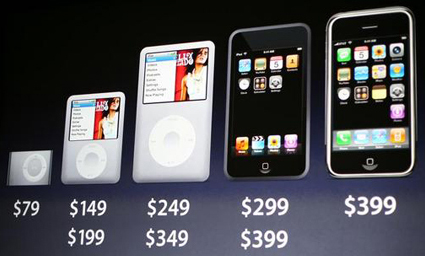
  • New red iPod Shuffle
  • New iPod Nanos with iPhone-like video
  • New iPod Classics with iPhone-like video — up to 160GB
  • New iPod Touch — a phoneless iPhone with WiFi, iTunes by WiFi and Starbucks music previewing (hold your nose for that last bit of flatulent decay from the Zune)
  • New iPhone price, 8GB version only going forward for $399

And remember that Leopard is still out there this year…

Technorati Tags: ,

What would you do with a totally free mobile phone?

We haven’t talked about the gPhone rumors, the possibly-apocryphal mobile phone alleged to be forthcoming from Google. I read about vaporware all the time, but I tend not to remark on it. Today is different.

Consider these conjectures from Seth:

My non-inside prediction of what the third-generation phone they ship will be like:
(Relatively) free
(Relatively) open
Ad supported

So, any carrier can offer it (hence the free part), any developer can easily modify it/enhance it, and the thing is paid for by location-aware permission marketing. Anticipated, personal and relevant ads based on who you are, what you do and where you are. GPS-coded photographs from all over the world automatically appended to Google Maps. Free calls if you’re on a wifi network. And it won’t be nearly as design-wonderful as an iPhone. But it will be addictive and in many ways, better.

Emphasis: “Free calls if you’re on a wifi network.”

Stipulate all of this just for the sake of the argument. If it’s not true of the gPhone, we’re probably headed in this direction, perhaps even toward “free” ad-supported cellular service.

First: This could easily be the primary phone for many, many people. No more for-pay mobile service, and no more for-pay land lines.

Next: The gPhone could be the ideal second phone for busy people like Realtors. I’ve thought for a while that I might end up with a BlueTooth headset on each ear. Imagine making all of your showing calls from the gPhone. Now you can ignore your main phone with clients — which I think is good marketing — but you will know to take the gPhone calls, since they will have the access information you need. You could also stage intra-skullular conference calls, which probably is more amusing in concept than in reality.

Moreover: You could use the gPhone as the mobile analogue to your Yahoo mail account: A throwaway that you will throw away when the spam gets out of control.

There is an argument that people don’t respect things they get for free. That may not be true, or it may be progressively less true, but it remains that we treat free resources very differently Read more

Active Rain Unleashes Impression Advertising

If they’re ain’t no margin, there ain’t no mission. Active Rain has released it’s revenue model to the network of 43,000 members. My only question is, “What took you so long?”

In the interest of fairness, Jon Washburn, Caleb Mardini, & Matt Heaton are tech-guys. They always felt that if they build it, the money will come. And build it they did. In the course of 13 months, Active Rain has grown to over 43,000 registered members and has established a community blogging platform that is unparalleled in the RE.net.

The idealistic approach of MyHouseKey.org was a great one but it failed because of a lack of participation. No points? No interest.
Gather.com is another approach to communal blogs outside of the RE.net. Gather also uses the point system and offers rewards of free Borders’ gift cards for serial contributors. It seems to attract a sort of pseudo-intellectual Myspace user and doesn’t get the communal participation Active Rain does.

The boys of Active Rain have done a great job of balancing the fragile egos often associated with top-producing Realtors and loan originators. They’ve established community guidelines and let the members pretty much police themselves. Their Localism.com portal is an interface with consumers. They won the coveted Inman Innovation Award in San Francisco. earlier this month; it couldn’t have happened to a nicer group of guys.

The climb to revenue wasn’t an easy one. Rumors abounded of lead poaching, black hat SEO, and other conjecture about the unbeleiveable and meteoric rise in the RE.net; none of it was true. Strategic alliances, partnerships, news sharing with mainstream media, and rumors of a buyout were all bandied about as the boys toiled away. They kept their focus and rolled with the punches.

Now, they want to get paid. Bravo! The success of the Active Rain Real Estate Network comes from the collaboration among its members. Members refer business back and forth, share marketing ideas, and help change the way we do business with the consumer. It is, without Read more

The scarcity shortage: Seth Godin on the Age of Abundance

I’ve written before about the practical consequences of the Age of Abundance. Here’s Seth Godin on the same subject:

So how do you deal with the shortage of scarcity?

Well, the worst strategy is whining–about copyright laws and fair trade and how hard you’ve worked to get to where you are. Whining is rarely a successful response to anything. Instead, start by acknowledging that most of the profit from your business is going to disappear soon. Unless you have a significant cost advantage (like Amazon’s or Wal-Mart’s), someone with nothing to lose is going to be able to offer a similar product for less money.

So what’s scarce now? Respect. Honesty. Good judgment. Long-term relationships that lead to trust. None of these things guarantee loyalty in the face of cut-rate competition, though. So to that list I’ll add this: an insanely low-cost structure based on outsourcing everything except your company’s insight into what your customers really want to buy. If the work is boring, let someone else do it, faster and cheaper than you ever could. If your products are boring, kill them before your competition does.

Ultimately, what’s scarce is that kind of courage–which is exactly what you can bring to the market.

Read the whole thing. And this was written four years ago… If you’re not moving up in incredibly irreplaceable value, you’re moving down in infinitely fungible price.

Technorati Tags: , ,

World’s Largest Property Search Engine to Re-Launch

Properazzi Home Search on Bloodhound BlogProperazzi has announced that it has grown to become the world’s largest property search engine and works with your specific computer history rather than a log-in.  With over 4 million listings in 49 countries, Properazzi will re-launch with a new interface with numerous uber-specific filters (balconies, parking, etc) so you can search for your next home in your undies… if you’re not in America.  Ah, I had you- no worries National MLS, sleep tight RedfinTruliaYahoo dudes; Properazzi hasn’t landed in the U.S.

But, what if it did?  With already so many properties and a snazzy name and website under their belt, could they branch out to become the ever feared/loved National MLS in America?

—–
Comments are encouraged!