
Can a picture really be worth a thousand words?

There’s always something to howl about.
Can a picture really be worth a thousand words?
This is my column this week from the Arizona Republic (permanent link):
How low can they go? Negotiating a real estate bargain
Everybody wants a bargain. The question for homebuyers is, how do you get one?
I was in a property last weekend with a buyer. The home was listed for $450,000 and the buyer asked, “Do you think they’d be willing to cut the price by $100,000?”
Stranger things have happened, but I’d bet against it.
Here’s why: Let’s assume the monthly payment is $2,000. The seller could afford to wait four years for a better offer before slashing the the price by $100,000 would make sense. There are other factors to consider in real life, and this kind of analysis is best done on a spreadsheet. But a lot can change in four years.
You certainly don’t want to pay any more than you have to, but you cannot possibly pay less than the seller will agree to.
What can make sellers particularly negotiable? A new job out of state and they can’t qualify for two mortgages. A new house under contract with a hefty non-refundable deposit. No one likes to think about profiting on the misfortunes of others, but sellers who are facing foreclosure are likely to be ready to cut to the quick.
In other words, sellers who have a strong motivation to sell now are going to be a lot more willing to negotiate price cuts than people who kinda-sorta want to move, provided they can get their price.
But even if you find a motivated seller, there’s a complicating factor: That seller has to have room to negotiate — equity in the home. If the house is encumbered at or near the list price, there’s a limit to how much the sellers can cut the price, no matter what their motivation. To go further would result in a short sale — the sellers would come to the closing table “short” of the full amount they owe.
Short sales can be great bargains, too, but, since you’re negotiating with the lender more than the seller, they’re a chancy proposition at best, and they can take a Read more

Commercial Real Estate Finance Expert
Structured Debt and Equity
Licensed Real Estate Broker in AL, CA, and FL
HR 3915 is referred to as the Mortgage Reform and Anti-Predatory Lending Act of 2007. It was introduced by Congressman Barney Frank of Massachusetts. I explored some libertarian thought about the bill here. I spent the last few days, perusing supporting messages, to discover if I might be mistaken. This is what I found:
The Center for Responsible Lending encourages support of this bill. Here is the letter they want you to write to your Congresspeople:
I am deeply concerned about the plight of 2.2 million families who have lost their homes to abusive subprime loans, or who will lose their home in the near future. Without stronger protections against predatory lending, the same conditions that led to this disaster will inevitably come up again. The Mortgage Reform and Anti-Predatory Lending Act of 2007 (H.R. 3915), which is based in part on existing state laws that have been effective, would help prevent another subprime disaster in the future.
Hmmm, well they fired a biased shot across the bow by referring to subprime loans (in general) as abusive. It lets you know that they despise any loan that isn’t an “agency” loan. The CRL also predicts that (a) more people will lose their homes (b) the disaster, left unchecked, will happen again. What they don’t tell you is that the innovative lending products added some ten million NEW homeowners to the ranks this decade. While 2 million foreclosures suck, a net gain of 8 million homeowners is nothing short of astounding.
The bill addresses many abusive lending practices that directly contributed to today’s foreclosures crisis, including reckless loan underwriting, abusive subprime prepayment penalties, and direct incentives for mortgage brokers to steer families into excessively expensive and risky loans. Basically, the bill would allow consumers to have greater confidence that subprime lenders will refrain from reckless lending and assess whether complex loan products are truly affordable for the families that receive them.
Ho ho ho! Reckless, abusive, and steering! Underwriting is to protect the lenders, not the borrowers. Here comes Big Momma to tell Read more
I could see the fan and I could see what was about to hit it. We were all sitting around the closing table…signing, witnessing, and waiting to be paid (the latter being me, of course), when the question was posed to my client by her counsel—an attorney I usually recommend for relatively routine transactions. A nice guy but no Bruce Cutler if you know what I’m saying. He’s cheap, actually.
“Married, Divorced, or Spinster?” he asked my client, looking at a title form he obviously had never seen before.
‘BAM!’ (splat)… then dead silence for one of the longer two or three second periods I can recall in recent weeks.
Did I just hear what I thought I heard? I hoped it went unnoticed as I looked up from the mindless game on my Treo, just three deals away from completing Solitaire for the 100th time in about as many closings. Not a chance.
“Did you just call me the ‘S’ word?” answered my client, a lovely unmarried woman who, with pen in hand, was about to sign the final document and close escrow on her first condominium in Chicago. When a question is answered with another question in such a situation then the next one who speaks loses. We all know this. And I knew who wasn’t going to say anything as I went back to my PDA, clearing the game and pretending to enter something into the calendar, all thumbs in different directions on the tiny keyboard. I was careful not to make eye contact with anyone. I was listening though.
“Pardon me?” asked the attorney.
I felt like popping him on his forehead with the palm of my hand …”Dumb dog, dumb dog.” The funds weren’t transferred from the Federal Reserve yet. Say something stupid after we’re paid for our services and keys are handed over. And just like the time one of my golfing buddies got caught cheating on his wife, I was also in trouble just by association. (And for the record, the wife was much hotter than the girlfriend, I thought. Either way, she got the house, the stock portfolio and the good car while he was left with the girlfriend and I guess, whatever Read more

Don’t blame me for this, pin the blame on Matthew Hardy.
Note that if you happen to be the constantly-besieged president of a beleaguered trade association, I will be in Las Vegas on Monday, November 12th. I can show you how to get out in front of all these ethics complaints.
Technorati Tags: disintermediation, real estate, real estate marketing
We’re adding another new BloodhoundBlogger today — and I’m not done yet.
Today’s addition? A well-known name in the RE.net, Jim Duncan:
 Jim Duncan is a third-generation Realtor, a graduate of the Virginia Military Institute and a long-time real estate weblogger. He is active within the NAR, and has made a name for himself as an ethical lodestone in real estate.
Jim was one of the first webloggers to make contact with us when we started BloodhoundBlog. He is a very thoughtful man — a man full of thought — and he is never hard to find, since he’s always on the side of the angels.
I think Jim is one of the most important voices on the RE.net, period, particularly on the subject of Realtor ethics. So why didn’t I invite him to join us a long time ago? Pure thoughtlessness on my part. For the most part we have added people by self-selection, and I have tried to avoid stepping on toes. (Honest, I have!)
In any case, I finally caught a clue and thought to ask, and Jim was gracious enough to accept.
Last night in email to me, Brian Brady pointed out that we had had 15 posts by nine contributors in the past two days. We’re not trying to overwhelm you, but we are trying to do what we came here to do. More and more, you will have to learn to treat the enblogged globe like television, tuning in to what works for you and switching away from what doesn’t. I know we are not for everyone. But for real estate professionals who care about the ideas that will drive our industry in the twenty-first century, we need to be a hot-button on your remote control.
And if it all gets to be too much for you, you can tune out everything except the Jim Duncan Channel.
Technorati Tags: blogging, real estate, real estate marketing
I caught this bit from the GeekEstate Blog in my feed reader.
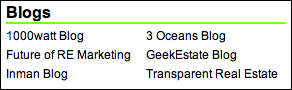
That’s the list of weblogs in the suitable-for-framing map of “Real Estate Web 2.0” produced by the 1000Watt Consulting group, a consortium of people who make money by not understanding the difference between wattage and luminosity.
Notice anyone missing? It’s not just us. Curbed can’t find a parking space. Rain City Guide is left out in the rain. Even Bert and Ernie, who have been everywhere, can’t make it here.
We get snubbed from dumbass beauty contests all the time, and I take a certain kind of delight in it. First, nobody has to be told what is going at BloodhoundBlog — or anywhere else that matters. And second — and this is especially rich — the essence of Web 2.0 is that no one can tell you what does or does not matter. The first middle-men to be disintermediated by Web 2.0 were the would-be arbiters of taste.
Technorati Tags: blogging, disintermediation, real estate, real estate marketing
Commercial Real Estate Finance Expert
Structured Debt and Equity
Licensed Real Estate Broker in AL, CA, and FL
Mortgage Grader is a consumer-operated, automated underwriting system. Jeff Lazerson, its founder, has been working on this idea for 3-4 years. It was released this summer.
Consumers enter information and are issued an approval. The mortgage grading engine mashes up various automated underwriting systems (FNMA Desktop Originator, proprietary sub-prime engines, etc.), searches out the best terms, and delivers the equivalent of a wholesale lending approval, with wholesale rates, to the consumer. The consumer then hires an approved mortgage broker to package the loan for a flat fee.
Have we heard this idea before? Jeff Corbett has been talking about a transparent underwriting and rate search engine for some time, now.
I know both Jeffs. I met Jeff Corbett last year and have known Jeff Lazerson, since 1997, when he was selling his book, “How to Make A Fortune In Loans Without Leaving Your Desk“. Both are veterans of the industry who have seen mortgage consumers get raked over the coals by originators.
Transparency is nothing new to the mortgage industry. Mortgage brokers have practiced transparency, by law, for years. Mortgage originators often teach customers how to lower their fees by accepting a higher interest rate in exchange for lender-paid yield spread premium– I’ve done that since the mid 90’s.
Transparency is the law for mortgage brokers. Flat fee loan originations are nothing new. Innovation Mortgage has been offering a flat fee model for 6 years now.
Is this the end of the full-service mortgage originator? Absolutely not. Technology, while useful, is the consumer’s worst enemy. Ten years ago, mortgage originators feared that Desktop Originator would eliminate their utility. It was the advancement of technology, however, that allowed for more innovative loan programs. The only way for these technology engines to work is if we revert back to the “good ol’ days” of two loan programs: 30 year fixed and 15 year fixed. Nobody really wants less choices.
Nothing beats the advice of a mortgage professional. We are the first experience many consumers have with financial planning. Two hours with one of us will help a consumer to better understand Read more
The confluence of events:
Last week I received a lead from our lead generation system. I had only a name and email address: she wanted info on three listings, then two more, then the next day seven more, each emailed separately. There was no contact number, only her email address, and it turned out she wasn’t really in the market to buy, just curious. And: all she wanted were the addresses, was more than a little annoyed – so was I – she had to jump through hoops to get them. Damned REALTORS®!
Monday I was in a meeting to introduce our new company web site, including a new property search engine. The mock up included maps, street view and… addresses! Transparency; terrific! But, no, sorry, that’s not a real fixture. Apparently that’s against the bylaws of one of the five MLSs we deal with; “Besides, we want to give a reason for the phone to ring!” See above.
Then last night – after fifty plus sugared up munchkins – I opened my annual Portland Metropolitan Association of Realtors bill, which includes dues for PMAR, OAR, and NAR. Last year it was $343, and this year: $459. For those who dabble in percentages, that’s a 34% increase.
The stated reason: A $100 ‘special assessment’ to OAR:
The Public Awareness Campaign is an integrated program designed to address multiple issues facing the real estate industry in Oregon as a result of extreme changes in the real estate market including the sub-prime mortgage crisis, the threat of an initiative petition to give unfair advantage to a new MLS provider and the ongoing threat of a real estate transfer tax.
The Public Awareness Campaign special assessment will accomplish two goals – it will fund the specific campaign to raise the profile and enhance the image of our Members [sic] in the eyes of the public, and it will make available the necessary funds to educate the public regarding initiative petition issues that impact the real estate industry and consumers in Oregon.
So that’s a $2 million confiscation, not to study and/or implement ways to make agents more efficient, to make us Read more
Okay. So Cathleen is wicked sick, coughing like a rented tractor. We’re busy, and I don’t mean just a little. Applications are up, originations are up, rates are down, demand is maybe just short of a frenzy, and the mechanics of doom today accidentally discovered that the implications of currency inflation are that their desperately-sought collapse in values may already have happened — and no one noticed.
In any case, just to complicate my life, I agreed to present with Steven Groves this weekend at PodCamp AZ at The University of Advancing Technology.
We’ll be doing the session on “Real Estate and Social Media.” It’s Steven’s show, and his passion as well, so it should be worth seeing. We’re on from 3:30 to 4:30 pm, and we may be accessible in video live on uStream.com as well. I would like to shoot digital video, too, if we can rope a volunteer to operate the camera.
The links I’ve shown here will give you all the details. See you there!
Technorati Tags: blogging, real estate, real estate marketing
Dear Mr Shaw,
I am writing to inquiry about a position as Blogging Assistant. I am a fan of your work on the Bloodhound Blog; your piece on the bananas was pure genius. I believe I would add value to your blogging enterprise, and it would be an honor to work under your tutelage.
By way of background, I too used to contribute to the Bloodhound Blog. My tenure was cut short when some “Geno Petro” guy showed up. My spell checker says his name is really Genoa Petrol, but I don’t think that’s right. Anway, he knows books, he knows pop culture, and he can certainly turn a phrase. He even uses colons!
While I have no real writing training (I have admittedly never enjoyed formal instruction in the liberal arts beyond the requisite How to Write in Nearly Complete Sentences college course where, I am proud to say, I received a passing grade), I did take an English and American Literature class in high school. (Yes, my school combined the two; this allowed time in the schedule for Home Economics and Making Fire 101.) It was there that I was required to suffer through read Jane Eyre and the Grapes of Wrath. I finished both, although I found the latter unsettling and eerily biographical. Oh, and the Latin I know comes entirely from the back of a dollar bill.
So, I am seeking a position with the potential for upward mobility, as I find I have none at my current position. I believe that I can turn my “negatives” in to “positives”; unshackled as I am by the encumbrances of any real credentials or talent, I can quickly embrace new approaches. Since a truly original idea has never come within two quarks of my brain, I am adaptable. Finally, I have good problem solving skills.
I do not come to you without references. As a blogger, I have received much praise on my own blog which boasts a current readership of three:
“Since it doesn’t take much to be a Realtor, your pool is full of monkeys.” – – Eric Estrada
“Most Realtors are lazy and uneducated. They will go away like other brokers Read more
The other day Cathy asked me what a semi-conductor is. It takes courage to ask me an open-ended question, because you risk getting the full answer. We started with integrated circuits, which is what most people mean when that say “semi-conductor,” then got into the conductive properties of metals and minerals, slid from there to quantum physics and electron tunneling, jumping to the idea of electronic gates, which leads back to Boolean algebra, all of which briefly encapsulates the idea of contemporary computer science.
But: The role of semi-conductors in all this is relatively recent, so we talked about Pascal’s automated looms, Babbage’s Analytical Engine, Ada Lovelace’s invention of software engineering, Turing’s Enigma and the idea of the Turing machine — which, despite all the hype you read, is the underlying engineering for the computer in front of you right now, scaled up a bazillion times.
The Turing machine was mechanical. The role of semi-conductors in data processing came even later than that. So: We talked about integrated circuits, about Moore’s Law and most importantly about the information explosion, the practical corollary of Moore’s Law. We continued with the idea of the Semantic Web, the notion that, very soon, instead of you trying to find the data you want, the data you want will avidly be trying to find you.
There’s more: We talked about multi-core computer processors and their implications, particularly about their application in compute-intensive functions. As a matter of physics, there is a finite limit to Moore’s Law. Heat is a significant problem right now, but even postulating computers running immersed in liquid nitrogen, data moves at the speed of light. At some point, no matter how close together chip-makers manage to plant circuits, propagation delay will limit further speed increases.
But this is where massively-parallel multi-core processors come into their own. Imagine not two cores, or four, or eight — the most you can buy in a computer store right now. Imagine 64 cores, or 256, or 1,024 microprocessors running side-by-side, splitting jobs up into 1,024 separate tasks and performing all of them simultaneously.
There’s even more at the outer edges of Read more
For many of us that are involved in professional real estate designations (CCIM, CRB, SIOR, CRS, etc.), we’ve spent countless hours studying, networking and differentiating ourselves from the pack in order to better represent ourselves and our clients. Among the benefits is being alerted to the fact that someone in Washington is making a move that will impact our clients, their businesses and our livelihood without the aid of the WSJ, CNBC or the mainstream media’s focus on its impact to our profession. Below is an alert I received this evening that I wanted to pass along to the BHB:
CCIM INSTITUTE CALL TO ACTION: OPPOSE TAX INCREASE ON COMMERCIAL REAL ESTATE
House Ways and Means Chairman Charlie Rangel (D-NY) is moving forward with legislation that would make major changes to the tax structure. The bill proposes a massive tax increase for real estate partnerships, raising the tax rate on “carried interest” from 15% to 35%. This legislation would significantly impact commercial real estate projects, most of which are organized in partnerships. Why this legislation is detrimental to real estate practitioners:
- Drives investors to put their money elsewhere such as stocks with much more favorable tax treatment;
- Diminishes the value and/or put many partnership out of business because the capital would not be there to facilitate them;
- Creates a disincentive to investing in real estate since many would no longer earn a reasonable profit;
- Stifles growth in a part of our economy which has become increasingly important over the last several years due to manufacturing, call centers, and other key industries moving offshore;
- Punishes partners involved with prior arranged transactions by causing a totally different economic result than all partners agreed with in advance; and,
- Fails to recognize that real estate investors are involved in their investments daily, while hedge fund managers are not involved daily in their investments.
Contact your U.S. Senators and Representative informing them of your concerns and urge them to oppose the carried interest provision. How to contact your legislators:
- Look up your Members of Congress and their contact information;
- Introduce yourself in a sentence or two. For instance: “I am Read more
One very unique thing about investing is the valuation process. While there are numerous ways to value an investment, the only true measure is what it can be sold for. While I can say a piece of property is worth $1 million, if it does not sell at that value it is simply not worth $1 million.
This is essentially the free market concept. You can set your own price and your business will succeed or fail based on the number of people who think they are getting value. Another interesting part of this equation is time. The more time you have to wait, the more likely you are to find someone who agrees with your valuation. However, as the saying goes, “the market can stay irrational longer than you can stay solvent.”
This is the crux of a very important issue in investor perception. Most investors make irrational decisions quite rationally. If I see a house that seems unreasonably valued, and then I see a similar house that is even more unreasonably value, the first house now seems like a bargain. This cycle continues until investors either run out of money or some event scares investors back into rationality.
The problem then over corrects itself. Investors go the other way, thinking that every house is overvalued, when it may have only been a handful. This happens until there is an overwhelming amount of value on the table; so much value that even the most naïve investor could make money. And the cycle begins again, and again, and again.
Small investors are always the most susceptible to these cycles because they have the least amount of information. They have no idea where interest rates are heading or where the next hot spot is emerging. At best they might read the Wall Street Journal or Businessweek. The problem with this strategy is that by definition news is old. By the time something is reported, it will already have happened. Furthermore, by the time your neighbor mentions it to you or by the time you see a special report, the market has most certainly moved on.
This begs Read more
First, let me say that I normally DO NOT DO OPEN HOUSES! I generally think them to be a colossal waste of time for everybody involved. The neighbors come snooping, tire kicking strangers are tromping through a pricey home, and for what? Decorating ideas? Casing the joint? Checking list prices? I anticipate strangled cries of “BLASPHEMY” from the peanut gallery, but really, what are the stats? There have been lots of ideas bantered about concerning the efficacy of the open house, but I like the one that goes like this:
“Less than 1% of homes are sold at an open house.”
If I had any real credibility, I suppose that I’d provide a citation for that, but alas, I have none (er. . .citation, that is).

BUTT–I mean “BUT,” and that’s a big “BUT,” sometimes, extra-ordinary circumstances call for extraordinary measures, and there is a 1% chance, right?
For example, I have a listing on the market right now in Tramonto that is what I would call “ideally situated” for an open house: great traffic, premier location, smoking bargain, sits on the highest point of the mountain overlooking the valley, and in this market, every little bit helps. SO, I have determined that I will indeed do an open house, this very weekend. I have been planning it for a few weeks.
Now, because I am an “over-the-top” type of person (and I am obsessive compulsive), I decided to go all out. There are flyers blanketing the area shopping centers, restaurants, and cultural centers. There are postcards, to the tune of about 1000 going out to adjacent areas that may have “move-up buyers.” There are html blasts going out to about 600 people in my buyer and lead database. There are signs, balloons, food, drinks, door-prizes, the works.
Now, will this work? Perhaps. We’ll see. Maybe my faith in buyers will be restored. Maybe I will be firmly convinced that I should never do THAT again. Who knows. It does make me look like a good agent, I guess. If any of you all are in the area, you should stop by and say “hello.” Who knows, you Read more


