BloodhoundBlog

There’s always something to howl about.

Archives (page 353 of 372)

Bed-time real estate blog-bytes: “A hammer’s a great tool until you have to paint a wall, right?”

Rey Estate: Make things simple!

In The Trenches: There’s gold in them thar data!

The Property Monger: Scuse me while I Zillow the sky…

Hamptons Real Estate Blog: Home prices are stable, but the Zestimates are surging.

Rubbing elbows with Nubricks gets Real Central VA, The Real Estate Tomato and BloodhoundBlog in The London Times Online. And you thought my English was hard to read!

Sellsius° counters: Write it so they can read it…

True Gotham: Give buyers real control.

True Gotham again (blogrolled): “It’s a mistake to set up any system that denies there is expertise in real estate.”

The RE.net has been itchingly acrawl with creepy stories about creative mortgages and imminent doom. I have no idea how many of those loans have already been refinanced, but, whether or not they have, there are a hell of a lot more happy mortgage stories than sad ones. Behind the Curtain (blogrolled for sheer effrontery) on negative-amortization loans: “A hammer’s a great tool until you have to paint a wall, right?”

Ardell says buyers and agents need to feel each other out before committing to each other. I don’t hate this idea, provided that buyers remember to nail down the terms of their representation before they run out and fall in love with a house.

Bubbleboys: This is what you’re looking for: The Lord of the Bubbleflies: Lean-looked prophet whispers fearful change, cultivating the worst impulses in otherwise decent people…

Technorati Tags: , , ,

Shadowing Zillow, filleting Redfin, and a “Just Plane Smart” approach to change in the real estate business . . .

Dustin at Rain City Guide is giving stat-dancing lessons today. I am neither as talented nor as interested as he is, but I do have an interesting statistic to reveal: Debunking Zillow.com is averaging well over 100 unique hits a day. All of my extended Zillow rants do very well, and Debunking Zillow.com comes in third if you Google on “zillow.com” — which many visitors to BloodhoundBlog are doing every day. It pays to keep things in perspective: Our Zillow traffic can’t hold a candle to that which is landing directly on Zillow.com. But for anyone looking for a second-opinion, and apparently many people are, it’s right there on the shelf next to the branded product.

There are two memes I hear all the time in the disintermediation debate that I think are incorrect. The first is the implication that anyone who expresses a skeptical or negative view of one or more of the dot.com RealtyBots is either an actual luddite or is in some way frightened by technology, disintermediation or simply change in any form. The second is the idea that disintermediation in the real estate industry will — or will not — take the course followed by travel agencies and stock brokerages.

For the first meme, I can discern no evidence whatever. It’s a caricature composed of characterizations rather than quotations with supporting links. Surely I would qualify as a technophile of at least the second rank, and my objections to Zillow.com and Redfin.com have nothing to do with technology, fear or even the idea of disintermediation as such. Zillow.com is deceptive in its portrayal of what it can and cannot do, and Redfin.com is a cowbird that incubates its buyer representation commissions in the listing agent’s nest. I am one of the most pro-innovation Realtors on the planet — and, in case you didn’t notice, yesterday I proposed an innovation that will, as a secondary consequence, obviate Redfin.com’s current business model. What I am opposed to — and what every honest person should be opposed to — is unethical behavior.

For the second meme, I think both the “will” and “will Read more

Back story: How we evolved our policy forbidding dual agency . . .

Someone commented on Greg’s recent post regarding dual agency. I thought I’d give you the “back story” so you can understand how we came to this position.

Just this past May three events converged to make it crystal clear that dual agency was, in general, good for no one except the real estate agent — who doesn’t want to shake loose those extra dollars he can get from both of his clients by serving neither of them well:

One of the classes I attended to earn my GRI (Graduate of Realtors Institute) was taught by Cec Daniels and Don Martin, past president of Arizona Association of Realtors. For two days we learned from Cec all about how practicing dual agency was unfair to our clients, and Don was all over the idea of the liability dual agency creates for the brokers. During this lecture, one of the instructors wore a baseball cap embossed with a capital B (ostensibly for Buyer) and the other a cap embossed with a capital S (Seller). When they stood together in alphabetical order their caps spelled out another term for dual agency. 😉

At about the same time, Greg was representing a dear family friend in the sale of her house. He got a sign call from someone who didn’t think he needed buyer representation… he was shopping on his own and making sign calls. (He told us that the primary reason he was interested in our friend’s home more than any other was that Greg was the only agent who had returned his sign call!) By this time we were already convinced that it’s practically impossible to avoid dual agency when representing a client if the customer (a party in a real estate transaction who is not my client) is unrepresented. The party without representation is sure to rely on us for advice — even though we cannot advise a customer without creating an undisclosed dual agency. Thus, since we would be the only professional representation when half of the parties weren’t represented, we had made it policy to sign limited dual agency agreements with each party. Read more

Securing the home-buyer’s place at the table: How two simple reforms can finally result in a full, uncompromised form of buyer representation . . .

Executive summary: This is long, and it’s written (I hope!) for ordinary people, not real estate professionals. But I want for real estate professionals to be aware of this argument, because I think it solves several of the knottier problems affecting our industry. Here’s a quick summary of the essay:

  1. Buyers should negotiate the buyer’s agent’s compensation in detail and prior to looking at any homes
  2. Sellers and listing agents should concede funds directly to the buyer to be disbursed at the buyer’s discretion to compensate the buyer’s agent

Either of these two reforms, or ideally both, will finally, fully empower buyers as supervisory employers of real estate agents in the way that sellers always have been.

If you discuss this in your weblog — and I think you should, in order to hear what your clients think — I would appreciate it if you would either link back to this essay or use the Technorati tag “compensation for buyer representation” (that exact keyword, without the quotes), so that I can track the conversation.

–GSS

Securing the home-buyer’s place at the table: How two simple reforms can finally result in a full, uncompromised form of buyer representation…

I was at a real estate seminar a few years back and the instructor happened to ask what kind of commissions Phoenix-area Realtors were getting on their listings. “Six percent,” someone said. “Five percent,” said someone else. “Five percent.” “Five-and-a-half.” And then a very beautiful young man, not quite overdue for his second shave, stood up and said, “Seven percent.”

“Just keep thinking that way,” the instructor replied. “Someday you’ll make yourself believe it.”

This is a true fact of real estate, widely if not universally known: Sellers negotiate commissions. Routinely. As a matter of course. “How much do you charge?” is often the first question blurted out at a listing appointment. You undoubtedly already know this, as well, if you’ve ever sold a home in your life — or talked to anyone who has. Yet for some reason, people persist in pretending that the six percent commission is still ubiquitous — if it ever was.

As a matter of disclosure, we routinely Read more

The Lord of the Bubbleflies: Lean-looked prophet whispers fearful change, cultivating the worst impulses in otherwise decent people . . .

Ahem:

I am rooting for an epic housing collapse, a disastrous recession, the collapse of the stock market, a complete replacement of our current partisian leadership, a questioning of our country’s current economic model, and a severe and historic financial meltdown.

I told you so

Technorati Tags: ,

Real estate, reality TV, dual agency and the nefarious influences of the Dark Prince . . .

Daniel Rothamel musing on “Million Dollar Listing”, a real estate reality show on the Bravo TV network:

The fact that dual agency is legal had to be the direct result of Satan himself lobbying real estate commissions all over the country. The only person that EVER benefits from dual agency is the agent. His wallet gets fatter, and the buyer and seller get less representation. Only Satan would call that fair.

Actually, that would make a fun “South Park” episode: Satan versus Saddam at the Department of Real Estate.

I watched the show for the first time last night, but I was playing my guitar (loudly and badly, the way god and Leo Fender intended), so I missed a lot. I did see one agent who was clearly torquing her clients to buy when they weren’t ready to buy — way over the line. I think this might be the dual agent Daniel is talking about. But later in the show the buyers seemed to be completely happy. Maybe they were awed by the TV cameras and didn’t want to make a scene. Maybe they don’t understand reality TV…

Technorati Tags: , ,

No Memory Hole at Redfin.com weblog, where the dance of the mantises goes on forever . . .

(This teeters right on the brink of being either gossip or a pissing contest. I want to document the facts in a permanent way, but I won’t be in the least offended if you press on without reading this.)

One of the interesting defects of the enblogged globe is the de facto Memory Hole effect. If I change the appearance of a weblog, every page will reflect those changes, as though they had been that way forever. If I change a post, it’s changed forever, with no reference to its past form. There are various web-based Wayback Machines, but there is no built-in version history so that you can track what I have done — perhaps with an eye to judging my motives.

It could be there is no Memory Hole at Redfin.com’s weblog.

From a comment by Glenn Kelman at Rain City Guide:

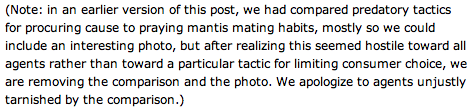
Regarding that reference, I had tried to explain that we deplore a particular tactic, not real estate agents, and I apologized. Later, before returning to this blog, I removed the reference from the blog, and inserted an apology with the same prominence as the original reference. This is because I respect Dustin, because I regretted the implications of my own statement, and because we all believe in fair, civil discourse.

And, indeed, this is the way that particular text appears on the Redfin.com weblog’s home page and at this permalink:

But there is no Memory Hole. The original entry is still on-line:

The reader comments are copied from the old version to the new, but the old version has not been supplanted by the new version, but, rather, duplicated and then edited.

I am drawing absolutely no inferences from this, simply taking note of a body of facts.

Further notice: I just went to set the trackbacks for the two separate permalinks — and they’re the same.

Technorati Tags: , , ,

Realty Reality: Lou’s lament in 22 unhappy photos . . .

I’ve written a bunch of these stories, and I’ve got a bunch more in me — I did CRS the hard way. Most of them have happy endings. This one does, too, I suppose, but the middle gets pretty morose. I’m telling the story to illustrate how badly things can go wrong in real estate despite the best preparation, despite the best of intentions.

This is a story about Lou, a long-time client whom I admire very deeply but have never met in person. He found us on the internet, and he’s been with us through thick and thin for coming on three years. In that time we have bought five houses, failed to buy many more, and we’ve sold three. There’s one more out there that we’re trying to sell right now.

Lou is a cop, a detective for a police department in a big California city. He makes a good living in his forty-hour week, then double that or more on over-time that never seems to end. Because of this, he has been able to invest in real estate for years, buying, fixing and flipping properties in California. He came to me when the prices in California got too high.

In the midst of the price boom here, we bought five rental properties — one condo and four single-family-homes. Lou was most interested in buying homes with tenants already under lease, but this put us into very competitive bidding situations. We were careful to buy into properties that were either cash-flow positive or at least neutral, so we wrote a whole lot more contracts than we got accepted.

I was working by myself on my end. I don’t know if Lou has ever been to Phoenix, but I’ve never caught a glimpse of the man. He would review listings I had sent by email and ask me to follow-up on those that seemed promising. I would do drive-bys, taking photos and looking for red flags. Then we would run the numbers on the property, and, if it made sense, write the contract. I have worked with a lot of game investors, but none Read more

Dissecting Glenn Kelman of Redfin.com . . .

From comments at Rain City Guide. I didn’t address this weblog entry from Redfin.com CEO and broker Glenn Kelman because I wasn’t sure how to strike a balance. But today, Dustin Luther offered this:

For those that haven’t seen Glenn’s comments on his blog, I highly recommend heading over to this post.

In case it wasn’t clear, Glenn is clearly not worried about making friends with real estate agents, and even compares listing agents (who don’t want to show their properties to Redfin buyers) to praying mantises who eat their pray: “a grisly illustration of realtors’ hopeful but incorrect argument that showing their own listing can procure cause for garnishing the buyer agent’s commission.”

P.S. Greg: he has a special treat over there for you as well…

This was my reply to him:

> Greg: he has a special treat over there for you as well

I saw it last night. I concluded that the man is a jackass and a fool. In rank order the fools would seem to be 3. Kelman’s clients, 2. Kelman himself, and 1. Kelman’s investors.

Debunking Zillow.com gets dozens of unique hits every day. Let’s go get sued, a blueprint for bringing litigation against cowbird brokers scores fourth when you search for Redfin.com. I think the people at Zillow.com have been very deft in the way they have dealt with criticism. I think Kelman is drunk on his own publicity. The route to fame can be long and uncertain. But it’s just a short hop from there to infamy…

Hustling uninformed newspaper reporters is one thing, but I’ll bet the man doesn’t have the guts to defend his business model in public against an informed questioner.

Further notice: Kelman adds a comment at RCG.

Technorati Tags: , , ,

Detailing the mechanics of the Redfin cost shift . . .

Taking on the New York Times’ fawning coverage of Redfin.com, Jim Kimmons at Transforming Real Estate details the details behind the cooperation/compensation model of real estate brokerage:

The contention that the listing agent should be pleased to show an “eager buyer” the home when they come with no agent is just not going to function in the way presented. Let’s say that I’m a listing agent and have say 20 listings. I know that many homes get shown upwards of 40+ times before selling, but let’s use 30 for an example. Also, I’m not sure how you can call someone an “eager buyer” when you’ve never met them and they’ve never seen the home, except in a drive-by. Now, using an hour each as a conservative example, if every buyer was a Redfin client, then this listing agent would work about 600 hours and drive a lot of miles in meeting “eager buyers” at their listings. Buyer agents do this all the time, but that’s what they get the 3% for.

Don’t stop there. There’s a lot more that Jim covers.

Technorati Tags: , , ,

Phoenix trolley planner: “Our job is to make sure we build something that will have riders and be successful”

How about a roller-coaster? Much more likely to have riders and be successful than a trolley in Phoenix — the most vast, most sprawling and most car-addicted city on earth.

The leader in today’s Republic details some ideas about putting trolley lines in even dumber places. It turns out that really, really rich people can’t abide not having their throughfares blocked by empty trolley cars, while the urban poor prefer to ride crowded buses — at least until their bus routes are cancelled to subsidize the trolley.

The last time a trolley system made money in America, there was less than one automobile per household. There are neighborhoods in Metropolitan Phoenix where that statistic is still true — and the trolley goes nowhere near them. Instead, it will tootle from one shiny-people destination to the next, an instant relic that very prosperous people can point to with pride — as they speed by it in their Jaguars…

Technorati Tags: , , , , ,

Working the numbers on real estate business models . . .

Altos Research on Redfin.com and other real estate business models:

Sales guru Jeffery Gitomer puts it this way, “if you have to compete on price, You Suck!”

We all invoke financial services as the analog for real estate. What isn’t commonly noted is that as technology swept through the financial services biz, two things happened: prices went down (e-trade et al) and prices went up (hedge funds). Why did prices go up? The same reason they always do. When you provide more value to a customer, you can (and should) charge more. I for one am looking for the real estate agents/brokers/sites that blow away their clients so completely with service, that they’re happy to pay more than 6%. Those are the innovators to watch.

Technorati Tags: , , ,