BloodhoundBlog

There’s always something to howl about.

Archives (page 84 of 372)

Reasons to be cheerful, part 0.5: Sleeping giants can’t sleep forever.

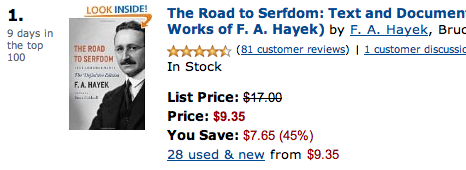
Do you want something to cheer about? Hayek’s The Road to Serfdom is the number one best-seller at Amazon.com right now:

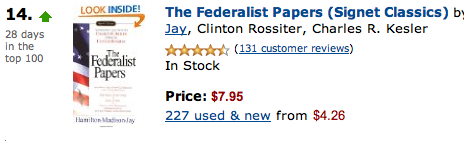
It gets better. The Federalist Papers is at number fourteen.

I think a lot of people are annoyed that the free country they still remember clearly has somehow vanished right from under their noses. It’s very inspiring to see them searching for it so assiduously. My read is that this is very different from 1994…

< ?php include "cheerful.php"; ?>

Are we losing our competitive edge?

With the start of the World Cup just hours away,  I am reminded of the unrelenting competitive spirit that makes such events worth the wait (and trust me, I have been counting every single day since Germany in 2006).  God-given talent can make one successful, but without that unwavering fire within the highest plateaus are unreachable.   Although Michael Jordan had an amazing ensemble cast to support him, you could see the determination in his eyes to single-handedly turn his team into a basketball dynasty.  Lance Armstrong had insurmountable obstacles on his path, yet his blind determination led him yet again to the greatest of success in his sport and his place in history.  There are countless stories (in sports, business, life) to illustrate this point, but I digress.

Real estate is obviously a highly competitive field in which individuals are publicly recognized for their accomplishments, everything from Top 40 under 40, to Top 100, to Realtor of the Year, Inman 100, etc.  But does it accurately reflect the competitiveness of the rest of Americans as a whole?  I recently took my 10 year old nephew to his Tae Kwon Do tournament, in which trophies were handed out, not on the basis of merit or skills, but rather on a rotating basis (the ones who took ‘silver medals’ this time, will inevitably get ‘gold medals’ next time).  Or have you been to those soccer/baseball games where they don’t keep score?  Sure, every person, whether a kid or adult,  wants to be acknowledged as special, a true champion.  But in so doing, are we embracing mediocrity?  Is there something wrong with accepting being average without unnecessary accolades?  Are other competing countries (i.e. China) teaching the same values to their future leaders?  Your thoughts/comments are welcomed.

competitive spirit

What a Young Sailor Teaches Us About Life

This morning I woke up to read this article on Abby Sunderland, a young sailor, who is attempting an around the world sail singlehandedly. If you sail, then you know how dangerous this is, and as this article indicates, perhaps that danger has now placed Abby’s life in danger.

I grew up in Youngstown, Ohio, and never though much of sailing. While in college I read about a guy who had worked for the Cleveland Plain Dealer, the largest newspaper in Cleveland, and who had managed to plan and sail the Atlantic Ocean in a boat that was just over 13 feet long…about the size of your car. His name was Robert Manry, and what he did influenced me to become a sailor when I found my way to San Diego some years later. Here’s a very short clip about his adventure.

But this story about Abby, a single day of which is recounted below from her blog, instructs us in the great adventure that awaits us every single day, doing the important, doing the mundane, living, longing, experiencing this opportunity to be the best we can be.

Thursday, May 27, 2010
A Tale from the Sea
Hey everyone,
Sorry it has been so long since I wrote. There were some problems with one of the Inmarsat satellites and so I wasn’t able to get online. That’s all sorted out now though and hopefully won’t happen again.

I have had a pretty busy past few days. Things went well getting out of Cape Town – everything was working well and I was having a lot of fun with my new auto pilot. I’ve been able to carry a lot more sail with the working auto pilot and making some pretty good speeds.

A few days ago (I’m sorry I don’t know exactly how long – the days started to blur together after awhile). I was sailing along nicely doing about 12-15 knots in perfect conditions. The wind started to pick up just as it was getting dark and was a bit too much for the sail I had up, so I went out to Read more

If the National Association of Realtors were to back the repeal of the mortgage interest tax deduction, it could do three very patriotic things: It could reduce the debt load on all Americans, help consumers make wiser use of their money — and get itself off the dole!

I had thought I had said my piece yesterday about the move to repeal the mortgage interest tax deduction as a means of reducing the federal deficit, but today I feel I have not said enough.

Here’s what I would add: The National Association of Realtors should lead the charge to rid the nation of the pestilential subsidy. Very far from being a good thing, it is an undiluted evil.

How so? Two reasons. First, it rewards homeowners by raising taxes on everyone else. This is true of every sort of tax deduction, tax credit or direct subsidy, but the mortgage interest tax deduction is especially pernicious in that it tends to reward the wealthy at the expense of the poor. Frankly, any sort of governmental favoritism is vile, but the NAR is doubly vile in this instance, since poor people are being despoiled not even to benefit the rich, but to benefit Realtors themselves.

Consider this, written in response to a defense of the tax deduction:

Defending mortgage interest deductibility (based on the current tax establishment) is very much in my favor as a consumer.

This is the seen and the unseen, classic Bastiat. You see a tax deduction and regard it as being to your immediate pecuniary advantage. You don’t see all the other taxes that are raised to make up for that deduction.

Worse, you don’t see that the NAR is not seeking your interests but its own: The deduction causes you to value housing above other investments, contrary to market forces, which results in your buying a home when you could and probably should be making more productive use of your surplus income. The goal? Commissions for NAR members, not your interests at all.

Still worse, you don’t see that the recession we are going into was caused, fundamentally, by overvaluing housing as a market good by means of tax deductions, credits, exclusions and deferrals. In five years you could be walking around shoeless, dining out of garbage dumpsters, but at least your mortgage interest will be tax-deductible.

In other words: You are a consumer in your every economic transaction, not just when you are Read more

What if they reduced a tax deduction hardly anybody gets? If you’re the the National Association of Realtors and you’ve been spinning lies for decades about mortgage interest deductibility, your whole make-believe world just collapsed…

Kicking this back to the top. It’s news again. I wrote this post more than a year ago, but, per The Hill, the tax-deductibility of mortgage interest is back on the table:

The popular tax break for mortgage interest, once considered untouchable, is falling under the scrutiny of policymakers and economic experts seeking ways to close huge deficits.

Although Congress last year rejected the White House’s proposed cut to the amount wealthier taxpayers can deduct for home mortgage interest payments, the administration included it again in its 2010 budget — saying it could save $208 billion over the next decade.

And now that sentiment has turned against all the federal red ink — and cost-cutting is in vogue — Democrats on President Barack Obama’s financial commission are considering the wisdom of permanent tax breaks such as the mortgage deduction and corporate deferral. Calling them “tax entitlements,” senior Democratic lawmakers have argued they should be on the table for reform just like traditional entitlement programs Medicare, Social Security and Medicaid.

Nothing has changed in my response to this news, so let’s dial the wayback machine back to February 26, 2009:

    The bay-trees in our country are all wither’d
    And meteors fright the fixed stars of heaven;
    The pale-faced moon looks bloody on the earth
    And lean-look’d prophets whisper fearful change;
    Rich men look sad and ruffians dance and leap,
    The one in fear to lose what they enjoy,
    The other to enjoy by rage and war:
    These signs forerun the death or fall of kings.

        — William Shakespeare, Richard II

I was out showing this afternoon and came home to find that President Barrack Obama has proposed giving the NAR’s cherished mortgage income tax deduction a very small haircut. From The Wall Street Journal:

The tax increases would raise an estimated $318 billion over 10 years by reducing the value of such longstanding deductions as mortgage interest and charitable contributions for people in the highest tax brackets. Households paying income taxes at the 33% and 35% rates can currently claim deductions at those rates. Under the Obama proposal, they could deduct only 28% of the value of those payments.

The changes would be phased in gradually over the Read more

Per-capita wealth and poverty in a given political economy is strongly correlated both with economic freedom and oppression and with the perception of integrity or corruption among government officials.

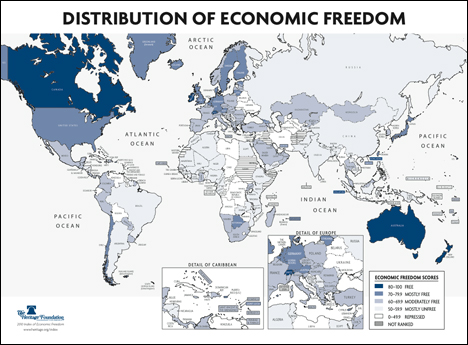
Countries that pursue policies of economic freedom have rich populations. Countries that obstruct free enterprise have poor populations. The relative wealth or poverty of a given population is strongly correlated with and can be readily predicted from the level of economic oppression in that political economy. This is easily understood from Austrian and Classical economic theory, but it’s stunning to see how relentlessly the theory is borne out in the real-life experiences of the countries of the earth:

This map is from The Heritage Foundation’s Index of Economic Freedom.

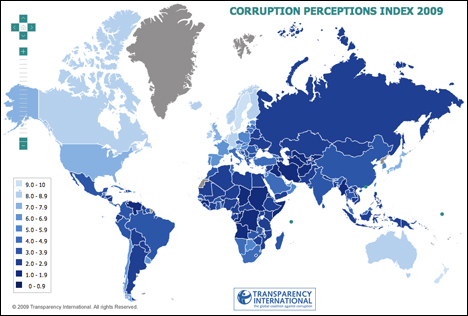
Interestingly, relative wealth and poverty are also very fairly correlated with perceptions of the local population of the integrity or corruption of government officials.

This map is from Transparency International’s Corruption Perceptions Index.

What’s especially striking is to look at the two maps together: Government corruption is correlated with economic oppression. This is not really surprising, but it seems to tell us everything we need to know about wealth and poverty: The closer a given country is to being a slave-state, the closer to starvation the people of that country will be.

Apple HTML5 demo: “Standards aren’t add-ons to the Web. They are the Web.”

Last week, Don Reedy talked to us about the cool stuff Apple is doing with HTML5 on the iPad. Unchained alum Scott Gaertner followed up with me to talk about the possibility of doing the kind of content we do as single-property coffee-table books, only expressing that content on the iPad like the issue of Sports Illustrated Don had cited.

Take a look at this Apple HTM5 demonstration site. In seven very quick demos, Apple illustrates all the cool things that can be done on the web using only HTML5, CSS3 and Javascript. The photo above was clipped from a live virtual-reality demonstration.

I’ve been talking to Cathleen a lot about the computer science paradigms behind this technology shift. It’s a big deal, actually, but Apple has been careful to sugar-coat it. Perhaps I’ll make a short video detailing what is going on.

The HTML5 demo requires the latest version of Safari, either desktop or mobile. Windazoids can play, too, by installing Safari. The rumor is that Safari 5 will be released this week, so there could be some more cool technology still to come.

How Socialism makes beggars of free people: “The predictable result of these efforts at preventing the exploitation of man by man was the collapse of production, pauperizing an already poor country.”

Theodore Dalrymple reflects on how the imposition of a Marxist redistributionist policy impoverishes what had been a self-sustaining economy:

I next spent a few years (1983 to 1986) in Tanzania, a country that presented another experiment in treating poverty as a matter of maldistribution. Julius Nyerere, the first—and, until then, the only—president, had been in charge for more than 20 years. His honorific, Mwalimu—Teacher—symbolized his relation to his country and his people. He had become a Fabian socialist at the University of Edinburgh, and a more red-blooded one (according to his former ally and foreign minister, Oscar Kambona, who fell out with him over the imposition of a one-party socialist state) after receiving a delirious, orchestrated reception in Mao’s China.

One can say a number of things in Nyerere’s favor, at least by the standards of postindependence African leaders. He was not a tribalist who awarded all the plum jobs to his own kind. He was not a particularly sanguinary dictator, though he did not hesitate to imprison his opponents. Nor was he spectacularly corrupt in the manner of, say, Bongo of Gabon or Moi of Kenya. He was outwardly charming and modest and must have been one of the only people to have had good personal relations with both Queen Elizabeth II and Kim Il-sung.

Nyerere wished the poor well; he was full of sympathy and good intentions. He thought that, being so uneducated, ignorant, and lacking in resources, the poor could not spare the time and energy—and were, in any case, unqualified—to make decisions for themselves. They were also lazy: Nyerere at one point complained about the millions of his fellow countrymen who spent half their time drinking, gossiping, and dancing (which suggested to me that their lives were not altogether intolerable).

But Nyerere knew what to do for them. In 1967, he issued his famous Arusha Declaration, named for the town where he made it, committing Tanzania to socialism and vowing to end the exploitation of man by man that made some people rich and others poor. On this view of things, the greater accumulation of wealth, either by some individuals or Read more

The first word in “free enterprise” is “free” — how economic fallacies are deployed to frustrate human liberty.

In a comment to my post on the NAR’s most recent attempts to rape the taxpayers, Michael Cook set forth a number of subtle economic fallacies. I am not picking on Michael. He is simply repeating Marxist propaganda that is ubiquitous, more’s the pity. But I thought it were well to take these claims apart, to illustrate how these kinds of fallacious arguments are used to frustrate human liberty. I’m taking this to a separate post because the comments thread on the original post is already wildly off topic.

So: Start here, quoting from Michael’s comment:

The very capitalist machine everyone here loves was bolstered by the use of slaves.

This is simply false, not alone simply by definition. The first word in “free enterprise” is “free.” Transactions in a free economy are always mutually-voluntary. If someone is being coerced, what is occurring is a crime, not an honest trade. Every modern economy we can speak of is in some way a form of socialism — a criminal conspiracy harnessing the power of the state to advantage certain people at the expense of the others. Slavery is of a piece with this pattern, although it predates modern economies by many millennia. Moreover, it was the free enterprise that was suffered to exist under modern Rotarian Socialist governments that finally rid the civilized world of chattel slavery. To be fair, this miracle was effected not by a moral awakening but simply because slavery is a lot less efficient than is investing wisely in fixed and human capital. In any case, slavery and free enterprise are mutually-exclusive phenomena.

History is wrought with takings back to the Egyptians, Roman and Greeks.

The same fallacious argument repeated, only this time with respect to land and portable wealth. Theft happens, but theft is not wealth creation. Consumable portable wealth quite literally turns into shit in no time. Mineral wealth and baubles can retain their exchange value, but these are static values. It is not possible to cultivate stolen gold or rubies. And stolen land or livestock is only productive of future wealth by means of intelligent husbandry.

Neither of these crimes — Read more

Another Life Lesson Courtesy of MLB

I love sports.  My wife – well, she pretty much despises them.  Why, she’ll ask, do I so often waste my evenings watching a game between two teams I barely care about?  I typically reply with “Sports are the ultimate in reality TV”.

It seems every week or two we’re dealing with another example of athletes making complete shit storms of their lives.  Tiger Woods.  Ben Roethlisberger.  It’s a long list.

However, this week something happened that inspired me.  It was a complete injustice – a robbery.  Detroit Tigers pitcher Armando Galarraga did something no other Detroit Tiger has ever accomplished.  He threw a Perfect Game.  Heck, the feat has only been accomplished 20 or so times in the history of Major League Baseball.  Only, on the way into the history books, something happened.  In case you haven’t seen it, you can find the video replay here.

The story, however, only begins when Galarraga’s foot steps on the first base bag.  The juicier – and more compelling – story comes out of the aftermath.

Photo: from nbcsports.com

Jim Joyce, the umpire who missed the historic call was devastated when he saw the TV replay:

“It was the biggest call of my career, and I kicked the [stuff] out of it,” Joyce said, looking and sounding distraught as he paced in the umpires’ locker room. “I just cost that kid a perfect game.”

No excuses.  No attempt at rationalization.  It was a bang-bang play that routinely gets botched by first-base umpires.  If this happened in the 3rd inning rather than with two outs in the 9th, we wouldn’t even be talking about it.  And the wonderful life lesson wouldn’t have been shared:

1)  Jim Joyce owns up to his mistake.  He then offers a sincere and heartfelt apology to Galarraga and all Detroit Tigers fans who were broken hearted that evening.  Not two weeks later, but immediately.

2)  Armando Galarraga accepts the apology and takes the high road.  “I have a lot of respect for the man. It takes a lot to say you’re sorry and to say in interviews he made a mistake.” said Galarraga.  Here’s Read more

Unchained melody: Seven nights in Eire by Reckless Kelly

The video is not just visually bereft, it’s also riven with misspellings. But the song is great fun, most appropriate for a Friday evening.

Here is a Pandora radio station built from the Reckless Kelly style of alt.country — rock ‘n’ roll instrumentation with rich saw-tooth voices lamenting intricately-detailed tragedies. This is what country music can and should be, when it’s not trying to sell beer and tampons. This is good art — pure, simple, brutal.