BloodhoundBlog

There’s always something to howl about.

Archives (page 89 of 372)

The threshold of accountability is accounting for things: Is this, finally, the CRM I’ll use?

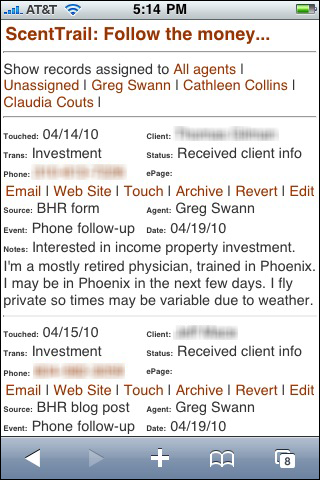
The iPhone screen shot is from a piece of software I’ve been playing with since Thursday. We got the gross idea from Redfin’s agent-monitoring software. Their stuff is simpler and prettier, but ours is robust and mission-critical.

What is it? Basically an automated tickler, the relationship-management part of Customer Relationship Management software. I’m still massively ambivalent about saddling on a big new piece of software like Salesforce, but I’ve been less than whelmed by cheaper products like Heap.

What I need, I realized, is this: Something to keep me on track every day. The records we’re showing are very brief, but they can contain every mission-critical detail we need to make contact with the client. The software runs on our file server, so it will work from any web browser and also from the iPhone. On a desktop machine, you can also do manual data entry, but typing on the iPhone is so painful that I left that feature out of the iPhone version.

But on the iPhone the phone number is “hot,” as is the ePage number if we have one. Likewise the email link, obviously. The Web Site link will take us to any URL we have linked to that record — with the most obvious destination being a cloud-based transaction-management page.

(I have plans there, also, with an iPhone-ready contact sheet for the entire transaction — agents, lender, title, inspectors, etc. On the iPhone, any PDF file is accesible, so the Web Site link will give us instant remote access to every live transaction.)

Here’s what it looks like on a desktop browser:
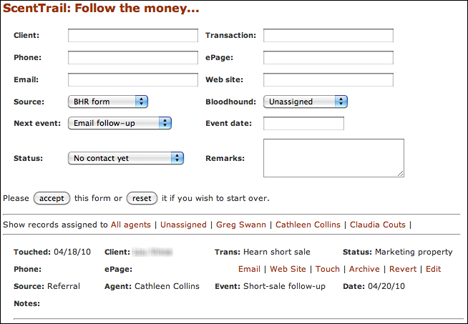
This doesn’t solve our larger CRM problem, but it’s built to harvest data from a real CRM system, once we have one. I have plans, too, to integrate it with Google Calendar — to calendar those events automatically — and with our existing web-based forms. Very soon, if you fill out a form on our web site, the form will create a record in this software automatically. I also want for it to tickle us by email on event days. Tickling us, too, to let us know when we’re not keeping Read more

iPad observation #10: Is the iPad an unforced error? I say Google and MicroSoft can’t even copy genius.

Busy as anything, ever, as I’m sure you can guess from my absence hereabouts. How busy am I? I still have not lain my own hands on an iPad. Tried to make time a couple-three times, but I couldn’t squeeze out the seconds.

But I have been paying attention to the aghastrointestinal noises made by the sputtering pundidiot class about the iPad, to some amusement. Translated into a language ordinary people can understand, the main objection runs like this: “These beach socks will look terrible with my tuxedo!” Could not agree more. But if you’re clamming or gigging frogs, you might-could find them a good fit.

Whatever. The iPad’s day is but barely begun, and one of the revolutionary things it will do is wash away this entire cadre of washed-up technology “experts.” Here’s hoping they can find a job worth doing.

Meanwhile, Richard Riccelli passed along this catalog of Grave Portents published by that citadel of techspertise, Slate magazine. Richard’s question is this: With the iPad and its closed software universe, has Steve Jobs committed an unforced error — unnecessarily created an obvious opening for Google and MicroSoft to compete?

My answer is no to everything.

Every kvetch about the iPad comes from people who will not be its audience.

1. It’s not a laptop. Duh.

2. It’s a closed hardware/software universe. Thus does Apple piss off 40% of the INTJs — 2.8% of the buying public.

3. It fosters a market opening for losers who could have beaten Apple ten years ago — except they’re losers.

We’ll have to wait to see it — Alice in Wonderland is an early mover (that munches up all of Brad Inman’s stale Vookies) — but the software built to take advantage of the unique iPad hardware will be killingthing.

Jobs is not wrong. Jobs is early. As always. Why? Because the future doesn’t exist until he invents it. Not hero worship, just an awareness of the amazing things the man causes to be done.

The two big iPad stories, going forward: How cool this tool is, and how lame are the clones.

Don’t believe me? Go buy an Android. Go buy a Zune. Google Read more

FHA/ VA Tip: The Amendatory Clause

Here’s a tip for real estate agents, when presenting an offer with FHA  or VA financing; include the FHA/VA Amendatory Clause to the Purchase Contract as part of the offer.   You’ll save you, the seller’s agent, the escrow company, the lender, and most importantly your buyer, a lot of last minute headaches.

You can download a copy of a templated form here.  Most lenders will accept this templated form.  If you don’t know the agency case number, etc, don’t worry about it.   The most important thing is to get the property address, the buyers’ and sellers’ names and the final contract price on the form.

Why the VA Amendatory Clause doesn’t need to be a “deal killer” for the appraisal contingency clause of a contract:

Contractually, the VA amendatory clause portends a 21-day appraisal contingency period for VA loans.  Pragmatically, the appraisers and underwriters complete their work prior to time limits making the 17-day appraisal contingency of the RPA feasible.  What that means to real estate agents is that it is conceivable that the appraisal contingency MAY have to be extended to 21 days if things go absolutely wrong but that the 17-day contingency period is reasonable for VA loans.

QUESTIONS AND ANSWERS:

From a Zillow Consumer:

Who must sign the Amendatory Clause? Two good answers were offered:

by Brenda Zabriskie:  Buyers, sellers, listing agent, and selling agent.  I usually scan it into my computer and send it off to the other Realtor who usually scans it again and sends it back to me.  I’ve never had a problem with having to have originals.  I guess it depends on which bank you are dealing with.

by Timothy Sutherland:  It depends also on the entity selling.  You don’t need it if it’s a bank owned property an FHA/VA/Fannie/Freddie sale.

From another Zillow consumer:

If I’m planning to use an FHA loan, can I order an appraisal in advance? Two good answers:

by Greg Darlin:  Yes, you can order an appraisal but you will be wasting your money.  If you order the appraisal on your own, it will be Read more

On work, busywork, hard work, and how to tell the difference

A revelation: At this moment in time, my business is exactly where I want it to be. Is that weird? I don’t think so, as I’m getting exactly the business I’ve earned. That’s not to say it’s the business that would make you happy, and it’s not to say it’s the business I want in six months or six years, even six weeks from now, but today, when I stopped to think about it, my business is in direct proportion to the amount of work I’ve put into it.

I’ve been busy over the past few years, but I haven’t always been busy on work. Some of that is my own fault, I’ll own that, I always have owned that, but the fact remains that the business I’m getting is exactly proportional to whatever I put into it, and that’s the good news for the day, because I know that whatever I put in, I’m going to get out.

I haven’t talked about my dad in a long while, but everything I know about work, I learned from him. I think you’d like my dad- he’s a Bloodhound. He grew up in a hardscrabble part of town, in a Catholic orphanage where the nuns let him be as much as they could. He is a kinesthetic learner. He’s one of the smartest people I’ve ever known, but not in a bookish way. He can teach himself any sort of thing, but only if he does it and the nuns allowed him to follow the plumbers, the maintenance people, the doers, around. He’d ask them questions about what they were doing and hand them tools when they asked. Other kids were off playing pick up games or getting into neighborhood fights, Dad was learning, always learning stuff.

When he had a family to support, Dad became a salesman which allowed him to get out and talk to people. A desk job? No thanks. My dad needed to live unchained, so he headed out- an independent sales rep for tool manufacturers. It wasn’t an easy life for him, but he was used to that. He loved Read more

Define the Tipping Point

The following began as a comment to a great post put up by Greg Swann recently, in which he excerpted a terrific article from Mark Steyn on income taxes and suckers:

…by 2004, 20% of U.S. households were getting about 75% of their income from the federal government… how receptive would they be to a pitch for lower taxes, which they don’t pay, or lower government spending, of which they are such fortunate beneficiaries? How receptive would another fifth of households, who get about 40% of their income from federal programs, be to such a pitch?

I believe My Styne is talking about the “tipping point” here, something I’ve also been talking about since before the election in 2008. Once enough people are dependent on the government, we reach a tipping point from which there is no purposeful return; only failure and rebirth. This is not news.

What’s interesting (at least to me) is the actual equation marking this tipping point. Obviously if more than 50% of the populace received 100% of their income (or benefits) from the government, we’d be over the tipping point. Not much of a stretch there, but not much of a definition either. I suggest the tipping point is well below the “50% get 100%” threshold.

So what is the level? This strikes me as a very important number – and concept – to know. Where is the line if it’s not “50% getting 100%:”? For argument’s sake, let’s say we have a voting block that will endorse politicians and policies which benefit themselves. Is receiving 75% of their income from entitlements enough to effect that vote? 60%? 45%? I suggest that the block crumbles at 20%, but is monolithic at 75%, so the answer lies somewhere in between. A 30% loss of income would be pretty bad for most people, but may not be bad enough that they would forsake their principles and beliefs. At 40% though… I think we’re dialing in the range.

On top of this, we should take into account the actual voting numbers of the population. How is the tipping point affected if Read more

9,999,999 iPads left to sell…

Well, I couldn’t help myself. I bought the iPad – the to-be-shipped-in-late-April, 3G & WiFi, 64 gig model.

I see significant work applications – for instance, keeping all client files available for court, creating eBooks of NC criminal code so I don’t need to lug around books, and, I hope, doing document signing on the fly.

I have not used DocuSign yet since, until now, I’ve been doing criminal law which doesn’t have a lot of documents that need to be signed, and, what’s more, they usually are signed in court.

But I’m starting to do bankruptcy and civil litigation work related to debt defense, and for that I think I’ll either subscribe to DocuSign or some similar service. DocuSign claims their service works with the iPad, although they haven’t created an App for that. As Greg mentioned, they need to Get On That.

I’ll post a review once I get the iPad in late April or early May.

UPDATE: I’ve been searching for a good list of productivity apps for professionals. I stumbled across this article in Forbes Woman which I found pretty irritating. Why? Second app listed is “Big Oven,” an app to help people find recipes so if you “[e]ver find yourself roaming grocery store aisles with little or no clue what to make for dinner.” Are you kidding me? Is this the second most important app for working professionals? No: it’s just obnoxious sexism.

Simple Concept – Not So Simple To Execute – Grow a Pair

As if it happened yesterday, I remember having just began seriously bodybuilding with a (understatement) stern trainer, a world champ who had no patience for anything less than all-out effort. One day my partner and I were following the workout he’d given us, when our trainer, Gene, walked up without preamble. “This is a man’s gym. If you girls are gonna keep playin’ around, get outa here!” What? Huh?

From that day forward, my workout partner and I never gave less than 100% again, at least if Gene was in the same hemisphere. He was that scary, and we were, well, 16. Gene wouldn’t let us fail. Our goal was to end up competing — which we did about 30 months later. In that time we became the more or less adopted sons of nearly the entire gym population. Our growth musta been fun to watch. What I thought would take a few months though, took over two years to accomplish. The goal was met though, as we both competed, and credibly so.

One might think I’d of learned my lesson about goals through that experience.

Much is made of setting and achieving goals. Dad was a crazy-ass goal setter. The guy had the ability to set a goal, become Stephen King obsessed, yet without anyone knowing about it. Try that sometime. One day after his third Jack on the rocks at the Club, his friends got him to share with them the 10 year goal he’d set for his real estate company over five years earlier. They were dumbfounded, and proceeded to ‘let him down gently’ by explaining how he’d maybe been a mite too optimistic.

It wasn’t ’till almost a year later that he told them he’d already accomplished that 10 year goal a few months before the first conversation. He’d done what they told him was impossible to accomplish in a decade, in just over half the time.

Setting goals and achieving them are entirely different things, an understatement of which I’m sure you’re painfully aware. We’ve all learned that one the hard way, right? I sure did.

I’m putting Read more

Mark Steyn: “We are now not merely disincentivizing economic energy but actively waging war on it.”

Shrug, Atlas, shrug. Mark Steyn from Investors’ Business Daily:

In less than a quarter-millennium, the American Revolution will have evolved from “No taxation without representation” to representation without taxation. We have bigger government, bigger bureaucracy, bigger spending, bigger deficits, bigger debt, and yet an ever smaller proportion of citizens paying for it. The top 5% of taxpayers contribute 60% of revenue. The top 10% provide 75%. Another two-fifths make up the rest. And half are exempt.

This isn’t redistribution — a “leveling” to address the “mal-distribution” of income, as Sen. Max Baucus, (D-Kleptocristan) put it the other day. It isn’t even “spreading the wealth around,” as then Sen. Barack Obama put it in an unfortunate off-the-prompter moment during the 2008 campaign.

Rather, it’s an assault on the moral legitimacy of the system. If you accept the principle of a tax on income, it might seem reasonable to exclude the very poor from having to contribute to it. But in no meaningful sense can half the country be considered “poor.” The U.S. income tax is becoming the 21st century equivalent of the “jizya” — the punitive tax levied by Muslim states on their non-Muslim citizens: In return for funding the Islamic imperium, the infidels were permitted to carry on practicing their faith.

Likewise, under the American jizya, in return for funding Big Government, nonbelievers are permitted to carry on practicing their faith in capitalism, small business, economic activity and the other primitive belief systems to which they cling so touchingly.

In the Islamic world, the infidel tax base eventually wised up. You can see it literally in the landscape in rural parts of the Balkans: Christian tradesmen got fed up paying the jizya and moved out of the towns up into remote hills far from the shakedown crowd.

In less mountainous terrain where it’s harder to lie low, non-Muslims found it easier to convert. That’s partly what drove Islamic expansion. Once Araby was all-Muslim, it was necessary to move on to the Levant, and to Persia, and to Central Asia and North Africa and India and Europe — in search of new infidels to mug.

Don’t worry, I’m not Read more

How To Salvage The Mortgage Industry in Six Months

I’m going to say something very unpopular… again:

We gotta get the Government out of the mortgage business.

That’s not going to happen anytime soon but we, as responsible free market advocates of our respective industries, must never stop saying “I told you so” when the whole thing implodes again.  After repeated admonitions, they’ll start listening.  When they start listening, we’ll experience a brutal but swift decline followed by a healthy and sustainable restoration of private mortgage banking.

Everyone is worried about Wall Street securitizing the paper.  The prevailing thought is that without a government guarantee, no clear-thinking investment banker will ever take a risk on the American homeowner again.  I know how to solve that problem;

Make ’em an offer they can’t refuse.

If a housing capital drought reduces housing prices to a stoopid low level, those investment bankers will be back.  Investment bankers have the memory of a four-year old.  We have to remove the current arbitrage game they’re playing so that they can get back into the business of doing what they should be doing; analyzing and pricing risk.

Right now, your mouth is probably shaped like an “O”.  You’re most likely  thinking “mortgage rates will skyrocket to 10% and NOBODY will buy a house! ”  Your conclusion would be wrong and I’ll prove it to you:

Today, a $300,000 30-year, fixed-rate loan, at 5% requires a monthly principal and interest payment of $1610.  If mortgage rates skyrocketed to 10%, the loan amount, for the same payment, would drop to $183,500.

That’s an offer Wall Street can’t refuse.

PS:  If I’m sounding like a broken record, it’s because I’m going to keep saying” I told you”, as my battle cry, until they start listening.  For those of you who believe in “spreading the wealth around”, believe me when I tell you that price deflation redistributes wealth to its proper stewards.

Dawn in America Part 3.5- Who Needs Jobs?

The current Adminsitration has its target on one more component of the capitalist model; free labor.  From today’s Wall Street Journal:

You might therefore expect a federal effort to encourage employers to give unskilled youngsters a chance. You would be wrong. The feds have instead decided to launch a campaign to crack down on unpaid internships that regulators claim violate minimum-wage laws.

“If you’re a for-profit employer or you want to pursue an internship with a for-profit employer, there aren’t going to be many circumstances where you can have an internship and not be paid and still be in compliance with the law,” the Labor Department’s Nancy J. Leppink tells the New York Times.

Did you hear that?  You might not be allowed to employ a willing student, who wants to learn a trade, without paying him minimum wage.

Consider these two summer job options:

1- Working in the Goldman Sachs  mail room for minimum wage.  That job certainly gets a young person in the door but the opportunity to learn, network, and accept greater responsibilities are practically nil.

2- Interning on a trading desk, for PIMCO, for no compensation.  While that young person won’t make a dime, she has the chance to work alongside fixed income legend Bill Gross.  She’ll speak to fund managers all over the country, meet people who might hire her after graduation, and accept challenges few people her age would ever see.

Anyone should be able to see that the latter is the equivalent of a free MBA while the former is an invitation to a labor union.  Chris Gardner knew the value of an internship.  He worked for free, when he needed fast cash to support his son.  He willingly traded his labor for future opportunity-that’s an investment.

Read what Greg Swann wrote about the value of free, in the early days of Bloodhound Blog:

How much future is there in a job that millions of very smart people are willing to do for free? Maybe not the same work, but so close that any differences become academic.

Greg was talking about the disintermediation of the Read more

SplendorQuest: Loving Cathleen…

Cathleen and I have been on a love jag, lately, and I cannot begin to tell you how beneficial it’s been. A very simple idea: We added spending time alone together every day as a part of our goal-getting regimen. This turns out to have been an inspired idea, although I did not foresee that going in.

At some point I may write about this experience in detail, because there is a lot to be learned from it. As an example, consider this: If you want to end the day married, start the day married. No relationship can endure if you’re not doing anything to maintain it.

Teri and I have been talking about the same sorts of issues privately. Here’s a clip from email I wrote to her:

My wife is most beautiful when she’s all the way in love with me. Her features are very fine in the ground state — striking, as an old family friend would have it. But when those features are lit from within by her passions, then she is many orders of magnitude more enthralling. But it’s my job to earn that response from her — and I wish I could insist that I’ve earned that response every day. But there is no better incentive to staying on the path to Splendor than to marry someone you have to live up to.

We are a spiteful race. We wound all our treasures and treasure all our wounds. The SplendorQuest begins when you learn to think the other way — to focus on the world as you want it and not as you don’t want it. I wrote the essay shown below six years ago, and I wish I could say I’ve always lived up to it — all the way, every day. But I’m living up to it now better than I ever have before, and I can’t think of any reason why I should not be able to get better at loving my wife every day from now on.

What does this have to do with real estate? I hope you figure that out before a judge orders Read more