There’s always something to howl about.

Category: Marketing (page 169 of 191)

The BloodhoundBlog Valuation Challenge . . .

Here’s a cute little game for people who think they know a thing or two about real estate…

I’m looking at houses for an investor client who is also a close friend of the family. He picked out a house he was interested in, and, as a matter of course, I ran every comp listing in that subdivision — active, pending and sold — going back to May.

I found ten active listings in that exact floorplan in that same subdivision. Unzillowables be damned, this is as close as you can get to stone identical comps, like little plastic Monopoly houses, each one the twin brother of the next. All of them were built between 2002 and 2004, all by the same builder, of course, all upgraded to some degree, none to the ultimate degree. No premium lots, no view lots, no pools.

What would you expect the spread of prices to be?

You would be wrong, no matter what you said, wrong by a lot. There is actually $115,000 between the highest and lowest priced homes.

The nature of this insane market is that people are still seeking prices for their homes that would have been obscene a year ago, as we neared the end of our housing boom.

This is the range of prices sought for these ten homes:

  • $245,000
  • $257,900
  • $257,900
  • $265,000
  • $266,355
  • $272,000
  • $275,000
  • $283,900
  • $299,900
  • $360,000

Here is your challenge:

Go take a look at this particular house and tell me what price it’s selling for.

Anyone can enter. You cannot possibly guess worse than some of these listing agents! It’s like The Price Is Right, just enter your best guesstimate as a comment. We’ll send a great prize to everyone who guesses correctly…

Technorati Tags: , , , , ,

BloodhoundBlog’s WordPress plug-ins . . .

Daniel Rothamel is swapping over to WordPress, and other people have told me that they are, too, so here, for canonical purposes if for no other, are the WordPress plug-ins BloodhoundBlog is currently using:

Akismet
Akismet checks your comments against the Akismet web serivce to see if they look like spam or not. You need a WordPress.com API key to use this service. You can review the spam it catches under “Manage” and it automatically deletes old spam after 15 days. Hat tip: Michael Hampton and Chris J. Davis for help with the plugin.

Customizable Post Listings (I’m not doing anything with this yet)
Display Recent Posts, Recently Commented Posts, Recently Modified Posts, Random Posts, and other post listings using the post information of your choosing in an easily customizable manner. You can narrow post searches by specifying categories and/or authors, among other things. By Scott Reilly.

Filosofo Comments Preview
Filosofo Comments Preview lets you preview WordPress comments before you submit them. It’s highly configurable from the admin control panel, including optional captcha and JavaScript alert features. By Austin Matzko.

Popularity Contest
This will enable ranking of your posts by popularity; using the behavior of your visitors to determine each post’s popularity. You set a value (or use the default value) for every post view, comment, etc. and the popularity of your posts is calculated based on those values. Once you have activated the plugin, you can configure the Popularity Values and View Reports. You can also use the included Template Tags to display post popularity and lists of popular posts on your blog. By Alex King.

Related Posts
Returns a list of the related entries based on active/passive keyword matches. By Alexander Malov & Mike Lu.

Subscribe To Comments
Allows readers to recieve notifications of new comments that are posted to an entry By Mark Jaquith and Jennifer (ScriptyGoddess).

Search Meter
Keeps track of what your visitors are searching for. After you have activated this plugin, you can check the Search Meter Statistics page to see what your visitors are searching for on your blog. By Bennett McElwee.

Google Sitemaps
This generator will create a Google compliant sitemap of your WordPress blog. By Arne Brachhold.

WordPress Read more

Zillowing the convergence: ‘Close enough is good enough’ will eventually eat every anti-Zillow argument except the ethical complaint . . .

When I was young, I was convinced I was going to work in either editorial or advertising. I was a teenage photo geek, a Junior Jimmy Olson with thousands of dollars worth of professional photo gear slung over my shoulder. In college, I was publisher of the student newspaper. From the time I was very young, single digits, I was producing all sorts of printed material. And because I often didn’t have a budget, I learned how to do a lot of it by myself.

The net consequence of all this is that, by the time I had to get a real job, I knew how to write, I knew how to create images — and I knew how to do many of the back-end jobs associated with producing printed words and images. I looked at my job opportunities and saw that print production paid a helluva lot better than content creation. So I went to work in Wall Street (where the very best money was found) producing 10-Ks and Blue Sky Reports and Annual Reports. I worked a boatload of IPOs, and 102 weblog posts overnight is not a very big job compared to the 100+ hours of the revision cycle on an Initial Public Offering.

All of this was happening at an epoch we might name The Dawn of the Age of Connectivity. The law firms we worked for had high-end dedicated word processing systems, and they wanted to know why they couldn’t do everything “on disk” — in the dewy-eyed lingo of the day.

It fell to me to do this, mostly because I was interested and no one else was. The “disk” problem was a bear, and there were dozens of kludgey “solutions” to this dilemma over the years. But, understood as a telecommunications problem, mere capture of keystrokes was not that big a problem.

The big problem was expressing word-processed coding as typography — and if you are not fairly well-versed in typography, you are probably already saying, “What’s the difference?” And, indeed, the difference today is much smaller than it was when I was doing this work. Typography once Read more

Where the babies are — and where they aren’t . . .

There’s a decently if not very deftly balanced comparison of Gilbert, Arizona, to Portland, Oregon, in the Christian Science Monitor today. The star of the piece is urbanologist Joel Kotkin, so Gilbert doesn’t suffer the usual big-city-dweller’s I-just-don’t-get-it sliming. The issue of fecundity is touched upon without any mention of the fact that Gilbert is fecundity made flesh — that cities like Gilbert are where U.S. population growth occurs. Portland’s New Urbanism is detailed, although neither Richard Florida nor the much lower fecundity rates — or even net population decline — associated with the New Urbanist movement are mentioned.

Technorati Tags: , , , , ,

The Fountainhead rises early in the West, but how many works of art are so thoroughly about the real estate business?

How’s this for a synopsis of the best real estate movie ever made:

An idealistic architect battles corrupt business interests and his love for a married woman.

So little argue against, so much to dispute…

Nevermind. The Fountainhead is on Turner Classic Movies tomorrow night at 5 pm MST (YTZMV (your time-zone may vary)). That’s a poor time of day for watching TV, so you might wait for the DVD version, to be released November 7th.

Or just forget the whole movie, which is flawed by creepy performances and even creepier architecture, a huge betrayal of the Sullivan/Wright modernism the film intends to celebrate. Snag the bookinstead, which, for my money, is in the running with Huckleberry Finn and Moby Dick as The Great American Novel — the work of literature that best explicates the American Experience.
Plus which, movie or book, how many works of art are so thoroughly about the real estate business?

Technorati Tags: ,

Appraiser reverse-engineers Zillow.com’s “secret sauce”: Can you guess the main ingredient . . . ?

Lee Ovington, a real estate appraiser who works and blogs in Elgin, IL has successfully reverse-engineered Zillow.com’s Automated Valuation Method:

The above examples give us some indication of how Zillow arrives at its value estimates (or Zestimate). Quite simply, the Zestimate relies on a calculated relationship of assessed value to sale price. Zillow merely takes selected transactions and calculates the relationship between the Assessed Values and the Sales Prices. It then applies that ratio to the subject’s assessed value (plus or minus some adjustments) and “whala”, you have Zestimate!

The above examples show that even when Zillow has a large margin of error in its Zestimate of 10-15%, the Zestimate is still highly correlated with the Assessor’s Values. We can conclude from this analysis, that the Zestimate is a derivative of the Assessor’s Values. Zillow may be slightly modifying the data by some weighting or factor like time or distance. That “tweaking” of the data could be the “secret” part of its formula; but clearly, the Zestimate is based on the underlying Assessor’s Values as indicated by the high correlation coefficient.

This is not surprising, by itself. It’s how AVMs work, after all. But by deconstructing Zillow’s results, Ovington demonstrates how little sauce there is in the vaunted “secret sauce”…

Technorati Tags: , , ,

Looking for a neat trick to make a house sell in a slow market? Clean it!

In last week’s Blog-off Greg addressed the importance of cleaning your house before listing it in no less than three of his posts: #43, #78 and #98. When you’re posting over 100 articles in one day you don’t have the luxury of putting a lot of thought into your posts, but keeping your house clean while it’s on the market shouldn’t require a lot of thought. This should be obvious to everyone… It should be obvious to those of us who make a living marketing homes, of course. But this isn’t a trade secret. This is a precept that every seller, represented or not, should take to heart.

So when I was showing a buying client houses this past weekend, I was surprised to see these comments in the Remarks field of the listing:

This house is priced right and just needs cleaned up.

The remarks go on to highlight the features of the house. And everything that was promised in the remarks was dead-on accurate! It’s a wonderful floor plan in my favorite Surprise community, priced $22,000 under the most recent sale of this same model in the same subdivision. The only discernible difference between the higher priced structure, which went under contract only two weeks after it was listed earlier this year, and the house we saw Friday, which has now been on market for six and a half months, is the higher priced house had “fresh paint,” and Friday’s house “needs cleaned up.”

I had warned my clients before we entered, and told them that the seller was paying, with a low list price, for someone else to clean the house. The house is vacant, so I expected dirty walls that need painting, a dirty perhaps pet-soiled carpet, maybe some nicks or dents in the sinks or on the dishwasher. I had expected the type of problems that maybe a down-on-his-luck seller couldn’t afford to invest in fixing. But the house is only five years old, and as I said, empty, so I had hoped for better.

Instead, we were faced with an empty home filled with trash. Nothing big, nothing that would Read more

Fast full-service buyer’s brokerage at a flat fee: That smells like a big win to me . . .

This is from a comment by Jeff Brown, responding to an earlier post. I’m only showing a snippet here, but Jeff’s ideas are worth apprehending in full and pondering at length.

Once and for all, the money paid for representing a buyer OR a seller is based upon only one factor: The ultimate value perceived by the client. Is the client better off being represented by you than not represented period? Is he better off with you vs. another agent?

Here’s the thing: The market will bear what it knows about. This is the purpose of marketing, to educate your own buyer.

So think of it this way:

I personally can sell about a house a week. More than that, and I can’t juggle all the eggs. But even assuming I have enough ready, willing and able buyers to sell a house a week, the effort involved for some transactions can exceed the time I can afford to spend on it. Because we don’t relate costs to compensation, sometimes we make good money, and sometimes we take it in the shorts. No other personal services/consultation business works this way — except for contingency-fee attorneys.

So: In ideal circumstances, I can sell a house a week at $250,000 each, on average, earning $7,500 each, on average, for a gross income of $375,000. Not bad. My marketing costs and other expenses are huge, and, practically speaking, some of those transactions were under-performing: Either the deal didn’t close at all or my costs exceeded my return. And, of course, I don’t always have a buyer to work with every week. Unused Realtor capacity is a hidden cost in this business, one that would be accounted for in the books for in any other business. But still, after everything: Nothing to sneeze at.

But suppose I can structure my business a different way. What if I were to charge a flat fee to represent a buyer in exchange for a non-refundable retainer. My marketing costs just plummeted, especially for the high-end clients whose homes we want to list — now and also when they move again. My exposure for under-performance just Read more

Beautiful and functional: New BlueRoof.com map searching interface sets bar higher . . .

BlueRoof.com has a new map searching interface, combining a number of good ideas from other interfaces with the company’s great design sense.

The interface features the slider controls seen in ShackYack.com‘s search tool. Unlike that system, though, BlueRoof.com does not get bogged down trying to display more listings than its underlying software can handle. If your search results in too many results, you are invited to narrow it.

The search area is defined by the visible portion of the map, however, which implies that, if you don’t already know where you want to be, you can’t use a relatively unfocused search to seek out neighborhoods in your price range. We’re sweltering under heat maps just now, and that would be a simple solution here.

The BlueRoof.com interface uses three different kinds of house icons to indicate active listings: A green roof is MLS-listed, a blue roof is a FSBO, and a blue roof with an avatar out front is a FSBO with broker participation. This is an idea we had talked about when first we saw the ShackYack interface — adding to it ShackYack’s idea of using color intensity as a one-glance method of comparing relative prices.

Things I don’t like:

I want more search tools, even if they come in a pop-down tab to make things simple for the punters.

I want to be able to get a feel of the whole housing market, even if I can’t see houses without narrowing down by area.

I have a huge screen, but I still get a small map. I think the page is being built to conform to BlueRoof.com’s toolbar (which is gorgeous), rather than growing to the available screen real estate.

I could not get to the detail page on any house. (Mac OSX 10.4.7, Safari 2.0.4)

Overall: Very pretty. I think this is the new high bar for map search interfaces. Considering the money in play at the Goliath-like realty.bot sites, BlueRoof.com is David triumphant today…

Technorati Tags: , ,

The things most worth talking about are the ones no one ever wants to talk about: Confronting the buyer’s agent’s commission amidst a glacial glut of real estate licensees . . .

I wrote this as a comment at Rain City Guide (which thread is very worth visiting), but I’m echoing it here:

> Who pays the commission is all semantics, really.

I would disagree with that. Buyers have been persistently misled about who pays the commissions, which skews their behavior.

> The buyer will not pay LESS for the house if there’s no buyers agent involved

Let’s put the buyer’s agent’s compensation under the buyer’s control and see what happens. A buyer who hires me to help execute a transaction he or she has already decided to undertake should pay less for my representation than a buyer commencing a completely unfocused home search. Do you disagree?

Ours is the only sort of business where compensation is completely uncoupled from effort and costs. That’s absurd, particularly as home prices surge upward. Doubly absurd when you consider that there is a glacial glut of real estate licensees.

> I don’t see the point for all the discussion here.

How about because the things most worth talking about are the ones no one ever wants to talk about? πŸ˜‰

Technorati Tags: , ,

Blogoff retrospective: Picking through everything and picking out the ones I like . . .

I finally made time today to read all of my posts in the Sellsius 101 Blogoff Challenge, correcting any errors I spotted and commenting where I had something to add to the conversation.

Jim Cronin of The Real Estate Tomato had asked me which posts I thought were my best and worst. I didn’t think any were horrible. There were plenty that I would not have done were it not for the contest, and others I might have done at greater length in different circumstances. I was gratified to show off many of my columns from the Arizona Republic, because they present a very hands-on approach to real estate.

Here are a few that I think stand out:

Blogoff Post #1: Cry, ‘Havoc!’ and let slip the war of blogs: “So, although there may be a lot of blog entries posted in this contest, I don’t think there will be any wasted entries. Your attention will be repaid with knowledge, insight, wisdom and, one hopes, grace.”

Blogoff Post #39: Work for passion, not money: “An admirable poverty is only admired from the outside. From the inside, eventually, it can come to be a tailor-made hell.”

Blogoff Post #45: Real estate weblogging? Yo, Shlomo! Cut back on the promo: “The bottom line is, if you start to look like spam to me, I’ll start to treat you like spam. How is that to your advantage…?”

Blogoff Post #50: Real estate weblogging? Write about blogging: “We become a forum, an agora — blog to blog, within a blog and within our own minds, solitarily engaged in the most blaringly public of debates.”

Blogoff Post #90: Stupid mistakes of the newly self-employed: “The only benefit I can think of to having a job is that there’s always someone to tell you to get busy. Not so for the self-employed. If you don’t learn to monitor and manage the hours of your days, you’ll be back on the clock in no time.”

Truly, time will tell: I link back to earlier posts all the time. We’ll know how these hold up by how I reference them in the future.

Thanks to everyone for being Read more

Ed Robson — Master Builder . . .

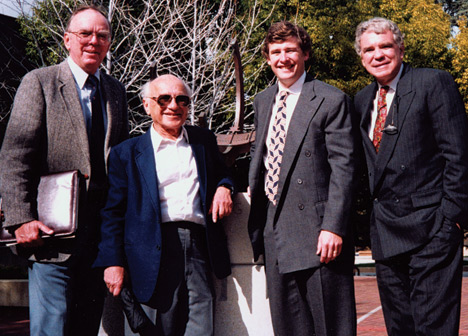
Because of my long-time affiliation with Tom Horton, I got to write the inside-front-cover copy for Outrageous Good Fortune, Tom’s biography of Ed Robson, founder and owner of Robson Communities, which builds active-adult communities all through the Sothwest.


From left to right, author and publisher Tom Horton, Nobel Prize-winning economist Milton Friedman, Mark Robson (now a real estate devloper in Southern California) and Master Builder Ed Robson.

Here is the copy I wrote for the Robson biography:

Here’s a trek for the intrepid: Take the I-10 Freeway south from Phoenix, Arizona, and get off on the Riggs Road exit.

If you drive west into the Gila River Indian Reservation, you will see some of the extent of Ed Robson’s legacy. In the reservation, the land is dead flat nothing for miles in every direction. Not beautiful, mountainous desert. Just desert, the kind that kills unprepared wanderers every day.

Now turn your car around and drive east into Robson’s Sun Lakes. You’ll find rolling hills, man-made lakes, golf courses, clean-lined stores and churches and compact, elegant homes — a model suburb.

But we’re not finished yet. Because when Ed Robson first set foot on the land that became Sun Lakes, the land he stood on and the entire southeast quadrant of the Valley of the Sun looked just like the reservation.

It was Ed Robson’s Sun Lakes that led the way as the southern corridor of Maricopa County was transformed from scraggly desert and struggling agriculture to very beautiful, very prosperous suburbs.

And Sun Lakes was just the beginning. Ed Robson spread his ideas about building master-planned active-adult communities throughout Arizona and into other states. As the Baby Boomers march en masse toward retirement, it will be Ed Robson who builds their homes — homes sturdy in construction and rich in luxuries, with the kinds of activities and amenities that make retirement an adventure.

Did Ed Robson get rich doing all this? Oh, you bet! But he has enriched us all along the way. Not just the people who live or work in his communities, but also the people who live and work in the surrounding communities, communities that would not Read more

Want to know where real estate corruption comes from? Whatever you do, don’t look in the newspaper . . .

I have a bunch of Phoenix-area real estate news piling up in browser tabs, so I want to reference it now, before it blows away in the autumnal desert breezes.

First, more fake good news downtown: “Phoenix is putting in place the final building block in its plan to construct a new downtown.” How? What are you, new? Massive tax-payer subsidies, of course. How else? But, not to worry. This will be the piece that completes the puzzle for a true downtown in Downtown Phoenix. Pay no attention to all those other, past, failed pieces that were to complete the puzzle. This is the real deal, you betcha. If you say otherwise you’re a counter-revolutionary running-dog imperialist wrecker. Oops! Wrong propagandists…

But don’t get the idea that Pravda — er, the Arizona Republic can’t issue a discouraging word: It turns out that trolley riders, if there are any, may have trouble finding shaded parking. If they can find any shaded parking now, in this benighted pre-trolley epoch, they should move to Vegas. They’re beyond lucky…

But at the same time, don’t conclude that the Republic can’t strain at gnats over a good press release: Active-adult housing is popular in the Southwest Valley — even though there almost isn’t any. The article justifies its spin by stretching as far as Sun City Festival — which is in the Northwest Valley. (Disclosure: I am a long-time friend and confederate of Tom Horton, who wrote the biography of Ed Robson, founder and owner of Robson Communities, which in turn owns PebbleCreek, the principle focus of this article.)

Did I say something about the Northwest Valley? Here comes the Northern Parkway, to relieve all the traffic out there where nobody lives — yet. The City of Glendale, which used to end at 67th Avenue, is going to extend itself miles and miles further west so that its tax-payers can delight in subsidizing thousands of new homes along the incipient SR-303 Freeway.

All of this serves as a nice way of distinguishing capitalism from mixed-economy socialism. None of this would be happening if our real estate economy were governed by capitalist Read more