There’s always something to howl about.

Category: Real Estate (page 230 of 266)

Dual Agency Smack-Down: More endless agency

First, as much as Jeff and I genuinely like Greg and appreciate his having us here in his cyber home – he is simply wrong-headed about all this agency stuff.

I don’t believe that Jeff is an angel and I know I’m not. But single agency is not a viable business model. Period. A viable business model is one that would allow for unfettered growth (as long as it was filling a need to the consumer) and single agency is not possible if a company grows.

I remember having an attorney for my client (he was a home seller) and when gave him the “Consent to Dual Agency” form to sign he handed it back and said he would not sign it. I asked him if he wanted his home sold for the highest price in the least amount of time. He answered “yes” that he did. I then asked him if he would like me to refuse to show his home to any of the hundreds of past clients of mine who might want to buy a house like his and if he would also like me to put in the MLS comments that NO JOHN HALL AGENT MAY SHOW OR WRITE AN OFFER ON THIS LISTING?

As he was a lawyer and did understand exactly why I asked him those questions he took the form from my hand and signed it.

There are about 925 agents with John Hall & Associates. It would be quite stupid to preclude them from showing a listing so the seller (and buyer) gets the “benefit” of single agency. What drug do Realtors take (and the lawyers and judges) that makes them even think that THEY control what the buyer or seller are going to do?

The argument I just love is the price issue. Go ahead and make all the low-ball offers you want. “Help” your buyer by writing loads of them. Try it on one of my listings and see how much it “helps” your buyer. I find that most buyers and sellers have a pretty good (and firm) idea of what they will pay for a Read more

Redfin Again

Trevor Smith writes (and I respond):

Your comment about Redfin is not only ignorant it is probably borderline libel.

Please feel free to pass my comments and my contact information along to them.

Do you even know exactly what services Redfin does or does not provide?

No. What I do know is that they are attempting to build a business model based on the buyer finding the house themselves (in many cases seeing it via the listing agent) and then going to Redfin to have them write the contract.

Redfin is not doing much less than your typical traditional agent, and they are providing their customers thousands in refunds… hmmm sounds like a great business model to me.

In most states there is a little issue called procuring cause. Here is how Redfin handles it – per their website.

If you are referring to the fact that they do not show their buyers prospective properties, this is no longer true either. So, as far as I am concerned, praise God for Redfin and other discounters who are awakening America to the fact that REALTORS are overpaid.

Your email address would seem to indicate that you ARE an agent with John L. Scott (known to be a highly successful and very reputable full service company) so truthfully, I do find it a bit odd that you choose to praise God for Redfin.

The part that would not align with your own long term survival is your belief that Realtors are overpaid – if in fact, you are one. The FTC monkeys (I believe I originally referred to them as “Howler Monkeys”) share your belief – so you aren’t alone on this point. Additionally, you state that Redfin isn’t doing much less than the typical traditional agent. Yes they are – they are not really performing the vital functions of any traditional buyer agent: taking the customer from the initial contact all the way through to the closing. They are asking the buyer to go and find the house and then “give us a call and we will write it up for you”.

I have no quarrel with any agent Read more

Dual Agency Smack-Down: Dueling angels are not persuasive . . .

I’m not really a Jesuit, I just play one in the blogsward. My mother had had enough of the Church before she went to high school, and, in consequence, I was sent to public schools. Those were actually quite a bit better then than they are now, but, even so, I bear my ignorance as a curse. I am too much aware that I am too much unaware, and every effort I make to correct this deficit serves only to deepen it. This is why I spend so much of my time crouched by Brother Quintilian, learning evermore to learn, to make up for my failure to have learned in the first place.

Say what?

In short: I am unswayed.

I have not heard what I consider to be a persuasively-valid argument in support of Dual Agency. Counting Our Lady Ardell in a comment, we have three testaments to personal integrity, and these I do not dispute.

But: So what?

The question is not: Can very trustworthy people effect Dual Agency in a way that occasions no overt objections from their clients? Surely this is possible.

The question is, rather: What policy should obtain in the absence of a presumptive angelitude?

The question is: Taking account that a certain percentage of licensees will be stupid, untrained, avaricious, uninformed or openly larcenous, what policy best protects the interests of the consumer — the alleged justification for our licenses?

Russell Shaw raises a lot of side issues that really don’t have anything to do with the debate. He gets quite a few of these sideways, in my opinion, but we can save those debates for other days. The meat of his argument is here:

My seller WANTS ME TO SELL THEIR HOME TO A BUYER I ALREADY HAVE – this is THE very thing they are hiring us to do.

That is: Dual Agency is valid because sellers want it. We turn to Quintilian, who advises us that, by this reasoning, Sub-Agency is also valid. Sellers want it, and many of them don’t truly understand that they no longer have it in Arizona.

Why don’t they have it? Because as much as sellers might Read more

Dual Agency Smack-Down: Bullied By Perception

Thanks to Greg Swann for his gracious invitation. Posting on the 900 pound gorilla known as Bloodhound is a feather in anyone’s cap. I’m not sure there’s more than five sites in the country creating more ripples than he does. You set the bar pretty high Greg.

Before I begin – God bless Russell Shaw. Until he came along I almost always felt like the Lone Ranger on most subjects the real estate blog-world considered earth shatteringly important. I’ve enjoyed his posts on various subjects, and have found myself wondering if my dad had another son he never told me about. Anyone who has ever read my comments on blogs discussing the latest ‘hot topics’ will easily discern how much he and I agree with each other.

Buyer representation? National MLS? Dual agency? NAR for heaven’s sake? Give me a break. Until I became a blogger I was both ignorant and apathetic about what opinions were held by others in the industry on those subjects. The only thing that has changed is the entertainment I sometimes enjoy while reading about them.

I read Russell’s dual agency post and laughed so hard I spewed my morning coffee all over my wife’s cat. He absolutely nailed it to the wall. Remember the Clint Eastwood movie, Suddent Impact? That was Russell’s way of saying, “Go ahead, make my day.” But, I was invited to post my take on dual agency, and I’ll do that now.

In the 1960’s I worked for a real estate firm that had six offices and give or take 40 agents. About 75% of the agents were full time. In the two years I was the janitor, and printer (mimeograph) of new listings, they closed over 1,000 transactions – 100% of which were dual agency sales. (Quick, get Greg a chair, he’s looking a little pale.) That same firm also escrowed the sales. And if an agent was caught showing another broker’s listings, he was fired on the spot. The company’s broker/owner didn’t cooperate with outside brokers – as policy. How could that work you ask? His company always had more listings under $20,000 Read more

Saturday morning links . . .

Todd Tarson goes flat fee for buyers. I’ll be interested to hear how this flies in the high desert. Inlookers, Mohave County, where Todd works, is boom country. The new bridge over the Colorado is expected to turn the SR-93 corridor from Kingman to the river into bedroom communities for Las Vegas — which is running out of land. You might consider giving Todd one day of your Vegas vacation to take a closer look.

Greg Tracy at BlueRoof.com asks: What if Zillow Got Serious? Indeed. This is what makes Fidelity’s half-baked AVM interesting, actually. They already have the title farm, and they already have the Realtor relationships. This could be fun…

Jay Reifert, a true buyers-only agent in Madison, Wisconsin, sent me a link to a form buyers can use to cling to their unrepresented status. Jay has a lot more at his real estate reform web site.

RSS Pieces advises us that it is a myth that stand-alone web sites for listings drive traffic. This is probably true in the large. It is certainly false from an incremental and long-term perspective. But the real point is: So what? The purpose of a discrete web site for a home is not to drive traffic but to sell that house. Do they work? Oh, good lord, yes! Lately, I’ve read a number of tone-deaf observations on this subject, and I don’t know if the writers just don’t get it or if they’re playing dumb to rationalize playing it cheap. Here’s how you do this: You have a summary listing on your main web site, just like everyone else, except that the summary links to the stand-alone site for that particular listing. Now you have searchability at your main site and a link back from the satellite site, marginally improving your Page rank. More importantly, you have knocked the socks off your seller, your prospective buyers and the entire neighborhood. We sell to people, not Google. Don’t forget.

The Phoenix Real Estate Guy has a new “Ask the Lenders” feature, which I think is a rockin’ idea.

And: Jim Cronin at The Real Estate Tomato asks: “Who Read more

The headline buried in the “news”: Real estate agents are as safe as houses!

It’s Saturday, and you know what that means. If the Arizona Republic doesn’t piss all over the real estate business, someone might accidentally go out and buy a house.

Here’s the scoop:

Complaints against real estate agents are on the rise, with consumers accusing them of everything from selling property without a license to cutting corners to make a sale.

As of June, the number of complaints opened with the Arizona Department of Real Estate had jumped 53 percent since 2003, the year before the housing boom took the Valley by storm. Complaints forwarded for discipline increased 150 percent in that same time.

If those numbers sound nebulous to you, you’re reading too carefully. Stop that!

Part of the spike in complaints reflects the rush of new agents who flooded the market to take advantage of the housing boom of 2004 and 2005.

Does it? Is there a correspondence of complaints to new licensees? If there is, it’s not demonstrated in this story.

The number of new brokers and agents rose 38 percent in the past three years, well behind the pace of complaints.

New brokers aren’t new licensees, so the correlation is even smaller than intimated.

Here’s a real number, though:

Most of the complaints come from consumers. Others come from agents complaining about other agents or governmental jurisdictions reporting what they believe are illegal subdivisions. In all, 1,620 new complaints had been opened with the real estate department through the fiscal year in June.

There are 90,000 real estate licensees in Arizona. About 90% of ADRE complaints are dismissed without action. With the right microscope, this “news” is a conflagration.

The top three complaints: License violations, convictions or failing to disclose a conviction, and advertising violations. Real estate advertisements must list the name of the broker that the salesperson works for, according to the department.

And these would all be complaints brought by the ADRE or other agents, not by consumers.

Elaine Richardson, the state’s real estate commissioner, said she was alarmed by the trend of new complaints exceeding the number of new brokers and agents.

“If we don’t get a handle on it, that brings us back to people getting bilked out of Read more

Dual Agency Smack-Down: An Argument FOR Dual Agency – part 1

This is a stupid subject. This is a necessary subject. There are a lot of different viewpoints on this subject. A lot of the viewpoints that seem to matter came from lawyers, court decisions (judges who are also lawyers), and other people who are also wrong.

Back in the days when it was sub-agency only and I took my sister, Diane out to find her a house to buy I was representing each and every one of the home sellers whose property I showed to my sister. I was not legally representing my sister, Diane – I was legally representing various random strangers (most of whom I never even met). Did it make sense back then to have it be required by law for me to disclose my relationship with my buyer to “my seller”? Yes. Today, agents are still required to disclose their relationship to the buyer? Why? Who is now being protected by this disclosure? If I take a listing now to sell Diane’s house am I going to give her “better agency” than I do my other clients? But I still have to put in the listing my relationship with Diane. Same deal if I were to sell her a house today. But today she would be my “client”, either as a buyer or as a seller. Who we represent is already a disclosure issue. This is just one example of the nonsense that passes for “important agency issues”.

The seller used to pay all the commissions directly. The listing signed by the seller via the listing broker required the seller to pay them – but that payment went directly (in a legal sense) from the seller to the respective agents (via their brokers). This was changed here in Arizona some years back to having the listing broker being made responsible for paying the selling (cooperating agent) bringing the buyer to closing. This was designed to prevent the seller (and / or buyer) from including the agents commission amounts as part of their offers or counter offers.

So I list a house and the seller agrees to pay me “X” amount Read more

Dual Agency Smack-Down: A category 11 hurricane of arguments against Disclosed Dual Agency . . .

I’m going to stir up a category 11 hurricane by basing my initial entry in the Dual Agency Smack-Down on our past posts on the subject. Cathleen and I have dealt with this topic at great length in the past, so it seems reasonable to reinforce our arguments by revisiting them.

For the benefit of readers who may not be real estate professionals, I’ll start with our Dual Agency policy page, which defines and frames the issue:

Dual Agency is the process by which one real estate broker represents both the seller and the buyer in a transaction. It is legal in Arizona, provided it is fully disclosed and consented to by all parties.

Clear as mud?

Here’s what you’re apt to think of, when you think of Dual Agency: An agent lists a home for sale, you see it at an open house and sign a contract on the spot. The agent represents the seller. Does he also represent you? If he does, his role is reduced to that of a transaction facilitator. He carries messages back and forth between you and the seller, but he is forbidden by the Dual Agency to advocate for either of you. He may be completely scrupulous in his performance, but the chances are excellent that either you or the seller — or both of you! — are going to feel cheated at the end of the process. If “your” agent isn’t working in your interest, he must be betraying it instead. This may not be the truth of the matter, but it’s a suspicion that leaps readily to mind.

But here’s how Dual Agency usually works out. Your agent from Behemoth Realty takes you to a number of homes, including some that are themselves listed by Behemoth. You select one of these. Your agent is not the listing agent of the home you picked. It’s listed with a different Behemoth agent. So there’s no problem, right? Wrong. Your Buyer Broker Agreement is with the broker of Behemoth Realty, not with “your” agent. The Listing Contract is with the broker of Behemoth Realty, not with the seller’s agent. Both Read more

Untying the Loop 202 knot: If only they let me draw the freeway maps . . .

Our friends in the Gila River Indian Community have elected to negotiate on the location of the Loop 202 Freeway:

In a surprise about-face, the Gila River Indian Community will talk to state and federal officials about the prospect of building the South Mountain Freeway on reservation land, possibly sparing hundreds of homes in Ahwatukee Foothills.

If this is a surprise to you, you don’t understand the economics of casinos. The tribe built one of its three casinos on the route of the planned freeway, and they won’t reap the anticipated windfall if the freeway is not built.

The Loop 202 was originally planned to run on Pecos Road, at the Southern edge of the Ahwatukee Foothills neighborhood. Bonehead developers built very expensive homes very near the freeway’s right of way, and owners of very expensive homes are the very nimblest of NIMBYists. You can hardly blame highway planners for casting an envious eye into the mostly-empty Gila River Reservation.

From west of Phoenix to east and south of Phoenix, from the I-10 to the I-10, the Loop 202 is intended to serve as a reliever freeway, skirting traffic around Central Phoenix. If we view the road strictly as a local route for Ahwatukee Foothills, then Pecos Road in its current configuration is more than adequate. In other words, the reliever function can easily be split from the local traffic problem in Ahwatukee Foothills.

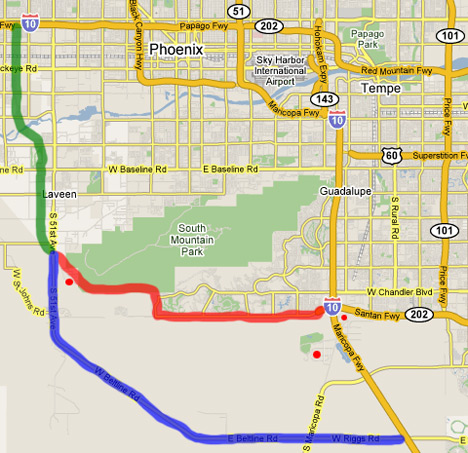
That being so, I like this route better:

The green line is the currently-planned route for the Loop-202 south from the I-10 west of Phoenix. Everyone on this route wants this freeway, the sooner the better.

The red line is the currently-planned route for the Loop-202 continuing east to the I-10 south of Phoenix. Virtually everyone on this route doesn’t want the freeway to be built.

The bright red dots are the locations of the three Gila River Indian Casinos, vast magnetic cash cows.

The blue line is my suggestion for an alternate route for the Loop 202. It wouldn’t connect with the SR-202 on the east side of the I-10, but it would be a whale of a traffic reliever. In the long run, the Read more

New NAR policy allows “objective” exclusion of certain listings from members’ presentations of IDX feeds . . .

This is the news from NARdiGras — from RealEstateJournal.com:

A revised policy approved by the National Association of Realtors this week may make it harder for discount brokers to draw attention to homes they list for sale.

The policy, approved by directors of the trade group at a convention in New Orleans, involves information about homes that real-estate brokers get from their local multiple-listing services, databases that are typically operated by local Realtor associations. Among other things, the policy reaffirms that brokerage firms that put listings from the MLS on their own Web sites can exclude certain homes.

The revised policy states that brokers must use “objective criteria” if they screen out some listings. The criteria could include location, type of property, compensation offered for agents who find a buyer, or the level of service provided by the listing company. Thus, listings from brokers providing limited service for lower fees could be excluded from other brokers’ sites.

By contrast, the policy now states that multiple-listing services must make all types of listings available to the Web sites of participating brokers. It would be up to brokers — not the MLS — to decide which listings are used on individual brokers’ sites.

A broker quoted in the article makes a compelling case for this position: “We spend a lot of money advertising our Web site to the public, and we have a right to put what we want on our site.”

Indeed. And as a counter-marketing strategy, a brokerage could proudly announce that its web site sports the full MLS.

But: There’s more. The other night Cathy, Russell Shaw and I were talking about the contrary case: What if I want to exclude one of my listings from the MLS feed? That sounds counter-intuitive, but for certain very-high-priced homes, it makes sense. As the listing broker, I might want to advertise and cooperate, but I would not want to invite a deluge of traffic from unqualified buyers.

Moreover, I think this new policy has about as much chance of succeeding with the Feds as the last one. The individual liberty of real estate brokers seems not to matter much in Read more

Home buyer always liable for mortgage . . .

This is my column from today’s Arizona Republic (permanent link). No fireworks, today, just real estate.

Home buyer always liable for mortgage

I got a great question by e-mail. It’s really a lender question, but it introduces a number of interesting topics.

“Are homeowners personally liable for their mortgages? If yes, is it possible to structure a home loan that doesn’t require a personal guarantee?”

Generally speaking, yes, a mortgage is secured both by the real property and by the borrower’s personal promise to repay the note.

If the down payment is 10 to 20 percent, the personal promise may not be as significant. But if the down payment is very low or if real estate is declining in value, the lender will depend on the borrower to bring any shortfall to the closing table, should the home sell for less money than is owed on it.

Many types of loans are not secured by the borrower’s personal promise to repay. The loan will be secured by the real property or by other assets. A foreclosure won’t affect the borrower’s personal credit.

Here is an example that can be used for mortgages for residential rental homes: the non-recourse loan. The loan is secured by the real property only, with no “recourse” to the borrower on default.

Obviously, the lender is going to make sure the amount lent is substantially less than the value of the property, that the property produces income sufficient to pay its own expenses, etc.

This is an investment product, but the interesting thing about non-recourse loans is that they can be deployed by self-directed retirement accounts to own real estate.

Your self-directed IRA, as an example, would have to make a hefty down payment on a piece of real property, and there are rules about what your IRA can own and to whose benefit. But by means of the non-recourse loan, your IRA can own real estate to build your retirement nest egg.

But the answer to the main question is probably no, alas. I know of no primary-purchase mortgage loan that does not require the borrower to personally guarantee repayment.

Technorati Tags: , , , Read more

How to make money banking on the West Valley real estate market . . .

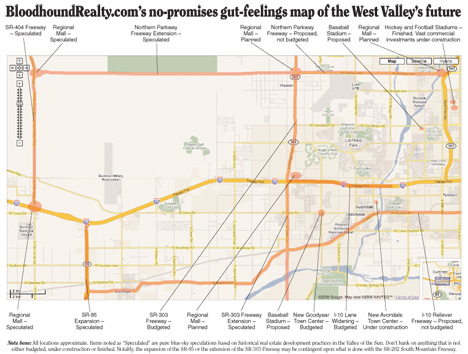
Want to get rich in real estate? A workable strategy might be to march your way west on this map:

If you click on the map, it opens to a larger, PDF version.

This is is significant chunk of the Southwest Valley in Metropolitan Phoenix. I’m showing you every major development that will affect real estate appreciation values — actual, probable and speculated.

Start by buying all the house you can afford in the eastern third of the map. Every two or three years, move yourself three to five miles further west, again buying all the house you can afford — from your income plus your accumulated equity. In five moves, you should have a ton of money regardless of your other investments.

Looking to invest in rental real estate instead — or as well? This map shows you where to move your money — again, slowly and incrementally to the west as development warrants. Your goal is to be where the great masses of people want to be — a year or two before they get there.

This is really not that large an area — it’s about 26 miles by 14 miles, 364 square miles. But as many as 1.5 million people will be moving into the area described by that map over the next twenty years.

Clearly, there is money to be made…

Technorati Tags: , , , ,

If the sheep are going to be sheared anyway, is it wrong to sell spectator seats . . . ?

Comes news today that we are that much closer to two new Food Stamps allocations to Major League Baseball. The count so far this year is three Welfare-addicted baseball teams moving into two brand new, taxpayer-funded stadia. If you read nothing but the Arizona Republic, you would never know that professional ath-a-letes and their empressariat make quite a bit of money. Cancel your subscription for three months and you might actually get the addle-pated idea that they can afford to pay for their own damn ballparks.

Not here.

Our public schools provide free breakfast and lunch all Summer long in even the wealthiest of suburbs, and the municipalities of Greater Phoenix have never once met an ath-a-lete who didn’t need a multi-million dollar hand-out. The quality of mercy is not strained.

Fine. Stipulated. This is the way things are, and they’re not going to change anytime soon. Metropolitan Phoenix grew faster than any American city by not emulating the dumb stunts by which other cites manage to lose population, but those days are done. We are still not as stupid as the cities celebrated by the celebrated Richard Florida — cities attractive only to people who don’t have children — but we inch our way ever more Floridaward with every election. Again: Fine.

My conundrum is that, as much as I hate these silly stunts, they turn out to be very good for my clients. Any rational economist is only too happy to point out that, in the long run, subsidizing the lesser producers of wealth at the expense of greater producers is suicidal — and who can walk the Floridian Utopias Back East without fearing that the collapse might come at any instant? We might spit in spite of John Maynard Keynes, who famously said, “In the long run, we are all dead” — but, alas, it’s true. In the long run, the policies that Phoenix is pursuing will result in the same civic, economic, cultural and demographic disasters we witness in the cities now feeding our population growth.

But real estate is a medium run investment.

We have a new football stadium on the west Read more

John L Wake says: Buy . . .

From my email this morning, Phoenix-area Realtor and weblogger John L Wake offers this advice:

I recommend that anyone who has been waiting to buy or who was considering buying with in the next 6 months, that they now seriously consider buying within the next 6 to 8 weeks.

The argument is based in a statistical analysis of listings history, and John’s audio explanation of his charts is worth listening to.

I thought yesterday that a podcast with Russell Shaw would be a wonderful thing, and here’s another case where I’d really like to explore John’s numbers in detail. I’m going to have to do something about this…

Technorati Tags: , , , ,