There’s always something to howl about.

Category: Technology (page 52 of 60)

By withholding the secrets of the mystical MLS system are we betraying the home-buyer’s interests?

In all my spare time, I’ve been working over the past few days on a real estate porn movie. The film features pictures from hundreds of homes, with loads of juicy details. We took the photos over the course of years, so it’s entirely possible that some of those homes are listed for sale right now. In making the movie available to the public, will we be “advertising” those listings without the listing broker’s permission? I don’t think we will be, but I also don’t give a damn. We have a right to our work product, and we have a right to do as we choose with our work product, and I will joyfully fight for my rights down to my last dime.

Let’s be obvious, at least for a moment. An appraisal is something you contract to have done and pay a substantial fee to obtain. Any state attorney general, even Arizona State Attorney General Terry Goddard, should be able to comprehend such a simple fact. In the same way, advertising is something you pay for. Quibblers will insist that paying web site hosting fees is alike unto paying publication line rates or broadcast fees. To this “argument,” the only reasonable retort is a Bronx cheer. When a word means almost anything, it means almost nothing.

The obvious fact is that MLS rules against advertising other broker’s listings without permission are devised to prevent Broker Paul from placing paid ads representing Broker Peter’s listings as his own. In fact, the motivating premise behind the rule is that Broker Paul, even while giving a false impression about his prowess as a lister, would nevertheless be promoting the homes in a positive light.

So why would Broker Peter object to free advertising of his listings? In other words, why does this MLS rule exist in the first place?

Too obvious, isn’t it? It’s because of the double dip. If Broker Paul advertises Broker Peter’s listings as his own, then Broker Peter might lose out on some opportunities to collect commissions from both sides of his transactions.

Real estate brokers implemented Buyer Agency not because they wanted to Read more
Speed links: Freakonomics, podcasting Dustin and WordPress 2.2

Thanks to Rueben Moore of BrickAndGarden.com, we were cited by the Freakonomics weblog today for beating up on the NAR.

BloodhoundBlog contributor Morgan Brown has a podcast interview with Rain City Guides’s Dustin Luther at BlownMortgage, his home weblog.

WordPress 2.2 is out. We’re running 2.1 on all our hosted weblogs except this one, which is still quivering in the corner under version 2.0.10. Time for some upgrades.

Technorati Tags: , ,

FTC to NCRC regarding Zillow.com: What price justice?

The attempted shakedown of Zillow.com that began last October — when The National Community Reinvestment Coalition (NCRC) sent a letter to the Federal Trade Commission (FTC) complaining that the nascent Seattle-based Automated Valuation Model (AVM) was misleading minority homeowners about the value of their homes — has come to stunningly banal conclusion.

In a letter dated May 4, 2007, the FTC elects to take “no further Commission action,” citing Zillow.com’s fortified disclaimers about the accuracy of AVM results and the need for site visitors to investiagte other sources of real estate evaluation.

The NCRC has since discovered the sub-prime mortgage melt-down as a more profitable mine to be quarried, since lenders can be faulted simultaneously for the foolish loans they made to minority borrowers in the past and for forbearing to be equally foolish in the present.

You can read the FTC’s letter here.

I wrote a great deal about this issue last fall, all of which is linked below. As with the State of Arizona’s persecution of Zillow.com, I see the NCRC shake-down as old-school criminality attempting to impose itself on the internet — trying to leverage off of Zillow’s fame or perhaps viewing AVMs as the weakest member of the new-economy herd in PR terms. In any case, this moral victory with the FTC will rob innuendo-wending reporters of a minor weapon to inveigh against the web start-up in stories about the on-going Arizona controversy.

These are my posts about the attempted NCRC shake-down of Zillow.com:

More at John’s Cook’s Venture Blog at Read more

Are traditional Realtors being undercut? There’s always room at the top

This is me from last July. Real Estate Wives has a post on Redfin and WalMart today, so I thought I’d bring this back to the top of the queue.

Are traditional Realtors being undercut? There’s always room at the top

Let’s see… Our customers are leaving us in a steady march. They’ve found an alternative that is easier to use, more convenient, overall just a better fit to their lives — and to top it all off, it’s much cheaper than our product.

What should we do?

Here’s an idea. Our customers are telling us in no uncertain terms what they want: More! Newer! Better! Faster! Cheaper! So let’s do the same things we’ve been doing all along, only less!

From Reuters.com:

The New York Times Co. plans to narrow the size of its flagship newspaper and close a printing plant, resulting in the loss of 250 jobs, the company said in a story posted on its Web site late on Monday.

The changes, set to take place in April 2008, include the closure of a printing plant in Edison, New Jersey. The company will sublet the plant and consolidate its regional printing facilities at a plant in Queens, the paper said.

The newspaper will be narrower by 1 1/2 inches. The redesign will result in the loss of 250 production jobs, the company said.

The New York Times said it expected the changes to result in savings of $42 million.

The narrower format, offset by some additional pages, will reduce the space the paper has for news by 5 percent, Executive Editor Bill Keller said in the article.

The Times will join a list of several other papers from The Washington Post to the Los Angeles Times that have reduced their size as they cut newsprint and other production costs and try to stem a loss of readers and advertising to the Internet and other media.

It might be fun to chortle about someone else’s troubles — and who doesn’t love seeing the New York Times get it good and hard?

But what they are doing is what the real estate industry, in general, is doing. In both cases, the consequences Read more

Video has a place in home sales, but use it wisely

This is me in today’s Arizona Republic (permanent link):

 
Video has a place in home sales, but use it wisely

This is purported to be the year of the listing video, but I am not hugely in love with the idea of video tours. I think digital photos do a much better job of selling buyers on the home. Why? Because they’re bigger. Brighter. Of much higher resolution. And because they hold still.

Video has age-of-wonders appeal to everyone, but if buyers want to get to know a house, they are going to study it. Even if online video overcame its muddy, fleeting quality, it would still be a poor medium for touring a home.

There’s more. Realtor-produced videos often have an amateurish quality that is hard to endure: “This. Is. The. Formal. Dining. Room. The. Residents. Dine. In. This. Room.” Even if the performance is sprightlier, the presentation is often an elaboration of the obvious.

But I do want to tap into that age-of-wonders appeal, and we always want to do more for our listings than our competitors can match. And if I can soak up a potential buyer’s time, that’s time that won’t be deployed looking at other houses. The point is, there are good competitive reasons for including a video tour with a real estate listing, even if video competes poorly with photography.

What I’ve been looking for is a video format that makes sense in the context of the listing — video doing a job that photography cannot do, rather than video doing photography’s job badly.

Here’s what I came up with: An interview with the seller. The particular home we tried this on is an extensive restoration. Taking the seller through the house room by room to talk about what was refurbished, what was remodeled, what was created from scratch was a way of turning video into a true asset in the listing package.

This works much better for me, in any case. We’re not depending on the video for high-resolution images, and we are able to take on the story behind the listing in a way that is both compelling and uniquely suited Read more

Trulia.com versus Zillow.com revisited: Are your end-users temporary or permanent?

This is me last month, at the time of the Zillow.com’s most-recent software release:

In the world of Trulia.com — and other listings.bots focused on evanescent listings — users come and go. On the idealized Planet Zillow, users come and stay.

Home buying is at most an 18-month effort undertaken every seven to ten years, on average. Home ownership is continuous. Zillow attracts a lot of sellers, and it seems certain that it hopes to attract a countervailing cadre of buyers. But what Zillow is really doing, I think, is aiming at the 100 million-plus Americans who own their own homes. Some may come every day — to see new listings, to see new home photos, to ask or answer questions. Some may come only once in a while, when they have a particular need.

But its databases are permanent and accretive, constantly improving. I think Zillow’s goal is not to compete with Trulia or Google Base for home shoppers in the short run. I think its goal is to suck every bit of oxygen out of the residential real estate space as a vertical market. I’m not implying malice. But where others see this opportunity or that opportunity, I think Zillow.com sees the information marketplace for homeowners as a single unified whole, and I think the company’s goal is to dominate the whole thing in its entirety.

Today’s changes have the potential to make Trulia.com a stickier experience. But will it retain end-users after their homes have closed?

Technorati Tags: , , ,

Is Trulia.com the UnZillow? Realty.bot emerges from beta with a new Q&A feature and robust, system-wide automated alerts

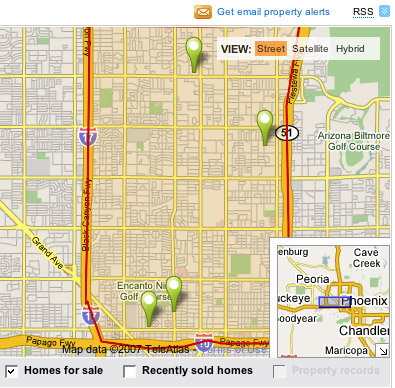
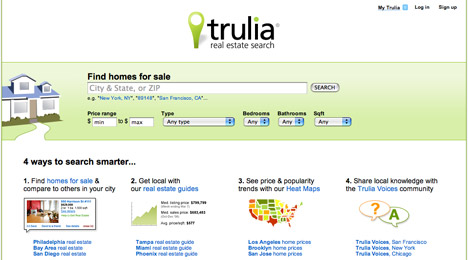
Come with me to the newly-reconfigured Trulia.com, freshly emerged from beta status. Let’s search for an ideal house. The criteria we can use are limited — location, type of structure, price range, bedrooms, bathrooms, square footage — but we can still scare up some results. Plus which, if you really know what you want — for instance, by winnowing the location down to a particular zip code — you won’t have a huge number of listings to sort through.

My search turned up four houses. Not a big number, but all of them are reasonably well-suited to my needs. But: None of them is a perfect fit. Here’s the cool part: I can instruct Trulia to send me email updates or an RSS feed of changed data in that particular search. When a new home matching my criteria is listed at Trulia.com, I’ll learn about it right away. Or, if I like a particular house, but I don’t like the asking price, I can subscribe to get an email notification of future changes made to that one listing.

I can set up any number of tightly focused searches, each with its own email alert or RSS feed. That much is not news to Realtors. We do this every day, with much more robust search tools. But we do it for clients. The clients themselves don’t have direct access to the MLS system. Some added-cost IDX systems permit saved searches with email updates, but then the search is not terribly more robust than Trulia’s.

But wait. There’s more. The new improved Trulia.com, will alert me when the house of my dreams becomes available. This is essentially the complementary counterpart to Zillow.com’s “Make Me Move” feature. Using a database of tax records, you can select a particular residence and ask Trulia to inform you by email or RSS feed when that home comes on the market.

Neither of these features is without problems. For example, where Trulia turns up four homes that match my criteria, either Realtor-listed or For Sale By Owner, the Arizona Regional MLS system unearths 146 active listings for the same search. And, at Read more

Podcast interview with Trulia.com’s Heather Fernandez: “Real estate professionals are going to be able connect directly with consumers”

Linked below is a podcast interview I conducted with Heather Mirjahangir Fernandez, Trulia.com’s Director of Marketing. Heather takes us through all of Trulia’s new functionality. At the end of the recording, I raise the idea that Heather might be getting a lot of email about the upgrade, so it seems appropriate to share her email address: heather@trulia.com. Let her know what you thnk of the new Trulia.com.

The NAR’s Operation Tip-Off: How to make yourself look guilty by protesting your innocence

Matthew Hardy of Real Estate Success Tools sends along a copy of the NAR’s press release on this Sunday’s 60 Minutes Redfin PR puff piece.

We are led by buffoons, avidly drawing attention to the stuff they want everyone to ignore. Two words is too many in reply to this crap: So what? Discount Realtors are nature’s perfect revenge on people who crave real estate discounts. The intelligent response is not to shout, like Redfin, “We’ll do nothing for even less!” but to offer a quality product at a fair price — and then actually deliver it.

Technorati Tags: , , ,

Hey, can I hop a train to that shack? ShackPrices.com introduces proximity to mass transit as a search criterion

Correct me if I’m wrong, but I think the most innovative of the map-based real estate search portals is ShackPrices.com. A house is a house and a neighborhood is a neighborhood, but a home is a lifestyle, and ShackPrices is doing more than anyone else to integrate lifestyle data in its databases.

The latest innovation is showing proximity to present or future mass transit services in its search results:

Beginning today, home buyers can search from thousands of homes for sale near bus stops along one or more King County Metro Bus lines or near Sound Transit Rail stops. Home buyers can combine their search for homes near mass transit lines with a variety of other factors including price, size, and keywords using ShackPrices’ intuitive map search.

“By letting home buyers search for properties near current and future transit stops, we are giving the public a valuable tool to find homes that fit an environmentally friendly lifestyle,” said ShackPrices.com co-founder Galen Ward, “Most importantly, we’re giving home buyers the opportunity to find a home that should substantially increase in value when transit lines are complete. Homes within 500 feet of rail lines are worth as much as $40,000 more than similar homes just a little farther away.”

I, personally, don’t like taxpayer-subsidized mass transportation, but “people like pie.” In the urbanosphere, proximity to mass transit is a very common question. Answering this question visually and automatically would seem to be painfully obvious — except no one else is doing it.

My frank assessment: ShackPrices.com should post a “Make Me Move” price to see if anyone in Seattle has brains enough to write an eight-figure check.

Technorati Tags: , ,

A world fit to be conquered: Five steps to total real estate listing dominance

Here’s the thing: We want to be excellent real estate listing agents. But there’s more to it than that. We want to be so good at listing real estate that no one can compete with us. The idea of selling “by-owner” pales in the light of what we do, but we want to be so effective, and so thorough, that not even our fellow Realtors will be able to compete against us. We want to charge top dollar — take that, Freakonomics! — and we want for other Realtors to get only the work we turn down.

That’s not very nice, is it? We’re not actually mean about anything, but to be the best necessarily implies that everyone else will be less than the best. Plus which, it kindasorta matters to our clients that we get the job done — and we don’t get paid until then, either.

Before I get to my list of five techniques, there are a couple of lists of three to consider. First, a successful listing praxis consists of three parts: Hiring the seller, marketing the home and servicing the transaction. I’ll be addressing marketing tactics below, but note that I said that we hire the sellers. Too many agents think the seller is hiring them, and it leads them into one obsequious error after another. We work with people who know that we know more about selling houses than they do. We interview them very carefully, and we turn down the ones who can’t or won’t do what we need them to do. We can only sell the houses that will sell — and whose owners are willing to sell — so we avoid the others.

Second, contracting a real estate listing actually entails three sales. We work very hard to sell the house with our marketing, but, before we can do that, we have to sell the sellers on working our way. And, as an ancillary consequence of working our way, we are going to sell a certain portion of the neighbors on working our way in the future. We don’t use our listings to market ourselves Read more

Pachelbel versus Warhol: Taking desktop real estate video to the streets

I stand accused of being the “Andy Warhol of real estate video”. I’m pretty sure them’s fightin’ words, but, rather than exacting my vengeance by making a nine-hour film of a dripping faucet, I have chosen instead to assert my classical roots.

Vide: I had planned to do a video for this listing, but it sold before I could get it done. So I did one now for practice. This is just another randomized slide show with music, but it works better for me than the kind of slow, blurry pan and stammer we see too often in real estate videos: “This. Is. The. Formal. Dining. Room. The. Residents. Dine. In. This. Room.”

But: I’m learning a lot by playing with this software. I have this same slide show in a rock video-style presentation, Ken Burns-style fauxtion with angled cuts and dissolves — completely MTV-creepy. What I want to learn how to do is supplant the images from recorded video, retaining the audio, so that the kind of interview I put together last Friday becomes more visually appealing and more informative.

This is doable. As with high-end graphics production, the software is takin’ it to the streets. Neither desktop publishing nor desktop video are necessarily as high in quality as a professional might achieve. But the price is right, and, most often, close enough is good enough.

Technorati Tags: , ,

What’s the antidote for a dubious statistic? A countervailing dubious statistic

Seventy-seven percent of home-buyers start their home search on the internet. Except, sixty-nine percent of Americans think the internet is a pain in the ass. What’s the real truth? I like to say that forty-seven percent of all statistics are made up on the spot. It’s not true, but, unlike all the other dubious statistical “news”, it’s funny.

The Almeria Files: 318 photos in 60 seconds

I made another short movie to demonstrate that real estate videos don’t have to be small and crappy and void of colorful details. Better than this, it seems to me to illustrate the real life of the wired listing agent. Believe it or not, the film features every photo we took for the Almeria listing — in 60 seconds.

This is for your eyes only. I’m not sharing it with potential buyers. If I can impose a theme upon it, it’s about the accelerated crush that goes into putting one of these listings together. I think the music — Midtown by Tom Waits — sets just the right tone…

Technorati Tags: , ,

Not-ready-for-HGTV: My alternative to the listing video

I am not hugely in love with the idea of video for listings. My problem is simple enough to state: I think photos do a much better job of selling buyers on the home. Why? Because they’re bigger. Brighter. Of much higher resolution. And: Because they hold still. Video has geek-appeal to geeks and age-of-wonders appeal to everyone, but if buyers want to get to know a house, they are going to study it. Even if video overcame its crappy, fleeting quality, it would still be a poor medium for touring a home.

However: I do want that age-of-wonders appeal, and we always want to do more than our competitors can on our listings. And: If I can soak up another twenty minutes of a potential buyer’s time, that’s twenty minutes that won’t be deployed looking at other houses. The point is, there are good competitive reasons for including a video tour with our listings, even if video competes poorly with digital photography.

So what I wanted was a video format that made sense in the context of the listing — video doing a job photography cannot do, rather than video doing photography’s job badly.

Here’s what I came up with: An interview with the seller. This film was made this week — and, yes, I know: I suck as a videographer. The particular home is an extensive restoration, so taking the seller through the house room by room to talk about what was refurbished, what was remodeled, what was created from scratch — this is a way of turning video into a true added-value asset in the listing package.

The next time this seller refurbs a house, we’ll shoot video all along, memorializing the major changes. It might be slick to mount a web-cam from the ceiling to snap a picture every five minutes while work is going on: Time-lapse remodeling.

This works much better for me, in any case. We’re not depending on the video for high-resolution images — there’s luck! — but we are able to take on the story behind the listing in a way that is both compelling and uniquely suited Read more