BloodhoundBlog

There’s always something to howl about.

Archives (page 280 of 372)

Ask the Mortgage Broker: On Title But Not On the Loan?

This came in today:

My Mortgage Broker told us; because of my low credit score (Low 600) and my husband’s higher score (High 600) — he wants to not include me on the mortgage, but put me on the title as a owner. This would mean the mortgage will not show up on my credit.

Can this work? If so, what are the pros and cons???
That sounds completely plausible. I would caution you that your addition to title is most likely post closing. If so, your husband would be technically violating the loan covenant he signs with the lender. It’s not a violation that is going to end him up in jail. A technical violation could result in default, which could start the foreclosure process.
Your husband on the loan (and title) will most likely give you a loan with better terms, Excluding you from the loan may be the best option at this time. My advice would be to proceed with the mortgage broker’s recommendation, attack and cure the issues which affect your credit score, and petition the lender to add you to the loan at a later date.

Redfin’s Sweet Digs weblogs resurrected as neighborhood sites

From John Cook’s Venture Blog:

“Sweet Digs” is back — kind of.

The Redfin real estate blog, which was shut down last month after agents complained to the Northwest Multiple Listing Service that the home reviews were hurting sales, is making its return today in a modified state.

No longer will Redfin bloggers post in-depth reviews of open houses. Instead, the posts will detail information such as price reductions, past sales, open house listings and the number of homes for sale in certain neighborhoods. It also plans to do previews of new listings.

Sweet Digs also will be launched later this summer in Boston and Southern California, the company’s two newest markets.

Technorati Tags: , , , ,

One simple step advertisers and Realtor associations can take for a cleaner, greener world: Stop printing stuff!

I’m in the process of cleaning my desk. Pause a moment and consider how big a chore has to be before it becomes a “process.” I did the lawnmower job yesterday (with poor Cameron hauling away the clippings, as it were), and I’ll tackle the finessing, the trimming and edging, in spare moments today.

But while I was working late yesterday, I had a blinding epiphany, a magical, mystical, miraculous method to keep my desk clean forever:

Would everyone please stop printing stuff!

I threw away half a landfill of Realtor association debris yesterday: Realtor magazine, the state and local newsletters, etc. I threw away two years’ worth of CRS membership directories, both still unopened in the boxes they shipped in. Miscellaneous Realtor magazines, direct-mail promotions I thought I might want to have a look at, the goofy workbooks they hand out at advanced-designation classes, etc. Piles and piles of paper — disorganized in the piles, but disorganized in essence, inherently non-searchable and thus inherently useless.

I thought about hanging onto the Realtor magazines, but why would I? I don’t have the time to give to everything I want to read on-line. I have almost zero time for printed books, which at least promise to repay their marginal time-cost in information density. (A marginal calculus of reading!) It could be that there is something in all those unread magazines that I cannot discover on the net. But, second-for-second of my time, I will learn so much more working the way I do now that I cannot risk wasting my time prospecting through random atoms for a nugget of gold that may not even be there.

And: Where paper is static and dead, in the net.world, good ideas get echoed. If anyone, anywhere dug up gold in a dead-tree artifact, I will run across that idea a dozen times over the course of a year on the net. The web is dynamic, self-correcting and searchable. Atom-based media are inherently inferior to electronic media.

That’s not all. Half of the dead-tree detritus I threw away yesterday was yammering about the fundamental religious virtue of being “Green.” Rationing is the Read more

Zillow.com and MarketLinx/Tempo work with Safari 3, suggesting that they will also work on the iPhone

At today’s World Wide Developer Conference, Apple CEO Steve Jobs announced the availability of a public beta version of Safari 3 for both the Macintosh and Windows. Apple’s goal is to increase Safari’s already-respectable market share, probably to induce more Windows users to switch to the Macintosh.

Importantly, Safari 3 successfully runs Zillow.com’s main web site, as well as the MarketLinx/Tempo MLS system. These were two of the more notable sites that failed to work properly with past versions of Safari. The inability to run the MLS system in Safari had stymied our own plans at BloodhoundRealty.com to completely jettison Windows and the kludgey hardware it runs on.

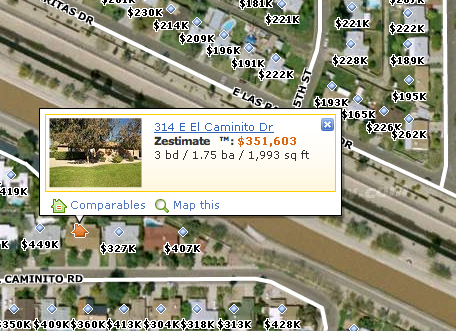
This is our house on Zillow.com. The Zestimate is off by $123,397 or so, but the site is running flawlessly in Safari, where it has never run before.

There’s more. Last week, Jobs said that the operating system on the iPhone will be a full version of Mac OS X. Today at the WWDC, he said that the iPhone will be running a full version of Safari.

The implication? As I discussed when the iPhone was introduced, with MLS access, this will be the best Realtor phone ever.

Guess what? This is looking like the best Realtor phone ever…

I’ve found all kinds of cool upgrades in the Safari 3 beta just in the course of writing this post. Download it and play with it yourself. Not only did your Windows machine just drop off the edge of the universe, your laptop, whether Windows or Mac, may have gone with it.

Further notice: Richard Riccelli points out that pre-release software always entails a risk. If you can’t get yourself out of trouble, better not to get in. On the other hand, Saft has been updated to work with the beta. And while the Windows wizards have been trying to knock Safari down, over 1,000,000 people have downloaded the WinSafarai beta.

Technorati Tags: , ,

Nadel’s critique of commission structures gets wider distribution

Mark Nadel‘s ground-breaking paper on traditional real estate commission models has been published in an abbreviated form in the Cornell Real Estate Review.

Nota bene: I embedded the wrong link for the Cornell version of the paper. It’s fixed now.

Technorati Tags: , , ,

Who says print advertising doesn’t work? One of our ads is working so well a competitor cut out the good part!

I showed a house today in one of the historic districts we farm. A copy of the neighborhood newsletter was laid out the mantle, along with the fliers and business cards. I took a quick peek to see our ad, the only print advertising we’re doing right now.

Here’s what I saw:

A piece of our ad had been cut out. There was nothing significant behind it, so it was clearly our ad that had been excised. This is what that ad should look like:

You can click on the image to see a PDF version, if you like.

What was cut? The highlighted copy in this picture:

The only thing I can figure is that the lister didn’t want the seller to see that part of our ad. Nice to know someone is paying attention…

Technorati Tags: , , , , ,

Real estate licensing laws are a criminal conspiracy against the consumer created by and for the benefit of a cartel

When I walk into a supermarket, the first thing I look at are the floors. If they aren’t buffed to a blinding glow, I walk right back out. Why? Because if the manager isn’t staying on top of the floor maintenance, he isn’t staying on top of anything else, either. Without doubt, I am “protected” by vast armies of federal, state and local food cops, but it turns out that they are not willing to get food poisoning in my place. If I fail to guard my own self-interest, the courts might make me (or my heirs) whole — after-the-fact. But nothing can protect me if I won’t protect myself.

Surely you effect many similar sorts of “consumer protection” in your own behalf, possibly believing in your heart that the laws can protect you, yet exercising caution to protect yourself even so. But consider this: If, when selecting electrical equipment, you had to choose between oversight by government functionaries or the Underwriters Laboratories — but not both — which one would you choose?

If you said government, you can stop reading now. You’re hopeless. For those still with us, what we’re doing is exploring the implications of doing away with real estate licensing laws. And if that idea makes you shiver, you can settle down: No matter what I say, the real estate laws are not going to be repealed any time soon.

But imagine for a moment that your neighbor’s mother introduced an old friend to the FSBO seller up the street. This is brokerage, introducing buyer to seller. The principals are unrepresented, but they can do everything they need to do — in Arizona, at least — at the offices of a title company. Nothing unlawful has occurred — until grandma takes a finder’s fee from either the seller or the buyer.

At that point she is in violation of real estate licensing laws. She can connect buyers with sellers all day, every day — provided she does not get paid for doing so. The purpose of the real estate licensing laws is not to protect buyers and sellers from chatty grandmas, who Read more

New York Times works hard to put the fizz in FSBOs . . .

My own personal experience with For-Sale-By-Owner sellers is pretty limited. I’ve never farmed them for listings, so I know nothing of that part of their lives. I’ve called a bunch of them to try to show their homes, but only once have I successfully gotten into one with my buyers. Mostly my experience consists of unreturned phone calls. Not a huge tragedy: The houses I’ve called on were almost always insanely over-priced. Actually, I have seen quite a few FSBOs — after they were listed by professionals and professionally-priced.

This has led me to believe that newspaper reporters live in a different universe. I’m pretty sure that most FSBO stories have unhappy endings, but you’d never guess that by reading the papers.

The New York Times coughs up another example today, this one based on a study done in Madison, Wisconsin. The story doesn’t concern FSBOs, but, rather, an alternative discount listing service, essentially an MLS-less real estate brokerage. The claim of the study is that sellers willing to sell into an artificially limited pool of buyers do as well or better than the sellers of Realtor-represented homes.

Is it true? Who knows? There’s not enough data to judge. Apparently the study measures sold homes. What about the homes that didn’t sell, or didn’t sell until they were listed by a Realtor? The authors of the study claim they were able to account for differences among properties, but this is simply an invitation to endless quibbling. In the end it doesn’t matter. Value is at once a matter of subjective perception and a practical, real-world trade-off. If you believe your time is best spent changing your own oil, you’re probably not my ideal client.

As you might expect, the study was done during the boom, when you couldn’t get a yard sign posted before the home sold. It is also reasonable to expect that newspapers all over the country will pick up the story, since it offers such amazingly bad advice in the current market.

More: Galen Ward speculates on agent skill sets, Glenn Kelman finds still another foot to shoot: Redfin is useless for Read more

Consumer is the loser with real estate licensing, broker argues

This is me in today’s Arizona Republic (permanent link):

 
Consumer is the loser with real estate licensing, broker argues

We’ve been talking about real estate licensing laws, admittedly an exercise in futility. Whatever arguments I might make for repeal, it remains that the Arizona Department of Real Estate is not going to dry up and blow away like tumbleweed.

But here’s an important question: Who do real estate licensing laws benefit?

If you thought of consumers, that would be incorrect. The model legislation for real estate licensing laws in every state was written by the National Association of Realtors. The purpose of these laws is to artificially limit entry into the real estate business, with the objective being to artificially raise the prices paid by consumers.

The fact of the matter is that virtually all government regulation of commerce exists to limit supply, thereby raising prices. This is not an unavoidable consequence, but since regulations are either written by or heavily-influenced by the regulated industries, the alignment of government and business in one conspiracy after another against the consumer is a nearly-universal outcome.

As we discussed last week, another key beneficiary of real estate licensing laws is the real estate broker. Real estate salespeople must be licensed, but in order to work, they must also “hang” their licenses with a real estate broker, another category of license.

The broker will take a bite out of every dollar his salespeople bring in. It is not an exaggeration to say that a broker’s license is a license to steal.

It gets better. Real estate brokers have managed to get themselves exempted from IRS income reporting and withholding regulations. In any other business, the boss has to withhold taxes. Taxes are vile, but the reporting and withholding requirement discourages careless hiring practices. There is a significant cost to adding employees, so employers will not take a chance on just anyone.

Not so real estate brokers. Adding a new Realtor costs virtually nothing, so many brokerages are packed wall-to-wall with thoroughly incompetent agents — haphazardly trained but licensed by the state to wreck your financial life forever.

If you think these laws and regulations benefit Read more

The question: How do you write so much? The answer: I don’t . . .

Lani Anglin asked me in email about my “blogging regimen.” That would almost seem to imply a plan or a schedule, and I don’t do things that way. So I ignored that idea and responded to her second remark: “I’m curious to know how you crank out so many freakin’ blogs.”

Here’s my short answer: I don’t write very much here. I could write quite a bit more. I don’t think the quality would suffer, but I think your patience might. This is what I wrote back to Lani:

I can write 2,000 words an hour if I need to. I can dictate good-enough text at 150 words a minute for as long as necessary. It’s not any sign of genius, it’s more like running: Do it enough and you get good at it. When I was a younger man, I used to write at least 8,000 words every day, seven days a week. The Grand Opera stuff takes more time, but not as much as you’d think.

If you watch the fifth to the tenth minute in Video Verité, you’ll see me deliver a lecture, ex tempore, on the aesthetics of discursive prose. It’s not perfectly-drafted text, but I could whip a transcript into shape in no time. But it would be a lot better — more informative, more memorable, and probably longer — if it were written as an essay rather than spoken.

As it happens, I wrote about writing, among other things, when BloodhoundBlog was just short of a month old. We were just starting to get some attention, and I wanted to memorialize the blog’s beginnings:

 
Word-slinging in the Rain — or: How I learned to stop worrying and love the blog…

None of this is new to me — except for the parts that are.

I’ve been writing on the nets since before there were nets. Since BBS systems — I ran two of them at different times of my life. Since CompuServe was a time-share system called MicroNet that charged $3.00 an hour for half-duplex transmission at 300 baud.

(Think about that! “Baud” is Bits of Audio Data. My first modem had an acoustic Read more

The pup growls

The first thing Greg did as my coach was to throw me at the wall of Bloodhound contributors to see if I stick. His request was for me to write about the Project Blogger experience. Gulp. Deep breath. Here’s an update.

My inexperience coupled with my polite Midwestern upbringing, have caused me to hold my tongue about Project Blogger. However, the last few weeks much has been written both in public and privately to me, about blogging styles and what makes for great real estate blogs. So I figure what-the-hell, now is the time for a pup to speak up.

Two months ago I didn’t know what an RSS feed was. I read two blogs on a regular basis. Now I have about twenty blogs in my reader, half have been added in the last few weeks, and only 3 are real estate related; yes, one is BHB. The blogs that move me and fascinate me and don’t bore me to tears are for the most part, not RE and the reason is, move in closely- I’ll whisper it to you: Real estate blogs suck (that’s four words, 5 syllables). But hey, I’m just an apprentice here, what do I know?

This pup thinks it’s a big world out there, that outside-of-real-estate world, and in her inexperienced opinion the world out there is much more fascinating blog-wise than the world of RE blogs. I read blogs to grow- to see new thoughts and ideas and new ways of expressing those. Following some bland blogging formula is uninspiring. If it’s a formula, then what’s the point? Leads? Somewhere Peggy Lee is singing… Is that all there is?

Jim Duncan’s realcrozetva blog, Greg’s post about weblogging and dancing on bridges, Brian’s post about selling lifestyles, and Daytonian David Esrati’s thoughts about creating community– that is blogging that inspires, moves, and fascinates me. So when I sit down to post, that’s the advice I work with and I don’t see any formulas there. But hey, I’m just an apprentice, what do I know?

Here’s where I’m at blogging-wise: If blogging and Project Blogger are only about following Read more

Where Did Your $40,000 Go? , or Why Your Buyer’s Prequalification Needs A Refresher

Just a quick note to the real estate agents that read Bloodhound Blog: now would be a terrific time to have all of your buyers re-prequalified for a home.

Mortgage markets are suffering through an old-fashioned beatdown and some rates for some products are now sitting 0.750% higher than they were just 10 weeks ago.

The last 48 hours account for 0.250% of that increase.

Your buyer’s prequal from even two weeks ago is likely worthless.

As a real-life example, consider a client that can afford a $2,100 monthly mortgage payment and wants an amortizing loan.

  • April 7: $350,000 loan size = $2,100 payment
  • June 7: $310,000 loan size = $2,100 payment

That’s a $40,000 difference — poof!

(Image courtesy: American Museum of Natural History)

Redfin discovers Earth: “It was wetter than we were expecting…”

You just can’t make this stuff up. Redfin’s Glenn Kelman:

At lunch with Cynthia and a local real estate baron, we heard about a new tactic for getting a deal on a property. Rather than offering a lower price, ask the seller to handle closing costs, which can run up to $10,000 or more.

How long have they been doing real estate? And today they discovered that they can negotiate the closing costs?

Recall that Kelman claims that Redfin agents are better negotiators. I mentioned closing costs when discussing why that claim might not be true:

A complicated negotiation might result in a higher reported sales price but a better overall deal for the buyers — for example, repairs or even remodeling, seller concessions, no out-of-pocket costs, etc. These are the types of arrangements more likely to be made by more-experienced agents.

A question their clients — and their clients’ attorneys — might ask: What else don’t they know?

In a word: Yikes!

Technorati Tags: , ,