








Wednesday, April 05, 2006
Market-Basket of Homes: Values up 1.97% in March
The month's activity was actually stronger than the raw numbers indicate, with many homes selling at or above list price. A few deeply-discounted properties pulled down the average, but average discounting netted out to only 1.37%, down from 1.42% in February.
A total of 189 Market-Basket homes were sold in March, up from 145 in February. As noted in January and February, the early months of 2006 very strongly resemble the first quarter of 2004. The one significant difference is that overall inventories are substantially higher. For example, there are now 1,209 homes available for sale in the Market-Basket, which would imply an absorption rate of 6.4 months. A six-month absorption rate is considered normal.
"If the Spring selling season is everything it should be," said BloodhoundRealty.com Broker Greg Swann, "then we have no problem. Right now there seem to be a lot more sellers than buyers, and the religious holidays in April could slow things down. But if the market heats up with the weather, we should be fine."
Based on the idea of the Consumer Price Index market-basket of goods and services, the Market-Basket of Homes uses average sales prices for a small subset of all Valley home sales to get a clearer idea of what is happening in the middle of the bell curve. The alternative method, striking a median among all closed transactions, introduces too many extraneous factors to provide a reliable indicator of what is happening to prices for those homes that are most avidly desired by the greatest number of people. To that end, the Market-Basket of Homes looks at sales prices for MLS-listed suburban homes from 1300sf to 1900sf built in 1998 or later, the homes that drive the resale market.
The BloodhoundRealty.com Market-Basket of Homes is updated monthly and is always available at http://www.BloodhoundRealty.com/MarketBasket.pdf
posted by Greg Swann | 8:11 AM | 0 comments | links
Monday, April 03, 2006
Question: How do you see the market now?Fulton also points out that builders were lying in 2004 when they named their reasons, dutifully transcribed by the Republic, for excluding investors from new home subdivisions:
Answer: This is just a small correction that needed to happen. The velocity (of sales), the appreciation of the homes, was not sustainable. Last year was a complete anomaly. It's not normal. You can't compare last year to anything. When people say, "Gee, last February there were 4,600 houses on the MLS (Multiple Listing Service) and this March, there's 36,000," you're just comparing apples and oranges. It's a different marketplace. Completely.
Q: Isn't that how you typically compare, looking at last year?
A: Go to '04. Go to '03. You'll see that there were 30,000-plus in the same time frame.
Q: Why is that? Supposedly, the home builders weeded out all the investors.
A: Not until probably August, September of '05. We started doing it because we saw what happened in Las Vegas in the investor market, which was people closing on their homes and competing with the still-open model home complex and undercutting you by $10,000 and still making tons of money. . . . We were creating our own feeding frenzy. People were standing in line because of the increases. If you slowed down your increases, it slowed down sales. Tell me that isn't scary. . . . The key wasn't so much the overall price as much as the increasing price. . . . Some people thought the price increases would never stop.
posted by Greg Swann | 6:53 AM | 0 comments | links
Sunday, April 02, 2006
Sating the State's OPM addiction...
Answer: Put your hand on your wallet. A brand new campaign of larceny has begun...
Never is heard a discouraging word, it goes without saying. This is propaganda, not news. I could name dozens of reasons why this is a poor idea, but what would be the point? Arizona is by now nothing but an echo chamber. When it comes to the palpable stench of corruption, we hear only from people with no sense of smell...
posted by Greg Swann | 10:12 AM | 0 comments | links
Tuesday, March 21, 2006
Properly belaboring the obvious takes time...
Today, March 21st, Dr. Jay Butler of ASU's Center for the Extended Belaborment of the Obvious, finally arrives at the same conclusion, even though the trend has been obvious since the end of January. Properly belaboring the obvious takes time, after all.
Dr. Butler also released his calcuations on median home values for the month of February, up for the month, surprisingly enough, and a net positive for the year-to-date.
posted by Greg Swann | 2:41 PM | 0 comments | links
Sunday, March 19, 2006
Valley resales figures for February are due out this week. And early analysis from Arizona State University's Real Estate Center shows the median price might have dipped slightly again.Might have dipped? Readers here have known since March 3rd that prices were down in February. As we reported last week, values are up for the month of March so far and for 2006 year-to-date. However: Around half of all residential real estate transactions close in the last ten days of the month. The numbers have been volatile so far, and we still could end the month on a down note. Days on Market is keeping pace with February, so far, at an average of 57 days. A total of 97 transactions have closed so far. This information is current as of 6:45am Sunday, when no one at either ASU or the Republic is working.
In January the median price of all resales was $257,000. They hit a high of $263,000 in September.
It's important to remember that both our analysis and ASU's are trailing indicators. The houses that close in March will have gone under contract in February and before, for the most part. In consequence, while reports of past results offer a general guide to the health of the real estate market, they don't tell us very much about what is happening right now. Of course, the relative lack of utility of the numbers is substantially enhanced by ASU's dilatory habits, but you can always turn to the BloodhoundRealty.com Market-Basket of Homes for a better, much earlier snapshot of the marketplace.
posted by Greg Swann | 6:44 AM | 0 comments | links
Friday, March 03, 2006
"Home values are down for the second month in a row in the February 2006 BloodhoundRealty.com Market-Basket of Homes. Average sales prices dropped by 1.14%, just under $3,000, from $263,638 to $260,645.
The weakness was felt mostly at the higher end of the price range. While a few homes sold for discounts from $10,000 to $30,000, compared to list price, many moderately priced homes sold for above list price. Discounting overall averaged -1.42%.
A total of 145 of the homes Bloodhound tracks were sold in February. This is down from February 2005, when 254 homes sold. But it is up from February 2004, when 137 homes were sold. The homes averaged 58 days on market in February 2006, 17 days in February 2005 and 56 days in February 2004.
Said BloodhoundRealty.com Broker Greg Swann, 'While the media never tire of telling us that 2006 is not like 2005, which is obvious, it turns out that 2006 very strongly resembles the beginning of 2004, which was a completely normal real estate market.'
In the overall Arizona Regional Multiple Listing Service, 6,168 properties sold in February of 2004 in an average of 61 days on market with an average of -2.4% discounting. In February of 2006, 5,868 properties sold in an average of 56 days on market with an average of -2.4% discounting.
'The real test,' Swann said, 'will be March, April and May, the traditional selling season. If those months are healthy, we'll have a great year despite getting off to a slow start.'"
posted by Greg Swann | 9:18 AM | 0 comments | links
Wednesday, March 01, 2006
• 1950: Phoenix covered an area of 17.1 square miles, had a population of 106,000 residents and was the 99th-largest American city.In a word: Wow...
• 2006: Phoenix spans across more than 514 square miles, has a population of more than 1.4 million residents and is the sixth-largest city in the country.
posted by Greg Swann | 7:27 AM | 0 comments | links
Sunday, February 26, 2006
An open letter to the Citizens of Phoenix: Why I oppose the bonds
This little datum actually tells you all you need to know about the bond campaign: In large measure, it is welfare for the rich.
I'm not playing a class-envy card. I despise welfare in all its forms. I can sympathize with the plight of the poor, and I can even volunteer my time and my money to help them. But I think it is vile to use force to steal wealth from honest, innocent producers in order to confer it upon people who have not earned it. But if this is vicious and wrong when done for benefit of the poor, how much worse is it when the recipients are among the wealthiest of the city's residents?
The actual purpose of the bond issue - and of the Trolley and of the recidivist reconstruction of the Civic Center and of all the other so-called 'investments' downtown - is to provide free upscale amenities for the use and enjoyment of rich Phoenicians and their out-of-town visitors. There are miserly little bribes to other constituencies beneath the vast Christmas tree of bond programs, but the overwhelming amount of money will be spent to amuse and enrich people who are already laughing all the way to the bank.
Almost a year ago, I wrote about how these corrupt 'investments' are carefully target-marketed to the most corruptible kind of investors. And this is the first and biggest benefit to the rich of the bond issues: The bonds themselves. They will be underwritten by a politically-connected investment firm, and they will be purchased by politically-wired investors. Even though the city's property tax receipts will surge this year, making it possible to pay for any improvements that are actually needed out of the general budget, we will still issue bonds, paying massive amounts of interest over the years to people who are already very, very wealthy.
But Christmas will come twice for prosperous Phoenicians. Take a drive by the Herberger Theater some night. It's a colossal failure as a theatre, but it's an excellent place for rich matrons to show off their thousand-dollar gowns. When you look at your property tax bill - which is probably up 25% or more - take solace that you'll be subsidizing the Herberger to the tune of $16.7 million - plus tens of millions more in interest.
There's money for the Arizona Opera, another outrageous failure, and for the zoo and the art museum and for Phoenix Theatre - because you can't have too many under-attended taxpayer-subsidized theater companies.
Add to this all the money to be blown building downtown campuses for Arizona State University and the University of Arizona. These are completely redundant facilities, of course. What's worse, the state's universities are actually the responsibility of the state government - which is running a billion-dollar surplus. But why should the state pay when the city of Phoenix is willing to milk its own taxpayers in the state's behalf?
But why should the taxpayers of Phoenix strap themselves with $878.5 million in debt, plus as much as $2 billion more in interest over the years, to build these campuses? For the same reason the taxpayers were saddled with the costs of every other 'investment' downtown: In order to provide free upscale amenities for the rich.
It gets better, though: The city hopes that, this time, it will achieve critical mass downtown. It is hoped that by coercing thousands of students to live in downtown Phoenix - won't their parents love that? - the central core of the city will finally come to life, an ungainly, undead Frankenstein stuffed full of tax dollars.
Incidentally, this is why the Trolley runs to ASU. The greatest concentrations of adult bus passengers in the city are in Sunnyslope and South Phoenix. A transit system designed to move the greatest number of passengers would run straight down Central Avenue from Dunlap Road to Baseline Road. But we can't have that. For one thing, that would run the Trolley right past all those gorgeous multi-million-dollar homes, each one sporting a "Support the Bonds" sign. For another, by forcing ASU students to come downtown, then sending them back to Tempe at least once a day for their core-curriculum classes, the Trolley will seem to be working, even though, by Valley Metro's own estimates, it will be yet another colossal failure, with the taxpayers paying huge subsidies for each rider - and even bigger subsidies for each ASU student on the train. But those students will be young, attractive and nice-smelling, which will be very pleasing to all the wealthy residents and their guests, who may ride the Trolley on a lark, but who will never use it for day-to-day transportation.
Incidentally yet again, the Trolley and everything that goes with it are buttressed by a Transit-Oriented Development zoning overlay. Small business-people all along the route of the Trolley are slowly discovering that one of the purposes of Trolley construction is to kill their businesses. As profitable as those businesses might have been, and as popular with their clients, they are not pretty enough to appeal to the sensibilities of Yuppies, the Bohemian Bourgeoisie and the avidly-courted Creative Class. The Trolley's construction will bankrupt the small firms that had done business along its route, and the Transit-Oriented Development zoning overlay will forbid anything similar from replacing them. This is in essence a hidden tax enacted by these so-called 'investments', the deliberate destruction of profit-making businesses - along with an epidemic confiscation of taxable commercial real estate.
And incidentally one more time, downtown Phoenix will never work. It will always be a colossal failure, soaking up tax dollars to subsidize the existing 'investments' and to fund ever-newer boondoggles, each one of which will be promoted as the final answer to all the problems downtown, each one of which will fail in its turn, soaking up tax subsidies forever. The downtowns of the cities we think of as having a downtown - cities like New York or San Francisco, London or Rome - the central cores of those cities developed when transportation was very costly. A city like Phoenix, which developed when transportation was cheap and progressively cheaper, can never have that kind of throbbing, vibrant, population-packed downtown. Never. No matter how much money we throw away on the Trolley or the Civic Center or the chimerical bio-medical bonanza.
Here are some secrets you will never see reported anywhere: Every city in America with a chip on its shoulder is building that paragon of 19th century technology, a Trolley system. Every city with something to prove is building and rebuilding and rebuilding a vast, empty convention center. Every city with an inferiority complex plans to buy its way to greatness by throwing billions of dollars in corporate welfare at the biotech industry - since, as we all know, the most consistently successful venture capitalists are politicians and newspaper columnists. Phoenix is not innovative in any way, not even in its choices of doomed downtown 'investments'.
A self-selected minority of people may long for life in a make-believe-Manhattan, but, in reality, there will never be a dense-enough concentration of them to yield even a chintz-Cincinnati. The closest thing there is in Phoenix to an actual downtown - a walkable concentration of high-commerce, retail and residential skyscrapers - is the area around the Biltmore Fashion Square. The city is doing what it can to destroy this, to protect its futile vision downtown. But even more urban than the Biltmore is downtown Tempe, a pretend-Paris the Phoenix City Council is having a harder time trying to vanquish - although it is trying.
And there's more. All of this, the giveaways to the very wealthy, the redundant college campuses, the destruction of existing businesses, the war on non-taxpayer-subsidized vertical development in other locations - even the improvements to the sewers and fire stations, the true business of city government - all of it will entail the letting of thousands of lucrative contracts to politically-favored developers, vendors, attorneys, consultants - an endless soup-line of mendicants in $900 suits. Where do those folks live? Amazingly enough, they live in the same neighborhoods where you see all the little "Support the Bonds" signs. The neighborhoods where the Trolley will never run. The neighborhoods where the bus-stops - if any - have no overhead shelters.
Bond supporters are ready with talking points for every objection an opponent might raise. No tax increase, 700 participants, the sacred deity that is public education, blah, blah, blah. None of that matters. Every proper function of city government can be more than adequately funded from the impending property tax windfall. The city has no business building colleges or subsidizing the diversions of millionaires. Of course, if the bonds fail, this will be offered as the reason why downtown failed. Take heart: Downtown will fail anyway, and the downtown boondogglers will never admit it. Why should they? It's making them rich.
"Cui bono?," the Roman poet Juvenal asks? Who benefits? As Thoreau reminds us: "That government is best which governs least." The absolute best thing the City Council can do for you and for the city is to get out of your way - and out of your wallet. But who will benefit from this billion-dollar bond boondoggle? If you have to look at your bank balance before you write a check, it isn't you.
I voted by mail, so I've already voted "No" on all seven bond proposals. I encourage you to do the same.
posted by Greg Swann | 10:20 AM | 0 comments | links
Saturday, February 25, 2006
One year of experience eleven times...?
Bad news for the many homeowners trying to sell: It's likely only going to get tougher.The source for this is probably an article by Betty Beard, who is actually a responsible journalist. Witness:
The number of home listings in metro Phoenix is at an all-time high. In January, there were 30,113 houses for sale across the Valley. A year ago, there were 3,402.
The last time the Southeast Valley had listings in the 10,000 range was in late 2002 and early 2003, according to the Arizona Regional Multiple Listing Service Inc.You see, like seemingly no one else at the Republic, Betty Beard is aware that there were years prior to the completely anomalous 2005. Here's more from Ms. Beard:
Robert Rucker, the multiple listing service's chief executive officer, said he couldn't determine that 11,512 is a record because the records are not set up easily to compute that.It may be that Ms. Reagor has a source for her claim that the current inventory is a record, but she doesn't say who it might be. In any case, since a normal inventory prior to the completely anomalous 2005 was around 25,000 homes, and since we've built tens of thousands of new homes since then, it would be very difficult to say what is by now a normal market. The NAR's standard for normal, a six-month absorption rate, is substantially longer than what we're seeing locally.
More from Ms. Reagor:
Some sellers still don't realize the housing market has deflated from last year's peak. Not only are the bidding wars gone but so, too, are many of the buyers. Most of the speculators who sparked multiple offers on homes early last year are long gone, and there aren't as many regular buyers because fewer can afford today's higher home prices. The typical house costs 50 percent more, and the typical income climbed less than 5 percent in the past year.In January 2004, 5,103 MLS-listed properties sold in an average of 67 days on market at 97.7% of the list price, on average. In January 2006, 5,252 properties sold in an average of 50 days on market at 97.7% of the list price, on average. The paragraph is mostly editorializing, but the claims about the market are easily demonstrated to be false to fact.
Want a reality check? Go to zillow.com, a new Web site with a program that calculates a home's value for free. It values several Valley homes for tens of thousands less than the price listed on them.If you want to know what your house is worth, do not go to a zillow.com, which delivers completely useless estimates of value for free. Even Net Value Central, a tool used by professionals, lags the market by a month or more. The only way to price a house is to work as rigorously as possible from current and recently-sold listings for extremely similar properties. If you price your house to sell from sources like zillow.com, you will give thousands of dollars away. If you rely on zillow.com to tell you how much to offer on a home, you will see it sold to someone else.
(You can prove all this to your own satisfaction, if you like. Most of Ms. Reagor's mistakes seem to come from falling in love with ideas she doesn't check out. Here she tells us that she ran zillow.com on live listings and found it came in much lower than the listed prices. How did it do against sold listings? She didn't check, but you can. Run zillow.com on the sold homes documented in your local section of the Republic. You'll see that, time after time, zillow.com is substantially under real-life market results. It's a useless toy, which Ms. Reagor might have discovered on her own had she bothered to test it properly.)
It gets better, believe it or not:
Any Valley homeowner with a good crystal ball would have sold last summer and rented until now to be able to take advantage of all the deals out there.It's no kindness to lie to a fool: This is stupid. The average suburban home that you might have sold for $252,000 last July would have cost you more than $263,000 in January, not counting transaction and closing costs and the costs of renting a home and moving twice. The home prices are all rigorously documented, and I've pointed Ms. Reagor to the source data more than once.
I didn't, but I wish I had.It's because she's bad at arithmetic.
Who would have guessed home prices would climb 50 percent in a year?I did. I actually predicted higher and longer, but events haven't borne me out so far.
And who knows where they are headed?In the long run, up. It's not a lead-pipe cinch, but it's a great bet for the Phoenix market. We are an excellent fit for many, many monied demographic segments.
Analyst forecasts run the gamut from prices dipping 10 percent this year to climbing 10 percent.I have not heard a single prediction about values dropping for the year. If Ms. Reagor has a source for this claim, she should name it.
Everything Catherine Reagor said in the matter I quoted is dumb. In the next segment of her column, she wonders why homeowners aren't facing foreclosure. Seemingly, the question "Who would have guessed home prices would climb 50 percent in a year?" doesn't connect in her mind to the idea that even the most financially-troubled of homeowners is sitting on a ton of equity. Because the Republic has become such a cesspit of corruption, it's hard to distinguish stupidity from calculation. With a writer as oily as Jon Talton, the malice is palpable and you know the man is lying in pursuit of propaganda goals. But I don't like to think the worst of people where a more innocent explanation will suffice. In email to me, Ms. Reagor has bragged that she has eleven years' experience "covering real estate in metro [P]hoenix". I'm thinking maybe she's had one year of experience eleven times.
posted by Greg Swann | 11:30 PM | 0 comments | links
Monday, February 20, 2006
posted by Greg Swann | 4:30 PM | 0 comments | links
An open letter to Catherine Reagor and Glen Creno of the Arizona Republic
Second, I would dearly love it if both of you would bring some perspective to your writing. For example, from Catherine's new column:
What this year holds is the multibillion-dollar question. A 10 percent drop in home building or sales would cost the Valley's economy at least $1 billion.There are two important caveats missing from this conjecture. First, we are more likely to gain 10% in value this year than to lose it. Las Vegas had a 50% upswing in 2004, very much like our year last year. Their appreciation in 2005? An incredible 19.2%, four times their normal appreciation.
I doubt Phoenix will do this well, especially since the year has started down, with a serious dearth of buyers. But Catherine's worst-case scenario seems even less likely. But even if we entertain it, what are the consequences?
If I bought a home for $300,000 in January of 2005 (which I actually did do), and if that home is worth $450,000 in January of 2006, and if the market now suffers a "ten percent drop," what happens? My home would then be worth $405,000, $105,000 more than I paid for it. I put 5% down, so my cash-on-cash return after what Catherine seems to regard as a financial cataclysm would be--how much? Jeepers, it's only 700%. A ten percent drop in values would not be good, but after the surge we've had over the last 18 months, it would hardly be tragic, and most people would still be far head of where they were before this boom began.
The "would cost the Valley's economy" argument is also specious except as a bookkeeping analysis. A homeowner's equity isn't actually gained or lost until it is liquidated. If values drop by 10% this year and gain 6% a year for the next three years, none of it matters until the homeowner either sells or refinances. A drop in values might matter to builders' shareholders, and it would matter to homeowners if their notes were to be called by their lenders, but otherwise it's all academic. Without doubt, someone will claim that because his home lost 10% of its value, he now eats oatmeal for every meal, but this will not be true--not the whole truth in any case. A paper loss against paper profits will have few if any measurable real-world consequences, sob stories notwithstanding.
In the same respect, Glen, I've chided you for reacting to the market like Austin Powers with The Mole. Both of you are persistently guilty of this, and I think you are being less than forthcoming in not putting your reports into perspective. Yes, 2006 isn't starting like 2005 did. But if we acknowledge that 2005 was an anomaly--which is what makes the stories newsworthy--then what is actually important is that 2006 seems to be off to a better start than 2004.
Omitting this essential fact is either tendentious or puerile, I can't decide which.
I really can't decide which. The Republic has become such a translucent propaganda organ, it is by now hard to tell when the paper is actively campaigning for some covert purpose of its own, and when it is merely badly informed or poorly thought out.
Your Saturday article was actually funny, and not just because we caught another sighting of The Mole:
The number of existing homes for sale has shot up from a year ago. Home prices are flat or down slightly in most areas. And in January, used-home sales were half of what they were in August, a record month.Again, January 2006 was a much better month than January 2004. And we all can see the mole on The Mole.
As a side note, I'd love to hear how it could be that investors "snatched up three or four new homes at time a year ago" when they were forbidden to buy any new homes. The Republic printed the builders' propaganda line when they trotted it out, and I told you at the time that it was propaganda. I don't believe in proof by isolated anecdote, but can you name even one investor who successfully reserved an unbuilt home last year and has walked away from it now? As R.L. Brown points out to you, the return on investment would be huge--a $2,000 deposit turns into maybe ten or twenty times that in instant equity. Why would an investor leave that kind of money on the table?
But I'm more interested in this remark by the estimable Dr. Jay Butler:
Just look at all the ads.Indeed. Look at the ads, the other white meat in the newspaper.
An incentive is not a fire sale, it's an enticement to induce the buyer to do what he otherwise might not do. In many cases, the incentive is just icing on the cake, since the buyer was already committed. Are builder incentives working? Call and ask. But in fact, incentives are not news. I started hearing about them in September of 2005. This is also when builders resumed courting Realtors--and boosting commissions by double or triple what they had been paying.
Note, however, that investors are still excluded from most new home subdivisions, as least as a matter of stated policy. What this suggests is that the builders themselves do not regard the current market as being as soft as it was in 2004, when the investor policy was all-you-can-eat. In other words, the no-investors rule argues that builders believe they can sell all the inventory they intend to build as high-profit, highly-upgraded owner-occupied housing. They do not need to sell excess to-be-built inventory as low-profit, upgrade-free models to investors.
All of which brings me to my own little bit of news: I had a very busy weekend, which is good for me. But I saw more showing activity among other parties than I've seen so far this year. My joke last year was, if you lingered in a doorway you'd be trampled by the next party of buyers. Saturday was the first day this year when I have seen anything like that. Quite a few Realtors' business cards in newly-listed properties, too, which is also a good sign.
This is nothing more than the kind of isolated anecdote I hate to see reported as real estate news, but it is one data point of actual on-the-ground evidence. If next weekend is just as hot, it will be a strong sign that the drought of buyers is over.
And, all that by the way, I encourage you both to call upon me if you have questions about how real estate works in real life. Someone once told me that I am "rather glaring on the receiving end," which I thought was an exceptionally polite way of putting things, but it remains that I can give you a perspective on what is really going on, short- and long-term, that you are not getting anywhere else. At a minimum, if you let me do your math problems for you, I won't make fun of you for getting them wrong.
Very best,
Greg Swann
posted by Greg Swann | 6:10 AM | 0 comments | links
Wednesday, February 08, 2006
How to make headlines by ignoring the news...
An example:
The number of houses for sale in metro Phoenix has nearly tripled in the past year, based on December data from the Arizona Regional Multiple Listing Service.This is simply irresponsible. The inventory of available homes last year was abnormally low. There are about 30,000 active listings right now. Two years ago, I would have said that 25,000 listings is a normal market. We've built 120,000 new houses since then, plus we went through last year's boom. I don't know what a normal market is now, and I may not have a clear idea for months. But to say "tripled" without saying anything about "normal" is just sensationalism.
Creno offers some loose conjectural reasons why inventories are up, but he fails to cite the incessant scare-mongering of the Arizona Republic.
However, "Mortgage rates have nudged higher," he says, another reckless claim the media never tires of making. Every time you read something about rising mortgage rates, click on this link. I wish I had a chart for ten or twenty years instead of just five. Mortgage rates are amazingly low and mortgage lenders make their money by writing loans. They have an incentive to keep new-loan-origination activity high. Other factors influence rates--but not so much, as Alan Greenspan discovered in 13 failed tries to influence them--but it is not unreasonable to expect them to stay low and possibly go even lower. That nothwithstanding, if you saw a chart of mortgage rates over the last 35 years, you'd gape in horror. Even so, people continued to buy and sell houses even when rates were over 20%.
Dr. Jay Butler, who apparently keeps his head where he can best monitor his gut feelings, weighs in with this profound scientific observation: "If prices and rates move up, we're in deep trouble." Oh, my.
Here's the real truth, which Dr. Butler could have given Creno were he not so devoted to undefended off-the-cuff remarks:
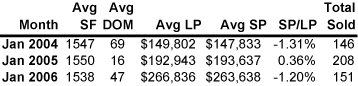
Those are the numbers for the last three Januaries from the BloodhoundRealty.com Market-Basket of Homes. January of 2005 was a banner month, to be sure. But compare January of 2006 to January of 2004. January of 2004 was worse by every measure: Fewer homes sold at a higher rate of discounting with 22 more days on market, on average.
Whether we are really back to normal is a question I'm not prepared to answer until March or April, but our current real estate market is better than it was at a time when the Republic was not running scary stories about how bad everything is.
This is the actual news.
posted by Greg Swann | 7:35 AM | 0 comments | links
Friday, February 03, 2006
Despite not even being among the 10 most populated areas in the country, metropolitan Phoenix led the nation in absolute job gains from December 2004 to December 2005.
The seasonally unadjusted figures from the federal Bureau of Labor Statistics confirm the Valley's status as a growth market not only for new residents but for new jobs as well.
The region added 83,200 jobs to its economy over the year, topping the Washington, D.C., metropolitan area's 81,600 jobs.
Somewhat remarkably, the Census Bureau reported last year that metropolitan Phoenix was only the 14th most populous metropolitan area in 2003, while metropolitan D.C. was the 7th-largest region.
That means the Phoenix region created more new jobs than even such metropolitan goliaths as Los Angeles, New York and Chicago.
"We've actually done incredibly well since the end of the last recession," said Tracy Clark, an economist at Arizona State University. "In percentage terms, we tend to be behind only Las Vegas, but they have a much smaller base."
posted by Greg Swann | 6:24 AM | 0 comments | links
Saturday, January 28, 2006
Surfing a twenty-year wave in the desert
For the next 20 years, some of the weightiest issues for home builders will be figuring out where baby boomers really want to move, when and if they sell their homes, and what type of housing will they desire, be it city-center high-rise condo, beach house, or something in a golf course development.
With more than 70 million boomers heading toward retirement -- the oldest of them turn 60 this year -- these questions were prominent at the National Association of Home Builders' annual conference, which wrapped up on Jan. 14.
Though consumer survey research has shown for decades that homeowners in their 40s and 50s often have no detailed plans to downsize or sell their houses, a new statistical study unveiled at the convention suggests that boomers might have different ideas.
In the study, more than 50 percent of all homeowners ages 45 to 54, and nearly 60 percent of homeowners aged 55 to 64, rated themselves either "likely" or "very likely" to buy a vacation, investment or new primary home sometime in the coming 60 months.
posted by Greg Swann | 7:32 AM | 0 comments | links
Thursday, January 26, 2006
Look who's talking, Part II: Revenge of The Shiny People
The trolley is killing long-established businesses up and down its route, and the green-cheese-heads who inflicted it on us, along with all the other doomed Downtown 'investments,' don't dare admit this and dozens of other obvious truths. They use Soviet-style propaganda to afflict us with Soviet-style 'improvements.'The other shoe dropped today. That same Republic editorial page that warned you all about liars this Sunday just past, today issues the very lies I predicted:
The next step in the game will be to plead with you to go out of your way to 'support' the businesses that are nope-no-way-uh-uh-never not being hurt by trolley construction. And that is propaganda perfection, Soviet-style, to tell two self-contradicting lies in one moondacious exhortation, challenging you--on pain of being declared a counter-revolutionary wrecker--to question anything you are told.
Phoenix can survive Jon Talton, as odious as he is. And we will overcome the stupid mistakes of the moondacious green-cheese-heads Downtown. But I'm not sure that any good thing can thrive in a place where public discourse consists of nothing but lies, and where anyone who dares to whisper the truth is shouted down and, in then end, self-censored.
Businesses along the construction route bear the brunt of a program that will benefit the Valley for decades to come. All of us should appreciate their sacrifice through these challenging times.Their "sacrifice" will be to be destroyed. The actual purpose of all of this massive destruction of wealth is to provide upscale amenities for the people talk-radio host Bob Mohan used to call The Shiny People. The downscale businesses in the path of the Trolley will not survive, nor are they meant to survive.
This is important to understand, because again it's the seen and the unseen. The planned "improvements" around which the Trolley is the lynch-pin will not be nearly as nice as predicted, but they will be very nice, especially from the point of view of The Shiny People. But their cost will be a huge, permanent and on-going destruction of wealth, robbing the Valley of everything that might have been done with the expropriated land and money, of all the opportunity costs occasioned by that expropriation, and of all the leveraged future benefits of profit-making investments, as contrasted with the on-going wealth-destruction of profit-devouring government boondoggles.
What will be seen will be all the fun new places for rich people to play – at taxpayer expense. What will not be seen is all the wealth-producing businesses that were destroyed, nor the wealth-producing investments that might have been built instead, if the City had not robbed it citizens of their money, their land and the future taxable value of that land.
An honest newspaper would at least report both sides of this story. But as the Republic itself admits:
[O]nce truth becomes malleable, once lies become facts and facts become lies, then we make ourselves suckers for every con man, every flimflam artist, every propagandist whose schemes may range from petty theft to the takeover of an entire body politic.When we finally think to ask, "Who crashed the Phoenix?," the best answer will be: The Arizona Republic.
posted by Greg Swann | 9:37 AM | 0 comments | links
Wednesday, January 25, 2006
City officials are negotiating with a St. Louis-based company that wants to build a $22 million parking garage on the eastern edge of downtown.What it says, reading between the lines, is this: Free land for a profit-making parking structure.
The six-level structure would be on city-owned land on the Phoenix Biomedical Campus, near Fifth and Van Buren streets.
But wait. There more.
The garage would contain about 860 parking spaces, including two levels below ground, plus 18,400 square feet of medical office space and about 5,600 square feet of retail space.It turns out it's free land for a profit-making parking structure plus 24,000sf of profit-making commercial real estate.
The land will be untaxed, of course. It's City-owned.
But here's the cutest part of all:
The Transit Oriented Development zoning overlay would forbid this if it were being done on private land with private money.
The full triumph of corruption comes when uncorrupted commerce becomes impossible...
posted by Greg Swann | 7:40 AM | 0 comments | links
Funny thing about "knowledge workers": They don't like to drive.This is so cute. The taxpayer subsidy on the Trolley will be $10 per trip, possibly much more. So the subsidy per "knowledge worker" – these would be the same "knowledge workers" who buy all the insanely expensive sports cars? – will be something like $20 per work day, $100 per work week, $5,000 per year.
That's one of the reasons Thomas Gorny decided on a site along the future light-rail line when he relocated his Web-hosting business to Phoenix from Santa Monica, Calif., late last year.
"I found that a lot of developers and IT people don't like to drive," said Gorny, chief executive officer of iPowerWeb Inc.
He hasn't plumbed his employees' psyches to understand why, but he estimates 20 percent of his 120 workers carpool, take the bus or bike to work, anything to avoid the car commute.
When rail opens in late 2008, Gorny figures he'll be perfectly positioned at 919 E. Jefferson St. to use the rail as a perk for his transit-loving staff.
Why wouldn't Gorny be glad? He's getting up to $5,000 per employee in benefits, paid for by the gullible taxpayers of Phoenix.
The City is destroying an immense amount of wealth. It's not just the billions in tax dollars that will be thrown away building and operating this paragon of 19th Century technology. Vast tracts of land Downtown have been expropriated, as has the entire south side of Camelback Road from 19th Avenue to Central Avenue. This was all taxable commercial real estate, and its taxable value is now gone forever. Still worse, its value as space where profits are produced by production, not destroyed by taxation, is gone forever. Profit-seeking small businesses are perishing all along the route of the Trolley as construction makes them inaccessible.
But all we get from the local media – and not just the Republic – is propaganda. If we had just one actual newspaper in this town, we might have been spared the slow-motion train wreck the Trolley and its attendant boondoggles will cause.
posted by Greg Swann | 7:15 AM | 0 comments | links
The AAA travel and financial services club will locate up to 1,100 new jobs over the next three years in Glendale as it creates a regional customer service and information technology center in the West Valley.Sounds like good news, doesn't it? Not quite...
Roughly 500 of the jobs are considered "high-wage" positions, paying more than $75,000 a year, said Barry Broome, chief executive of Greater Phoenix Economic Council, which helped broker the deal. Up to half of the jobs would be call-center positions that would pay less than Maricopa County's median household income of $46,111.
When fully staffed, the facility will employ up to 1,400, according to AAA, and will be one of the city's largest employers.
City Council members will hold a special meeting Thursday to discuss, and likely accept, the 10-year incentive package the city is offering AAA. Glendale is offering to:That $1,200 subsidy per job doesn't sound like much, but about 700 of the jobs will qualify for it. That's $840,000 of the taxpayers' money to buy these jobs. Given that it's a "10-year incentive package", I'm wondering if it's $840,000 per year. Throw in another three-quarters of a million for redecorating and some miscellaneous regulatory relief, and the owners of AAA – a profit-making enterprise – brought home quite a score.
• Give AAA $1,200 for every job the company creates that pays more than $50,000.
• Reimburse the company up to $750,000 for facility rehabilitation and waive permit fees up to $49,700.
"But, but, but!," the City of Glendale and the Greater Phoenix Economic Council will exposulate:
The project is expected to pump $42 million into Glendale's economy over 10 years.As always, it's the seen and the unseen. Whether the total price tag is $1.6 million or $9.1 million, it remains that the City of Glendale is going out of pocket to buy jobs. Certainly those jobs have an economic benefit, but we can never know what economic benefits are lost by robbing a profit-producing Peter to pay corporate welfare to a profit-devouring Paul. All we can know is that what might have happened will not.
Here's a simple lens for distinguishing one from the other, though:
The businesses that do best for everyone – their clients, their employees and their investors – are the ones that are so busy making money that they don't have time to wrangle deals to rob the taxpayers.
posted by Greg Swann | 6:54 AM | 0 comments
Sunday, January 22, 2006
Because once truth becomes malleable, once lies become facts and facts become lies, then we make ourselves suckers for every con man, every flimflam artist, every propagandist whose schemes may range from petty theft to the takeover of an entire body politic.You see, if we're not careful, we could end up with a newspaper that actively campaigns for insane boondoggles, that puts an openly lying socialist on its business and editorial pages, that distorts the positions of anyone daring to oppose it.
This is a free country - for now. The Republic has every right to campaign for every possible form of idiotic, liberty-devouring 19th century social planning. It has every right to be the cesspit of tendentious corruption it has become. The press is free, so it even has the right to pretend to a virtue it has long since forsaken by decrying in others the persitent deception it has long since habituated - most especially on its editorial pages.
But it has no right to expect anyone to take it seriously...
posted by Greg Swann | 6:25 AM | 0 comments | links
Sunday, January 15, 2006
How to profit by bad examples...
Witness:
Kurt Nishimura is taking a calculated ride on Arizona's real estate wave. He sold his home in the Willo neighborhood, believing its value has topped out, and is renting an apartment in the Arcadia area for a year, hoping to buy something after the wave has crested.The Willo is the most popular of the historic districts downtown. Well-restored Willo homes are avidly sought. People cruise the streets slowly, watching for real estate signs to be posted so they can get their bids in first. I am not making this up.
The rate of appreciation in the Willo consistently eclipses the baseline appreciation rate for the Valley. It's not hard to understand why: The supply is fixed and finite and the demand is unlimited. The rest of Mr. Nishimura strategy is also daft, but selling a home in the Willo because he expects its value to go down is particularly addle-pated.
But how about Tom Connelly, "president and chief investment officer for Versant Capital Management"? He "recently sold his house near a mountain preserve in Paradise Valley and is renting an apartment near 24th Street and Camelback Road." What was he thinking? This again is a house that will consistently beat the market. Connelly has a strategy, though. Unfortunately, it's based on securities trading, rather than real estate: "I think that in 12 to 36 months things will go down, way down."
Wanna bet?
Gene Cohen wanted to make the same dumb mistake, but in the end he was just too complacent. He's hanging onto his Willo home for all the wrong reasons. In due course, he will celebrate his inertia.
There is another article in today's Republic asserting that 20% of Americans think the only way they could save $200,000 is to win the lottery, so I suppose we shouldn't be surprised that Ms. Nichols was able to find three seemingly well-heeled gentlemen who are so clueless about basic economics.
For example, Mr. Nishimura wants to wait until interest rates go up before he buys another house. His expectation is that houses will be much cheaper. This will not be the case, but his monthly payments could easily be 25% higher.
This is all very simple calculator math. Any of these men should be able to do it, as should Ms. Nichols. On the one hand, they're going to give up at least 10% a year appreciation on their homes, probably much more, along with the mortgage interest deduction and all the other benefits of owning versus renting--most notably the future leverage value of that accrued appreciation. And on the other hand, they're going to pay a lot more for a lot less when they finally realize that real estate does not work like the stock market.
But if all that is true, what are we to make of these three stooges? Are they really that dumb, or are they concealing other motives?
Could it be that Mr. Nishimura really didn't like the hassles of being a homeowner, so he sold his home and justified it with a bogus economic argument? Could it be that Mr. Cohen is embarrassed that he loves being a homeowner so much? Given that Mr. Connelly telecommutes to Minnesota, is it plausible that he might have wanted a zero-maintenance residence?
We'll never know, because Ms. Nichols didn't drill down to the underlying emotional reasons for selling, for which the purportedly 'logical' reasons may simply be a cover.
On the other hand, it could be they really are as clueless as they come off.
Either way, they have reaffirmed my already strong belief in the long-term value of investing in rental housing.
Who says there's nothing to be gained from reading the newspaper?
posted by Greg Swann | 6:42 AM | 0 comments | links
Tempe puts the fork in the Thunderbird...
But as cities compete for overnight stays, the numbers could work in Tempe's favor:It is needful to point out that these are not to be taxpayer-subsidized hotel rooms. They are being built by actual entrepreneurial businesses risking their investors' capital. Amazing...
• Business travelers' stays increased last fiscal year at almost twice the rate in Tempe as the average rate in Phoenix, Chandler, Mesa and Scottsdale, according to TravelCLICK, a company that tracks tourism figures.
• Sporting events are drawing even bigger crowds. Last year, 2,425 overnight Tempe stays were attributed to the P.F. Chang's Rock 'n' Roll Arizona Marathon & 1/2 Marathon. This year, that number jumped by about 1,000, according to the Tempe Convention & Visitors Bureau.
Yet the vast menu of events at Arizona State University and in Tempe's downtown can overwhelm Tempe's 5,000 or so hotel rooms, city leaders say. Consider the Fiesta Bowl. Many of the cash-carrying fans, along with the Ohio State and Notre Dame football teams, left Tempe to spend their nights in Scottsdale and Phoenix.
That's why plans for expansions at two of the city's most prominent hotels are hailed as big news. Tempe Mission Palms may add up to 200 guest rooms and 20,000 square feet of meeting space, according to Chris Kenney, the hotel's director of marketing. The Fiesta Inn Resort's new ownership is injecting $5 million worth of renovations in the form of landscaping and adding conference space, General Manager Sherry Henry said.
Plus, a new upscale hotel will likely go into Tempe's newest lakeshore project. Starwood Capital Group, the brawn behind the Westin, Sheraton, "W" brands and other hotel chains around the world, has expressed "enthusiastic" interest in putting a luxury hotel on the Tempe Town Lake site, said Chris Salamone, Tempe's development manager.
"Building new hotels to fulfill the needs of all the tourists our events bring in, for a city that's landlocked it's the key to our financial solvency," he said.
posted by Greg Swann | 6:17 AM | 0 comments | links
Thursday, January 12, 2006
Sprawl in Connecticut is advanced almost every time somebody pulls a zoning permit. Good intentions about sprawl become academic when someone goes in for a permit. It is far too late for lofty thoughts. All that matters is how well you've met the zoning code.
Zoning is, in effect, the codification of a town's desires for itself - its self-image. Developers, architects and engineers are smart enough to know they must conform, or they will suffer. Zoning appeals are no fun; they are expensive and unbelievably time-consuming. Most developers would like to avoid appeals. And even once you reach the Board of Zoning Appeals level, staff and board members do not welcome blue-sky discussions about alternative ways of doing things.
Sprawl may not be what The Courant wants, and it's not what a growing segment of the population wants, but it is what our zoning codes demand, so it is what we have and what we will continue to have until we change our codes.
On the whole, our zoning codes are nonsensical. In my town of Essex, as in most Connecticut towns, it would be impossible to use the town's zoning code to build anew the very hometown Essex citizens love. Few aspects of urban density that make Essex village special are allowed by the town's zoning code. In a new Essex, buildings would be too far apart, and they would be placed too far from the sidewalk. There would be too much space around each building. Houses would be too far back from the water. The streets would be too wide, and houses wouldn't be tall enough to have the elegant proportions of those built in the 18th, and especially the 19th centuries.
The village would be too spread out and suburban in feel. You could have the best architects in the country working on a new Essex, but if they're following the Essex zoning code, they'll arrive at something very different from our town. And this disconnect is not unique to Essex; it's typical of most Connecticut towns.
posted by Greg Swann | 8:24 AM | 0 comments | links
Wednesday, January 11, 2006
A: Because the State government has $850 million in surplus funds.
Not funny, but true. Here's an even better puzzler: Why is no one else asking this question?
posted by Greg Swann | 7:05 AM | 0 comments | links
Even when the news is good, it's bad
Construction expert: Home building to slowThe body of the story:
The Census Bureau last month reported from July 2004 to July 2005 population grew 3.5 percent in Arizona. That's four times the national growth and puts you just a hair behind Nevada. Two hundred thousand people moved into Arizona during that time and they all want a place to live.
posted by Greg Swann | 7:05 AM | 0 comments | links
Monday, January 09, 2006
Why the sky doesn't fall, despite the constant warnings
If present trends continue, the price of gasoline may someday hit $50 a gallon. The average worker could spend as much as 36 hours of his 40-hour work week to buy a tank of gas.If you stipulate the premise, "if present trends continue," the rest follows logically enough. The trouble is, present trends will not continue. The free market is dynamic, and no commodity is valuable irrespective of its relative cost. If we anticipate a steady increase in transportation costs (and the experience of history is all the other way, despite the nonsense you read in the newspapers), then we should also anticipate a decrease in the amount of transportation. This is already happening, not because of gasoline prices but because of time lost to commuting and convenience gained by working from home. From the Las Vegas Review-Journal:
As attendees at last week's Consumer Electronics Show perused gadgets that could enhance their leisure time, their bosses were plotting to get them out of the office for good.The point applies to any economic good - most especially real estate - provided it is not monopolized by government. If people are free to choose among alternatives, and if vendors are free to provide those alternatives, buyers and sellers will arrive on their own at a mutually-satisfactory meeting-of-the-minds. This only happens millions of times a day, so it's perfectly understandable that Chicken Little would fail to notice...
Members of a panel that delved into the world of technologies for home use said businesses are increasingly eyeing products that will enable employees to telecommute, or work from home.
"We're seeing a huge trend in the business world to move consumers away from commutes," said Alexander Ramia, director of product development for Innofone, an Internet consulting company in Santa Monica, Calif. "The person working at home doesn't know when to quit, so companies get more work out of them, and time spent in cars commuting is lost productivity."
posted by Greg Swann | 7:09 AM | 0 comments | links
Thursday, January 05, 2006
December 2005 BloodhoundRealty.com Market-Basket of Homes: Values up 1.73%
posted by Greg Swann | 12:47 PM | 0 comments | links
Tuesday, January 03, 2006
Setting the record straight...
The Valley ranks as the second-safest major metropolitan area in which to conduct business and avoid major natural disasters and terrorism.So says the Business Journal of Phoenix, citing a survey by Risk & Insurance magazine.
Second-safest? Who's number one?
Sacramento, California, believe it or not.
Surely this is a mistake. Note these important Sacramento defects:
- It freezes in Sacramento, several times a year
- It rains 18 inches a year, three times more than anyone should have to abide
- It's only 17 feet above sea level, which can't be good
- The population of the city is only 400,000--a little more than Mesa
- Worst of all: It's in California!
I designed this billboard for New Orleans a few months ago:

Perhaps we need to post it in Sacramento as well...
posted by Greg Swann | 4:41 PM | 0 comments | links
Sunday, January 01, 2006
An open letter to Ken Western, Editor of the Editorial Pages of the Arizona Republic
Regarding your New Year's Resolution to improve the opinion pages of the Republic, is it possible to petition for a more balanced coverage of the forthcoming City of Phoenix bond issue?
From my point of view--and you probably disagree--the Republic is a tireless cheerleader for all of the--to me--insane boondoggles being effected Downtown. For example, nation-wide, all public transportation schemes are colossal failures from a cost-recovery standpoint, but the Republic publishes nothing but puff-pieces about the ValleyMetro Trolley--which stands an excellent chance of being the biggest failure of all. As far as I'm concerned, this is not news, not opinion, not even public relations. It is active, knowing mendacity, deliberately concealing facts, uncontested but largely undisclosed, for purposes of propaganda.
That notwithstanding, the tax-payers of Phoenix are about to be strapped with nearly a billion dollars of new debt, much of which--in my opinion--will be entirely wasted. It seems only reasonable to me that we have something resembling a debate on the issue. As much as PNI as a corporation or the Republic as a newspaper might favor the bonds and their proposed uses, it remains that the newspaper is the only remaining medium in which such a debate could take place.
Institutional criticism is usually futile. From a customer-oriented point-of-view, criticism is a great gift. It may tell you how to do better, but, at a minimum, it tells you how to stop doing badly. But the denizens of most institutions, when criticized, will instead circle the wagons, insisting on the rightness of their positions and the risible nature of anyone who would dare to challenge their expertise, experience and endless estimable qualities. Certainly this has been the case with the mainstream media, which never tires of ridiculing the alternative media and its audiences, bidding good riddance to every former cash customer. The auctioneer has a cure for this syndrome, but what does he know, anyway?
A couple of weeks ago, I had thought to write to you to offer to elucidate my objections to the Downtown boondoggles, and the course of municipal government in general in the Valley. My working title was "10 ways to crash a Phoenix," reflecting the ten weeks until the bond issue comes to a vote. At the time, I reconsidered, first because I felt it was a waste of my time even to offer to do the work, and second because I have very little confidence that the Republic or any other medium in Phoenix will ever utter a discouraging word about the Creative Class Cargo Cult and its grand designs.
But in light of your article today, I am re-reconsidering my position.
Here is my offer: I will produce op-eds arguing against the bond issue and everything it portends, to be run in the Viewpoints section over the next ten Sundays. I'll write whatever I want and you can edit for length, if you'll promise not to eviscerate the content. You'll pay me nothing, which is already my arrangement with the Republic.
Obviously I can write. You can see me on topic here. You didn't run this when I submitted it in May, but I didn't expect you to.
Please understand that doing this is not good for me. It will be bad for my business, both because it will take time away from profitable work and because it will alienate some potential clients (although it may endear me to others). Even so, I care enough about the future of the Valley that I am willing to act contrary to my own interests in order to see this issue debated in the full context of all the facts.
The fact is, the bond issue will probably pass. As the Republic accidentally reported last week, the deck is already stacked against opponents. But when the Trolley and the Civic Center and the hotel--decorated by genuine bureaucrats!--all fail, along with all these other stupid stunts, it would be nice if somewhere in the public fora there had been a discussion of why they must fail. And--who knows?--maybe the tax-payers still have time to catch on to what it being done to them, if they are given the opportunity to exercise an informed discretion.
My expectation is that you'll refuse this offer--probably without even the courtesy of a reply--but I'm open to the possibility of a surprise. In fact, it is in the long-term best-interest of the Republic to be an honest broker of information in the Valley. I don't think it has honored this obligation with respect to these Downtown boondoggles, but, as you note, New Year's is our big chance to resolve to do better.
So: I'm game if you are.
Best,
Greg Swann, GRI, CBR, Realtor
Designated Broker
BloodhoundRealty.com
Vox: 602-740-7531 | Fax: 602-504-1353
posted by Greg Swann | 2:34 PM | 0 comments | links
Get a grip on the growing tyranny of politically adept neighborhood groups.
The flip side of all those aggrieved neighbors who opposed building the so-called Trump high-rise (it was neither The Donald's own project nor a "high-rise" in any serious sense of the term) is that there were plenty of others in the neighborhood who supported the project. I've met with them. Talked with them. Looked at the bullying, browbeating lawyer letters that the anti-Trump activists had sent to them.
I could gripe about all the undeserved nobility assigned to the opponents of development in the East Camelback area, but, really, they acted no different from countless other neighborhood groups that have come before them. Their power is in opposing. And in their growing effectiveness, they are giving us all a textbook lesson in the perils of direct democracy.
Phoenix is in a precarious position. The outlying cities are growing, including their commercial centers. If Phoenix is to keep pace at all, much less thrive, it must tend its commercial gardens. By placating activist "neighbors," many of whom don't even live in the affected 26th Street subdivision, the Phoenix council is putting at risk one of its most vibrant commercial cores.
Absolutist-minded neighborhood activism is probably the purest example I can imagine of Arizona's rejection of the power structure that once existed here.
posted by Greg Swann | 10:41 AM | 0 comments | links
Friday, December 30, 2005
Housing is is more affordable despite contrary opinions
Despite a widespread sense that real estate has never been more expensive, families in the vast majority of the country can still buy a house for a smaller share of their income than they could have a generation ago.Actually, it would be interesting to compare square-footage-per-occupant with the percentage of income needed to pay for a home. Homes are a lot larger than they used to be, with fewer full time residents. Anyone who pays attention to reality and not the news media knows that virtually everything is better and cheaper--expressed in work-effort-expended-to-obtain--than it was twenty years ago, and there is no reason I can think of that housing should be any different.
A sharp fall in mortgage rates since the early 1980's, a decline in mortgage fees and a rise in incomes have more than made up for rising house prices in almost every place outside of New York, Washington, Miami and along the coast in California. These often-overlooked changes are a major reason that most economists do not expect a broad drop in prices in 2006, even though many once-booming markets on the coasts have started weakening.
The long-term decline in housing costs also helps explain why the homeownership rate remains near a record of almost 69 percent, up from 65 percent a decade ago.
But-but-but!--the "affordable housing" campaigners will exclaim--home-ownership in the Phoenix-area is below the national average! This is true. The national average is 69%, where the Valley of the Sun trundles along at a lowly--wait for it--68%. If you subtract our incompletely-documented residents, we are well above the national average.
But-but-but! People in Phoenix pay more than the national average for housing, expressed as a percentage of their income! This is also a case where subtracting the hard-working folks who live under the radar yields radically different results.
"Affordable housing" is a scam. There is no one with a decent income, good credit and well-managed debt who cannot purchase a home in the Valley. We prove this thousands of times a month. Creating a vast new government program to give the illusion of ownership to people who do not qualify for home-ownership will do no good, but it will do a lot of harm:
- People who do have good financial habits will be penalized; some or all of the homes they might otherwise have purchased will be expropriated
- People who have bad financial habits will receive unearned rewards in the form of housing they do not deserve and very probably will not respect or maintain; the experience of HUD housing subsidies makes this very plain
- The "owners" of so-called "affordable housing" will not be able to sell their homes at market value, realizing the appreciation, since, if this were permitted, the inventory of "affordable housing" would vanish in short order
- Since they will not have the right of unfettered disposal, the "owners" of so-called "affordable housing" will be, essentially, tenants-at-sufferance, further contributing to their indifference to their "property"
Home-ownership is the badge of the Middle Class, the backbone of America. But it is not a Cargo Cult. Behaving wisely leads to home-ownership, but "owning" a government-subsidized "affordable" home will not cause people to behave wisely. A thoughtful people could reasonably expect the contrary--informed by past experience if not by cold reason.
posted by Greg Swann | 8:16 AM | 0 comments | links
Monday, December 26, 2005
While it remains unclear who will emerge as winners or losers when neighborhood leaders and developers begin hashing out future building heights in the Camelback Corridor, one thing is certain: supporters of Phoenix's upcoming bond election are breathing a sigh of relief.In other words, the City wants to limit votes on the referendum to people who stand to prosper from it, with everyone else getting bilked. Everything that was ever done for any of the Downtown cargo cults was done this way. It's just rare for anyone to admit it.
When Phoenix City Council members decided last week to overturn their decision to allow more high-rises in the corridor to avoid a referendum, they managed to keep the issue off the March 14 ballot, the election in which voters will decide whether the city can sell almost $880 million in bonds for citywide capital improvements.
"Keeping the referendum off the same ballot is one less reason you have for people to vote no," said Jason Rose, a Valley political consultant. "Elections are highly uncertain events to begin with, and with the Trump dynamic, it created more uncertainty, more doubt. And at the end of the day, people didn't want to risk downtown getting trumped just like 24th Street and Camelback did."
posted by Greg Swann | 7:10 AM | 0 comments | links
Friday, December 23, 2005

Interest rates are down, Gas prices are down, housing starts nationwide are up, and home prices in the Valley are up, so you know what that means. Yup, the sky is falling yet again.
Affordable homes are vanishing. Vanishing! It must be the Grinch, slinking around with a bottomless bag full of affordable homes. And all the poor Whos down in Whoville--er, Phoenix--are rapidly becoming impoverished by their incredible real estate wealth.
Truly, these are Trying Times...
Here, by way of a metaphor, is a way of understanding real estate reporting as it is practiced in the Valley of the Sun:
The rains in Phoenix are torrential! When a big storm is coming, the clouds will gather all afternoon, piling up hundreds of feet high. You'll look off to the southeast, and it looks like the entire island of Manhattan is about to crash land onto the Valley. But first comes the dust, a thick carpet of brown grit propelled by sixty-mile-an-hour winds. And the first hint of precipitation may not even be rain: Golf-ball size hail is a common precursor. By now the winds will be entirely untamed, ripping away branches and uprooting whole trees, blasting picture windows right out of their frames, even tearing the roofs off of older homes. When the rain finally comes, it drenches, dumping inches of rainfall in a few short minutes. Flood retention ponds overflow. Sewers back up. The washes and floodways rush like rivers gone mad. If you are foolish enough to get caught in the path of the water, your car may be pushed hundreds of yards downstream--or totally submerged. A storm in Phoenix is like a storm nowhere else.Every bit of that is true, and none of it is relevant. We have three or four storms like that every year, almost always in the late Summer. They're over in a couple of hours and life goes on. Rain is interesting in Phoenix, but one of the things that makes it interesting is that it is extremely rare.
So: Is it possible that a homeowner could live through a 60% run-up in the value of his home and still have financial problems? You bet. Is it likely? Not so much. It is common? Not at all. If you want to insist that, say, 5% of homeowners are in trouble irrespective of all the gifts that wise men bring, we'll go along with that. But the other 95% are a lot richer than they were this time last Christmas--and most of them aren't even doing anything about it.
The same metaphor applies to the argument for so-called 'affordable housing'--which is not news but a political campaign. In fact, thrifty school-teachers and firefighters--the usual designated pity-objects--are buying homes every day. In general, thriftless people are not buying homes--not because the homes are 'unaffordable' but because they have no savings, their credit is bad, and their debt-to-income ratios are too high. How boring the news is when you drill down to the facts.
We should concoct a Grinch-be-gone spray, because these pitiful sob stories never go away. In March of 2005 and again in May, we were entreated to weep along with the Mahlerweins:
Just ask Rebecca Mahlerwein. She teaches in Tempe but can't afford a house in the same city as her kindergarten pupils. The starting salary for the typical elementary school teacher in the Valley is about $30,000. Mahlerwein's husband is also a teacher.Who doesn't commute? But that's beside the point, because we have to look at this situation like Realtors, not newspaper reporters.
The couple found a house they could afford in the southwest Valley suburb of Laveen, but now Rebecca has a 40-minute drive to her classroom every day.
"I carpool with another teacher so that helps, but it would be so nice to live in Tempe," she said.
First, the Mahlerweins have a combined Adjusted Gross Income of at least $60,000 a year--they're both teachers. With good credit and low debt, they were a slam dunk for a nice house in Tempe. Stipulating that they couldn't get a nice home in Tempe, what does that tell us? Yup, you guessed it.
What they did buy, on July 9, 2004, was a brand-new 1,943sf home with a pool in Laveen, a bucolic near-in suburb with sweet views of South Mountain. They bought the home in Rebecca's name only--this per the tax records--which suggests that the lender for whatever reason didn't want husband Randy on the loan application. In other words, what made Tempe 'unaffordable' wasn't that anything was actually beyond their reach, but that they bought their home with only half their income. Brand-new. 1,943sf. With a pool. Qualifying with only half their income. The poor babies!
Now here's the Grinch-getter for both sets of sob stories, the vanishing affordable homes and those poor, poor house-rich Phoenicians:
The Mahlerweins paid $161,739 for their home. It's now worth $300,000 at least. They put $8,931 down, so their cash-on-cash return is 1,548% in less than 18 months, an amazing rate of return. What's more, if they sell their home, they're sitting on around $135,000 in equity, after closing costs, which is 20% down on a $675,000 home in Tempe. The highest-priced home currently offered in Warner Ranch, a very nice place to live, is $599,900--for 2,813sf with a pool. If they want to, the Mahlerweins can hopscotch from a nice home in Laveen to an even nicer home in Tempe in only one hop. Everywhere but in the newspaper, that would be very good news.
The points are these:
1. Affordable homes are not vanishing, but under-qualified buyers cannot and should not buy homes.
2. Valley homeowners are not poor. They are really, really rich all of a sudden. They should put their newly-acquired equity to work getting even richer.
3. Don't believe everything you read in the newspapers.
4. Don't expect the Grinch to change his ways on Christmas morning. That's just in the storybooks.
posted by Greg Swann | 7:24 AM | 0 comments | links
Thursday, December 22, 2005
Splitting time between two homes
A new market segment of homeowners called "splitters," people who split time between two homes, are helping to fuel not only the home-building industry, but other industries as well, a survey from Florida-based WCI Communities found.
Splitters evolved from post-World War II migratory trends in the United States. How many places have they lived since birth? How many of their extended family still live in the same town?
These are among the 35 questions that were asked of 12,000 people in the survey, which required respondents to live east of the Mississippi River and be a homeowner. Of the 1,743 respondents, 408 qualified as splitters.
About 70 percent of splitters own a second home and 20 percent, identified as "super splitters," own three homes.
"Americans no longer expect to experience birth, life and death in the same city or town where they grew up, or even where their families currently live," WCI spokesman Kyle Reinson said.
He said the survey was commissioned to develop a better understanding of emerging American cultural and economic trends of second-home ownership.
A recent study from the National Association of Realtors projects a twofold increase in second homes by 2009, which would account for nearly 12 million homes by the end of the decade.
posted by Greg Swann | 8:02 AM | 0 comments | links
Lilliputians win: Downtown Phoenix to be erected in Downtown Tempe
The Phoenix City Council yielded to pressure from residents Wednesday and decided to reverse its decision to allow more high-rises in the upscale Camelback Corridor.This is the last, best hope for Phoenix to have something like a Downtown--a Central Business District, composed mostly of actual free-market businesses--within the borders of Phoenix.
The action effectively kills several projects, most notably the $200 million condominium/hotel development proposed by Donald Trump and development partner Bayrock Group near 26th Street and Camelback Road and sends them all back to the drawing board.
Of course, the City Council will continue to push for its dream of a fake Downtown--composed almost entirely of tax-payer funded structures--further south. This was the reason for their voting against the planned towers after they had already voted for them: The alternative was to have the issue as a ballot question at the same time Phoenix voters will be asked to saddle themselves with nearly a billion dollars of new debt to build a redundant campus for ASU and a redundant medical school for UA in the all-new fake Downtown. If you're wondering why the City's tax-payers should pay for State universities, the City Council doesn't want you to vote--no matter where you stand on the Biltmore towers.
In any case, the real action will move east, to Downtown Tempe. This is already as close as The Valley of the Sun gets to a Downtown out-of-towners can understand. Tempe has been land-locked for years, so its politicians, marginally less venal, understand that the only way the city can grow is up.
It still won't be a Central Business District--the Biltmore site was the only hope for that--but it will be alive and vibrant and dynamic, where Downtown Phoenix will always be just one Grand Tax-payer Boondoggle after another--all of them failures, all of them declaimed as great successes, the hails of elaborate praise echoing through the canyons of perpetually empty streets.
posted by Greg Swann | 7:45 AM | 0 comments | links
Sunday, December 18, 2005
"How would you like it if you owned a house or a business and the state came to you and said, 'You know what, we're not going to buy this piece of land ... and in the meantime, you can't do anything with your land?' " said Cochran of Calabrea Development. "It's just wrong. It's totally against property rights and what this country is built on. You can't control someone's land without owning it."This idea evidently hasn't made it to City Hall...
posted by Greg Swann | 6:27 AM | 0 comments | links
Thursday, December 15, 2005
Is that Starfleet Headquarters?
So there are three signal outcomes from the battle over the mostly free-market hotel that threatened the structural integrity of an antique warehouse Downtown:
First, the planned protest drew about 150 marchers out of a Valley population of more than three million.
Second, the mostly-entrepreneurs are free to proceed with their project, provided they are willing to throw a couple of bones to the 150 marchers, who vow to be dissatisfied no matter what.
Third, the mostly free-market hotel is going to look like this:
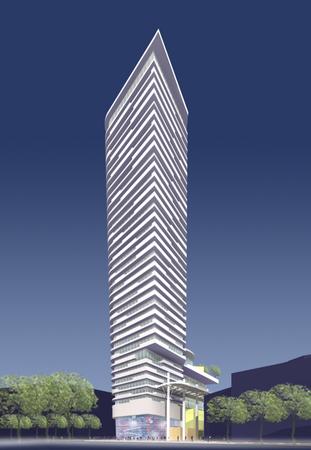
It will be built out of all-white Legos and will be erected in the lower-left-hand corner of the cover of a science-fiction novel.
Seriously, there's no accounting for taste, and I think we can be pretty sure the building won't actually look like this in any case.
But: Yikes!
posted by Greg Swann | 1:26 PM | 0 comments | links
Wednesday, December 14, 2005
Ho-hum: Sky doesn't fall after all
Metropolitan Phoenix's resale housing market slowed to a more sedate pace in November, although the price for a typical house bounced a few thousand dollars higher.This is pretty underwhelming considering all the hysterical build-up, but at least we don't have sob stories about innocent vicitms who can't afford surgery for their cat because they only got a 750% return-on-investment when their home sold.
posted by Greg Swann | 7:03 AM | 0 comments | links
Tuesday, December 13, 2005
[T]he median home price is back on the rise. After a decline in October to $259,900, the price returned to the record level of $263,000 set in September.The Business Journal is a boring old just-the-facts kind of paper, so we'll have to wait for the Arizona Republic to discover a cloud wrapped around the silver lining. We already know from the Bloodhound Market-Basket of Homes that the price news that actually matters is relatively good. And for reasons unknown, the seemingly unfounded claim By Dr. Jay Butler of ASU that some huge proportion of currently offered homes are investor-owned does not appear in this report. It will be interesting to see how the Republic handles this, too.
That fact that the news is very good--prices are holding and we've set a record pace for the year--calls even greater attention to the amazing number of doom and gloom stories that have appeared lately. The Federal Reserve Bank raised its interest rates again yesterday, so presumably we can look forward to more misinformation about how this relates to mortgage rates. Sellers are having to wait quite a bit longer to reap their windfalls of 50%-100%, so maybe that will be the flavor-of-the-month outrageous tragedy to turn good news into bad.
It's all one, really. Either you can see the sky with your own eyes or you are doomed to take someone's word about it. I don't look for clouds to whine about in the clear Arizona skies, but I don't encourage anyone to trust my testimony, either. I work from facts and reasonable--meaning pessimistic--inferences based on those facts. I'm happy enough to tell you what I think, but I can't think for you. In any case, I am not a Pollyanna. I don't care for the despair-mongering and sky-is-falling predictions that appear in the public prints, but only because these are contrary to the actual, uncontested evidence of experience in the Phoenix-area market.
So here's some really good news from RealEstateJournal.com: The Chicago Mercantile Exchange is about to start a Real Estate Futures market. Futures markets are much better predictors of future market activity than supposedly objective researchers like Dr. Jay Butler of ASU. The reason is simple: People are much less likely to be thoughtless when they have a large financial stake in their decisions.
Also from RealEstateJournal.com comes "The 10 Hottest Trends In the U.S. Housing Market." What's interesting to me about this article is what it portends about future long-term appreciation in the Valley of the Sun. I want to work from evidence in my own market, not gut feelings, not allegedly 'national' trends, and I do not ever want to treat real estate like a short-term securities investment.
So consider these trends cited by the Journal:
- Land-use regulations
- Creative loans
- Foreign investment
- Families owning two or more homes
If some declaimer-of-gloom, or just an habitual contrarian, wants to disagree with me, that's fine. But I want to hear facts and reasonable inferences based on facts, not gut-feelings, shaggy-dog stories or assertions of a predestinate fate. After all, we have the Business section Arizona Republic for that kind of nonsense.
posted by Greg Swann | 8:50 PM | 0 comments | links
Sunday, December 11, 2005
If you are intrepid enough to read the article all the way to the penultimate paragraph, you will discover the answer to Higuera's question: No.
[N]o GPEC client has actually said they were not coming because of high housing costs[.]It's annoying to have to issue all the usual caveats, but not as annoying as all these sky-is-falling 'news' stories.
For the record:
- Phoenix homes are very cheap in comparison to the real estate markets from which established businesses might move.
- The repeated incantation that Phoenix homes sell for 20% above the national median is meaningless; we're not competing with Iowa.
- While potential home buyers might cast a wary eye at our recent appreciation boom, they are going to be much more interested in our future appreciation prospects in order to reap a windfall of unearned increment for themselves--an unlikely prospect in many real estate markets.
- Our future appreciation prospects are excellent: 1. It's always snowing and freezing in the Great Lakes states, from which we draw thousands of newcomers every year. 2. Housing prices are between two and four times higher in California, from which we draw thousands of newcomers every year. 3. Hundreds of thousands of house-rich baby-boomers are looking for a warm place for their retirement homes. 4. The states along the Gulf of Mexico have proved themselves to be unacceptably hazardous.
- We have a large, educated, money-hungry work force.
It seems likely to me that the best way to attract the kinds of businesses Mr. Broome might hope to entertain is to offer them the usual Christmas Tree packages of tax-abatements. The best way to attract real entrepreneurs, not corporate welfare cases, is to cut taxes, cut regulation, cut red tape, eliminate zoning and building-permit hassles, etc.
For example, Higuera laments the high cost of land, but zoning rules in Phoenix-area cities require that even the smallest-footprint single-family homes use more than twice as much land as small-footprint homes in California and Nevada. This drives up the cost of those homes and limits the availability of that land for alternative purposes. (However, if you believe there is a shortage of available land in Maricopa County, you should immediately apply for a job on the Business pages of the Arizona Republic.)
I think the true purpose of the article is buried near the end:
In the next month or so, a task force on workforce housing formed last year will release recommendations on maintaining and adding to the area's stock of affordable housing.This will be a disaster, of course. We will bestow unearned rewards on the thriftless by taxing the thrifty, the age-old game of Grasshopper versus Ant that governments have played forever. The difference is, in a global economy the Grasshoppers get everything they've always deserved, and the Ants get down to business--everyplace the Grasshoppers aren't. If Broome thinks 'More taxes! More red tape! More busy-body government!' is a useful battle cry in his crusade, he may be fighting for the wrong side.
Task force chairman Gregg Holmes said the recommendations will seek public policies that create stronger incentives for home builders to provide moderately priced housing, offer ways to attract private and public financing that can be leveraged and grow the public and political will to address the issue.
This part--"attract private and public financing that can be leveraged and grow the public and political will to address the issue"--is interesting. People always tell the truth if you train your mind to listen. What it says is they want to use donated and taxed funds to hector you with more Soviet-style propaganda in support of affordable housing--in support of massive tax increases to pay for affordable housing. Thoughtful Ants are well-advised to guard their assets. The Grasshoppers may rejoice, because Grasshoppers never read the fine print. But so-called 'affordable' housing cannot be sold at its appreciated value, but only at prices set by the government. It's a pantomime of homeownership devised to make sure the thriftless Grasshoppers never discover the enduring value of life as a thrifty Ant.
There is nothing wrong with the Valley's housing market, although there is something badly amiss in our news market. In any case, if Valley cities want to attract new businesses, they should get the hell out of the way.
posted by Greg Swann | 9:26 AM | 0 comments | links
Saturday, December 10, 2005
When did reporters become the gullible stenographers of frauds?
The Phoenix region has landed on a list of "extremely" overvalued housing marketsBut, but but! Of course there's a "but":
but it's unlikely that the situation will lead to meaningful drops in home prices, several local housing analysts said.Whew! That was a close one!
Well, not really. The cited text comes from the Arizona Republic, reporting alarmist predictions that are based on no actual, on-the-ground experience that I can detect. The 'researchers,' "Global Insight and National City Corp., a Cleveland-based mortgage lender," couch everything they dare to say in the most mealy-mouthed possible language, for that simple reason that any long-range prediction about a particular real estate market is inherently suspect. Our Cleveland mortgage lenders only dare to make mealy-mouth predictions for--wait for it--"299 metro areas."
When did reporters forget how to make the Bronx Cheer? Isn't that what Hildy Johnson used to do, in The Front Page, when fed a line of bull?
Here's a better question. Assuming the absolute mealy-mouthed worst for the Phoenix market, how bad will things get?
"[W]hen you look back at markets that have declined 10 percent or more over two years, those markets were overvalued by that much or more[.]"That's choice. What it almost says is that the Valley might be at risk of losing 10% of the current market value of homes over the next two years. That is to say, the house that was worth $145,000 in December of 2003, which is now worth $265,000, may only be worth $238,500 in December of 2007. I'll take bets against that outcome at $100 a head, down to my last dollar. But, even conceding the (unmade) point, the four-year appreciation on the home would be 64%, $93,500 in unearned increment--wealth accrued without having to be produced.
But what the quotation actually says is this: If it turns out that homes have lost 10% of their value over two years, it's because they had been overvalued by 10% or more. Translated into English, it's just stupid. It sounds tautological, but it isn't, actually, because it introduces a false idea of causation.
The value of a thing is what that thing will bring. If people in Phoenix value beer more in Summer than in Winter (they do, by a lot), this doesn't mean the beer was somehow over- or under-valued, in means the value of the beer changes in the subjective evaluation of the buyer depending on the weather. If people in some future time offer less for comparable homes than they had in the past, this doesn't mean they had been over-valued in the past. It simply means they are less highly prized in the subjective evaluation of the buyer at that future time. The only commodity that can be said to be "over-valued" is the one that didn't sell.
There is actually nothing in the article that says Valley home values are going to drop, nor any indication of why they should, could or even might. To his credit, the reporter goes to R. L. Brown and Elliott Pollack for arguments why prices probably will not go down.
He doesn't mention the monthly results reported this week for Las Vegas, a useful leading indicator for Phoenix real estate results. Las Vegas is very similar to Phoenix, a high-growth city which has also undergone a sustained appreciation boom. Like Phoenix, Las Vegas suffered a very small decline in median values in October. For November, Las Vegas home prices were up slightly. We haven't yet seen November's overall median results for the Phoenix market, but the BloodhoundRealty.com Market-Basket of Homes shows a small increase in values among the subset of Valley homes it tracks.
When did reporters stop vetting the claims made by the sources of their stories? Maybe they never did. Maybe that's just a romantic illusion we got from the movies. Maybe they've always been the doe-eyed stenographers of charlatans and mountebanks, dutifully transcribing the absurd.
In any case, my favorite version of the make-a-scary-prediction-get-a-headline scam comes from KPHO Phoenix Channel 5 News in August:
Schiller predicts housing prices could fall as much as forty percent over the next generation, triggering a recession."Generation" is a nebulous term. At a minimum, it indicates the span of time necessary for infants to become parents, call it 20 years. A recession--a nationwide failure of the central banking system--runs 18 months peak to valley and 36 months peak to peak. So prices are going to decline by as much as 40% (a quantification that includes 0% and +200%) over the next 20 years, which could trigger a recession, although we may have to root around to find it somewhere in that 20-year span of time.
How can anyone hear such a blast of flatulence and not say, "Hold on a second there, Perfesser. Are you saying that the population of Phoenix or the United States or the Earth is going to decline? Or are you saying that people are going to start living outdoors? Or is your claim simply that the supply of housing is somehow going to massively and permanently increase by around 40%, abating demand by the same amount? Is there any basis in factual reality whatever for making such an absurd and seemingly undefended claim?"
You can see me asking the same sort of questions of Dr. Jay Butler, who in fact may not be pulling his best headline-grabbing claims out of thin air. But he has not yet responded to my questions--nor, to my knowledge, has anyone else pressed him for the underlying data behind his wilder statements.
While I wait--cum taces, clamas--I have one last question about the state of affairs in Valley real estate journalism:
Where, oh where, is Hildy Johnson when we need him?
posted by Greg Swann | 11:17 AM | 0 comments | links
Wednesday, December 07, 2005
An open letter to Dr. Jay Butler of the Arizona Real Estate Center at ASU
I saw this on money.cnn.com:
A researcher at Arizona State University told the paper that in the hot market of Phoenix, as many as 30 percent of the properties for sale on the market right now are owned by investorsThey were referencing this quote from the Wall Street Journal:
In the Phoenix area, as many as 30% of properties for sale are currently owned by investors, says Jay Butler, director of the Arizona Real Estate Center at Arizona State University. Six months ago, most investors were buying rather than selling, he says. The shift has helped to drive up inventories of homes for sale in the Phoenix area, which climbed to 22,340 in October from 8,600 in April, according to data from the Arizona Regional Multiple Listing Service.My question for you is this:
How did you arrive at the 30% figure?
As you know, a normal market in Phoenix is about 25,000 active listings. It's possible that the absorption rate will turn out to be so slow that we may end up with a surfeit of inventory, but I can't see any reason to raise alarms about inventory right now. The market is balanced, and, at the middle of the bell curve of residential real estate products, recent appreciation is mildly positive.
But what I would like to know is how you determine that "as many as 30% of properties for sale are currently owned by investors"? The only way I could think of ascertaining this as a matter of fact, rather than of gut-feeling, would be to go through the MLS listings one-by-one, comparing the listing data to the tax records. Even then, the error-rate would be huge. As you know, many investors falsely or erroneously report the residence address as the tax-billing address, intentionally or not giving the impression that the homes are owner-occupied. Add to this the considerable number of privately- and exclusively-offered homes, most of which would tend to be owner-occupied, and any correlation of listed to investor-owned homes seems to me to be impossible as a matter of practice.
Am I mistaken? Is there an actual basis in data for making this claim? I have taken you--and John Foltz and Jim Sexton, et alia--to task in the past for reporting anecdotes as facts. But if there is some factual way of determining that "as many as 30% of properties for sale are currently owned by investors," I would be delighted to learn what it is.
The fact is, you can prevail upon me for a free meal, if you like. I would love to learn what data gathering tools you have at your disposal, so I am certain that I would be more than enriched by picking your brain over lunch.
Best,
Greg Swann, GRI, CBR, Realtor
Designated Broker
BloodhoundRealty.com
Vox: 602-740-7531 | Fax: 602-504-1353
posted by Greg Swann | 1:14 PM | 0 comments | links
There are two fairly obvious conclusions to be drawn from this datum. Either: Phoenix cannot have a true Downtown--which explains why it doesn't--no matter how much money is wasted on cargo cult projects devised to mimic a Downtown. Or: Downtown Phoenix, wherever it emerges, must be entirely indoors. I wrote about this a while ago.
Today comes news of a yet another city-within-the-city that is just ambitious enough to succeed as a project, but nowhere near ambitious enough to work as a city:
Phoenix's largest mall developer says it will build a cosmopolitan city within a city in the northeast Valley that will feature the state's most upscale shopping, restaurants, nightclubs and spas, plus a boutique hotel.Here's the kick in the teeth, though:
Going after the Valley's most deep-pocketed residents and tourists, Phoenix-based Westcor and its partner, Landmark Land Co., said they will turn 2,200 acres of desert into a giant urban hub with buildings reaching 17 stories high, piercing the northeast Valley's low-slung skyline.
Plans are most firm for Westcor's 72-acre regional, outdoor shopping center, which will include 1 million square feet of high-end retail and restaurants.I added the emphasis. So how do you suppose people are going to get around this huge parcel of land?
But wait. There's more:
Creating upscale, outdoor shopping centers where people also live and work has been a hot trend among developers who want to renovate their old centers or build new ones.But it will not be a place where people will do things outdoors by choice for long periods of time. It will probably be very nice, but it won't be a Downtown.
The souped-up shopping centers are meant to look like minidowntowns or Main Streets but often feature high-end shops instead of dentists and dry cleaners.
That is in part due to the strength of the luxury retail market, said Patrice Duker, spokeswoman for the International Council of Shopping Centers.
"(Mixed-use) is what's in the air in regard to development trends," Duker said. "It's not full-blown across the industry, but there are certain developers that are getting a jump on it. They are creating environments and senses of place vs. an open-air center or a mall."
Palisene's architect said the development isn't just another faux-Main Street development.
"So many of those projects are like a mall without a roof," said Bob Tindall, president of Callison Architecture, based in Seattle.
"The goal of this project was really to be a hub of a new community," Tindall said. "The big thing that will separate this project is that . . . it will be a destination for people within the region and a destination for a really lively place to live."
posted by Greg Swann | 6:46 AM | 0 comments | links
Tuesday, December 06, 2005
In any event, Talton suffers from a rabid moondacity, a desperate need to tell mooney, transparent lies in support of unsupportable stupidities. From the Latin moondax, moondacis, moondacity denotes an incurable condition in which the sufferer's brain has turned into green cheese. It is epidemic in certain circles of Phoenix, particularly in the city government, where the afflicted affect to believe--and attempt to persuade others to believe--that Downtown will be revitalized by the erection of skyscrapers made exclusively from huge stacks of tax-dollars.
Here is a sampling of Moondacity, Talton style:
Maroney's is closing at Central Avenue and Camelback Road, taking away a landmark that has stood since the 1940s. There's a back story, of course: the dry cleaner sits atop contaminated groundwater."Closing"--what a failed business does--and "taking away a landmark"--what a tornado does--are not the same thing. This kind of corrupt conflation is constant among the moondacious, so learn to watch out for it. But this is the bigger lie: "the dry cleaner sits atop contaminated groundwater." In fact, Maroney's sits atop groundwater that it contaminated by dumping dry-cleaning chemicals into the ground-table for decades. Even so, the "contaminated groundwater" didn't cause the business to fail. Want to know what did? You can figure it out by inverting the next bout of moondacity:
Viacom, which owns the property and its lucrative billboards, is working with the Arizona Department of Environmental Quality to clean up the site. So this is hardly a business closing that can be blamed on the coming of light rail.Did you catch it? When Talton says, "this is hardly a business closing that can be blamed on the coming of light rail," he's telling us with all the veracity the moondacious can muster that the cause of Maroney's failing is the coming of light rail. Talton came right out and told you the lie, so you know it's true.
Is this so hard to foresee? Camelback and Central is fairly densely populated by Phoenix standards, but not by any standard that would apply Back East. All of Maroney's business is drive-up. Not walk-up. Not take-the-bus-to-and-fro. You drive up. You park. You drop off or pick up your clothes. You drive away. Drive-up traffic at that intersection will be substantially more difficult after the trolley is finished. As it happens, it's virtually impossible right now, as the trolley is being built. From Camelback to Campbell, Central Avenue is almost impassable. What killed Maroney's? Light rail.
Talton has the gall to wonder if Phoenix might fail to benefit from transit-oriented development--which forbids the establishment of any new drive-up businesses in the swath of the trolley. In the minds of the moondacious, it's completely plausible that people will take the trolley to the dry-cleaners, then hop on another trolley to go on to work. That may not seem reasonable to you, but you forget that, once the light-rail is completed, summer high temperatures will never hit the high seventies and all the bums will be coiffed and perfumed. Oh, wait--that's just in the ValleyMetro brochures...
But not even ValleyMetro can top Talton for bald-faced moondacity. Contaminated groundwater has nothing to do with anything. It's been there for decades, and nobody's drinking that water in any case. The trolley is killing long-established businesses up and down its route, and the green-cheese-heads who inflicted it on us, along with all the other doomed Downtown 'investments,' don't dare admit this and dozens of other obvious truths. They use Soviet-style propaganda to afflict us with Soviet-style 'improvements.'
The next step in the game will be to plead with you to go out of your way to 'support' the businesses that are nope-no-way-uh-uh-never not being hurt by trolley construction. And that is propaganda perfection, Soviet-style, to tell two self-contradicting lies in one moondacious exhortation, challenging you--on pain of being declared a counter-revolutionary wrecker--to question anything you are told.
Phoenix can survive Jon Talton, as odious as he is. And we will overcome the stupid mistakes of the moondacious green-cheese-heads Downtown. But I'm not sure that any good thing can thrive in a place where public discourse consists of nothing but lies, and where anyone who dares to whisper the truth is shouted down and, in then end, self-censored.
posted by Greg Swann | 8:30 AM | 0 comments | links
Monday, December 05, 2005
How Downtown Phoenix extinguishes itself
Here's a solution, Mr. Tang: Pay your own way.
The quote is taken from an Arizona Republic article on attempts to dictate to a group of private investors the terms on which they can build a brand-new barely-taxpayer-subsidized hotel in Downtown Phoenix. Mr. Tang and the Chinese community are joined by the Historic Preservationists, who by fiat of law create compulsory museums without compensation to the owners of the affected properties.
For all the hoopla regarding Downtown, it's important to understand that almost everything that is being planned will be paid for by the taxpayers. There is almost no entrepreneurial investment Downtown, and almost no privately-owned land upon wich to build entrepreneurial investments.
Still worse, for anyone foolish enough to put a nickel into Downtown, there stands Mr. Tang and other so-called 'stakeholders'--called this because they have zero financial stake in the investment--and all the busy-bodies at City Hall.
Just now a group of Luddities is trying to prevent vertical development in the Biltmore area--where, thankfully, there is no history to be preserved. If they succeed, the Downtown in Phoenix won't emerge in Phoenix at all. It will happen in Tempe.
Nice going...
posted by Greg Swann | 7:41 AM | 0 comments | links
Friday, December 02, 2005
Introducing the BloodhoundRealty.com Market-Basket of Homes
This is a moving target, for now at least. As we get a better idea of what we're aiming for, we may revise the search criteria. If we do, we'll revise all the numbers to reflect our changes. But even now, at the beginning, we have a better lens for understanding what is really happening with the real estate market than the one provided by ASU.
posted by Greg Swann | 4:25 PM | 0 comments | links
Here come the condo conversions...
They said:
Condominium conversions are happening all over the Valley, with new projects in Glendale, Phoenix, Chandler and Scottsdale.I said:
Real-estate brokerage firm CB Richard Ellis predicts about 6,000 apartments in the Phoenix metro area will be converted to condos by the end of the year.
What makes them appealing to potential homeowners is that they are relatively cheaper than single-family homes and a better investment than renting an apartment, experts say.
October figures for home sales in the Glendale and West Valley areas list the median condo sales price at $159,900, compared with $299,900 for a single-family home, according to the Arizona Regional Multiple Listing Service.
"It will offer an affordable alternative to someone who can't qualify for a new home," said Greg Burger of RL Brown Housing Reports. "It's a much better alternative than renting."
If there are suddenly a great number of qualified home buyers with no homes to buy, it's not difficult to figure out what will happen over the coming months. Here's the prognosis:My columns are written well in advance, so the two articles running on the same day is purely serendipity. But I think the conclusion I draw stands as a stout rejoinder to all the Chicken Little rhetoric we hear from allegedly-informed sources:
We will see more apartment-to-condominium conversions, especially at the low end of the price scale. There are qualified buyers with zero available inventory at the same time that older apartment communities suffer huge vacancies. This is an entrepreneurial opportunity.
Finally, expect the unforeseen. Where there is increased unmet demand, there will be increasingly creative solutions to meeting that demand.For every ten people wailing, "What will we dooooo?!?", there is one entrepreneur wondering, "How can I make this work to my advantage?" Chicken Little grabs the headlines, but it is the entrepreneurs who have given us all the wealth we have, and all the wealth we will have.
This is the dynamism of the free market, and this is why the sky so rarely falls, despite persistent predictions to the contrary.
posted by Greg Swann | 10:03 AM | 0 comments | links
Can we get some fake bums, too?
A stretch of Adams Street in the center city is now known as "Performance Street," and over the next month, and possibly longer, performers will be entertaining workers over the lunch hour twice a week as they walk to and from restaurants and dine at outdoor tables.In the cities of the East, the picking up is done by the police, who roust street-performing vagrants because they block pedestrian traffic. This is something the City of Phoenix could discover if there were any pedestrian traffic downtown.
"We're going to turn Adams Street into a stage of creativity and vitality," said Brian Kearney, president and CEO of the Downtown Phoenix Partnership, which is coordinating the program with the help of funding from businesses.
The idea came from Mayor Phil Gordon, who was impressed with the street performers he saw during a visit to Santa Monica, Calif. "A community isn't a community without artists and performers," Gordon said during a ceremony kicking off the program.
Because Kearney didn't know how to find street performers, he turned to Stephen Strange, a Phoenix vaudeville/circus performer who said he tapped into the "loose network of street performers" in the Valley. They will be paid a nominal fee, plus tips, to perform along Adams on Tuesdays and Thursdays and at various downtown spots on nights when there are major events.
"It was important to get paid something because there is no real culture of tipping down here yet," Strange said. "Hopefully that will pick up."
posted by Greg Swann | 8:38 AM | 0 comments | links
Thursday, November 24, 2005
Digging for the news on interest rates
Mortgage rates around the country, which have been trending upward, dropped this week, offering a dose of good news for prospective home buyers.Newspapers are all about bad news reported on the shortest possible range of vision, so I suppose we should rejoice that the paper actually took note of some good short-term news. But the news of interest rates--and of real estate in general--is always about the long-term. The news of securities issues might matter day-to-day, but nobody buys a house one day and sells it the next.
Mortgage giant Freddie Mac reported Wednesday in its weekly survey that rates on 30-year, fixed-rate mortgages averaged 6.28 percent. That's down sharply from last week's rate of 6.37 percent, which was the highest in more than two years.
So: What's the real news on interest rates?
Take a look at this graph:
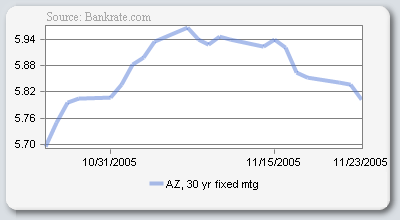
All of these charts come from BankRate.com. What we're looking at is the average rates for a 30-year fixed rate amortizing mortgage from Arizona lenders over the last 30 days. We hover between 5.70% and 5.96%, and the recent trend is decidedly downward. Good news, huh? Maybe not:
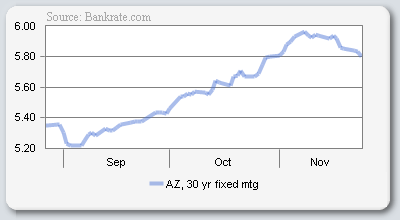
That's the three-month trend for a 30-tear fixed. The real trend is fairly steadily upward, right? But wait. There's more:
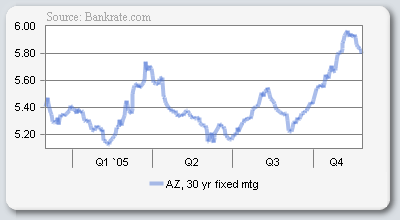
The same loan product over the last year. Down. Then up. Then back down. Then up a little. Then down a little. Then way up. Could it be that the sky really is falling?
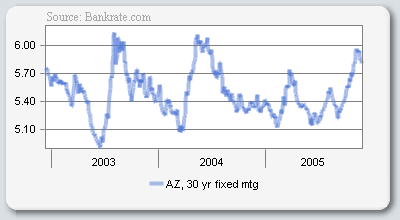
Phew! The three-year trend looks like a Drunkard's Walk, a random stochastic hovering right around 5.40%. Interestingly, the trend seems to be flattening. But: If you read anything into that, you're making an error. Mortgage rates aren't caused by trends, trends are a coincidental artifact of changes in rates.
But here's the real news:
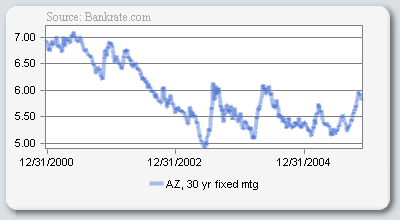
That's the five-year history of 30-year fixed rate mortgages in Arizona. Does that look like bad news to you? Does it look like bad news is lurking just around the corner, poised to strike?
Things can change. Disasters can befall us. Governments can inflict grievous errors on the national or international economy. But for now, at least, there is an awful lot of mortgage money out there looking for borrowers. This is why rates have been so low for so long. In the short-run, interest rates may be up a little or down a little. Over the long-term, assuming our economy stays on an even keel, the news is not just good, it's great.
posted by Greg Swann | 7:05 AM | 0 comments | links
Sunday, November 20, 2005
Rising rents keep sky from falling?
Here's further notice from the Arizona Republic:
According to Pierce Eislen, a Scottsdale market-research firm for the apartment industry, metro Phoenix apartment rental rates were up 4.3 percent in October over the same period a year ago. The average base rent was $697, up from $670 the previous October.Rents have been flat in the Phoenix market for a long time, but the same dyanmic--not static--market comes into play: If a 900sf three-bedroom apartment rents for $1,050 a month, how much more is a 1,400sf three-bedroom home worth? It's the competitive marketplace that 'decides,' ultimately, supply and demand. But through all of this, the supply of would-have-been home-buyers, tenants-for-now, is steadily increasing.
Rents had not risen significantly since 2001, said Ron Brock, Jr., vice president at Pierce Eislen.
Moreover, the number of apartments offering rental incentives dropped from 80 percent in 2004 to 43 percent this year through October, Pierce Eislen reported.
Several factors are converging to put the rental market in a better position to raise rents and drop concessions.
First, condo conversions are diminishing the stock of conventional apartment units faster than new stock is being built.
Second, the high median price of homes in the Valley is keeping many from owning their own home. And third, high land and construction costs are keeping apartment developers from building as many units as they traditionally have.
posted by Greg Swann | 7:10 AM | 0 comments | links
Saturday, November 19, 2005
After months of negotiations, the Sundome Center for the Performing Arts will soon be under new ownership.The Sundome is a failed arts venue, a failure even before newer and better free-market competition came on line. This "sale" simply moves its losses from one cadre of taxpayers to another.
The Maricopa County Board of Supervisors voted this week to approve the purchase of the 7,000-seat performing arts center.
The board agreed to pay $10 to the Arizona Board of Regents, the owner.
But there are three little ironies here: If the property had been "sold" for $10 to a private party, we would all understand that the taxpayers had been robbed by a sweetheart deal. But if ASU had sold the property at market value to a private developer, it would have received a huge sum of money for turning a vast parcel of land to a higher and better use. But, best of all, ASU will campaign next spring for the lion's share of a City of Phoenix bond issue to build a new campus for itself in Downtown Phoenix. If the taxpayers are willing to kick in yet another $855 million, ASU will be happy to donate the ten bucks it got from this "sale."
Actually, there is potential for a fourth and crowning irony:
Del E. Webb Corp. gave the Sundome to Arizona State University for $1 in 1984, with the university promising to keep it an arts venue.That reads like the grant to ASU may have been a qualified fee estate subject to condition subsequent, meaning that title would revert to Del Webb (now a division of Pulte Homes) if the property is not maintained as "an arts venue." But a common-enough provision in such a qualified fee estate would be that title would also have to vest in ASU, no other parties. In other words, it's possible that the original deed says that if ASU does not wish to retain the property, it automaticaly reverts back to Del Webb. The fallout from that would be an entertaining spectacle, worth ten bucks at least...
posted by Greg Swann | 9:25 AM | 0 comments | links
The cheapest metro area in the Realtors' report was Danville, Ill., where the median price in the third quarter was $72,800 -- a level that's scarcely imaginable to people house-hunting in, say, San Diego, Miami, or Boston.I grew up in Danville, IL. It's a grimy little industrial town in the middle of the corn belt. We're buying there, not because I think it's a good investment but because I want to be able to provide for my mother, who won't leave the place. You can buy a decent rental house for $40,000-$50,000 that will throw off cash with nothing down. The market is about one-third rentals, so the tenant pool is no problem. The only trouble is that appreciation is negligible in the good years, negative in the bad.
Rain, snow, grime and cheap houses. Funny how they go together...
posted by Greg Swann | 8:12 AM | 0 comments | links
Friday, November 18, 2005
Economics 101 at the airport...
Parking fees will be higher next year at Phoenix Sky Harbor International Airport.This is not completely bone-headed. In a free market, price is an indicator of relative demand, and as prices rise, prudent buyers seek alternatives.
Under the plan approved by the Phoenix City Council, daily parking fees in the economy surface lots will rise from $5 to $8.
Parking in the economy garages will go up from $7 a day to $10.
And terminal garage rates will rise from $16 to $20.
The new fees take effect Jan. 9.
Airport officials had requested the parking increases, citing too many cars, and too few parking spaces. The idea is that the higher rates may encourage more people to take public transportation when traveling to the airport or to park at private parking lots, outside of the airport.
Here's the bone-headed part, though. In the short-term lots, the lots most in need of turnover, you will pay $1 per half-hour, an impressively high price. If you stay for 23.5 hours, you will pay $47. Ouch! But stay just a half-hour longer and the charge drops to $20.
Good thinking!
posted by Greg Swann | 8:26 AM | 0 comments | links
Real estate investors who falsely claim their rental houses as 'owner occupied' are potentially draining millions from the state treasury and soon could face criminal charges.Much more serious is that fibbing about a rental being owner-occupied is potentially loan fraud--subject to the note being called--and insurance fraud--leaving the landlord with no homeowner's coverage. Time to come clean.
Maricopa County Attorney Andrew Thomas launched an investigation this week after an inquiry from The Arizona Republic spurred him to question the accuracy of the county's property records as well as the financial implications of errors.
posted by Greg Swann | 7:57 AM | 0 comments | links
Wednesday, November 16, 2005
A cloud for every silver lining...
Other housing markets that led the nation for home price increases in the past few years already have started to deflate. Las Vegas and San Diego both saw home price increases of only 10 percent in the past year.That is to say, an owner of a $300,000 home in Las Vegas reaped only $30,000 in effort-free appreciation income over the last four quarters. The shame of it all!
(There's a little bit of inside-baseball in the middle of all this. My expectation is that the numbers used in this article, provided by the National Association of Realtors, are based on MLS data. The numbers the Republic normally cites, provided by Dr. Jay Butler at ASU, are based on all recorded transactions. Both are medians, useless for understanding what's going on with a particular floor-plan in a particular neighborhood. But the MLS figures will likely be higher, all things taken together, than the County Recorder's numbers, for the simple reason that many unrepresented transactions go for far less than the fair market value of the property. I would love to have direct access to all the raw data, but the NAR's approach is closer to what the average buyer or seller is going to encounter in real life. A better approach altogether would be a 'market-basket' of homes, like the Consumer Price Index, representing very common sorts of transactions.)
Read the whole article. It's interesting. But remember that we're spoiled. Ten percent appreciation is not low, it's very high. And 6.36% interest for a 30-year fixed interest amortizing mortgage is not high, it's very low.
posted by Greg Swann | 7:31 AM | 0 comments | links
Monday, November 14, 2005
Metropolitan Phoenix isn't the poster child for sprawl, but it's a sibling.The study is one of the get-a-headline-by-inventing-a-big-scary-imaginary-peril variety, but it's hard to argue that the Valley is not a sprawling place.
A new study called "Sprawl Costs: Economic Impacts of Unchecked Development" ranked the Valley No. 12 among the nation's top 20 most sprawling areas.
Los Angeles took the top spot, and the Washington-Baltimore area was No. 2.
There is a cure of course: Stop building freeways to promote development. Areas already overburdened by traffic need freeways, that's understood. But freeways like the 101, 202, 303 (and you'd better know there will be a 404) are built to create traffic problems, not solve them. When you build a freeway through empty land, it won't be empty for long. The purpose of those outlying freeways--and of all those still to come in Pinal County--is to open up land to the dreaded sprawl--to subsidize future development.
posted by Greg Swann | 7:34 AM | 0 comments | links
Sunday, November 13, 2005
Is Arizona the new California?
Certainly, California's high tax climate is a direct result of a state government that refuses to curb its insatiable appetite for expansion. In addition, the promises made to government employee unions -- promises that will continue to be made, if Tuesday's vote is any indication -- will only hasten the state's need to capture more and more of the private sector's output.
High real estate prices? Why, that wouldn't have anything to do with burdensome regulatory environment governing land use, would it?
When you create conditions hostile to business, entrepreneurialism and economic growth, yet favorable to the advancement of big government -- and when you turn back any effort to implement even modest reforms -- the long-term results are easy to predict.
posted by Greg Swann | 9:03 AM | 0 comments | links
The population of Pinal County, which has about 250,000 residents, is expected to grow to about 1 million in 20 years.
But housing analysts say that for Pinal to continue to grow and entice people to make the commute, home prices in the area must stay lower than much of the rest of the Valley.
posted by Greg Swann | 8:38 AM | 0 comments | links
Saturday, November 12, 2005
"I love the dynamics of the population growth the area has," he said. "There's a lot of immigration from California, a lot of immigration from snowbird areas. Not everyone wants to be in the single-family life."So says Hosein Fateh about a condominium community he has planned for Gilbert. No projected prices as yet, but presumably these will not be aimed at the $300+/sf crowd sought by builders Downtown and in the Biltmore. It will be interesting to see if there really is a market for faux-urban-style living among people not quite as monied.
posted by Greg Swann | 11:55 AM | 0 comments | links
Friday, November 11, 2005
Sky falls as predicted, none injured

As has been persistently predicted for more than 18 months, the sky has at last fallen in the Phoenix real estate market. This per the Arizona Republic. The median price for residential housing actually went down by one percentage point in October, the first time this has happened since December of 2003.
Obviously our market is a lot softer than it was six months ago, but this is not quite the calamity so long foretold. Recall, until very recently every other mountebank was seething about a bubble that was doomed to burst at any instant. Instead, we've had a slow progression back to a relatively normal market, with nary a whimper of hardship to be heard.
This is me, in the first of my real estate columns published by the Republic:
When newsmakers make pronouncements about the real-estate market, they are conflating everything with everything else: north Scottsdale with south Phoenix, the stately custom homes of Litchfield Park with the ramshackle trailers of Ellsworth Road in east Mesa. The total supply of available homes is up from where it was a few months ago, but not by much. Among the homes that are most avidly sought and most assiduously marketed, demand is still very high - and price pressure is still very strong.Surely there is a net depreciation in values happening somewhere, but it's important to understand where. At the fringes the softness is pronounced--the very low and very high ends, along with niche products and less-prized options like mobile homes, co-ops, condos, etc. Homes and neighborhoods that were egregiously overpriced have given some ground. But in the bread-and-butter neighborhoods, well-kept, well-priced homes still sell in a sprightly fashion.
Real estate is non-fungible. That's the fancy way of saying that no one home can be substituted for another. So, to say that homes in greater Phoenix appreciated by 47 percent from July 1, 2004, to June 30, 2005, is interesting, but it is not hugely revealing. It conflates too many unlike homes and neighborhoods to be valuable.
It's much more useful to note that the 1,603-square-foot Terracina floor plan in Ashton Ranch in Surprise appreciated by 67 percent in that same span of time. The 1,313-square-foot Vail floor plan in Rancho Santa Fe in Avondale was up 56 percent. The 1,273-square-foot Sterling model in Fletcher Heights in Peoria gained 56 percent in value.
And then there's this:
But housing analysts don't expect Valley home prices to continue to fall and are calling for double-digit appreciation gains next year.No one can promise future appreciation, but our fundamentals are very sound. It still snows in the Great Lakes, houses are still extremely expensive in California, and, Chicken Little's lamentations to the contrary, interest rates are still very low.
This article neatly encapsulates the state of the market right now: Buyer's have some leverage for a change:
Metropolitan Phoenix's home-selling frenzy is beginning to calm and beleaguered buyers suddenly have more power in the fight for leverage in house deals.I'm writing deals with seller-paid closing costs for the first time in 15 months. Builders are offering huge incentives to new home buyers. Open houses abound, and listing agents are are once again routinely calling buyer's agents for feedback on showings.
We're not back to normal yet. There are about 21,500 active listings in the MLS, where a balanced market is about 25,000. And investors are still not welcome at new home subdivisions--as they will be as soon as the builders decide that the float on long-term deposits is worth more than the appreciation value of their inventory.
Chicken Little can rage on, but it's a great time to buy a house. There are plenty of sweet homes to choose from and sellers are ready to negotiate.
posted by Greg Swann | 11:40 AM | 0 comments | links
Thursday, November 10, 2005
The spring weather is starting to heat up, and after a short bus ride to the station at Central Avenue and Camelback Road, you're cooling your heels under one of the shade structures on the station platform.See, the thing is, the light rail is not actually intended for people who live in Phoenix--at least not for the tax-payers, nor for the current users of public transportation. The two largest concentrations of adult bus passengers are in Sunnyslope and South Phoenix, but the trolley goes nowhere near either place. The actual 'audience' for the light rail are tourists. They won't actually ride it, nor will the tax-payers, but the City wants to be able to shout, "Phoenix, too!," to the light rail-afflicted world. It seems likely that out-of-towners are the 'audience' for this article, too, since everyone who lives here knows how unbearably hot it is outdoors, even in the shade.
You're ready to get on board. Looking around, you see people heading for work, Arizona State University students, airline travelers with suitcases, and a few transient types.Of course, prosperous people love 'transient types.' That's why you see so many expensive suits on the bus. That's why hitch-hikers jump for joy when they see a $50,000 SUV--a free ride with lumbar support!
There are no advertisements inside or outside. Valley Metro put a moratorium on ads for the first year, then will decide whether to allow them.Here's an important fact: Light rail is very expensive to run. Not just to build, mind you, although it's hugely expensive to build; the system in Phoenix will run to more than $1,000 an inch before we're done. But even after it's built, light rail costs a lot more to run than do bus systems. That might matter if people who vote were users of public transportation, which they aren't, or if users of public transportation voted, which they don't. In any case, you can bet that Valley Metro will start taking advertising just before they publish the first year's deficit figures. They probably won't start cutting bus routes--the ones used by the actual users of public transportation--until the embarrassment of the second year's deficits.
Rolling down Central, you check out the construction on the western side of the street and wonder once again why you didn't have the foresight to buy land. Oh well.A lot of speculators did buy land, of course, but we probably won't read much about the current owners who have had many future uses of their land pruned by the Transit-Oriented Development zoning overlay.
At 44th Street, people get off with suitcases and duffel bags to catch a shuttle bus to Sky Harbor International Airport. Someday, an automated People Mover is supposed to whisk folks from here to the airport. But with an estimated billion-dollar cost, it won't come anytime soon.A thoughtful person could think to ask, "Why not run the eight-billion-dollar trolley through the airport?" The routes are parallel, essentially one mile south of the current route, and the train would chug into Tempe on University Drive, which would also make better sense--which is not to say that any of this makes sense.
You stop at Mill Avenue and step off with a gaggle of ASU students.It seems reasonable to me to conjecture that the actual purpose of building a new ASU campus downtown is to fill up this silly trolley--with people who are young and prosperous, rather than older and poor. The downtown campus will offer major-field-of-study classes, but the core curricula will still be taught in Tempe. At least one round-trip a day for the kids who get stuck downtown, but they'll be shiny, happy transit-patrons.
But: It doesn't pay to gripe about this. It's a done deal, as dumb as it is. It will set Phoenix back a lot in money and opportunity costs. It will not empty a single car, but it will make traffic and pollution worse. Valley Metro freely concedes these unhappy facts. But when other cities brag about their empty trollies running past their empty Convention Centers in their empty downtowns, Phoenix will be able to stand at the head of the line. It's hotter than blazes outdoors, so our civic boon-doggles will always be even emptier. No that's something to blow warm, wet kisses about!
posted by Greg Swann | 7:12 PM | 0 comments | links
Selling | Buying | Investing | Relocation | Current listings | About us
Find your ideal new home | Get a Market Analysis of your home
Search MLS listings | Make an appointment | Our offices
Tell your friends about us | Email Bloodhound | Home


|
Voted |
 |

BloodhoundRealty.com, LLC | Designated Broker: Greg Swann
Webmaster: Greg Swann | © 2005 BloodhoundRealty.com
