There’s always something to howl about.

Category: Marketing (page 160 of 191)

Dual Agency Smack-Down: A category 11 hurricane of arguments against Disclosed Dual Agency . . .

I’m going to stir up a category 11 hurricane by basing my initial entry in the Dual Agency Smack-Down on our past posts on the subject. Cathleen and I have dealt with this topic at great length in the past, so it seems reasonable to reinforce our arguments by revisiting them.

For the benefit of readers who may not be real estate professionals, I’ll start with our Dual Agency policy page, which defines and frames the issue:

Dual Agency is the process by which one real estate broker represents both the seller and the buyer in a transaction. It is legal in Arizona, provided it is fully disclosed and consented to by all parties.

Clear as mud?

Here’s what you’re apt to think of, when you think of Dual Agency: An agent lists a home for sale, you see it at an open house and sign a contract on the spot. The agent represents the seller. Does he also represent you? If he does, his role is reduced to that of a transaction facilitator. He carries messages back and forth between you and the seller, but he is forbidden by the Dual Agency to advocate for either of you. He may be completely scrupulous in his performance, but the chances are excellent that either you or the seller — or both of you! — are going to feel cheated at the end of the process. If “your” agent isn’t working in your interest, he must be betraying it instead. This may not be the truth of the matter, but it’s a suspicion that leaps readily to mind.

But here’s how Dual Agency usually works out. Your agent from Behemoth Realty takes you to a number of homes, including some that are themselves listed by Behemoth. You select one of these. Your agent is not the listing agent of the home you picked. It’s listed with a different Behemoth agent. So there’s no problem, right? Wrong. Your Buyer Broker Agreement is with the broker of Behemoth Realty, not with “your” agent. The Listing Contract is with the broker of Behemoth Realty, not with the seller’s agent. Both Read more
Untying the Loop 202 knot: If only they let me draw the freeway maps . . .

Our friends in the Gila River Indian Community have elected to negotiate on the location of the Loop 202 Freeway:

In a surprise about-face, the Gila River Indian Community will talk to state and federal officials about the prospect of building the South Mountain Freeway on reservation land, possibly sparing hundreds of homes in Ahwatukee Foothills.

If this is a surprise to you, you don’t understand the economics of casinos. The tribe built one of its three casinos on the route of the planned freeway, and they won’t reap the anticipated windfall if the freeway is not built.

The Loop 202 was originally planned to run on Pecos Road, at the Southern edge of the Ahwatukee Foothills neighborhood. Bonehead developers built very expensive homes very near the freeway’s right of way, and owners of very expensive homes are the very nimblest of NIMBYists. You can hardly blame highway planners for casting an envious eye into the mostly-empty Gila River Reservation.

From west of Phoenix to east and south of Phoenix, from the I-10 to the I-10, the Loop 202 is intended to serve as a reliever freeway, skirting traffic around Central Phoenix. If we view the road strictly as a local route for Ahwatukee Foothills, then Pecos Road in its current configuration is more than adequate. In other words, the reliever function can easily be split from the local traffic problem in Ahwatukee Foothills.

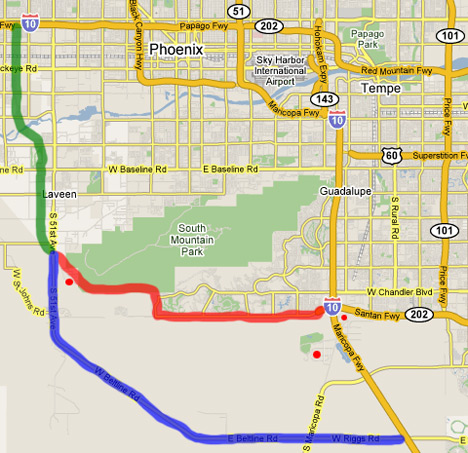
That being so, I like this route better:

The green line is the currently-planned route for the Loop-202 south from the I-10 west of Phoenix. Everyone on this route wants this freeway, the sooner the better.

The red line is the currently-planned route for the Loop-202 continuing east to the I-10 south of Phoenix. Virtually everyone on this route doesn’t want the freeway to be built.

The bright red dots are the locations of the three Gila River Indian Casinos, vast magnetic cash cows.

The blue line is my suggestion for an alternate route for the Loop 202. It wouldn’t connect with the SR-202 on the east side of the I-10, but it would be a whale of a traffic reliever. In the long run, the Read more

New NAR policy allows “objective” exclusion of certain listings from members’ presentations of IDX feeds . . .

This is the news from NARdiGras — from RealEstateJournal.com:

A revised policy approved by the National Association of Realtors this week may make it harder for discount brokers to draw attention to homes they list for sale.

The policy, approved by directors of the trade group at a convention in New Orleans, involves information about homes that real-estate brokers get from their local multiple-listing services, databases that are typically operated by local Realtor associations. Among other things, the policy reaffirms that brokerage firms that put listings from the MLS on their own Web sites can exclude certain homes.

The revised policy states that brokers must use “objective criteria” if they screen out some listings. The criteria could include location, type of property, compensation offered for agents who find a buyer, or the level of service provided by the listing company. Thus, listings from brokers providing limited service for lower fees could be excluded from other brokers’ sites.

By contrast, the policy now states that multiple-listing services must make all types of listings available to the Web sites of participating brokers. It would be up to brokers — not the MLS — to decide which listings are used on individual brokers’ sites.

A broker quoted in the article makes a compelling case for this position: “We spend a lot of money advertising our Web site to the public, and we have a right to put what we want on our site.”

Indeed. And as a counter-marketing strategy, a brokerage could proudly announce that its web site sports the full MLS.

But: There’s more. The other night Cathy, Russell Shaw and I were talking about the contrary case: What if I want to exclude one of my listings from the MLS feed? That sounds counter-intuitive, but for certain very-high-priced homes, it makes sense. As the listing broker, I might want to advertise and cooperate, but I would not want to invite a deluge of traffic from unqualified buyers.

Moreover, I think this new policy has about as much chance of succeeding with the Feds as the last one. The individual liberty of real estate brokers seems not to matter much in Read more

Home buyer always liable for mortgage . . .

This is my column from today’s Arizona Republic (permanent link). No fireworks, today, just real estate.

Home buyer always liable for mortgage

I got a great question by e-mail. It’s really a lender question, but it introduces a number of interesting topics.

“Are homeowners personally liable for their mortgages? If yes, is it possible to structure a home loan that doesn’t require a personal guarantee?”

Generally speaking, yes, a mortgage is secured both by the real property and by the borrower’s personal promise to repay the note.

If the down payment is 10 to 20 percent, the personal promise may not be as significant. But if the down payment is very low or if real estate is declining in value, the lender will depend on the borrower to bring any shortfall to the closing table, should the home sell for less money than is owed on it.

Many types of loans are not secured by the borrower’s personal promise to repay. The loan will be secured by the real property or by other assets. A foreclosure won’t affect the borrower’s personal credit.

Here is an example that can be used for mortgages for residential rental homes: the non-recourse loan. The loan is secured by the real property only, with no “recourse” to the borrower on default.

Obviously, the lender is going to make sure the amount lent is substantially less than the value of the property, that the property produces income sufficient to pay its own expenses, etc.

This is an investment product, but the interesting thing about non-recourse loans is that they can be deployed by self-directed retirement accounts to own real estate.

Your self-directed IRA, as an example, would have to make a hefty down payment on a piece of real property, and there are rules about what your IRA can own and to whose benefit. But by means of the non-recourse loan, your IRA can own real estate to build your retirement nest egg.

But the answer to the main question is probably no, alas. I know of no primary-purchase mortgage loan that does not require the borrower to personally guarantee repayment.

Technorati Tags: , , , Read more

How to make money banking on the West Valley real estate market . . .

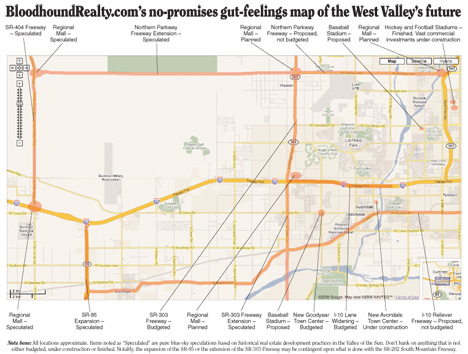
Want to get rich in real estate? A workable strategy might be to march your way west on this map:

If you click on the map, it opens to a larger, PDF version.

This is is significant chunk of the Southwest Valley in Metropolitan Phoenix. I’m showing you every major development that will affect real estate appreciation values — actual, probable and speculated.

Start by buying all the house you can afford in the eastern third of the map. Every two or three years, move yourself three to five miles further west, again buying all the house you can afford — from your income plus your accumulated equity. In five moves, you should have a ton of money regardless of your other investments.

Looking to invest in rental real estate instead — or as well? This map shows you where to move your money — again, slowly and incrementally to the west as development warrants. Your goal is to be where the great masses of people want to be — a year or two before they get there.

This is really not that large an area — it’s about 26 miles by 14 miles, 364 square miles. But as many as 1.5 million people will be moving into the area described by that map over the next twenty years.

Clearly, there is money to be made…

Technorati Tags: , , , ,

If the sheep are going to be sheared anyway, is it wrong to sell spectator seats . . . ?

Comes news today that we are that much closer to two new Food Stamps allocations to Major League Baseball. The count so far this year is three Welfare-addicted baseball teams moving into two brand new, taxpayer-funded stadia. If you read nothing but the Arizona Republic, you would never know that professional ath-a-letes and their empressariat make quite a bit of money. Cancel your subscription for three months and you might actually get the addle-pated idea that they can afford to pay for their own damn ballparks.

Not here.

Our public schools provide free breakfast and lunch all Summer long in even the wealthiest of suburbs, and the municipalities of Greater Phoenix have never once met an ath-a-lete who didn’t need a multi-million dollar hand-out. The quality of mercy is not strained.

Fine. Stipulated. This is the way things are, and they’re not going to change anytime soon. Metropolitan Phoenix grew faster than any American city by not emulating the dumb stunts by which other cites manage to lose population, but those days are done. We are still not as stupid as the cities celebrated by the celebrated Richard Florida — cities attractive only to people who don’t have children — but we inch our way ever more Floridaward with every election. Again: Fine.

My conundrum is that, as much as I hate these silly stunts, they turn out to be very good for my clients. Any rational economist is only too happy to point out that, in the long run, subsidizing the lesser producers of wealth at the expense of greater producers is suicidal — and who can walk the Floridian Utopias Back East without fearing that the collapse might come at any instant? We might spit in spite of John Maynard Keynes, who famously said, “In the long run, we are all dead” — but, alas, it’s true. In the long run, the policies that Phoenix is pursuing will result in the same civic, economic, cultural and demographic disasters we witness in the cities now feeding our population growth.

But real estate is a medium run investment.

We have a new football stadium on the west Read more

John L Wake says: Buy . . .

From my email this morning, Phoenix-area Realtor and weblogger John L Wake offers this advice:

I recommend that anyone who has been waiting to buy or who was considering buying with in the next 6 months, that they now seriously consider buying within the next 6 to 8 weeks.

The argument is based in a statistical analysis of listings history, and John’s audio explanation of his charts is worth listening to.

I thought yesterday that a podcast with Russell Shaw would be a wonderful thing, and here’s another case where I’d really like to explore John’s numbers in detail. I’m going to have to do something about this…

Technorati Tags: , , , ,

I’m all in

I’m all in.

Meeting Greg and Cathleen was good for me too. I really enjoyed the time we spent together. As all of the regular readers here already know they are very cordial and intelligent people. And isn’t that the whole idea for the individuals who congregate here – find people with those qualities to help and be helped by?

I need to wrap up some loose ends – respond to several posts that have been left hanging.

Benjamin wrote:

Hey Russell

I’m with a fairly new (just one year young) Keller Williams office in South Western Ontario, and we currently have the highest average commission out of offices in the area, averaging over 5%. The ‘normal’ commission out here is 5%, and increasingly we’re seeing 4.5 and 4 become normal for listing residential; many realtors in my office still are signing people up at 6% because we do offer more value and service than other firms. Does KW have the perception in the US of being a ‘discounter’?

No, they don’t. KW – from the top down – does not want to be perceived that way. There are KW agents here promoting 4% total commission listings (as there are agents with Re/Max and the company I am with, John Hall & Associates). But those agents are in the minority – advertising a low commission. I personally think that advertising a low commission is stupid and the agents who do it (thinking it will bring them more business) are doing a poor job in the area of strategic planning. They are not thinking very far into the future. 3% is what would be considered a “competitive co-broke” percentage in my market. In a market like Greater Los Angles that number is probably more like 2.5% – based on their much higher sales price. If the listing agent is only getting 1% they have set themselves up for failure.

Listing agents who work that cheap are doomed to failure. Why? Because a successful operation will actually spend more than the failure agent grosses on PROMOTION OF THEIR LISTINGS. It costs money to sell a lot of houses – a Read more

Meeting Russell Shaw: It turns out there is no topic of conversation except real estate . . .

Years ago, when I lived in Boston, I knew a computer programmer who had no interest in computers outside of work — not even to use, much less play with. I thought this was so weird, because my work completely dominates my attention. It’s all I think about, it’s all I want to talk about, it’s there in the back of my mind no matter what I’m doing.

When Todd Tarson came to visit us, we talked about real estate for every minute he had to spare.

Last night Cathy and I met Russell Shaw in person for the first time. We closed a Mimi’s Restaurant. We got together at 7:30 p.m. and left at midnight, just before they called the cops on us. No liquor, mind you — iced tea, cappuccino and ice-water. But we were drunk all the same, awash in ideas.

We talked about real estate the whole time. Russell is very smart, and very forthcoming with information — as you know from reading him here. We covered a vast horde of topics, from tiny marketing details to big-picture analysis of the NAR/DOJ/FTC fiasc-o-thon.

It was an amazingly wonderful evening for me — my birthday, by chance — entirely my style of living. Cathy has been making notes from memory all morning.

Here’s one concrete plan that came out of our scheming:

We’re going to debate Dual Agency in BloodhoundBlog, with Russell on the affirmative and me on the negative.

Russell is all over the idea that, while forbidding Dual Agency with buyers can make sense for us, we should not rule it out for sellers. He makes a very compelling case, and he may yet carry the day.

But, as the the great Arizona patriot Sam Steiger used to say, we’re just a wave, we’re not the water. The issue is bigger than either one of us can cover. I know there are many stout defenders of Dual Agency from whom we have heard nothing. Opponents may have arguments we have not yet considered. Either way, marshall your positions and tell us what we’re getting wrong.

I’ll post something in the next day or two. With Read more

Realty Reality: How Jake, Jurij and Tatiana Pawlenko wove their way into our hearts . . .

This is a shaggy dog story…

It begins with Jake, the world’s most playful Yellow Labrador Retriever, and Jake is a thread running all through this tapestry.

And that’s the way to think of it — as a tapestry. The clients we love best — and we love to love our clients — weave themselves into the tapestry of our lives. They are with us for years — for life we hope — and they show up again and again in all sorts of unexpected places. For, while this is a Jake story, it’s also a Ronan Doyle story and a Richard Riccelli story — it’s a story where many of the threads of the tapestry of our lives meet and merge in beautiful, unplanned designs.

But this is most fundamentally the story of the work we did with Jurij Pawlenko — himself a shaggy two-legged dog — and his lovely wife, Tatiana. And the thread of their story runs all through BloodhoundBlog, so much have they meant to us.

Begin at the beginning: Cathleen Collins was previewing houses for Robert and Lisa Pageler, and one that she looked at was 922 West Culver St, a 1936 Ranch-style home in the F.Q. Story Historic District of Downtown Phoenix. This was Jurij and Tatiana’s home at the time, and Jurij and Jake were home when Cathy arrived.

I like dogs. I’m indifferent to cats. Cathy loves any creature with fur. She and Jake hit it off immediately, especially since Jake loves to play so much. His favorite game is fetch, and he will play it forever. Cathy threw her arm out throwing grapefruit for Jake to fetch — thus endearing herself forever to Jurij.

This was the Summer of 2005, and Cathy wrote about this part of the story earlier this year.

In January of 2006, we listed Ronan Doyle’s home at 1102 West Culver St for sale. If you go to our About BloodhoundRealty.com page, you’ll see that our brokerage consists of Greg Swann, Cathleen Collins, Cameron Swann and Odysseus the TV Spokesmodel Bloodhound. That’s true day-to-day, but there are two other key players without whom none of Read more

Once more unto the breach: Assailing home-buyers from a different direction . . .

We are forever indebted to Richard Riccelli. The ad shown below is another attempt to persuade buyers to think about what they’re paying for buyer representation, and how they might pay less. This approach was suggested by Richard, and he out-and-out wrote about half the copy. If we had to pay him for these efforts, we would have to sell our own house!

Sometime very soon, I’ll write the full story of our work for the Pawlenkos — which is involved — and from that I’ll revise the landing page for this ad.

Splitting our bets, here’s a completely different take, commended to us by Jeff Brown. As I’ve discussed, we list very hard, but we’ve been very careful taking listings this year. If a house isn’t A+ in all categories it won’t sell, and we don’t list to not sell. But Jeff is convinced that the worm will turn with the calendar, and we’re inclined to agree. And, unlike buyers, sellers care a great deal about value propositions.

The real push for an approach like this is door-to-door, and we’ll begin that in earnest in early December…

Technorati Tags: , , , , ,

How I almost wasn’t an e-Pro: Why you shouldn’t wait to the last minute to do your homework . . .

Shhh. Come closer. I have a confession to make. This past week I became an e-Pro! It took me an entire six months to become one — not because it was so difficult, nor because I was so very busy, but because I wasn’t motivated. Then why, you might wonder, particularly if you are in the techno-crowd who subscribes to RSS feeds and reads this weblog, would I have spent $359 and any precious time at all to earn my tinfoil badge?

About the time I enrolled Greg and myself in the e-Pro program, I was finishing up my GRI courses and Greg had just earned his CRS and ABR designations. I had taken the ABR courses with Greg, but couldn’t earn the designation yet because I didn’t have enough buyer sides. In fact, the only NAR-recognized designation left to me at that point in my career was e-Pro. And, as I explained to Greg while twisting his arm to join me in getting the designation, it was just plain silly for the two of us to not be able to promote ourselves as being technologically astute. Other Realtors who hadn’t even known email basics before taking the e-Pro course were able, with NAR’s blessing, to promote themselves as

highly skilled and continuously trained professionals who provide high quality and innovative online-based real estate services.

Further,

Consumers can identify the e-PRO through the exclusive e-PRO Internet Professional logo.

Now, I can’t come close to Greg or even Cameron when it comes to IT proficiency, but I left a job as an IT consultant at PerotSystems when I began working as a Realtor. So if a consumer of real estate services wants someone with technology skills to help buy or sell his house, and believes that the e-Pro designation is the industry’s endorsement of a Realtor’s IT competence, and we didn’t have the designation, we might be missing the opportunity to meet the very type of people whom we could serve best.

So, I enrolled us both in the e-Pro course, and by the end of the week Greg had begrudgingly earned his designation. He just sat Read more