
The Phoenix Real Estate weblog has an original take on our favorite real estate reporter, Catherine Reagor of the Arizona Republic.
Category: Real Estate (page 266 of 266)
Me, in today’s Arizona Republic:
Here’s a complicated question: How much money should you put down as an earnest deposit on the purchase of a home?
You’ll find a more permanent link on the BloodhoundRealty.com News and Views page.
We looked at a house yesterday in Las Vegas. We’re loosely motivated buyers, so we didn’t waste an agent’s time. But we have this idea that we might buy a distinctive home in a choice location, trick it out in every possible way, then own it as a getaway vacation rental that we will rent ourselves from time to time, when we’re in town. We were looking yesterday in the allegedly ‘historic’ neighborhood of Downtown Las Vegas, which makes the historic neighborhoods of Phoenix look positively ancient.
Anyway, here’s what’s important in the present context: The lister of the home happened to be there as we drove by, and she offered to show it to us. She was eager and energetic, well-informed and enthusiastic, everything you might want in a Realtor, either as a broker or a seller. Except that in the course of about ten minutes, she committed at least two Federal Fair Housing law violations – religion and family status.
We can give the lady a break, I suppose. We weren’t offended, and I can’t image that even members of the two protected classes would have been offended. She was trying to be inclusive, even if unlawfully, not exclusive. All she really wanted to do was get the house sold, so she gave us information she thought we would want, even though doing so was in violation of the law, even though we had disclosed to her our status as Realtors from out of state, even though she should have known we would hear every violation of the law.
As it happens, we are very, very careful about this stuff. Not because we believe all people are individuals, equal in every metaphysical respect. Not because we find prejudice and exclusion abhorrent, repulsive, nauseating. Not because we want to spread the social, emotional and financial benefits of homeownership as far and as wide as possible. We uphold every one of those noble ideals. But here is the reason we are so serious about Fair Housing laws: Because the fines at the Federal level are $11,000 – per violation. Add to that state, county Read more
At 360 Digest, an exceptionally fine real estate weblog, Marlow Harris weighs in with this idea about an incipient on-line real estate start-up:
Blue Roof, like Redfin and Zip Realty, misrepresents their status as “Realtor” and claims to be a member of the National Association of Realtors and adhere to its strict Code of Ethics, while actually NOT being a Realtor subject to their rules, regulations and ethical code.
I don’t know if this is true or not, with respect to any of the vendors named, but, if it is, it seems to invite considerable exposure to litigation. No, not a trademark infringement suit from the NAR. A judge might reasonably hold the RealtyBot sites to the claims they are making, even if those claims are untrue. A mere real estate licensee is answerable only to the statute law of the licensing jurisdiction. Realtors are held to much higher standards, both because of the NAR Code of Ethics and because of the presumption that the aspiration to professional status implies greater education and more rigorous care and diligence. Real estate brokers, whether or not they are Realtors, are held to the highest standards. Ignorance of the law is not only not an excuse, it is not even a mitigating factor.
For all its virtues, the internet has always been driven by an ‘aw shucks, we’re just having some fun’ attitude. Witness a major, multi-national communications conglomerate named ‘Yahoo’. But real estate is not an ‘aw shucks’ business. A real estate practitioner – licensee or not, Realtor or not – has the power to ruin his clients’ financial lives forever. We’re not talking about impersonating a Realtor, a funny idea. We’re talking about depersonalizing, deprofessionalizing – ultimately deligimating – the fiduciary relationship. If the agency law hammer ever drops on these practices, whether or not they are buttressed by lies, the damage awards are going to be collossal.
Before we hopped our Southwest flight to Sin City, I had time to read but not comment upon this bit by Catherine Reagor of the Arizona Republic. The truth is, it gets hard to care after a while. Whether the Republic‘s real estate reporting is completely tendentious, completely uninformed or completely random, it is almost always completely wrong. Ms. Reagor, in particular, never once saw a cliff that she didn’t immediately jump off of, whether it’s the wonder and beauty of ‘affordable’ housing expropriated at gunpoint or the dream of a desert paradise master-planned in every particular by Locutus of Borg. If the Republic is singing the praises of an on-line real estate start-up, it might be wise to park your wealth anywhere else.
Even so, and harkening back to the idea of lawsuits against RealtyBots, I seized upon the opportunity to play my favorite game as a real estate broker: Name that violation. I summarized the article to Cathy, emphasizing this:
Some real estate Web sites make money on advertising.
Others, such as myfuturenet, try to make money on the back end by getting buyers and seller to close deals online using their mortgage and title firms.
In possession of that little bit of information, a mere 36 words, the challenge for you is to name that violation.
Cathy got it instantly, of course, as every skilled practitioner would. The law this business model is most likely to violate is RESPA, the Real Estate Settlement Procedures Act. Every vendor used in a real estate transaction should be chosen by the buyer. If a real estate licensee refers a vendor, he must disclose any ‘referral fees’ or other kickbacks received from that vendor. Our policy, of course, is no kickbacks of any kind, ever, since there should never be a doubt in our clients’ minds about our absolute fidelity to their interests. But a business model that binds buyers to certain third-party vendors seems to have a RESPA suit, an agency suit – or both – baked in the cake.
Is there light at the end of the tunnel? Home values were up slightly, by 0.33%, in the June 2006 BloodhoundRealty.com Market-Basket of Homes. Average sales prices were up $851, from 257,148 in May to 257,999 in June. Nevertheless, values are down $11,876 from the December 2005 high of $269,875. Market-Basket homes spent an average of 69 days on market, one day less than in May.
As has been the case in recent months, most Market-Basket homes are selling at or above list price. A few deeply-discounted properties pulled down the average, and average discounting netted out to 1.75%, up from 1.31% in May.
A total of 176 Market-Basket homes were sold in June, down from 211 in May. Inventories of available homes continue to climb. There are now 1,525 homes available for sale in the Market-Basket, which would imply an absorption rate of over eight months. A six-month absorption rate is considered normal.
Based on the idea of the Consumer Price Index market-basket of goods and services, the Market-Basket of Homes uses average sales prices for a small subset of all Valley home sales to get a clearer idea of what is happening in the middle of the bell curve. The alternative method, striking a median among all closed transactions, introduces too many extraneous factors to provide a reliable indicator of what is happening to prices for those homes that are most avidly desired by the greatest number of people. To that end, the Market-Basket of Homes looks at sales prices for MLS-listed suburban homes from 1300sf to 1900sf built in 1998 or later, the homes that drive the resale market.
The BloodhoundRealty.com Market-Basket of Homes is updated monthly and is always available at http://www.BloodhoundRealty.com/MarketBasket.pdf
We’re living la vida Vegas for our anniversary, but before we take off, here is the brand new Bloodhound newsletter.
In a comment below, Jon offers this:
What are you talking about? Lawsuits against emongoo, zillow and refin? None of them are doing anything wrong…sorry to say. I looked at emongoo, zillow and redfins sites and I don’t see anywhere where they say they give legal advice.
First, I only cited legal advice with respect to emongoo.com – and we’ll come back to that. We should exclude zillow.com from this discussion, because, for now at least, they are doing nothing but running a look-up service with no legal consequences that I know of.
But redfin.com has considerable legal exposure, as does buysiderealty.com and anyone emulating the general redfin.com business model. The first and most obvious problem is the legal doctrine known as procuring cause. These sites are a procuring cause lawsuit – or perhaps a procuring cause class action suit – waiting to happen. They go out of their way to flout the rights of cooperating brokers, openly advising buyers to see homes at open houses or by contacting the listing broker directly. The NAR Code of Ethics forbids brokers from letting a procuring cause dispute impede a transaction, but there is nothing to prevent the aggrieved broker from pursuing damages after the fact. I’m not saying this will happen, but their noses are wide open.
(As a side note, the way I read buysiderealty.com’s web site, their real business is loan origination. My guess is that the real estate brokerage side of the business will be one or more separate operating entities, with the broker being hung out to dry in the event of a lawsuit.)
The entire discount sector of the real estate industry – on-line and brick ‘n’ mortar – faces huge risks on the subject of agency law. It is difficult to argue that you did everything possible to advance your client’s interests when you did everything possible to avoid knowing what your client’s interests actually are. From the outside, you might want to shout caveat emptor! But the law of agency in real estate is by now much closer to caveat venditor.
There is actually added risk for the discounters, as Read more
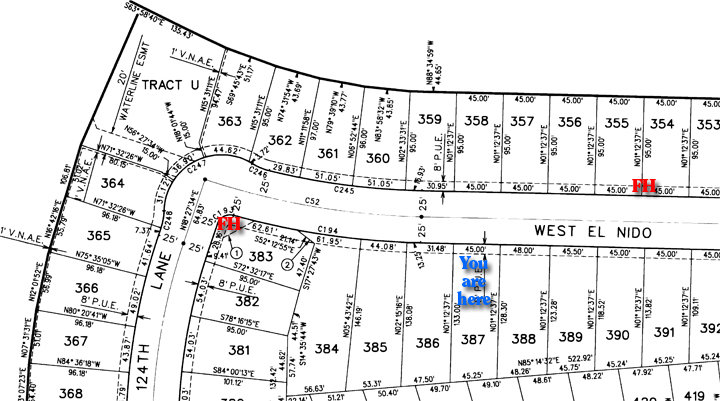
The map above is a tiny slice of my week. My clients are buying the home that sits on lot 387 of that plat map. Their insurance underwriter deemed it vital that they know where the fire hydrants are with respect to that house. This is a job that can be delegated, but it is not a job that can be easily disintermediated. In anticipation of sputtering expostulations: I made another trip to that house to measure the exact dimensions of the cavities of space into which the appliances will be installed. These are but two of the dozens of little things that go into delivering the whole product…
I have been devoting a lot of my time to some ascendant ideas in Real Estate loosely based on the Web 2.0 model of internet commerce. The ideas are ascendant, but they’re not necessarily good. I weigh in on the skeptical side for now, but I’m watching all this with interest. I’ve been wrong before.
Of all the fascinating things I’ve seen, the most impressive was the painstaking deconstruction of the redfin.com numbers. We can scale those results any way we want and they still stink. Any brick ‘n’ mortar accountant could do the math. As with Web 1.0, it doesn’t matter how many different ways you shout down the numerical analysis, ten trillion times a tiny loss is a huge loss.
So: One procuring cause lawsuit–and there are apt to be dozens… One negligence lawsuit–and the business model is proudly based on negligence… Emongoo.com is actually in worse shape, since they’re taking quite a bit less money but openly promising legal advice. The aggregators and sites like zillow.com are probably safe–though possibly not profitable. But sites attempting anything like agency have the same legal exposure as B&M brokers, but with a lot less money to cover the losses.
It’s an interesting problem…
Here’s another one:
The real estate industry has always been about seller representation. This was true historically, but it’s still a huge source of lawsuits among the old-timers. The idea of dual-agency–itself a huge fount of lawsuits–is an attempt to cling to double-commissions in the age of buyer agency.
But here is where we’re headed, at least for now: In the world of redfin.com, emongoo.com, HelpUSell, etc., buyers will have full representation, but many sellers will be essentially unrepresented.
The immediate knee-jerk answer to this would be to make buyers pay for their own representation, but, of course, now more than ever buyers arrive at the closing table with no cash at all. Good income, good credit, but little or no cash.
So why should sellers pay for the buyer’s agent? For the same reason they always have, agency law be damned: For the introduction.
So how does this shake out?
On the one hand, sellers might think Read more