
We’re living la vida Vegas for our anniversary, but before we take off, here is the brand new Bloodhound newsletter.
Archives (page 368 of 372)
In a comment below, Jon offers this:
What are you talking about? Lawsuits against emongoo, zillow and refin? None of them are doing anything wrong…sorry to say. I looked at emongoo, zillow and redfins sites and I don’t see anywhere where they say they give legal advice.
First, I only cited legal advice with respect to emongoo.com – and we’ll come back to that. We should exclude zillow.com from this discussion, because, for now at least, they are doing nothing but running a look-up service with no legal consequences that I know of.
But redfin.com has considerable legal exposure, as does buysiderealty.com and anyone emulating the general redfin.com business model. The first and most obvious problem is the legal doctrine known as procuring cause. These sites are a procuring cause lawsuit – or perhaps a procuring cause class action suit – waiting to happen. They go out of their way to flout the rights of cooperating brokers, openly advising buyers to see homes at open houses or by contacting the listing broker directly. The NAR Code of Ethics forbids brokers from letting a procuring cause dispute impede a transaction, but there is nothing to prevent the aggrieved broker from pursuing damages after the fact. I’m not saying this will happen, but their noses are wide open.
(As a side note, the way I read buysiderealty.com’s web site, their real business is loan origination. My guess is that the real estate brokerage side of the business will be one or more separate operating entities, with the broker being hung out to dry in the event of a lawsuit.)
The entire discount sector of the real estate industry – on-line and brick ‘n’ mortar – faces huge risks on the subject of agency law. It is difficult to argue that you did everything possible to advance your client’s interests when you did everything possible to avoid knowing what your client’s interests actually are. From the outside, you might want to shout caveat emptor! But the law of agency in real estate is by now much closer to caveat venditor.
There is actually added risk for the discounters, as Read more
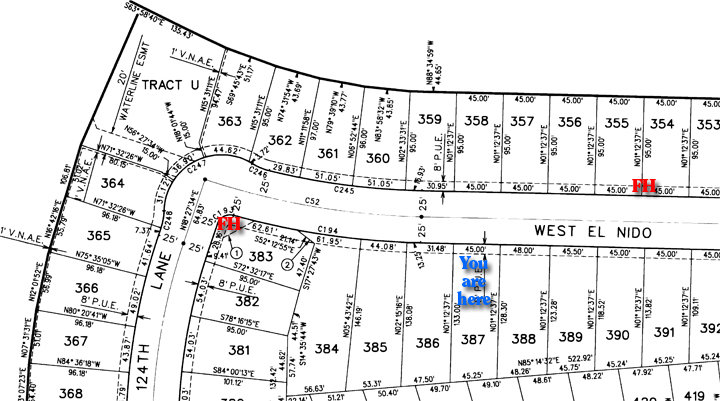
The map above is a tiny slice of my week. My clients are buying the home that sits on lot 387 of that plat map. Their insurance underwriter deemed it vital that they know where the fire hydrants are with respect to that house. This is a job that can be delegated, but it is not a job that can be easily disintermediated. In anticipation of sputtering expostulations: I made another trip to that house to measure the exact dimensions of the cavities of space into which the appliances will be installed. These are but two of the dozens of little things that go into delivering the whole product…
I have been devoting a lot of my time to some ascendant ideas in Real Estate loosely based on the Web 2.0 model of internet commerce. The ideas are ascendant, but they’re not necessarily good. I weigh in on the skeptical side for now, but I’m watching all this with interest. I’ve been wrong before.
Of all the fascinating things I’ve seen, the most impressive was the painstaking deconstruction of the redfin.com numbers. We can scale those results any way we want and they still stink. Any brick ‘n’ mortar accountant could do the math. As with Web 1.0, it doesn’t matter how many different ways you shout down the numerical analysis, ten trillion times a tiny loss is a huge loss.
So: One procuring cause lawsuit–and there are apt to be dozens… One negligence lawsuit–and the business model is proudly based on negligence… Emongoo.com is actually in worse shape, since they’re taking quite a bit less money but openly promising legal advice. The aggregators and sites like zillow.com are probably safe–though possibly not profitable. But sites attempting anything like agency have the same legal exposure as B&M brokers, but with a lot less money to cover the losses.
It’s an interesting problem…
Here’s another one:
The real estate industry has always been about seller representation. This was true historically, but it’s still a huge source of lawsuits among the old-timers. The idea of dual-agency–itself a huge fount of lawsuits–is an attempt to cling to double-commissions in the age of buyer agency.
But here is where we’re headed, at least for now: In the world of redfin.com, emongoo.com, HelpUSell, etc., buyers will have full representation, but many sellers will be essentially unrepresented.
The immediate knee-jerk answer to this would be to make buyers pay for their own representation, but, of course, now more than ever buyers arrive at the closing table with no cash at all. Good income, good credit, but little or no cash.
So why should sellers pay for the buyer’s agent? For the same reason they always have, agency law be damned: For the introduction.
So how does this shake out?
On the one hand, sellers might think Read more
The phenomenon Chris Anderson writes about in this article from Wired Magazine is a secondary consequence of outrageous abundance. In a subsistence culture, the work of the mind is precious and literally unsupportable. We are by now so rich that millions of people can create intellectual resources that they give away, in turn to be remarketed by others. This may or may not work in the long run for companies tapping into and amplifying open-source-like works of the mind. Consider that aggregator software levels the playing field for small players. The interesting thing is what it will do to companies whose entire business model is based on scarcity and hoarding. If almost-as-good is free or nearly free, what is the market value of slightly-better?

Home values were up a substantial 1.97% in the March 2006 BloodhoundRealty.com Market-Basket of Homes. Average sales prices were up more than $5,000, from $260,645 in February to $265,778 in March. Values are still down slightly more than $4,000 from the December 2004 high of $269,875. Market-Basket homes spent an average of 62 days on market, up four days from February.
The month’s activity was actually stronger than the raw numbers indicate, with many homes selling at or above list price. A few deeply-discounted properties pulled down the average, but average discounting netted out to only 1.37%, down from 1.42% in February.
A total of 189 Market-Basket homes were sold in March, up from 145 in February. As noted in January and February, the early months of 2006 very strongly resemble the first quarter of 2004. The one significant difference is that overall inventories are substantially higher. For example, there are now 1,209 homes available for sale in the Market-Basket, which would imply an absorption rate of 6.4 months. A six-month absorption rate is considered normal.
“If the Spring selling season is everything it should be,” said BloodhoundRealty.com Broker Greg Swann, “then we have no problem. Right now there seem to be a lot more sellers than buyers, and the religious holidays in April could slow things down. But if the market heats up with the weather, we should be fine.”
Based on the idea of the Consumer Price Index market-basket of goods and services, the Market-Basket of Homes uses average sales prices for a small subset of all Valley home sales to get a clearer idea of what is happening in the middle of the bell curve. The alternative method, striking a median among all closed transactions, introduces too many extraneous factors to provide a reliable indicator of what is happening to prices for those homes that are most avidly desired by the greatest number of people. To that end, the Market-Basket of Homes looks at sales prices for MLS-listed suburban homes from 1300sf to 1900sf built in 1998 or later, the homes that drive the resale market.
The BloodhoundRealty.com Market-Basket of Homes is updated Read more
A nice interview in this morning’s Republic with Doug Fulton of Fulton Homes. Fulton scouts out and shoots down The Mole:
Question: How do you see the market now?
Answer: This is just a small correction that needed to happen. The velocity (of sales), the appreciation of the homes, was not sustainable. Last year was a complete anomaly. It’s not normal. You can’t compare last year to anything. When people say, “Gee, last February there were 4,600 houses on the MLS (Multiple Listing Service) and this March, there’s 36,000,” you’re just comparing apples and oranges. It’s a different marketplace. Completely.
Q: Isn’t that how you typically compare, looking at last year?
A: Go to ’04. Go to ’03. You’ll see that there were 30,000-plus in the same time frame.
Fulton also points out that builders were lying in 2004 when they named their reasons, dutifully transcribed by the Republic, for excluding investors from new home subdivisions:
Q: Why is that? Supposedly, the home builders weeded out all the investors.
A: Not until probably August, September of ’05. We started doing it because we saw what happened in Las Vegas in the investor market, which was people closing on their homes and competing with the still-open model home complex and undercutting you by $10,000 and still making tons of money. . . . We were creating our own feeding frenzy. People were standing in line because of the increases. If you slowed down your increases, it slowed down sales. Tell me that isn’t scary. . . . The key wasn’t so much the overall price as much as the increasing price. . . . Some people thought the price increases would never stop.
Question: what does it mean when the Arizona Republic publishes–count ’em–one, two, three, four, five, six, seven articles and one, two editorials on the same subject on the same day?
Answer: Put your hand on your wallet. A brand new campaign of larceny has begun…
Never is heard a discouraging word, it goes without saying. This is propaganda, not news. I could name dozens of reasons why this is a poor idea, but what would be the point? Arizona is by now nothing but an echo chamber. When it comes to the palpable stench of corruption, we hear only from people with no sense of smell…
On February 5th, we told you that the start of 2006 resembled the start of 2004. We reinforced this idea on February 8th, and many times since then.
Today, March 21st, Dr. Jay Butler of ASU’s Center for the Extended Belaborment of the Obvious, finally arrives at the same conclusion, even though the trend has been obvious since the end of January. Properly belaboring the obvious takes time, after all.
Dr. Butler also released his calcuations on median home values for the month of February, up for the month, surprisingly enough, and a net positive for the year-to-date.
Catherine Reagor in the Arizona Republic asks, “Another price dip?”:
Valley resales figures for February are due out this week. And early analysis from Arizona State University’s Real Estate Center shows the median price might have dipped slightly again.
In January the median price of all resales was $257,000. They hit a high of $263,000 in September.
Might have dipped? Readers here have known since March 3rd that prices were down in February. As we reported last week, values are up for the month of March so far and for 2006 year-to-date. However: Around half of all residential real estate transactions close in the last ten days of the month. The numbers have been volatile so far, and we still could end the month on a down note. Days on Market is keeping pace with February, so far, at an average of 57 days. A total of 97 transactions have closed so far. This information is current as of 6:45am Sunday, when no one at either ASU or the Republic is working.
It’s important to remember that both our analysis and ASU’s are trailing indicators. The houses that close in March will have gone under contract in February and before, for the most part. In consequence, while reports of past results offer a general guide to the health of the real estate market, they don’t tell us very much about what is happening right now. Of course, the relative lack of utility of the numbers is substantially enhanced by ASU’s dilatory habits, but you can always turn to the BloodhoundRealty.com Market-Basket of Homes for a better, much earlier snapshot of the marketplace.
From The BloodhoundRealty.com Market-Basket of Homes for February:
“Home values are down for the second month in a row in the February 2006 BloodhoundRealty.com Market-Basket of Homes. Average sales prices dropped by 1.14%, just under $3,000, from $263,638 to $260,645.
The weakness was felt mostly at the higher end of the price range. While a few homes sold for discounts from $10,000 to $30,000, compared to list price, many moderately priced homes sold for above list price. Discounting overall averaged -1.42%.
A total of 145 of the homes Bloodhound tracks were sold in February. This is down from February 2005, when 254 homes sold. But it is up from February 2004, when 137 homes were sold. The homes averaged 58 days on market in February 2006, 17 days in February 2005 and 56 days in February 2004.
Said BloodhoundRealty.com Broker Greg Swann, ‘While the media never tire of telling us that 2006 is not like 2005, which is obvious, it turns out that 2006 very strongly resembles the beginning of 2004, which was a completely normal real estate market.’
In the overall Arizona Regional Multiple Listing Service, 6,168 properties sold in February of 2004 in an average of 61 days on market with an average of -2.4% discounting. In February of 2006, 5,868 properties sold in an average of 56 days on market with an average of -2.4% discounting.
‘The real test,’ Swann said, ‘will be March, April and May, the traditional selling season. If those months are healthy, we’ll have a great year despite getting off to a slow start.'”
The City of Phoenix just celebrated the demi-sesqui-centennial of its incorporation in 1881 (the town was founded by Col. Jack Swilling in 1867). The Republic has a timetable of key events in today’s paper. I thought I’d highlight two, for the wow factor:
&bul; 1950: Phoenix covered an area of 17.1 square miles, had a population of 106,000 residents and was the 99th-largest American city.
&bul; 2006: Phoenix spans across more than 514 square miles, has a population of more than 1.4 million residents and is the sixth-largest city in the country.
In a word: Wow…
If you drive through my neighborhood of North Central Phoenix, you’ll see plenty of little signs entreating you to support the seven proposed bond issues to be put to a vote in the March 14 election. But if you drive through other neighborhoods of the city, you’ll see few if any signs. Supporters and opponents will have planted huge placards at major intersections, but you’ll see the little yard signs – “Support the Bonds” – only in the most prosperous of neighborhoods.
This little datum actually tells you all you need to know about the bond campaign: In large measure, it is welfare for the rich.
I’m not playing a class-envy card. I despise welfare in all its forms. I can sympathize with the plight of the poor, and I can even volunteer my time and my money to help them. But I think it is vile to use force to steal wealth from honest, innocent producers in order to confer it upon people who have not earned it. But if this is vicious and wrong when done for benefit of the poor, how much worse is it when the recipients are among the wealthiest of the city’s residents?
The actual purpose of the bond issue – and of the Trolley and of the recidivist reconstruction of the Civic Center and of all the other so-called ‘investments’ downtown – is to provide free upscale amenities for the use and enjoyment of rich Phoenicians and their out-of-town visitors. There are miserly little bribes to other constituencies beneath the vast Christmas tree of bond programs, but the overwhelming amount of money will be spent to amuse and enrich people who are already laughing all the way to the bank.
Almost a year ago, I wrote about how these corrupt ‘investments’ are carefully target-marketed to the most corruptible kind of investors. And this is the first and biggest benefit to the rich of the bond issues: The bonds themselves. They will be underwritten by a politically-connected investment firm, and they will be purchased by politically-wired investors. Even though the city’s property tax receipts will surge this year, making Read more
Our most favorite real estate oracle, Catherine Reagor of the Arizona Republic weighs in with some observations that may actually be as undefended as they are unthought out. In fairness to Ms. Reagor, I’ll quote her text as I explore it:
Bad news for the many homeowners trying to sell: It’s likely only going to get tougher.
The number of home listings in metro Phoenix is at an all-time high. In January, there were 30,113 houses for sale across the Valley. A year ago, there were 3,402.
The source for this is probably an article by Betty Beard, who is actually a responsible journalist. Witness:
The last time the Southeast Valley had listings in the 10,000 range was in late 2002 and early 2003, according to the Arizona Regional Multiple Listing Service Inc.
You see, like seemingly no one else at the Republic, Betty Beard is aware that there were years prior to the completely anomalous 2005. Here’s more from Ms. Beard:
Robert Rucker, the multiple listing service’s chief executive officer, said he couldn’t determine that 11,512 is a record because the records are not set up easily to compute that.
It may be that Ms. Reagor has a source for her claim that the current inventory is a record, but she doesn’t say who it might be. In any case, since a normal inventory prior to the completely anomalous 2005 was around 25,000 homes, and since we’ve built tens of thousands of new homes since then, it would be very difficult to say what is by now a normal market. The NAR’s standard for normal, a six-month absorption rate, is substantially longer than what we’re seeing locally.
More from Ms. Reagor:
Some sellers still don’t realize the housing market has deflated from last year’s peak. Not only are the bidding wars gone but so, too, are many of the buyers. Most of the speculators who sparked multiple offers on homes early last year are long gone, and there aren’t as many regular buyers because fewer can afford today’s higher home prices. The typical house costs 50 percent more, and the typical income climbed less than 5 percent in Read more